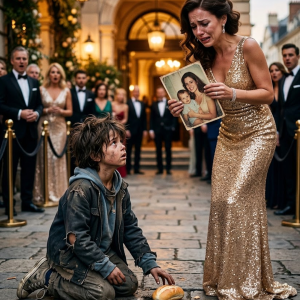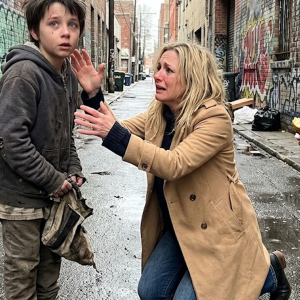
The first thing anyone noticed was the dirt.
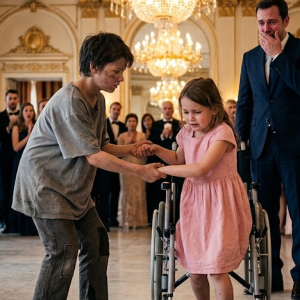
It clung to the knees of a little boy wearing faded jeans and an oversized shirt that had clearly belonged to someone else before him. His sneakers were worn thin, the laces frayed almost beyond repair. Against the polished marble floors and glittering crystal chandeliers of the charity gala, he looked impossibly out of place.
Conversations slowed as guests watched him.
Most assumed he had wandered inside by accident.
Some glanced toward the security staff.
Others simply looked away, uncomfortable.
The annual gala had gathered some of the city’s wealthiest donors, business leaders, and philanthropists. Cameras flashed. Waiters floated through the ballroom carrying silver trays. Music drifted softly through the room.
The little boy noticed none of it.
He had only one destination.
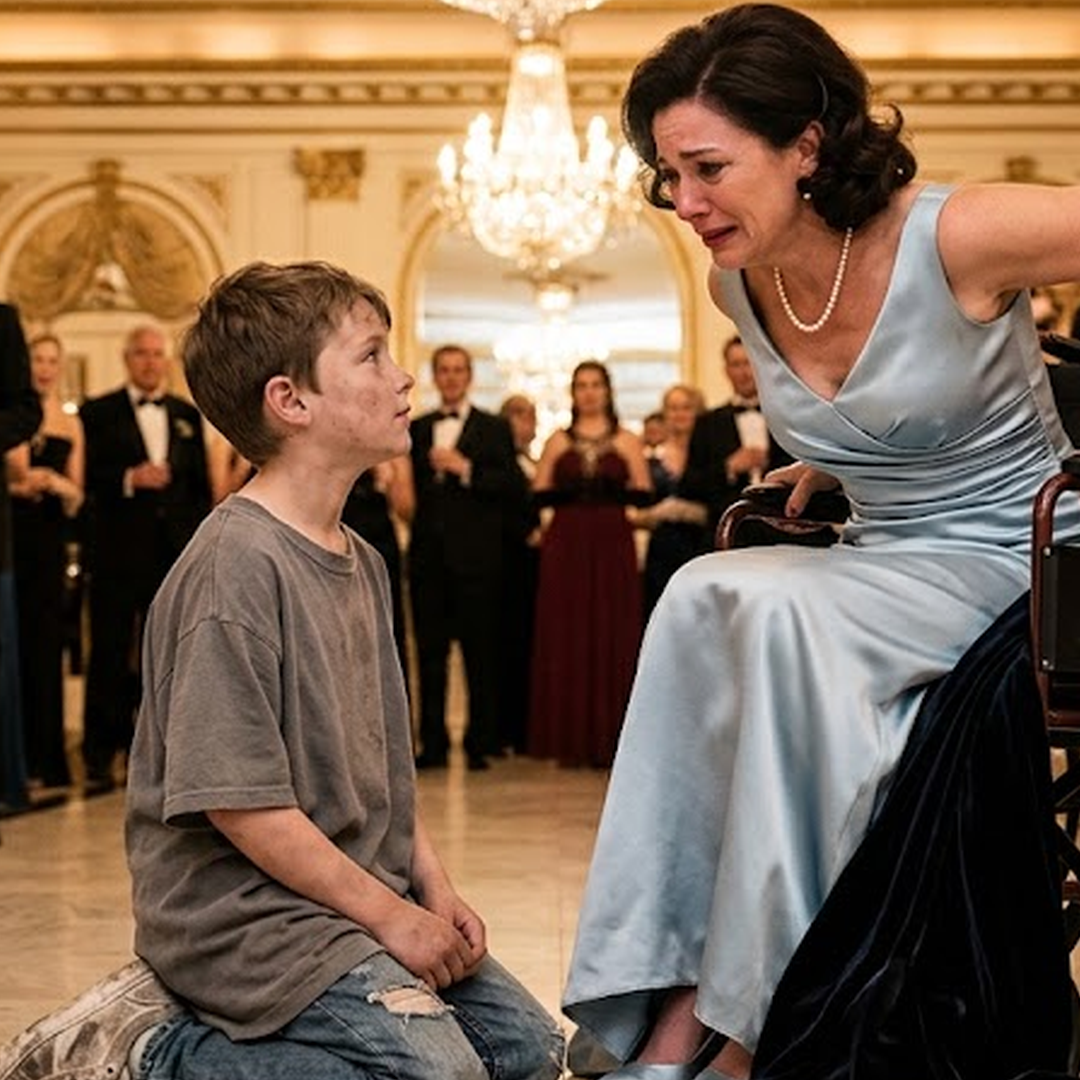
Near the edge of the ballroom sat a woman in a wheelchair.
She wore an elegant pale blue gown with a strand of pearls around her neck. Her smile appeared warm enough for photographs, but her eyes carried an exhaustion that years of polite conversation had never hidden.
A blanket covered her legs.
She accepted greetings gracefully.
She thanked donors.
She smiled when expected.
Yet when no one was looking, her expression quietly fell.
The boy walked directly toward her.
Guests began watching more openly now.
When he reached her chair, he stopped.
Then he slowly knelt.
The woman looked surprised.
“Hello,” she said gently. “Are you lost?”
He smiled.
“No.”
His answer was simple.
“I came for you.”
She laughed softly, assuming it was childish confusion.
“For me?”
He nodded.
Nearby conversations faded as curious guests leaned closer.
“What do you mean?” she asked.
The boy lowered his eyes briefly, concentrating as though recalling instructions given with great importance.
“My mother said some people forget they can stand.”
The sentence hit the woman with unexpected force.
Her smile disappeared.
She stared at him.
Around them, guests exchanged puzzled looks.
Then the little boy reached forward and rested one small hand lightly on the blanket covering her knees.
“Count to three.”
Logic told her to refuse.
She had spent years in that wheelchair.
Doctors had explained the damage repeatedly.
Physical therapy had ended long ago.
Hope had quietly dissolved into routine.
Yet something about the child’s calm certainty unsettled her.
She nodded almost without realizing she had decided.
“One…”
Her breathing changed.
“Two…”
Her fingers dug into the armrests.
“Three.”
She felt something she had not experienced in years.
Not strength.
Not certainty.
Only possibility.
Her muscles trembled violently.
The blanket slipped onto the floor.
Gasps rippled through the ballroom.
She pushed.
Her legs shook.
Pain raced through her body.
Then, inch by inch, she rose.
Standing.
Not steadily.
Not confidently.
But standing.
Silence swallowed the ballroom.
She looked at her own feet in disbelief.
Tears blurred her vision.
When she finally lifted her eyes to the little boy, he smiled gently.
“My mother told me you’d know me when you stood.”
Everything inside her froze.
Those words belonged to another lifetime.
Many years earlier, before the accident that changed everything, she had shared countless evenings with her closest friend—a woman whose optimism seemed impossible to extinguish.
They had dreamed together.
Laughed together.
Made promises that felt unbreakable.
One promise, spoken almost jokingly after a difficult season in life, stayed with them.
“If either of us ever forgets who we are,” her friend had once said, “the other will remind us to stand again.”
Years later came tragedy.
They lost contact.
Circumstances separated them.
Letters stopped arriving.
Phone numbers changed.
Eventually, the woman believed her friend had disappeared forever.
Yet the little boy standing before her somehow knew words spoken in private decades earlier.
Hands trembling, she whispered, “Who is your mother?”
Instead of answering, he reached carefully into his pocket.
He unfolded a worn piece of paper.
Its edges had softened from being opened countless times.
“I was told not to give this to you unless you stood.”
She accepted it.
The handwriting stole her breath before she read a single sentence.
She recognized every curve of every letter.
Her friend’s handwriting.
The room disappeared.
Only the paper remained.
The note explained everything.
Her friend had fallen seriously ill years earlier.
Knowing her time was limited, she had written one final letter.
She explained that she had never forgotten their promise.
She admitted she had searched for her for years but could never find her.
When her son became old enough to understand, she entrusted him with one mission.
“Find the woman who taught me courage,” the letter read.
“Tell her she never stopped standing. She only forgot.”
The woman pressed the letter against her chest as tears poured freely.
“When did she…” she struggled to ask.
The little boy lowered his eyes.
“My mom died last year.”
Several guests quietly wiped away tears.
The ballroom had transformed from a glamorous celebration into something far more human.
No speeches.
No fundraising announcement.
No performance.
Only one child’s determination to fulfill his mother’s final wish.
The woman slowly knelt despite the weakness in her legs and embraced him tightly.
“I’m so sorry,” she whispered.
He hugged her back.
“She said you would understand.”
For several moments neither spoke.
Eventually the crowd, unsure whether to applaud, remained respectfully silent.
The woman finally stood once more—still trembling—but this time she did so without looking at her wheelchair.
She looked only at the little boy.
“You brought me more than a letter,” she said.
“You brought me back to myself.”
The charity gala ended differently than anyone expected.
No one remembered the expensive decorations.
Few recalled the fundraising totals.
Everyone remembered the child whose quiet faith changed an entire room.
In the months that followed, the woman began rehabilitation again.
Her recovery was slow.
Some days she managed only a few steps.
Other days she accomplished less.
But she never quit.
She often visited the little boy, helping care for him and ensuring he always had what he needed. Their bond grew into something neither had expected—a family built not by blood but by a promise faithfully kept.
The wheelchair eventually became something she used less often.
Not because of a miracle.
But because someone reminded her that hope sometimes returns in the smallest voice.
People who heard the story argued endlessly about what truly happened that evening.
Some believed the boy inspired an emotional breakthrough.
Others believed the doctors had underestimated her condition.
Still others simply called it destiny.
The woman never argued with any explanation.
Whenever someone asked what changed her life, she smiled and answered with the same quiet certainty the little boy had carried into that ballroom.
“I didn’t learn how to stand that night.”
“I remembered.”
And perhaps that was the greatest miracle of all—not that someone found the strength to rise, but that one final promise, carried by a child who had almost nothing, reminded two lives that love can outlast absence, grief, and even time itself. Anyone hearing the story was left wondering what mattered more: the impossible moment itself, or the unwavering devotion of a mother who believed that one last promise was worth entrusting to her son.