
I drove past Route 9 farmhouse every single day for thirty years.
Never stopped. Never slowed down. Never let myself look at the mailbox too long.
Today was my last day on the route. And something made me turn the wheel.
—
My name is Dottie Farwell, and I have been delivering mail in Haller County since 1994. I know every gravel driveway, every broken fence post, every dog that’s going to come running before I even kill the engine.
I know this county the way you know the back of your own hand.
But Route 9 — the old Whitmore property at the end of Sycamore Hollow Road — that place has lived in a corner of my mind I don’t visit.
Not since the funeral.
—
It was November of 1994 when we buried Carla Ann Whitmore.
She was thirty-one years old. Closed-lid service at First Baptist. Her mama picked out a pale blue dress and asked the funeral director to clasp Carla’s locket around her neck before they shut the casket for good.
I know because I was standing right there.
I know because I helped choose that locket.
It was small. Oval. Gold, but not fancy gold — the kind that gets a little worn on the edges. There was a dent on the left side from the time Carla dropped it on her daddy’s concrete porch steps. And scratched into the back, in letters so small you had to tilt it toward the light to read them:
*C.A.W.*
Carla Ann Whitmore.
She was my best friend since the third grade.
They put that locket in the ground with her, and I watched them do it, and I drove Route 9 for the next thirty years without ever once stopping at that farmhouse.
—
Until today.
My last day. My retirement. The post office gave me a sheet cake with blue frosting and everyone signed a card. I cried a little in the parking lot and told myself it was allergies.
Then I got in my truck and started the route one final time.
When I reached Sycamore Hollow Road, my hands turned the wheel before my brain gave permission.
I told myself I was just closing a circle. Just saying goodbye to a road I’d driven half my life.
That’s what I told myself.
—
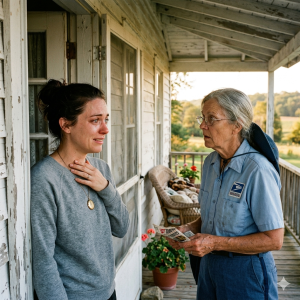
The farmhouse looked different up close. Someone had painted it white sometime in the last decade. There were clay pots on the porch with late-season mums, orange and rust-colored. A welcome mat that said *Home Is Where The Story Begins.*
I sat in the truck for a full two minutes.
Then I got out and walked up those porch steps with a piece of bulk mail — a Tractor Supply circular, of all things — just so my hands had something to hold.
I knocked.
—
The woman who answered looked to be about thirty, maybe thirty-two.
Dark hair pulled back loose. Blue eyes. A cream-colored blouse with the top button open.
And at her throat —
I stopped breathing.
At her throat was a small oval locket.
Gold, but not fancy gold. Worn a little at the edges.
With a dent on the left side.
My vision went strange. The porch tilted. I gripped that Tractor Supply circular so hard it crumpled in my fist.
“Can I help you?” she asked.
“I’m sorry,” I said, and my voice came out like it belonged to somebody else entirely. “I’m the mail carrier. Retiring today. I just — I wanted to say —”
I couldn’t finish the sentence. I couldn’t stop staring.
She noticed.
Most people would have taken a step back. Closed the door a little. Given me the polite smile that means *please leave.*
She didn’t do any of that.
Instead, she tilted her head.
And I felt the ground shift under my feet, because I had seen that exact tilt — that precise, slow, curious angle — ten thousand times in my life.
Every time Carla was about to say something she’d been thinking about for a while.
The woman reached up and touched the locket at her throat.
Touched it gently, the way you touch something precious. The way you touch something that means something.
She turned it slightly — just slightly — and even from where I was standing, I could see the back of it catch the afternoon light.
I could see the scratched letters.
*C.A.W.*
“You know,” she said, and her voice was low and calm and completely certain, “I’ve been waiting for someone from Haller County to finally come to this door.”
—
I don’t know how long I stood there before I managed to speak again.
Long enough that a crow called from somewhere in the tree line and the sound of it brought me back to my body.
“How do you have that,” I said. It wasn’t really a question. It came out flat and strange, like a sentence that didn’t know what it was.
She pushed the screen door open and held it.
“Come inside,” she said. “Please. I have coffee on and I’ve been carrying this for a long time.”
I followed her.
I don’t know what else I would have done.
—
The inside of that farmhouse was nothing like I expected. I think I expected something dim and held-in, the way grief can settle into a house and never quite leave. But the kitchen was bright. Yellow curtains. A row of small succulents on the windowsill. Children’s drawings held to the refrigerator with alphabet magnets.
She saw me looking at the drawings.
“My daughter,” she said. “She’s seven. She’s at school.”
She poured two mugs of coffee without asking how I took mine and set them on the table. Pushed the creamer and sugar toward me like she’d known me for years.
I sat down.
She sat across from me.
And she unclasped the locket.
She set it on the table between us, and it made a small soft sound against the wood, and we both looked at it like it was something alive.
“My name is Reese,” she said. “Reese Callahan. I bought this house four years ago. I’ve been here ever since.”
She paused.
“This locket was in the house when I moved in.”
—
I heard what she said. I understood the words individually. But they took a moment to arrange themselves into meaning.
“It was in the house,” I repeated.
“In a cigar box,” she said. “On the top shelf of the bedroom closet. With some other things. Letters. A photograph. A folded-up piece of paper that turned out to be a birth record.”
She wrapped both hands around her coffee mug.
“The locket was on top of everything else. Like someone had placed it there deliberately. Like someone wanted it to be found first.”
I pressed my fingers flat against the table to keep my hands from shaking.
“Whose name is on the birth record,” I said.
Reese looked at me steadily.
“A girl,” she said. “Born July 14th, 1994. Four months before Carla Whitmore died.”
She let that sit in the air between us.
“The father’s line was left blank,” she said. “But the mother’s name was filled in. Carla Ann Whitmore.”
—
I have thought about Carla every day for thirty years. That is not an exaggeration. Every day. Some days just a flicker, some days a long ache that settled in behind my sternum and stayed there through supper.
But in all those thirty years, I never knew about a baby.
Not once. Not a whisper.
And I was her best friend since the third grade.
I said that out loud, sitting at Reese Callahan’s kitchen table. I said, “I was her best friend since the third grade. How did I not know?”
Reese was quiet for a moment.
Then she said, “She hid it. From everyone, by the looks of things. She hid the whole pregnancy and she hid the birth and then she — she gave the baby up. Private adoption. The letters in the box explain most of it.”
She got up and left the kitchen. I sat there and stared at that locket on the table between the two coffee mugs and I thought about 1994. I thought about how Carla had gone quiet in the spring of that year. How she’d said she was dealing with some personal things. How I’d given her space because that’s what she asked for. How she’d come back to herself by late summer, or mostly come back, though something was different in her eyes that I’d convinced myself was just maturity. That’s what I’d told myself. Just maturity. Just time.
How wrong I had been.
Reese came back with a cigar box. Old wood, a little warped. She set it on the table.
“Go ahead,” she said. “They’re yours as much as mine.”
—
The photograph was on top.
Carla, maybe six months along by the look of her, standing in what I recognized as the side yard of this very farmhouse. Her parents’ farmhouse. Wearing a yellow sundress and squinting into the summer light. One hand resting on her belly.
She was smiling.
It was the smile I remembered most from when we were girls. The one that started slow and ended up taking over her whole face. I hadn’t seen that smile in years by the time she died and I hadn’t known until this moment how much I’d been grieving it separately, that smile, all this time.
I set the photograph down because I couldn’t see it anymore.
I unfolded one of the letters.
It was in Carla’s handwriting. Addressed to no one. Dated September 9th, 1994.
*I have decided to leave the locket with the rest of these things,* she had written, *because I cannot send it with her and I cannot keep it on my body and I cannot throw it away. So it stays here. In this house. In case anyone ever comes looking. In case she ever comes looking.*
*I want her to know she was not given away because she wasn’t wanted. I want her to know she was given away because I was not well, and I knew it, and I loved her enough to know the difference.*
*I want her to know her initials are on the back of this locket. C.A.W. Carla Ann Whitmore. I gave her my initials because I gave her everything else I had to give.*
*If she ever finds this, I want her to know her mother sat in this kitchen on a September afternoon and loved her so completely that the love had nowhere left to go.*
—
I looked up at Reese.
She was watching me with those blue eyes. Carla’s eyes. I could see it clearly now, now that I was looking for it instead of away from it. The particular shade. The steadiness in them.
“You’re her,” I said. “You’re the baby.”
Reese nodded once. Slow.
“I found the adoption records when I was twenty-six,” she said. “Took me two more years to track down the birth mother’s name. By then she’d been gone for a long time.” She paused. “I came to Haller County. I found the farmhouse. It had been sitting empty for years by then, the estate tied up. I made an offer on it.” She looked around her kitchen, at the yellow curtains and the children’s drawings. “I don’t know exactly why. I think I just needed to be somewhere she had been. Somewhere real.”
“And then you found the box.”
“And then I found the box.”
We sat quietly for a moment. Outside, wind moved through the trees at the edge of the property and the light through the yellow curtains shifted.
“I’ve been here four years,” Reese said. “I’ve talked to a few people in town. Most of the ones who knew her are gone or moved away. Nobody knew about me.” She turned her coffee mug in her hands. “I wasn’t sure anyone would ever come to this door who actually knew her.”
She looked at me with an expression that was not quite hope and not quite grief but something that lived between the two.
“What was she like,” she asked. “Not the sad parts. I know enough of the sad parts. What was she like when she was just — herself.”
—
And so I told her.
I told her about Carla in the third grade, who could hold her breath the longest of anyone in our class and was so proud of it she’d challenge strangers. I told her about the time in eighth grade we stayed out past curfew walking along Miller’s Creek and made up elaborate lies to tell our mothers, and Carla’s lie was so detailed and theatrical that her mama actually applauded. I told her about how Carla could not carry a tune to save her life but sang constantly anyway, loudly, in the car, in the grocery store, without a trace of embarrassment, and how that had been one of the bravest things about her even though it seemed small.
I told her about how Carla had a gift for finding four-leaf clovers. Just walking through a field she would stop and bend down and come up with one, every single time, and she would give them away immediately, press them into whoever’s hand was nearest.
I told her about how Carla laughed. How it was sudden and whole and completely unguarded and how a room changed when she did it.
I talked for probably forty-five minutes straight.
Reese sat across from me the whole time with her hands wrapped around her coffee mug and she did not say a word except once, near the end, she said, “Tell me the clover thing again.”
So I told her the clover thing again.
—
When I finally wound down, the coffee was cold and the afternoon had moved. The light coming through those yellow curtains had gone the amber color it gets in late October around four o’clock.
Reese picked up the locket from the table.
She held it for a moment, both hands, the way you hold something you’ve held a thousand times and are still deciding what it means.
Then she held it out to me.
I shook my head.
“She left it for you,” I said. “She meant it for you.”
“I know,” Reese said. “But I’ve had it for four years and I know everything it’s going to tell me now.” She kept it extended toward me. “I think she’d want you to have something too. I think that’s what she’d say.”
I took it.
It weighed almost nothing. It was warm from sitting in her hand.
I turned it over and tilted it toward the window light, and the scratched letters caught and held for just a second.
*C.A.W.*
I closed my fingers around it.
—
I stood up to leave and Reese walked me to the door. On the porch she stopped me.
“The daughter,” she said. “My little girl. Her name is June.”
She smiled then. The first real full smile I’d seen from her, and when it came it started slow and took over her whole face, and I had to hold onto the porch railing for a moment.
“She’s wild about four-leaf clovers,” Reese said. “She finds them everywhere. I always thought that was funny. Couldn’t explain it.”
“I can,” I said.
Reese looked at me.
“It’s just how they are,” I said. “The Whitmore women.”
—
I sat in my mail truck at the end of Sycamore Hollow Road for a long time before I started the engine.
The locket was in my jacket pocket. I could feel its small weight against my ribs.
Thirty years I drove past that house. Thirty years I kept my eyes on the road. I thought I was protecting myself. I thought distance was the same thing as surviving.
But Carla had left something in that house the whole time. Left it carefully, deliberately, in a cigar box on a high shelf, for someone to find. She had kept a thread running even when she couldn’t hold on to the other end herself.
All I had done was drive past.
I thought about June, who is seven years old and finds four-leaf clovers in every field she walks through and doesn’t know yet that this is anything but ordinary luck.
I thought about Reese, sitting in her bright kitchen with the yellow curtains, four years of living in her mother’s house, patient in a way I don’t have words for.
I thought about Carla in her yellow sundress, squinting into the summer light with her hand on her belly, smiling that smile that took over everything.
I put the truck in drive.
I have one more letter to deliver before this route is through. Not through the mail. In person. I’m going to drive back out to Sycamore Hollow Road in a few days with a photograph of my own — I have one of Carla and me at eighteen, laughing on somebody’s back porch, squinting into the sun — and I’m going to give it to Reese so she can put it on her refrigerator next to her daughter’s drawings.
June should know what that laugh looked like.
Somebody should make sure she knows.
—
If you knew Carla Ann Whitmore — if you grew up in Haller County and you remember her, or if she ever handed you a four-leaf clover