Every Tuesday for six weeks, she ordered the same thing.
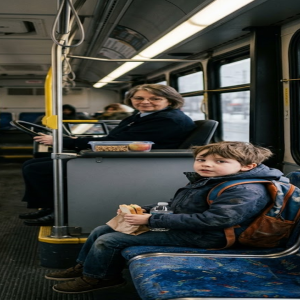
One bowl of soup. One half sandwich. Coffee, black.
Earl Hutchins noticed because he always sat at the same end of the diner counter — third stool from the window — and she always sat two stools down. That was just the way of Becky’s Family Diner in Wenatchee. People had their spots.
He noticed something else, too.
She never finished the sandwich.
She’d eat the soup. She’d drink the coffee down to the cold ring at the bottom. But that half sandwich — she’d fold the wax paper around it real careful, like it was something fragile, and tuck it into the inside pocket of her coat.
Same coat every week. Tan canvas, worn at the elbows, a little too big for her.
Earl was seventy-one years old, retired after forty years running apple orchards east of town, and he had learned a long time ago that you don’t ask a person why they’re saving food. You just notice. And you remember.
He didn’t know her name.
He knew she had a little one at home — she mentioned it once to Darlene the waitress, something about a nap schedule. He knew she paid in cash, always exact change, always sorted in her palm before she sat down. He knew she smiled like she meant it but laughed like she’d forgotten how.
And he knew about the library card.
He’d seen it slip out of that coat pocket one Tuesday when she was pulling out her wallet. Small, laminated, a little bent at the corner. She snatched it up faster than you’d expect and pressed it back inside the pocket without a word. Held her hand over it for just a second after.
Earl hadn’t thought much of it at the time.
He thought about it now.
Because it was Tuesday.
And she hadn’t come in.
—
He was on his second cup when the bell above the door jingled.
Darlene looked up. Earl looked up.
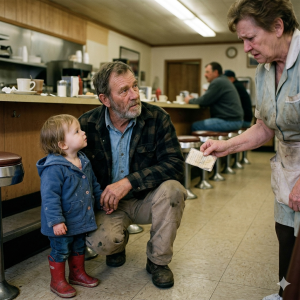
The little girl standing in the doorway couldn’t have been more than two and a half, maybe three. Red boots. A jacket that was buttoned wrong, one side higher than the other. She had her fist pressed to her chest, holding something, and she was looking around the diner with the kind of calm that was worse than crying.
That particular calm that means a child has been scared for long enough that scared became normal.
Darlene was around the counter before Earl could stand up.
“Sweetheart. Hey, sweet girl. Where’s your mama?”
The little girl opened her fist.
A laminated library card. Bent corner. The same one.
She held it out to Darlene like it was an answer. Like her mama had told her: if you get lost, show this to someone.
Earl’s chest did something complicated.
Darlene took the card gently, and Earl watched her face change.
She read it. Read it again.
Then she looked up at Earl with an expression he hadn’t seen on her in thirty years of Tuesday breakfasts.
“Earl.” Her voice had gone quiet. “Earl, come look at this.”
He crossed the diner in about four steps.
The name on the library card wasn’t the young woman’s.
He didn’t know how he knew that — he’d never known her name — but he knew it the same way you know when a fruit is wrong before you’ve cut it open. Something about the age of the card. Something about the photo, smaller than a thumbnail, worn almost to nothing.
It was a Wenatchee Public Library card.
And the name printed on it in that small, clean font—
Earl recognized it.
Not from the diner. Not from the orchard. From the flyers.
The ones that had gone up around town back in March, then quietly come down by May, the way these things do when weeks turn into months and hope gets harder to hold.
A woman. Missing since the 12th.
A woman whose family had stood in the parking lot of the Safeway with printed photographs and tired eyes, asking strangers if they’d seen her.
The little girl tugged on Earl’s sleeve.
She wanted the card back.
He looked down at her red boots, her crooked buttons, her ancient and patient eyes.
And somewhere across Wenatchee, in whatever room held the answer to all of this—
A tan canvas coat was hanging on a chair.
And half a sandwich was going cold.
—
Earl gave the card back.
He didn’t know why exactly. It just seemed wrong to hold onto something a child was clinging to that hard. She pressed it back against her chest and looked up at him and he said, very carefully, “Where’s your house, sweetheart?”
She pointed.
Not a direction. Just up. The way small children point when they mean somewhere behind the world.
Darlene had already picked up the phone behind the counter. Earl heard her say “non-emergency” and then drop her voice. He didn’t listen to the rest. He crouched down, which took more effort than it used to, and looked the little girl level in the face.
“What’s your name?”
“Rosie.”
“Rosie. That’s a good name. Are you hungry?”
She thought about it with a seriousness that broke his heart a little. Then she nodded.
Darlene set a plate of buttered toast on the counter without being asked, because Darlene had been doing this job for thirty-one years and she understood things without needing them explained.
Earl lifted Rosie onto the stool. Two stools down from his. The one her mother always took.
The little girl ate the toast in careful, deliberate bites, watching the door.
—
The name on the card was Patricia Dunmore.
Earl knew the name from the flyers the way you know a song you’ve only heard once in a gas station — imperfectly, but enough. Missing since March 12th. Fifty-three years old. Last seen near the Wenatchee Valley Mall.
He didn’t understand how that connected to the young woman who ordered soup and tucked sandwiches into her coat. He was still working it out when the patrol officer came through the door.
His name tag said SEWELL. He was young, maybe twenty-six, with the particular face of someone trying to look like they’d seen everything. He talked to Darlene first, then to Earl, then he crouched down in front of Rosie the same way Earl had, and he had enough sense to let her finish the last piece of toast before he started asking questions.
“Rosie, can you tell me where you live?”
“With Mama.”
“And where’s Mama right now?”
Rosie looked at the door again. Then she reached into the front pocket of her jacket — the little kangaroo pocket, the kind kids love — and pulled out something else she’d been holding onto.
A folded piece of paper. Not new. Creased to softness from being folded and unfolded many times.
Sewell took it, unfolded it, read it. His expression did something that Earl caught the edge of even from across the counter.
He looked at Earl. He looked at Darlene.
“Is there a back room?” he said.
—
It turned out the young woman’s name was Casey.
Casey Dunmore.
Patricia’s daughter.
She was twenty-eight years old and had been living in a one-bedroom apartment on Ninth Street for the past four months, since coming back to Wenatchee to look for her mother. She’d come alone, with Rosie and a car that needed a new alternator and not much else.
She hadn’t found her mother. Nobody had. But she’d stayed anyway, because leaving felt like giving up, and giving up felt like something she didn’t know how to do.
The folded note explained most of this, though not in so many words. It was a note Casey had written to Rosie, meant to be read if something happened. It said: go to the diner. It said: show the card to someone with a kind face. It said: Mama will come.
She had written her apartment address at the bottom.
—
They found Casey on the landing outside her apartment door.
She’d fainted — low blood sugar, the paramedics would determine later, complicated by a week’s worth of not eating enough, complicated further by a bad head cold she’d been fighting off and ignoring. She’d made it as far as the landing on her way to come get Rosie herself, and that’s where her body had decided it had taken enough.
She was conscious by the time Sewell got there, sitting up against the railing with her knees pulled to her chest and her eyes doing that rapid recalibrating thing that happens when you come back to yourself in a strange way. The tan canvas coat was around her shoulders. Somebody in the building — a neighbor, an older woman named Greta — had seen her go down and covered her with it and called 911 and then stood nearby because she didn’t know what else to do.
Earl had ridden over in the front seat of the patrol car, which was not standard procedure, but Sewell had looked at him standing there on the diner sidewalk and seemed to understand that he was coming regardless.
Rosie ran to Casey the second she saw her.
Casey caught her daughter and held on with the kind of grip that comes from a place past relief, past fear, down in the basement of the body where the rawest things live.
Earl stood at the bottom of the stairs and gave them a minute.
—
He talked to her later, at the hospital, while Rosie slept in the chair beside the bed with her red boots still on and the library card still in her fist.
He didn’t stay long. He wasn’t family, and he knew it. But Casey had asked the nurse who the older man was who’d come in with her daughter, and the nurse had told her, and Casey had asked if he’d come in for a minute.
She looked younger lying down. And older. Both at once.
“She did everything right,” Earl said, nodding at Rosie. “Everything you told her.”
Casey looked at her daughter for a long moment. “I was terrified to teach her that. That there’d be a time she’d need to know it.” She paused. “I kept thinking — what if she picked the wrong person?”
Earl thought about that. About the way the bell above the diner door sounded when it swung open. About third stools from the window and a child with an ancient, patient face.
“She picked Darlene,” he said. “And she picked me. She did fine.”
Casey smiled. That same smile. The one that meant it.
—
Earl found out about Patricia three weeks later.
He didn’t learn the whole story at once — it came in pieces, the way truth usually does. Patricia Dunmore had not been taken, had not been harmed. She had walked away from her life in March for reasons that were hers alone, reasons that had to do with an illness she hadn’t told her daughter about and a decision she’d made, incorrectly, that leaving quietly was better than the alternative. She’d been living in a motel in Ellensburg under a name that was close enough to her own that it still felt like hers.
A Chelan County deputy had found her in July, not because of the flyers, which had come down by then, but because a librarian had mentioned her name in passing to a social worker, who’d made a call, who’d made another call. The particular slow machinery of people trying to help.
She was sick. She was getting treatment now. She and Casey were talking, which was not the same as being fine, but was the thing that had to happen first.
Earl heard all this from Darlene, who heard it from Greta the neighbor, who had apparently become something of a presence in Casey’s life in the months since July. That was the other thing about Wenatchee. People had their spots. And once in a while, a spot expanded to make room.
—
By September, it was still a Tuesday habit.
Casey and Rosie came in together now, most weeks. Rosie sat on the stool next to Earl’s and ate oatmeal with an intensity that Earl respected. Casey ordered the same thing she always had — soup, half sandwich, black coffee — except now she ate the whole sandwich.
Earl noticed.
He always noticed.
He never said anything about it, because you don’t. You just notice. And you remember. And some weeks, when the diner is warm and the coffee is good and a three-year-old in red boots is explaining something very serious about the color orange to anyone who will listen, that is enough.
That is, in fact, more than enough.