
The fire had already been declared under control.
Smoke still drifted into the gray afternoon sky as firefighters finished soaking the last stubborn hot spots inside the ruined home. The family stood across the street wrapped in donated blankets, staring silently at what only hours earlier had been the place where birthdays were celebrated, holidays were shared, and ordinary evenings had quietly passed.
Now it was little more than a skeleton of blackened beams.
The firefighters had done everything they could. They had searched every room, checked every corner, and confirmed that no people remained inside. The danger had passed.
Or so everyone believed.
As hoses were drained and equipment packed away, the youngest firefighter on the crew paused.
He tilted his head.
“Did you hear that?” he asked.
The others barely reacted.
“Hear what?”
He listened again.
There it was.
A tiny sound.
High-pitched.
Weak.
Almost impossible to distinguish from the creaking of scorched wood.
“It’s probably the house settling,” one firefighter said while rolling another hose.
The captain nodded. “We’re finished here.”
The younger firefighter wasn’t convinced.
The sound came again.
Not louder.
Just enough to make him wonder whether he could forgive himself if he walked away.
He looked toward the collapsed back porch where smoke still curled through broken boards.
“I’m checking.”
The captain hesitated.
“It’s unstable.”
“I know.”
Without waiting for another response, the young firefighter pulled his mask back into place and disappeared into the damaged structure.
Outside, time suddenly slowed.
The family watched.
Neighbors held their breath.
The crew stood ready in case the weakened building shifted again.
Inside, visibility was poor. Ash floated through the air. Burned furniture lay scattered across the floor. Every movement had to be careful.
He stopped.
Listened.
Nothing.
Then…
A tiny cry.
He followed it deeper beneath partially collapsed beams until he spotted a narrow opening under the remains of the porch.
Getting closer required crawling.
Carefully, he eased himself forward, avoiding splintered wood and unstable debris.
The sound came once more.
He reached underneath.
At first, his fingers touched only ash.
Then something warm.
Something unbelievably small.
He gently lifted both hands.
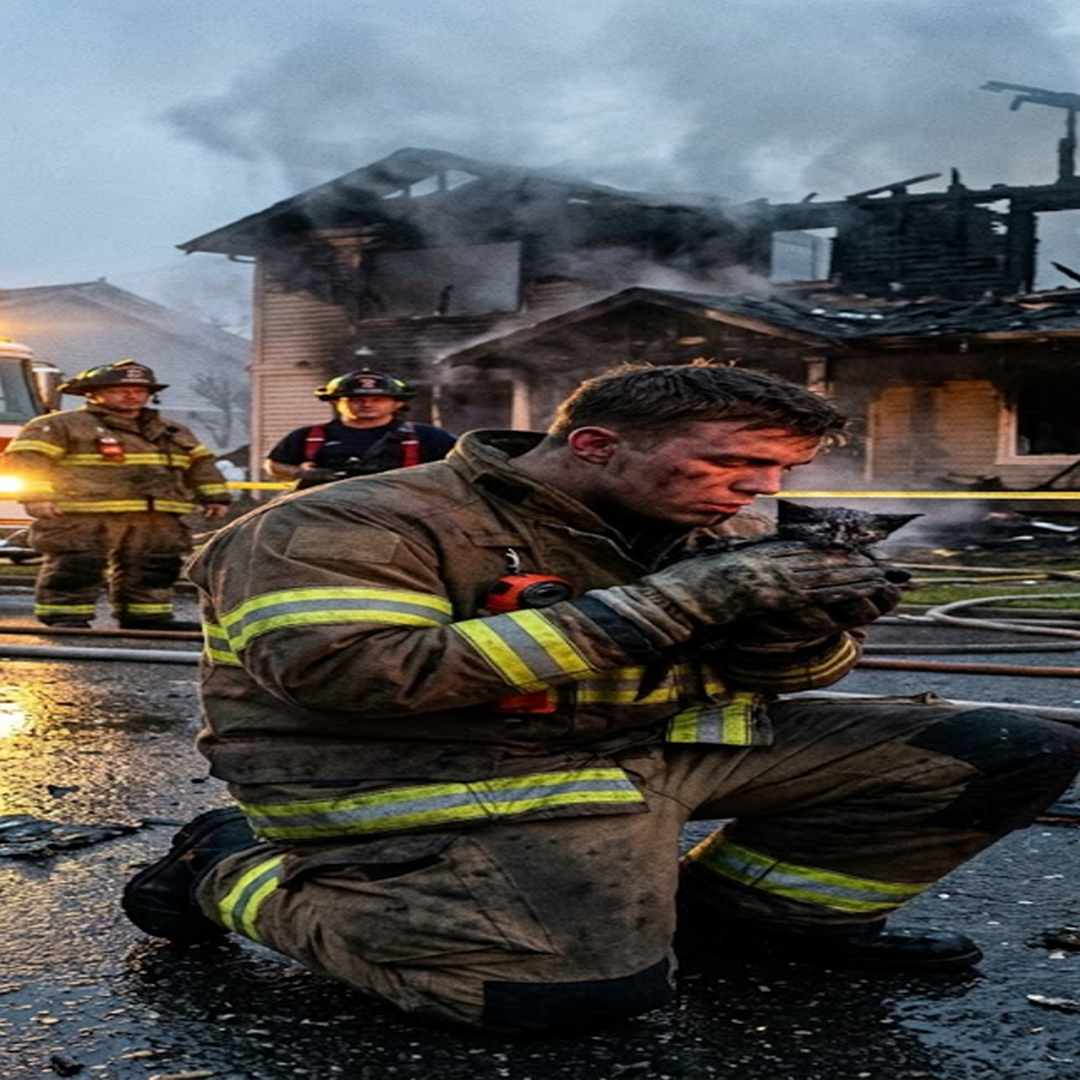
Curled inside them was a soot-covered kitten, scarcely larger than his palm.
Its fur was black with ash.
Its eyes remained shut.
Its tiny body barely moved.
He hurried back toward daylight.
The moment he emerged, every conversation outside stopped.
“What did you find?”
No answer came immediately.
He knelt on the wet pavement.
The kitten remained frighteningly still.
Using one finger, he brushed soot away from its face.
Nothing.
He lowered his head and gently breathed warm air across the kitten’s nose.
Again.
And again.
The tiny whiskers trembled.
Someone whispered, “Come on…”
Another breath.
A faint twitch.
Then, almost too softly to hear, a tiny meow escaped.
The kitten inhaled.
Its chest rose.
The crowd burst into relieved applause.
Some cried openly.
Others laughed through tears.
The young firefighter simply smiled with overwhelming relief.
Across the street, neighbor Linda Matthews had been photographing the aftermath for the family, hoping to preserve evidence for insurance.
She instinctively raised her camera.
Click.
She captured the exact second the kitten opened its eyes while resting safely inside the firefighter’s soot-covered hands.
It was an ordinary photograph.
Except it wasn’t.
That evening she posted it online with a brief caption describing what had happened.
By morning, thousands had shared it.
Then tens of thousands.
Comments flooded in.
People wrote about hope.
About compassion.
About refusing to give up.
Many admitted they couldn’t stop looking at the image.
Requests began arriving from people asking how they could help the family.
A local charity created a donation page.
Someone contributed enough to replace school supplies.
A furniture store promised beds.
A hardware supplier donated building materials.
Electricians volunteered.
Plumbers volunteered.
Roofers volunteered.
Restaurants sent meals.
Children organized lemonade stands.
Church groups collected clothing.
Retirees mailed handwritten cards filled with encouragement.
None of them knew the family personally.
They simply wanted to help.
The donations exceeded every expectation.
Instead of merely surviving the disaster, the family found themselves surrounded by an entire community determined to help them rebuild.
Construction began before winter ended.
Volunteers appeared nearly every weekend.
When spring finally arrived, new walls stood where blackened ruins had once been.
The family attended the final walkthrough with tears in their eyes.
It wasn’t simply another house.
It represented kindness from thousands of strangers.
Meanwhile, the kitten recovered at the local veterinary clinic.
Despite smoke inhalation and dehydration, it proved surprisingly resilient.
Within days it was climbing blankets.
Within weeks it chased shoelaces.
Everyone at the fire station visited.
The young firefighter who rescued it stopped by often.
So did the captain.
The veteran firefighter had spent nearly thirty years answering emergency calls.
He had rescued children.
He had comforted grieving parents.
He had seen enough heartbreak to last several lifetimes.
He rarely showed emotion.
But that photograph captured something few had ever witnessed.
Standing behind the rescue, he had quietly turned away, wiping tears before anyone noticed.
The image spread almost as widely as the rescue itself.
People recognized strength in the young firefighter.
They recognized humanity in the captain.
Reporters asked him about the photograph.
He shrugged.
“I got something in my eye,” he joked.
Nobody believed him.
Months later the rescued family visited the station carrying homemade cookies.
The kitten instantly climbed into the captain’s lap.
The firefighters laughed.
“Looks like you’ve been chosen,” someone said.
The captain smiled.
“We’re just babysitting.”
Weeks passed.
No owner appeared.
No adoption inquiries arrived.
The kitten kept sleeping in the captain’s office.
One evening another firefighter noticed paperwork sitting on the desk.
“What are those?”
The captain sighed.
“Adoption forms.”
“So you’re finally admitting it?”
“I suppose I am.”
The station erupted into cheers.
The kitten officially became part of the department.
A tiny bed appeared near the engine.
Someone donated food bowls engraved with a small fire helmet.
Another firefighter bought a reflective collar.
Soon the kitten learned everyone’s routines.
It greeted each shift.
Curled up during paperwork.
Watched training exercises from a safe distance.
Whenever the alarm sounded, it raced toward the engine, expecting another adventure.
The captain eventually allowed it to ride in the front seat while traveling between community events and non-emergency appearances.
Children adored it.
Adults remembered the famous photograph.
School groups visiting the station always asked one question first.
“Is this really the kitten?”
The captain always smiled.
“It certainly is.”
Then he told the story.
Not about himself.
Not about the photograph.
Instead, he spoke about listening.
About paying attention when everyone else assumes there’s nothing left to find.
He always ended with the same quiet thought.
“If something tells you another life might still need help, don’t ignore it too quickly.”
Years passed.
The rebuilt house filled once again with birthday parties, family dinners, and ordinary mornings.
The photograph remained framed in both the family’s living room and the fire station.
Visitors often studied it.
Most focused on the tiny kitten.
Others noticed the soot-covered firefighter.
Eventually someone would point toward the man standing in the background with his face turned away.
“Why is he looking the other direction?”
The answer never changed.
“Because even heroes sometimes need a second to wipe away tears.”
The rescued kitten eventually grew into a healthy cat, but it never lost its habit of riding with the captain whenever community events allowed. To children, it became a symbol of hope. To firefighters, it became a reminder that the smallest cries are sometimes the easiest to miss—and the most important to answer.
Looking back, people still debate what made the story unforgettable. Was it the firefighter refusing to give up? The community rebuilding a family’s life? The hardened captain quietly crying when no one was supposed to notice? Or the tiny survivor whose faint voice changed everything?
Perhaps the real answer is that compassion often begins with a single choice: to listen one more time when everyone else has already walked away.