The morning Gary cut the ribbon on his new pharmacy, he finally looked up from the mayor’s shoulder — and saw his wife standing at the back of the crowd.
She was smiling.
That’s when the woman in the red dress went the color of chalk.
—
Let me back up.
Donna Halcomb spent thirty-one years as an IRS auditor in Tulsa, Oklahoma. She could find a discrepancy in a seven-hundred-page return the way a bloodhound finds a trail — quietly, patiently, and without ever letting on that she’d found it.
Gary knew this about her.
Which is exactly why what he did next was so spectacularly, breathtakingly foolish.
—
They’d been married thirty-four years.
Gary was a pharmacist. Good one, too. Steady hands, good memory, the kind of man who remembered your mother’s blood pressure medication without looking it up.
On the wall above their kitchen sink, Donna kept a laminated CVS receipt in a little frame. Dated May 14, 1987. The first prescription Gary ever filled — some blood thinner for an elderly woman named Mrs. Kowalski, $4.12 after insurance.
Donna had found it in his coat pocket the night he came home from his first shift, grinning like a boy who’d caught his first fish. She framed it herself. He always said it was silly.
She always said it was the beginning of everything.
It hung above that sink for thirty-four years.
—
The grief started the way it always does — not with a bang, but with a number that didn’t belong.
Donna wasn’t even snooping. She was organizing their financial files — something she did every March, same as always — when she noticed a transfer. Then another. Then a name she didn’t recognize attached to an LLC she’d never heard of.
NovaCare Pharmacy Solutions, LLC.
Registered in Delaware. Opened eighteen months ago.
She sat very still at the kitchen table for a long time.
Then she stood up, walked to the sink, took the little framed receipt down from the wall, and tucked it carefully into her purse.
She never put it back.
—
What followed was six weeks that Gary would later describe, to anyone who asked, as “the hardest stretch of our marriage.”
Donna cried. She stopped cooking. She watched a lot of television. She forgot to return phone calls.
She seemed, to everyone around her — including Gary — like a woman too hollowed out by sadness to do much of anything.
She was, in reality, the busiest she’d been in fifteen years.
Old colleagues from the IRS don’t exactly retire. They just stop getting paid for it.
Donna still had friends. She still knew how shell companies worked, how to trace capital flows, how to read a Delaware incorporation filing like it was a grocery list.
She found the mistress on week two.
Her name was Renee. She wore a lot of red. She had worked at Gary’s pharmacy for three years, and her name appeared alongside Gary’s on every NovaCare document Donna could find.
She found the account on week three. The one Gary had been quietly feeding for two years. Their savings. The money from Donna’s mother’s estate. The vacation fund. The retirement cushion they’d built together, contribution by contribution, year by year.
All of it moving, slowly and carefully, into NovaCare Pharmacy Solutions, LLC.
By week five, the manila folder on Donna’s nightstand was two inches thick.
—
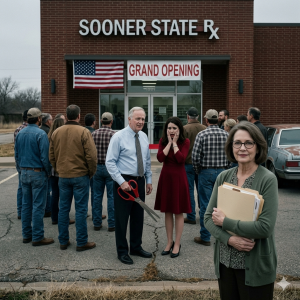
The grand opening was on a Thursday morning in April.
The mayor came. There was a banner. A little podium. Helium balloons in green and white. A photographer from the Tulsa World.
Gary stood out front in a new shirt, looking like the happiest man in Oklahoma.
Renee stood beside him in a red dress.
Donna drove herself to the parking lot, checked her lipstick in the rearview mirror — she hadn’t worn lipstick in two months — and reached into her purse.
The manila folder was there.
And underneath it, tucked against the lining, the little laminated CVS receipt from 1987.
She took a breath.
She got out of the car.
—
The crowd wasn’t large. Maybe forty people. Local business owners, a few reporters, the mayor with his ceremonial scissors.
Donna walked in from the back and stood quietly near the edge of the parking lot.
She didn’t push forward. Didn’t make a scene. Just stood there, holding her folder, wearing that smile — the one her daughter later said she hadn’t seen on her mother’s face in over two years.
The mayor raised the scissors.
He gave a little speech about small businesses and community and the American dream.
Gary laughed at something Renee whispered to him.
And then, right before the blades came together —
He looked up.
His eyes found hers through the crowd.
And the woman in the red dress went the color of chalk.
—
Gary’s smile didn’t fall all at once. It sort of dissolved, the way a sugar cube goes in warm water — slowly, then completely.
Renee saw it happen. She followed his eyeline to the back of the crowd, and that’s when the color left her face.
Donna held the smile. She’d been practicing it, she told her daughter later. Not out of cruelty. Because she needed it to hold.
The mayor finished his speech. The scissors came together. The ribbon dropped. People clapped.
Gary stood there with his hands at his sides like a man who had just watched the floor fall out of a building he was standing in.
—
She didn’t approach him at the ceremony.
She let him shake hands. She let him pose for the Tulsa World photographer. She let Renee hover beside him with a glass of orange juice she never touched, while Gary’s eyes kept skating to the back of the lot and finding Donna right where she’d been.
Still holding the folder. Still wearing the smile.
At some point, Renee touched Gary’s arm and said something. He shook his head. She said it again.
He shook his head again.
At ten forty-seven in the morning, Gary excused himself from a conversation with the manager of the QuikTrip two doors down and walked to the back of the parking lot.
He stopped about four feet away from his wife of thirty-four years.
“Donna,” he said.
“Good turnout,” she said.
—
He tried several things in the next two minutes. She counted them later, describing the scene to her friend Patrice over the phone that evening.
He tried confusion first. What are you doing here? Said with just enough bewilderment that a less prepared woman might have second-guessed herself.
Then he tried warmth. It’s so good that you came. Said like she’d shown up to support him, like the folder under her arm was a card and a casserole.
Then — and this was the one Donna had been expecting, the one she’d been ready for since March — he tried minimizing. It’s not what you think it is. The LLC is just a business arrangement. Renee is a partner, that’s all, I was going to tell you —
Donna opened the folder.
She didn’t hand it to him. She just opened it, so he could see the first page. The bank statements. The transfers. The account number for the joint savings alongside its steadily decreasing balance.
Gary stopped talking.
“My attorney,” Donna said, closing the folder again, “has had a copy of this since Tuesday.”
—
A woman named Linda, who owned the alterations shop next door and had come for the free coffee and a good look at the new space, later told her book club that she hadn’t heard the exact words exchanged between the couple at the back of the lot. But she had noticed them. Hard not to.
The wife, she said, was the calmest person in the parking lot.
The husband looked, Linda said, like a man trying to remember which wire you weren’t supposed to cut.
—
What Donna did next is the part people always want to know about.
She reached into her purse — past the folder, past her keys, past her phone — and her fingers found the small flat rectangle she’d been carrying for six weeks.
The laminated receipt. Mrs. Kowalski. $4.12. May 14, 1987.
She held it for a moment. Looked at it.
Then she held it out to Gary.
He took it, confused. Looked down at it. His face did something complicated.
“I want you to have it,” Donna said. “I framed it because I thought it was the beginning of everything. But I’ve had some time to think, and I’ve decided I was wrong.”
She picked up her folder.
“It was the beginning of your everything,” she said. “I’m going to go find the beginning of mine.”
She left him standing there in the parking lot, holding a thirty-seven-year-old receipt for a blood thinner that cost $4.12 after insurance.
—
The divorce was finalized eleven months later.
Donna’s attorney, a compact, extremely focused woman named Brenda Oakes who had once spent four years untangling the finances of a Tulsa car dealership owner with a similar fondness for Delaware LLCs, handled the asset division with what multiple people involved later described as quiet devastation.
NovaCare Pharmacy Solutions, LLC, it turned out, had been substantially capitalized with marital assets. Donna’s documentation was precise enough that Gary’s attorney reportedly went pale at the deposition.
Donna received the house. Half of the retirement accounts. Restitution for the funds drawn from her mother’s estate. And, because Brenda Oakes was thorough, a percentage of NovaCare’s projected future earnings for a period of five years.
Gary and Renee still opened the pharmacy. It has a decent Google rating. Three and a half stars. Several reviews mention long wait times.
—
Donna sold the house eight months after the divorce.
Too many sinks, she told Patrice.
She bought a smaller place near Brookside, the kind of neighborhood where people actually walk to things. She got a dog — a basset hound named Gerald, who has no strong opinions about anything except napping and the location of the treat cabinet.
She started teaching a financial literacy class at a community center on Tuesday nights. Mostly women in their forties and fifties who smile too quickly when money comes up in conversation. Donna recognizes the expression.
She teaches them what she knows. How numbers tell the truth even when people don’t. How to read a statement. How to ask the right questions. How to sit very still at a kitchen table when you find something that doesn’t belong, and then stand up, and do what needs to be done.
—
Her daughter, Melissa, came to visit last October.
She noticed, when she walked into the kitchen, that the little nail above the sink was still there. The one where the frame had hung for thirty-four years.
There was something new on it.
A photograph. Small, in a plain wooden frame. Taken last spring.
Donna, standing in the community center classroom. Twelve women around a folding table covered in binders. Everyone laughing at something. Donna’s hands spread wide, mid-explanation, like she’s just shown them something that surprised them.
She looks, in the photo, like herself.
Melissa stood there looking at it for a while.
Then she asked her mother when she’d started smiling like that again.
Donna thought about it.
“April,” she said. “Thursday morning. Parking lot off Peoria.”
She poured them both some coffee.
“Funny how things start,” she said.