He thought he’d gotten away with it.
He almost did.
But Marlene Tidwell spent thirty-one years at the IRS finding money that didn’t want to be found. And she brought a sweet potato pie to his engagement party.
—
Let me back up.
Six weeks ago, Marlene’s husband of four years — the charming, square-jawed Davis Holt — disappeared from their Savannah home on a Tuesday morning. Left his coffee cup on the counter. Left the faucet running in the guest bath. Left Marlene, and left thirty-one families from their church holding worthless paperwork on a “historic inn restoration” that existed only in a glossy brochure and Davis’s very convincing smile.
Three hundred and forty thousand dollars. Gone.
The sheriff said it was complicated.
The bank said there was nothing they could do right now.
Marlene’s pastor held a prayer vigil. Her book club brought casseroles. Her neighbor Linda cried harder than Marlene did, which told you something about Marlene.
She didn’t cry. She made a list.
—
She found him in six days.
Not because she hired someone. Not because she got lucky.
Because Marlene Tidwell knows how money moves, and money — even stolen money, especially stolen money — always moves the same way.
He was in Charleston. He had a new name — Bradley Caine, if you can believe the nerve — a new haircut, a new waterfront condo, and a new fiancée named Courtney who sold real estate and had no idea what she was engaged to.
The engagement party was announced in a Charleston lifestyle blog. Four photos. Floral arrangements. A rooftop venue. Bradley — Davis — grinning in a linen blazer like a man with a spotless conscience.
Marlene read that blog post twice.
Then she baked a sweet potato pie, the good kind with the brown sugar crust, and she drove two hours to Charleston in her good navy dress.
—
She signed in at the door with her real name.
Nobody recognized it. Nobody questioned her. She had that quality — the ability to look like she absolutely belonged wherever she stood — that had served her well for three decades in federal buildings full of men who didn’t expect much from a woman with a church voice and reading glasses on a beaded chain.
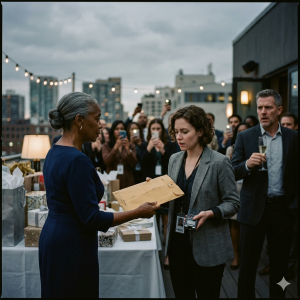
She set the pie on the gift table.
And beside it, she set a manila envelope.
No label. No name written on it. Nothing to indicate what was inside.
She smoothed her dress, accepted a glass of sweet tea from a passing tray, and began to make small talk.
—
That envelope.
Guests noticed it almost immediately. There was something about the way it sat there — plain and patient among the ribboned gift bags and silver-boxed place settings — that made people’s eyes drift back to it. A woman in a yellow sundress picked it up, turned it over, set it down. A man in a seersucker jacket leaned in to read something that wasn’t there to read.
Courtney, the fiancée, noticed it too.
Marlene watched her notice it.
Watched her walk to the gift table twice — once to refill a water pitcher that didn’t need refilling, once to adjust a flower arrangement that was already fine — and both times, quietly steer guests to the other end of the table. Away from the envelope. Without touching it herself.
Courtney didn’t know what was in it.
But some part of her understood it was not a gift.
—
Davis — Bradley — worked the room like a man running for office. Marlene watched him shake hands and throw his head back laughing and touch people’s arms the way he’d touched hers. The way that had felt, once, like warmth.
She sipped her sweet tea.
She waited.
—
The toast came right at seven o’clock.
Davis clinked his champagne glass once, twice, and the room went soft and attentive. Phones came up — forty, fifty of them, little glowing rectangles, everyone ready to capture the happy moment for people who weren’t there.
Every camera in that ballroom pointed at the man who had stolen $340,000 from a church community and driven away on a Tuesday with the faucet still running.
Marlene set down her sweet tea.
She walked to the gift table.
She picked up the envelope.
And she turned — not toward Davis, not toward Courtney, not toward any of the cameras — but toward a woman standing near the microphone. A woman Marlene had positioned herself near all evening without once introducing herself to.
A woman who, when Marlene held out the envelope, took it immediately.
Without hesitation.
Like she’d been waiting for it.
Like she already knew exactly what was inside.
Davis was still smiling. The cameras were still rolling. Courtney’s hand was still raised with her champagne glass, frozen mid-toast, her eyes locked on that plain manila envelope now in the hands of a woman Marlene had never formally met.
But who had a press badge clipped to her blazer.
And a recorder already running in her other hand.
The room hadn’t understood yet what they were watching.
But Marlene had.
—
The woman’s name was Patrice Odom. She wrote for the Charleston Post and Courier, the same paper that had run a small, forgettable item three years ago about a real estate investment scheme in Columbia that had left fourteen families short of their savings. That item had no follow-up. The case had gone quiet.
Marlene had found that item on day three of her six-day search.
She’d cold-called Patrice on day four.
Patrice had called her back in eleven minutes.
—
Inside the envelope was a forty-two-page document that Marlene had assembled over six weeks at her kitchen table, working between midnight and four in the morning while her book club thought she was sleeping and her pastor thought she was healing.
Bank transfer records, pulled from documents Davis had carelessly stored in a shared cloud folder he’d never thought to unshare from her. Property filings in three states under four different names, each one a variation on the same scheme — a building with history, a prospectus with photographs, a promise of fifteen percent returns. A pattern going back eight years. At least six prior victims in two states, none of whom had known the others existed, because this particular kind of man relies on the shame of the defrauded to keep them quiet and separate.
Marlene had found them. She had called them. She had, over the course of those six weeks, collected signed statements from nine of them.
She was not quiet. And she was not separate.
The forty-two pages also included the address and lease documentation for the waterfront condo registered to Bradley Caine. The vehicle registration for the pearl-white Escalade parked in the venue lot outside. And a copy of the glossy inn restoration brochure, with a red-ink annotation on page three where Davis had accidentally reused the same stock photograph of a staircase that appeared in a 2019 scheme in Greenville under the name Robert Ashworth.
Same staircase. Different brochure. Different name. Same man.
Marlene had a gift for finding things that didn’t match.
Thirty-one years of practice.
—
Davis had just gotten to the part of his toast about building a life with Courtney. His voice had that particular quality it got when he was performing sincerity — slightly slower, slightly lower, the way a man sounds when he’s practiced something in the mirror.
Marlene had heard that voice in their kitchen. At their dining room table. In the car on the way to church, where he’d talked about the inn restoration project to her pastor and squeezed Marlene’s hand like they were partners.
She watched his face while Patrice read the first page of the document.
She watched the exact moment Davis’s peripheral vision caught Patrice reading. Watched him register the press badge. Watched his smile go just slightly fixed, the way a photograph of a smile is not quite the same as a smile.
He looked toward the gift table.
The envelope was gone.
He looked at Marlene.
She was holding her sweet tea with both hands, looking back at him pleasantly, the way a woman looks when she has already done everything she came to do and there is nothing left to do but finish the tea.
He understood then. You could see it move across his face like weather.
He took one step toward her.
And the two men near the door — men who had arrived thirty minutes before the party started and accepted ginger ales and made very little small talk — stepped forward also.
Federal agents do not wear a uniform to an engagement party. They wear blazers, and they hold ginger ales, and they wait.
Marlene had made a second call on day four. Right after Patrice.
The FBI’s financial crimes tip line. She had a name for the agent who’d been assigned the 2021 Greenville case, which had also gone quiet, which had also lacked a cooperative witness willing to do the unglamorous work of documentation.
Marlene had sent them four hundred and seven pages. Forty-two was what she’d given Patrice. The rest had gone to the Bureau three weeks ago.
Tonight was what they call a controlled apprehension. Marlene had not been consulted on the timing. She had simply known, when she read about the engagement party in the lifestyle blog, that she wanted to be there for it, and she had asked if that was possible, and the agent had been quiet for a moment and then said he didn’t see why not.
—
Davis did not make a scene. That surprised some people in the room, afterward, when they talked about it.
It didn’t surprise Marlene. A man like that — a man who has talked his way into forty rooms and out of forty tight spots — knows when there is no version of loud that ends well for him. He set down his champagne glass. He said something brief to Courtney that no one else could hear. Courtney’s face did something complicated. She took a step back from him, which was, Marlene thought, the right instinct.
He walked with the agents without being asked twice.
The room was absolutely silent. Forty people holding champagne glasses, phones still raised, recording something entirely different from what they’d intended to capture.
Marlene finished her sweet tea.
—
She spent forty minutes with Patrice after the agents left, sitting in two chairs on the edge of the rooftop while the caterers moved around them pretending not to listen.
Patrice had good questions. The kind that meant she’d done her own preparation.
They agreed that Marlene would be quoted in the piece, by name, and that the piece would mention the Savannah congregation specifically and list a contact for the other prior victims who were interested in the civil recovery process. There would likely be federal restitution proceedings. Marlene had already spoken to an attorney about this. She was not optimistic about recovering the full three-forty, but she was, as she told Patrice, not a person who lets the imperfect outcome prevent her from pursuing the correct one.
Patrice wrote that down. She used it as her closing quote.
—
The article ran six days later.
The congregation shared it eleven hundred times in the first hour. Marlene’s neighbor Linda called crying again, but differently this time. Marlene’s pastor called it an answered prayer and then caught himself and asked if Marlene minded him calling it that, knowing that she had done a significant portion of the answering herself.
She told him she didn’t mind at all. She thought the two things could coexist.
—
Courtney reached out two weeks later. Not to Marlene — Marlene had not expected her to — but to Patrice, who passed along the message.
Courtney said she’d had doubts. Not about anything specific. Just a particular kind of doubt you push to the back corner of a shelf and don’t look at directly. She asked if Marlene was angry with her.
Marlene thought about that for a day before she responded.
She said no. She said that a convincing man is convincing, and that is not a failing of the people he convinces. She said she hoped Courtney would be careful and that she meant that without any edge in it.
She thought that was the truth. She decided to keep thinking it until it was entirely true.
That’s another thing thirty-one years in federal service teaches you. The difference between what you feel right now and what you will feel if you choose it patiently.
—
Davis Holt — Bradley Caine — Robert Ashworth — whatever name he is currently not using — is awaiting trial. Federal. Three counts of wire fraud to start, with additional charges likely as the other victim cases are formalized. His attorney has been very busy.
The waterfront condo has been frozen as a seized asset.
The pearl-white Escalade too.
The linen blazer they can keep.
—
Marlene drove home from Charleston the same night as the party. She got back a little after eleven. She turned off the guest bath faucet, which she had left running for six weeks because she is human and also possibly to remind herself of something.
She made herself a cup of tea.
She sat at the kitchen table where she’d spent six weeks building forty-two pages into four hundred and seven, and she sat there quietly for a while without doing anything in particular.
She hadn’t cried yet. She wasn’t sure she was going to.
But she called her neighbor Linda, who answered on the second ring, and Marlene said, “I’m home,” and Linda said, “I know, I saw your lights,” and that was enough.
That was, for that night, exactly enough.
—
She kept the sweet potato pie, by the way.
Not out of bitterness — she will tell you that clearly. But the gift table had enough on it, and the pie was, by any honest measure, too good for that occasion.
She brought it to church the following Sunday.
Her pastor said it was the best thing he’d ever tasted.
She said she’d had a good week.