They fired her at the Christmas party.
Not quietly. Not with a phone call on Monday morning. Right there in the lobby of Meridian Energy, in front of the shrimp cocktail and the tinsel garland and every single person she worked with.
December 1987. Tulsa, Oklahoma.
Bev Mosier was twenty-nine years old, wearing a red dress she’d saved up three paychecks to buy, and she had no idea what was about to happen.
—
Her supervisor’s wife had too much eggnog and too many suspicions.
She crossed that lobby like she was walking to a verdict.
“Everyone needs to hear this,” the woman announced, loud enough to stop the string quartet cold. “This girl has been *chasing* my husband.”
The room went still.
Bev’s boss — Dale Pruitt, Senior Vice President of Land Acquisitions — stood six feet away and said absolutely nothing.
Not one word.
Security escorted Bev out before she could finish her sentence. She stood on the sidewalk on a December night in that red dress, holding her purse and her coat and nothing else, watching her reflection in the glass lobby doors as they swung shut behind her.
She reached into her purse.
Her fingers found it automatically — the small square photograph, slightly bent at one corner, that she’d been carrying for three months without knowing exactly why. She looked at it for a long moment.
Then she slid it back into her purse and walked to her car.
—
Thirty-seven years is a long time.
Long enough to rebuild from nothing. Long enough to start over in Houston, get your land-man certification, claw your way into a field that didn’t want you, prove yourself in rooms where you were always the only woman, and eventually — *eventually* — build a consulting firm that the industry couldn’t ignore.
Long enough that when the Midcontinent Energy Conference invited Bev Mosier to deliver the keynote address, they introduced her as a legend.
She accepted, and she didn’t tell a single person why she specifically requested it be held in Tulsa.
—
The Meridian Energy building had a new name now.
Different company. Same lobby. Same marble floors, same soaring windows, same glass doors she’d been escorted out of on a cold December night in a red dress.
She walked back through them on a Tuesday morning in the spring of 2024, pulling a rolling carry-on, wearing a charcoal blazer that cost more than a month of that 1987 salary.
And inside the blazer pocket — the Polaroid.
She’d transferred it from purse to purse, wallet to wallet, for thirty-seven years. She’d almost thrown it away a dozen times. She’d almost shown it to people maybe half that many. Every single time, something stopped her.
*Not yet,* she always thought. *Not yet.*
—
The ballroom held four hundred people.
Bev stood in the wings, listening to her introduction, doing what she always did before a speech — touching the pocket of her blazer. Feeling the small, slightly bent square photograph through the fabric.
Her assistant noticed. “You okay?”
“Fine,” Bev said. “I’m fine.”
She was almost sure she meant it.
—
The applause when she walked out was the kind that fills a room all the way up to the ceiling.
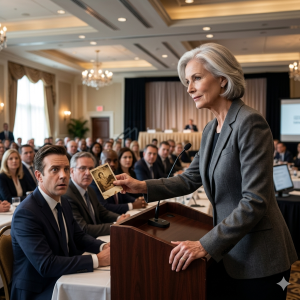
Bev smiled. Set her notes on the podium. Looked out at the crowd.
And then her eyes found the front row.
She knew the face immediately — the jaw, the coloring, the particular way he held his shoulders — even though she’d never met him. She’d only ever seen him in a photograph.
A photograph she had been carrying in her pocket for thirty-seven years.
He was maybe forty years old. Sharp suit. Conference lanyard. He was looking down at his program, and he hadn’t looked up yet.
Dale Pruitt’s son.
Bev stood at the podium and breathed.
She had prepared a speech. A good one — forty-five minutes about land rights, industry evolution, mentorship, the long game. She’d delivered versions of it a hundred times.
Her hand moved to her blazer pocket.
The audience was settling, expectant, smiling up at her. She could feel the Polaroid under her fingertips — the bent corner, the slick surface, the weight of something that had waited a very, very long time.
The man in the front row finally looked up.
He smiled politely, the way you smile at a stranger at a podium.
He didn’t recognize her.
Not yet.
Bev took the photograph out of her pocket.
For the first time in thirty-seven years, she held it where someone else could see it.
“I had a whole speech prepared,” she said into the microphone, her voice steady and clear and warm. “But I think we’re going to start somewhere else today.”
She looked directly at the man in the front row.
“Actually — I think *you* need to see this first.”
And she held the Polaroid out toward him.
The room went absolutely silent.
—
His name was Carter Pruitt.
She knew that from the conference program. VP of Business Development, Sable Basin Resources. Thirty-eight years old, according to the brief bio. Dale’s only child.
Carter looked at the photograph the way you look at something that doesn’t make immediate sense — a slight tilt of the head, a narrowing of the eyes.
Then the color left his face.
Bev lowered the photograph but kept it in her hand.
“I’m going to tell you a story,” she said to the room. “And I want to be clear from the start — it’s not a story about a villain. It’s a story about a document, a decision, and what thirty-seven years of waiting can teach you about the right moment to do the right thing.”
She set the Polaroid face-down on the podium.
The audience wasn’t breathing.
—
Here is what was in the photograph.
In September of 1987, three months before the Christmas party, Bev Mosier was working late on a Thursday night. She was a land records analyst — junior staff, the kind of person who was trusted with the filing room but not the conference room. She knew every lease document, every plat map, every title chain for the company’s northeastern Oklahoma holdings. It was meticulous work. It was invisible work.
She had stayed past eight o’clock to finish an audit the department head needed by Friday morning.
That was when she found the file.
It was misfiled — slipped behind a hanging folder in a cabinet that technically didn’t belong to her section. She only opened it because the label was wrong and she thought she was putting it back where it belonged.
Inside was a lease modification for a parcel of land in Rogers County. 4,200 acres. The modification transferred mineral rights — quietly, through a shell company — from Meridian Energy to a private entity. The kind of transfer that should have gone through the legal department, the board, two layers of regulatory approval.
It had none of those signatures.
It had one signature.
Dale Pruitt, SVP Land Acquisitions.
And the shell company’s registered agent — she’d looked it up in the business filings directory, because that was the kind of person she was — was Dale Pruitt’s wife. The same woman who would, three months later, cross a lobby to destroy her.
Bev had stood in that filing room for a long time.
She had thought about what to do.
She was twenty-nine years old. Junior staff. A woman in a field that tolerated her presence the way you tolerate a draft — you notice it, you find it slightly unpleasant, you wait for it to stop. She had no lawyer. She had no union. She had no idea who above Dale Pruitt she could trust, because Dale Pruitt had been at Meridian for eighteen years and knew everybody.
So she did the only thing she could think to do.
She found the office Polaroid — the one people used to photograph well site conditions for the files — and she took a picture of the document.
One photograph. Slightly blurry at the edge. You could still read every word.
She put the file back exactly as she’d found it, misfiled and all.
She put the Polaroid in her purse.
And then she went home and tried to figure out what a twenty-nine-year-old woman with no power was supposed to do with what she knew.
—
She never got the chance to figure it out.
Three months later, Dale Pruitt’s wife crossed a party lobby and solved that problem for her husband before it could become one.
Bev had always wondered if Dale found out she’d been in that filing room. If someone had told him. If the wife’s outburst was less about jealousy than about a targeted decision to remove a problem.
She had never known for certain.
What she did know: the Rogers County parcel was sold to an independent operator in 1989 for $4.2 million. Meridian Energy’s board never audited it. Dale Pruitt retired comfortably in 1994. His wife sat next to him at his retirement dinner, according to the Tulsa World, looking very pleased.
He died in 2019.
Bev had seen the obituary.
—
She was not there to expose a dead man.
That was the first thing she said when she got to this part of the story. She looked out at the four hundred people in that ballroom and she was direct about it.
“I am not here to blow up anyone’s family or relitigate a forty-year-old crime in front of a conference audience,” she said. “That is not what this is.”
The room was so quiet she could hear the ventilation system.
“I’ve had this photograph for thirty-seven years. Long enough to think hard about what justice means, and what it costs, and who it actually serves.”
She looked at Carter Pruitt.
He was sitting very still. His conference lanyard was slightly askew. He looked like a man holding himself together through sheer will.
“I did my research,” Bev said. “I know you took over your father’s interest in Sable Basin when he passed. I know you have spent five years doing something with that Rogers County acreage that your father never did.”
She reached into the folder on the podium — the one her assistant had placed there that morning, the one nobody had asked about.
She held up a printout. A land trust document. Public record, filed with Rogers County three years ago.
“You put it in conservation easement,” she said. “Twelve hundred of the forty-two hundred acres. Permanent. You donated the mineral rights on another parcel to the Muscogee Nation.”
Carter Pruitt closed his eyes.
“I know you didn’t know where your father got it,” Bev said. “Or maybe you suspected and didn’t want to know. I don’t have any interest in deciding which. That’s between you and your conscience.”
She set the printout down.
“What I do know is that you’re sitting in this room, and you work in this industry, and you are going to make decisions for the next twenty years that will affect people who look a lot like I looked in 1987. Young. Junior. Invisible. Holding something true with nowhere to put it.”
She picked up the Polaroid.
“So I want you to have this.”
She stepped away from the podium — something she almost never did during a speech — and she walked down the three steps to the floor of the ballroom, and she crossed to the front row, and she held out the photograph.
Carter Pruitt took it with both hands.
He looked at it for a long time.
When he looked up, his eyes were wet. He didn’t seem embarrassed by that.
“I’m sorry,” he said. He said it quietly, but the room was quiet enough that people heard it anyway.
“I know,” Bev said.
She walked back to the podium.
—
She gave the rest of the speech.
All forty-five minutes of it — land rights, industry evolution, mentorship, the long game. The audience gave her a standing ovation that she said afterward was the most disorienting experience of her professional life, because she still wasn’t entirely sure she’d done the right thing.
That uncertainty, she told her assistant later, was probably a good sign.
—
Carter Pruitt found her at the reception.
He waited until the crowd around her had thinned, which took a while. He was holding a glass of water and he looked like he hadn’t touched it.
“I have to ask you something,” he said.
“Okay.”
“Why today? Why — why now, after all this time? Why not ten years ago, or after he died, or never?”
Bev thought about it. She had thought about it for a long time, but she thought about it again, because he deserved a real answer and not a rehearsed one.
“I’ve been waiting for a moment where it could mean something instead of just hurt something,” she said. “For thirty-seven years, every time I thought about coming forward, the only outcome I could see was damage. To me, to his family, to people who had nothing to do with it. There was no version where the truth made anything better.”
She paused.
“And then I read about the conservation easement. And I thought — there it is. There’s the version where it makes something better.”
Carter looked at the photograph in his hand.
“What do you want me to do with this?”
“Whatever you think is right,” she said. “You could destroy it. You could donate it to a land records archive with a note. You could do nothing. I genuinely don’t know what the correct answer is.”
“Do you want it back?”
She shook her head.
“I’ve been carrying it long enough.”
—
There is a footnote to this story, and it matters.
Six weeks after the conference, Bev received a letter from Sable Basin Resources on company letterhead. It announced the establishment of a new program: the Meridian Land Fellows, a paid mentorship and certification track for first-generation professionals entering the oil and gas land sector, with particular focus on recruiting women and Native candidates from northeastern Oklahoma.
The letter said the program was named for the original Meridian Energy building — the one with the marble floors and the soaring windows.
It did not explain why.
At the bottom, in handwriting, Carter Pruitt had written: *I told my kids the whole story. I thought they should know.*
Bev kept that letter.
She has stopped carrying things in her pocket.
She says she doesn’t need to anymore.