She walked into his wife’s grand opening carrying a silver tray and a USB drive — and two hundred people watched his face turn the color of old grout.
But let me back up eight months.
—
Marlene Vásquez had spent twelve years building something real.
Sunrise Catering wasn’t just a business. It was her grandmother’s green chile recipe on every holiday spread from Albuquerque to Santa Fe. It was Marlene’s handwriting on every contract, her station wagon loaded with chafing dishes at 4 a.m., her voice on the phone calming down every panicked mother-of-the-bride in Bernalillo County.
Her partner, Doug Ritter, handled the books.
She trusted him the way you trust someone who’s eaten at your table. Completely. Without checking.
That was the mistake.
—
One Tuesday in October, Marlene got a certified letter informing her that Sunrise Catering had been dissolved — sixty-three days prior.
She read it standing at her kitchen counter in her house slippers.
She read it three times.
Dissolved. Bought out. Her signature on the paperwork.
Except she had never signed anything.
—
She didn’t scream. She didn’t call Doug.
She went to her junk drawer, pulled out a laminated index card — the one with her abuela’s handwritten posole recipe, the one she’d carried since culinary school, edges soft from years of handling — and she propped it against the fruit bowl on her counter.
She looked at it for a long time.
Then she made a phone call. Not to Doug.
To a lawyer.
—
Eight months is a long time to be quiet when someone has stolen everything you built.
Marlene was quiet for all eight of them.
She pulled bank records. She tracked the new LLC — filed under Doug’s wife Pamela’s name, same client list, same vendor contacts, same signature green chile recipe on the sample menu.
Her recipe.
She photographed everything. She organized it into folders. She handed her attorney a case so clean it practically had a bow on it.
And then she waited.
—
The laminated index card started showing up in strange places.
Her attorney noticed it first — Marlene had tucked it between two pages of the fraud documentation, almost like a bookmark.
“What’s this?” he asked.
“Good luck charm,” she said.
He didn’t push it. But he glanced at it again before sliding it back into the file. The handwriting was small, cramped, hard to read from an angle.
Nobody ever quite got a good look at what it said.
—
When Pamela Ritter announced the grand opening gala for her new venture — Sunrise Events & Catering, same name, different punctuation, two hundred invited guests, a venue in downtown Albuquerque — Marlene read about it in a local business newsletter.
She sat with that information for three days.
Then she made another phone call.
Not to her attorney this time.
To the event venue’s coordinator.
—
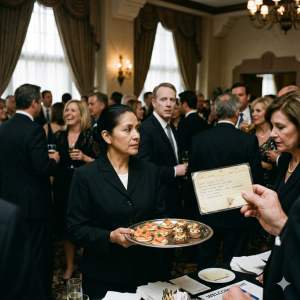
The night of the gala, Marlene arrived through the service entrance at 5:45 p.m. in her good black catering jacket, her hair pinned back, carrying a silver tray covered in her most famous appetizers — the chorizo-stuffed dates with the honey glaze that had made grown men close their eyes at first bite.
The USB drive was in her apron pocket.
The laminated index card was there too, tucked flat against her hip, soft and warm like it always was.
—
She moved through the kitchen without a word, the way you do when you belong somewhere.
Because she had belonged somewhere like this for twenty-three years, and her body still remembered.
She carried the tray to the welcome table herself. Set it down. Straightened the garnish.
Smiled at the two hundred guests filling the room in their heels and sport coats, glasses of sparkling cider catching the light.
Doug was across the room talking to a city councilman.
He hadn’t seen her yet.
—
The emcee tapped the microphone.
“Good evening, everyone, and welcome to this incredible celebration —”
Marlene smoothed the front of her jacket.
“— and in just a moment, a few words from the original founder of what would become tonight’s vision —”
Doug turned.
The color left his face so fast it was almost impressive.
Because he had not sent Marlene an invitation.
He had not told Pamela about Marlene.
He had not told anyone that the invitation list — all two hundred names, the city councilman, the food editors, the former clients — had been curated and delivered to this venue by one person.
Marlene watched him look at her across that beautiful, crowded room.
She reached into her apron pocket.
And Pamela Ritter, standing three feet away, picked up one of the chorizo dates from the tray — and noticed, propped against the centerpiece bowl, a laminated index card covered in small, cramped handwriting.
She picked it up.
She read the first line.
And her hand began to tremble.
—
The first line of the index card was not a posole recipe.
It had never been a posole recipe.
It was the original partnership agreement between Marlene Vásquez and Douglas Ritter, dated eleven years and four months ago, handwritten by Marlene’s abuela — a notary public for thirty-one years before her hands gave out — and signed by both of them at Marlene’s kitchen table over a bowl of that same posole on a cold November Sunday.
Two witnesses. Two signatures. Notary stamp pressed into the paper so hard you could feel the seal from the back.
Laminated the following Monday, because Marlene’s abuela said that’s what you did with things that mattered.
What Pamela was holding was not the original, of course. The original was in a fireproof lockbox at Marlene’s attorney’s office. What Pamela was holding was a copy — a very clean, very legible copy — that had been slipped into a sleeve on the back of the index card, folded once, and tucked against the centerpiece bowl by Marlene’s own hand approximately four minutes before the guests started arriving.
The index card that Pamela was reading said, at the top, in Marlene’s grandmother’s cramped cursive:
Partnership is not a signature on a form. It is a promise made at a table. — E. Vásquez, November 9th
And beneath it, the terms. Every one of them. Including the clause that said either partner’s departure required a documented buyout, agreed to in writing by both parties, notarized, filed with the state.
None of which had happened.
—
Doug crossed the room in eleven seconds. Marlene counted.
She had imagined this moment in a lot of ways over eight months. She had imagined herself saying something cutting. She had imagined herself cold and composed. She had imagined, in her lowest moments at 3 a.m., saying nothing at all and just watching him sweat.
What actually happened was simpler.
He came to her, and he said, very quietly, “Marlene. You need to leave.”
And she looked at him with an expression she had practiced exactly zero times, because it wasn’t something you could practice — the look of a woman who has already won, who has known she was going to win for eight months, who is not angry anymore and hasn’t been for quite some time.
“Doug,” she said, in the same even voice she used with panicked mothers-of-the-bride, “I’m the caterer.”
She nodded at the tray.
“My dates are very popular.”
—
Pamela was still holding the index card.
She was a tall woman with good posture and expensive highlights, and she had the look of someone who had just opened a door expecting a closet and found instead a long staircase going somewhere dark. She turned to Doug.
She didn’t say anything. She just held up the card.
And Doug, who had spent eight months believing that the laminated index card was a sentimental keepsake, a good luck charm, a piece of kitchen nostalgia that an overly sentimental woman carried around because she missed her grandmother — Doug finally understood what it actually was.
The emcee was still talking. The city councilman was eating a chorizo date. The food editors had their notebooks out.
Nobody in that room except three people knew what was happening yet.
But two hundred people were about to.
—
Because the USB drive was not a backup plan.
It was the plan.
Marlene had spent a portion of those eight months locating every client on that invitation list — every wedding coordinator, every corporate event planner, every city official, every food journalist — and contacting them personally. Not to badmouth Pamela. Not to make accusations. Just to introduce herself.
“My name is Marlene Vásquez. I founded Sunrise Catering in 2011. I wanted to make sure you had my correct contact information.”
That was it. That was the whole email.
She’d included her logo, her license number, her portfolio, and a brief note that there was some ongoing legal matter regarding the business name that her attorney was handling.
She had sent that email to every name on the list.
The list that Doug had built over twelve years using her contacts, her relationships, her reputation.
Most of them had written back within forty-eight hours.
—
The USB drive contained a slideshow. Thirteen slides. Clean design, professional font, Marlene’s catering logo in the upper left corner of every page.
Slide one was the original partnership agreement.
Slide two was the dissolution filing, with Marlene’s forged signature highlighted in yellow.
Slide three was a side-by-side of the forged signature and Marlene’s actual signature, provided by a forensic document examiner who had submitted a formal affidavit.
Slides four through nine were bank records showing the systematic transfer of Sunrise Catering’s client retainers — money paid by clients on the invitation list, money paid for events Marlene had booked and organized — into an account she had never seen and never approved.
Slide ten was the new LLC filing, with Pamela’s name on it, and the date, which was nineteen days before Doug had made his first mention to Marlene of wanting to “restructure the partnership.”
Slide eleven was the sample menu for Sunrise Events & Catering. Beside it, in a parallel column, was the Sunrise Catering menu from 2019. They were identical, down to the green chile description. Word for word.
Slide twelve was Marlene’s attorney’s contact information and a note that a civil suit had been filed that morning in Bernalillo County District Court.
Slide thirteen was a photograph of the laminated index card, front and back, with a scale ruler beside it for reference, the way they do in evidence photography.
The filename of the slideshow was: For_your_records.pptx.
—
The venue’s A/V coordinator — the same person Marlene had called eight months after getting the certified letter — had been given the USB drive at 5:30 p.m. with a simple instruction: at the emcee’s cue, load it and display it on the main screen.
The cue was the phrase “original founder.”
The emcee, who had been hired through the venue and had no particular loyalty to the Ritters, had been told only that there was a presentation from the business’s founding partner, and that it would run automatically.
He had assumed this was planned.
—
The screen behind the welcome table lit up.
Two hundred people turned.
They saw slide one.
Marlene stood beside her silver tray and watched the room read. She had written the slides for a general audience, for people who didn’t know the background, who had never heard of Doug Ritter or Marlene Vásquez or Sunrise Catering. She had made it simple and clear and completely impossible to misunderstand.
The city councilman put down his plate.
The food editors started writing.
Pamela read slide two and made a sound that was not quite a word.
Doug put his hand on Marlene’s arm and said her name again, lower this time, with an edge to it that was either a threat or a plea — she had known him long enough that she couldn’t always tell the difference.
She looked down at his hand on her arm.
She looked up at him.
“You’re going to want to call your attorney,” she said. “Not mine. Yours.”
He let go.
—
She didn’t stay for the whole thing.
That surprises people when they hear it. They expect the story to end with Doug in handcuffs or Pamela in tears or some kind of dramatic confrontation. But Marlene had spent eight months getting to this point, and she was tired in a way that had nothing to do with the event setup or the 4 a.m. drive or the hours she’d spent organizing folders.
She was tired the way you’re tired when something has been pulling at you for a long time and then it stops.
She collected her silver tray — it was a good tray, her grandmother’s, and she wasn’t leaving it — and she walked back through the kitchen the same way she’d come in.
She pushed through the service door into the cool October air.
She stood in the parking lot for a moment, just breathing.
Then she reached into her apron pocket and took out the laminated index card.
She held it the way she had held it a thousand times, thumb running along the soft laminated edge, feeling the faint impression of her grandmother’s pen strokes through the plastic.
She’d thought she might feel triumphant.
She felt, mostly, tired and clean. Like a kitchen after a long event. Everything put away. Every surface wiped down. The work done.
—
Her attorney called the next morning at eight forty-five.
The civil suit was already drawing attention. Two of the food editors had filed pieces overnight — one in the Albuquerque Journal, one in a regional food industry newsletter with a larger circulation than either of them expected. Three of the clients on the invitation list had already reached out to formally terminate their contracts with Sunrise Events & Catering and requested conversations with Marlene about her new venture.
Because Marlene had not only filed a civil suit the morning of the gala.
She had also, the week before, registered a new business with the state of New Mexico.
Vásquez Kitchen. Catering, events, and consulting. License number on file. Green chile recipe proprietary.
The phone had been ringing since six a.m.
—
The civil case settled fourteen months later.
The terms were confidential, the way those things usually are, but Marlene’s attorney looked extremely satisfied when he shook her hand outside the courthouse, and Marlene bought her station wagon a long-overdue replacement — a proper cargo van, white, with Vásquez Kitchen in dark green lettering on the side.
She had the lettering done by a sign painter in the South Valley who had done the original Sunrise Catering van twelve years earlier. He remembered her. He gave her a good price.
Doug Ritter did not go to jail, which is also how these things usually end. There were consequences. There were financial ones and professional ones and, by most accounts, significant personal ones. But that’s his story to carry, and Marlene stopped being interested in carrying it for him a long time ago.
Pamela Ritter dissolved Sunrise Events & Catering four months after the gala.
The chorizo-stuffed dates with honey glaze appeared on the Vásquez Kitchen menu the following spring.
They are still the first thing to go at every event.
—
The laminated index card lives on Marlene’s desk now, in the new commercial kitchen space she leases off Girard Boulevard. Not tucked away. Not propped against a fruit bowl as a prop or a message or a piece of evidence.
Just there. In a small wooden stand her daughter made her, the kind you’d use for a recipe card.
Which is what it was, originally. What it has always been, really.
A recipe for what lasts.
Her grandmother wrote it down at a kitchen table on a November Sunday, pressed a notary seal into the paper hard enough to feel it from the back, and said: that’s what you do with things that matter.
Marlene has not disagreed.