My daddy left me something I didn’t even know I was carrying.
I found out the hard way that I’d been erased from the records. But I didn’t find out until I was already standing ten feet away from the man who did it — with the proof hanging right around my neck.
Let me back up.
—
My name is Della Faye Broussard, and I grew up on the water.
Not near the water. On it.
My daddy, Earl Broussard, worked oyster beds off Apalachicola Bay his entire life. Woke before sunrise. Came home smelling like salt and something deeper — the particular Gulf smell that gets into your clothes, your hair, your dreams.
When I was seven, he pressed a little stamped metal tag into my palm.
“That’s my mark,” he said. “Every single oyster that leaves my lease has one of those. You hold onto it, baby girl. That tag is Earl Broussard’s name on the water.”
I threaded it on a piece of leather cord that same night.
I have worn it every single day since.
—
Daddy passed four years ago. Heart attack, fast, the way he would have wanted. No long goodbyes.
What came after was slow and ugly in the way only family can manage.
My cousin Terrance — Daddy’s sister’s boy, a man I hadn’t spoken to in years — told everyone at the funeral that I’d moved away. That I’d “wanted nothing to do with the family or the lease.” That I’d said as much to Daddy himself.
I was standing in the parking lot of the church when someone told me what he’d been saying.
I hadn’t moved away. I was right there. I’d driven seven hours to bury my father.
But by the time the paperwork was done, my name was gone from the oyster lease records. Replaced by Terrance’s. Legal as sunrise, he said.
I didn’t have the money to fight it. I didn’t have a lawyer. I had grief and a leather cord and a little stamped tag resting against my collarbone, and I didn’t know what any of it was worth.
—
I took a summer job at Lula Mae’s Diner on the Apalachicola waterfront mostly to keep moving.
That’s what you do when something’s been taken from you and you can’t prove it yet. You keep your hands busy. You pour coffee. You learn which regulars take it black and which ones want so much cream it barely counts as coffee anymore.
The tag catches the light sometimes when I lean across the counter. Customers notice it occasionally. I just smile and say it was my daddy’s.
I didn’t think about the lease much anymore.
I was trying not to.
—
Yesterday was a Tuesday.
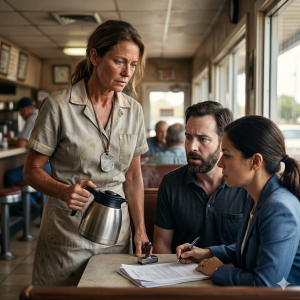
Slow morning. A family from Tallahassee. Two shrimpers I recognized from the docks. Then — around half past ten — a booth by the window filled up with people I didn’t immediately place.
A woman in a pale blue blazer with a leather portfolio. Professional. Notary, I thought, from the stamp kit on the table.
A man across from her in a short-sleeved button-down, talking with his hands the way he always did at family gatherings.
Terrance.
I felt the floor shift under me. Not dramatically. Just a small, quiet tilt, like the bay deciding something.
He hadn’t seen me yet. I was behind him, at the service counter, holding a coffee pot like it was the only solid thing in the room.
The woman in the blue blazer spread papers across the table. A lot of papers. She was pointing at lines, explaining something, her voice low and professional. Terrance was nodding. Smiling the particular smile he uses when he thinks he’s already won.
I heard two words clearly.
“Final transfer.”
My daddy’s lease. Terrance was selling it. Right now. Right here. Ten feet away from me in a waterfront diner where I had been pouring coffee all summer without knowing this day was coming.
My hand went to my neck. To the tag.
I don’t know why. I do it when I’m scared. When I need to feel something real.
I walked toward the table because my section ran along that window, and I was a professional, and I was not going to fall apart in Lula Mae’s on a Tuesday.
“Can I warm up your coffee?” I asked.
Terrance turned.
And for one long second, the whole world was just his face going the color of old bait.
“Della Faye,” he said.
The notary looked up at me. Standard professional courtesy. Then her eyes dropped — just for a moment — to the tag resting against my collarbone.
She went very still.
She uncapped her pen. Slid the transfer papers one inch closer to Terrance’s hand.
And then she slowly, quietly set the pen down.
She was looking at the tag like she recognized it.
Like she knew exactly what it was.
—
She said: “Where did you get that marker tag?”
Not hello. Not excuse me. Just that, straight and quiet, the way you ask a question when you already know half the answer and you need to hear the other half before you do something irreversible.
I set the coffee pot down on the edge of the table. My hands were steadier than they had any right to be.
“My daddy gave it to me,” I said. “Earl Broussard. When I was seven years old.”
She looked at it for another long moment. Then she looked at Terrance.
Terrance had stopped smiling.
“This is my cousin,” he said. The word cousin came out like he was trying to make it small. “She doesn’t have any involvement with the lease. This is a private transaction and she’s just —”
“Sir.” The notary’s voice was not unkind, but it had an edge that could cut glass. “I need you to stop talking for a moment.”
She reached into her leather portfolio. Not for the transfer papers. For something else, something at the bottom, protected inside a manila folder that looked like it had been handled many times.
She set it on the table between us.
It was a photocopy of a document. Older paper, the kind that turns amber at the edges. Lease records from the Florida Department of Agriculture and Consumer Services, Division of Aquaculture. I could see the header from where I was standing.
“I’ve been the notary for aquaculture transfer documents in this county for eleven years,” she said. “My name is Patricia Fontenot. Before I was a notary, I worked in the Division of Aquaculture office in Tallahassee for nine years. I processed lease registrations.”
She tapped the photocopy.
“Earl Broussard registered his lease in 1987. He was one of the last leaseholders to use the old aluminum marker system before they switched to plastic tags. Each aluminum marker was stamped with a unique registration number tied directly to the leaseholder’s name in the state record.”
She looked at my tag. The little stamped tag I had worn every day for twenty-three years.
“The number on that tag is part of the original lease registration,” she said. “It’s not decorative. It’s not sentimental. In the original filing, Earl Broussard listed it as a physical identifier of the lease itself. His attorney — a man named Gerald Picou, who I believe is still practicing in Panama City — drafted the original paperwork to include language stating that physical possession of a numbered marker tag constituted evidence of intended succession.”
The diner had gotten very quiet. Lula Mae herself had come out from the kitchen and was standing near the pass-through, dish towel in her hands, not pretending to be doing anything else.
Terrance said, “That’s not legally —”
“I didn’t say it was the only thing that mattered,” Patricia said. “I said it was evidence. There’s a difference.”
She looked at me then, fully, the way you look at someone when you’re deciding whether to hand them something heavy.
“When I saw that tag, I recognized the stamp format. I’ve seen maybe a dozen of those in my career. When the name Broussard came across my desk last month for this transfer, something nagged at me. I pulled the original file. Read the succession language. I’ve been sitting with it for four weeks trying to decide if I was obligated to say something before I notarized anything.”
She paused.
“I think you just answered that question for me.”
—
I don’t remember sitting down but I must have, because at some point I was in the booth across from Patricia Fontenot and Terrance was standing up. Standing the way men stand when the walls of a thing they built start showing cracks — not collapsed yet, just a sound they don’t like.
“This is harassment,” he said. “This is —”
“Terrance.” My voice surprised me. It was low and level, the voice of someone who has been pouring coffee and keeping her hands busy and waiting without knowing she was waiting. “Sit down or leave. But you’re not going to stand there and talk over her.”
He left.
Walked out the front door of Lula Mae’s Diner into the Tuesday morning heat and got into his truck and sat there. I could see him through the window. He didn’t drive away for a long time.
Patricia Fontenot wrote Gerald Picou’s phone number on a napkin and slid it across the table.
“He’ll remember the file,” she said. “He’s particular about his older clients. And the succession language is real — I’ve read it three times. It won’t win the case by itself, but it establishes that your father knew exactly what he was doing when he gave you that tag. It gives a lawyer something to build on.”
I held the napkin. I looked at the number.
“Why are you doing this?” I asked. “You don’t know me.”
She was quiet for a moment. She looked out at the bay, which was doing what it always does — just sitting there in the light, silver and indifferent and ancient.
“I grew up on the water too,” she said. “Different water. Louisiana side. My grandfather lost his shrimp lease in a paperwork dispute when I was twelve years old. We never got it back.” She picked up her portfolio and clicked it shut. “I’ve been a notary for eleven years. I have never once notarized a document I believed was built on a lie. I’m not going to start today.”
She stood up.
She left a five-dollar bill on the table for her untouched coffee.
“Call Gerald Picou,” she said. “Today, not tomorrow.”
—
I called him from the parking lot, still in my apron, the Gulf wind coming off the water and the tag warm against my collarbone from where my hand had been pressed to it.
Gerald Picou answered on the third ring.
When I said Earl Broussard’s daughter, he went quiet in a way that felt like recognition, not surprise.
“I’ve been wondering,” he said, “when you were going to call.”
He told me he remembered Daddy. Remembered him well. Said Earl had come to see him about six months before he died — long enough before that it wasn’t a death-bed thing, it was a planning thing, a man who knew his heart wasn’t right and was trying to put the world in order.
Daddy had told Gerald about Terrance. About his worries. About what he suspected might happen.
“He couldn’t predict exactly how it would go,” Gerald said. “But he knew the lease would be contested. He wanted the succession language in the original file to be findable. He said, and I’m remembering this pretty clearly — he said, ‘My girl wears my marker tag every day. If she ever needs to prove she’s mine, it’ll be right there around her neck.'”
I had to put my hand over my mouth for a second.
Twenty-three years. Every single day.
He had known. He had known I would keep it. He knew me that well, and he planned around it, and then he pressed it into my seven-year-old hand and told me it was his name on the water.
It was. It was his name. And he gave it to me.
—
That was yesterday.
Today Gerald Picou filed a formal challenge to the lease transfer in Franklin County. The sale Terrance was trying to finalize has been put on hold pending review. That’s not a guarantee. I know that. There’s still a process, still a fight, still a version of this where the lawyers and the paperwork and the money all win the way they usually do.
But there’s also a document in a state file in Tallahassee that an old attorney with a good memory put there on purpose, and there’s a notary in a pale blue blazer who read it and couldn’t let it go, and there’s a woman who has been pouring coffee all summer in the exact building where the lease was going to be signed away.
Daddy left me something I didn’t even know I was carrying.
I thought it was just comfort. Just grief made metal. Something to hold onto on the hard mornings.
It was that.
It was also evidence.
It was also his handwriting on the future, his quiet insistence that I was his, that what was his was mine, that a man who wakes before sunrise and comes home smelling like salt and Gulf water does not let his daughter be erased without leaving a way back in.
I wore it every day.
He knew I would.
The lease is still in dispute. I’m still pouring coffee. But tonight I’m going to sit on the dock and put my feet in the water and hold that tag in my palm the way I did when I was seven years old and see if I can feel him in it.
I think I can.
I think I always could.
🌊