The air brakes released with a long, weary hiss as Loretta Mae Jenkins eased Bus 47 to a stop at the county line.
The sound had always reminded her of an old man lowering himself into a chair after a hard day’s work. On that afternoon, it sounded even more tired than usual, as if the bus itself knew this was the last run.
Loretta kept both hands on the wheel for a moment after stopping. The familiar vibration of the engine buzzed through her palms. For forty-two years she had driven this route through the same stretch of country roads, past the same leaning fences, the same rusted grain bins, the same porches where children had once chased each other barefoot before growing into adults with children of their own. She had driven through summer heat that turned the seats into griddles, through winters when sleet made every curve feel like a prayer, through spring rains that swallowed half the road in mud.
And now it was over.
She was seventy-two years old, widowed, tired in ways sleep no longer fixed, and by the end of that day she would no longer be Miss Loretta the bus driver. She would simply be Loretta, alone in a small white house at the edge of town, with no husband in the kitchen and no route to run in the morning.
She blinked and looked up into the wide rectangular rearview mirror above her windshield.
Forty students stared down into their laps, faces washed in the pale glow of smartphones. Earbuds sealed their ears. Thumbs tapped quickly. The bus was so quiet that she could hear the faint rattle of a loose panel near the back wheel.
Years ago, her bus had been a rolling storm. Children had thrown paper footballs, traded stickers, argued over baseball teams, whispered secrets across aisles, and shouted goodbye out the windows. Back then she had complained about the noise, but secretly she had loved it. Noise meant life. Noise meant children still belonged to the world around them.
Now the quiet felt heavy.
She told herself she shouldn’t judge. Every generation said the next one was going to ruin everything. She knew that. But some days, watching all those bowed heads and blank screens, she felt as if she had become invisible. Not disliked. Not disrespected, exactly. Just unseen. Like the steering wheel or the stop sign arm. Something useful, but not human.
She adjusted the mirror and saw the same boy she always noticed because he never seemed to notice anything at all.
Silas Mercer sat in the second-to-last row on the right side, wearing his usual faded black hoodie despite the June heat. His long legs were stretched slightly into the aisle. His boots were dusty, heavy work boots that looked too worn for someone his age. Dark headphones covered his ears. He stared toward the window with that guarded expression teenagers perfected when they wanted the world to leave them alone.
In two years of driving him, Loretta could count on one hand the number of words he had spoken to her.
“Morning.”
“Thanks.”
“Sorry.”
That was about it.
He was sixteen, quiet as fog, and from where she sat he seemed to represent everything she didn’t understand anymore. A child with earbuds in his ears, a screen in his pocket, and a permanent wall between himself and anyone trying to reach him.
She sighed and shifted the bus into gear.
The route resumed. Gravel crunched. Tree shadows slid across the windshield. One stop at a time, children stood, gathered bags, and filed off into the thick afternoon heat. Some gave absent little waves. Most did not. Loretta answered every goodbye whether she heard one or not. Habit. Pride. Maybe a little heartbreak too.
Her thoughts drifted, as they often did, toward Henry.
For thirty-eight years he had met her after the afternoon route whenever he was home. He would step out onto the porch with a glass of iced tea and a grin, like she was returning from some grand adventure instead of driving the same roads she had driven for decades.
“How were my kids?” he always asked.
Never “How was work?”
Always “How were my kids?”
He had known all their names almost as well as she did. When storms came through, he worried about the children on dirt roads before he worried about the roof. When Loretta brought home stories, he listened like each one mattered. And because Henry listened, they had mattered.
Two springs earlier, cancer had taken him in a blur of hospital smells, folded blankets, and unreal paperwork. In the months after his death, the silence of the house had grown so sharp Loretta sometimes left the television on just to hear voices. But the one place she still felt useful was Bus 47. Behind that wheel, she still had purpose.
Retirement had sounded peaceful when she signed the papers in February. Sensible. Earned. People told her she deserved rest. What they didn’t understand was that rest and emptiness could look frighteningly alike.
The bus heater clicked unexpectedly and blew a weak wave of stale air at her ankles. Loretta almost laughed, remembering the day it had broken in January. She had been freezing, muttering to herself while trying to coax the old machine through one more route.
“Barnaby better appreciate this,” she had grumbled aloud. “I’m driving an icebox to get home and feed a three-legged fool cheap cat food.”
It had been one of those things people say when they think no one is listening.
Barnaby had shown up months after Henry’s funeral, a ragged orange-gray stray with one torn ear, one cloudy eye, and only three legs. He lived under Loretta’s porch and accepted her offerings with a level of suspicion usually reserved for criminals and tax collectors. He was not a lap cat. He was not sweet. But every evening he was there. In a world that had taken too much too quickly, even Barnaby’s prickly consistency had become a comfort.
The bus turned onto a narrower road lined with pines, then onto the long dirt stretch near the old lumber mill. The light had changed by then, turning gold and low. Dust lifted behind the tires.
Only one student remained.
Silas.
Loretta pulled to the shoulder at his stop and set the brake. The red lights flashed. The folding doors opened with a metallic groan.
She waited.
Usually Silas was gone in seconds, slipping off the bus with his head down and vanishing toward a small rental house beyond the tree line. But that day he didn’t rise immediately. He sat there for a beat longer than usual, then stood and started down the aisle.
Loretta felt a strange flutter of nerves. It was irrational, but the quiet bus made his footsteps sound important.
Thud. Thud. Thud.
He stopped beside her at the front.
Then, to her surprise, he pulled down his hood and removed his headphones.
Without them, he looked younger. Not smaller exactly, just less armored. His hair was flattened at the sides. His face was pale from staying out of the sun, and there was something hesitant in his eyes that she had never noticed before.
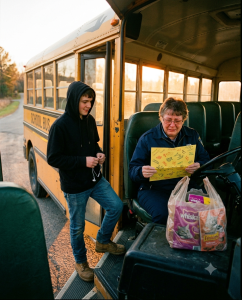
He reached into his backpack and pulled out a thick manila envelope. Then he bent again and lifted out a heavy plastic bag from Miller’s Grocery.
He placed both gently on the doghouse beside Loretta’s seat.
She stared at the bag first. Through the thin plastic she saw packages of premium salmon cat treats, the kind with glossy labels and tiny letters boasting real fish and no fillers. The fancy kind. The kind she had picked up once, checked the price, and put right back.
“Silas?” she asked. Her voice sounded rough in the stillness. “What is all this?”
He shoved both hands into his hoodie pocket and looked down at the floor.
“You mentioned your cat once,” he said.
Loretta frowned. “Barnaby?”
He nodded. “A few months ago. Maybe more. You said he had three legs and liked the cheap food.”
He glanced up, nervous but trying for a smile.
“So I thought maybe for your retirement he could have something better.”
For a second Loretta could only stare.
That tiny muttered comment on the freezing bus. She remembered it clearly now, because she had been in such a rotten mood that morning. She had assumed every child on the bus was sealed off from the world behind music and screens.
Apparently one of them had heard every word.
“Open the envelope,” Silas said softly.
Loretta set the bag aside and slid one finger beneath the flap. Inside was a folded sheet of yellow construction paper, thick and slightly wrinkled. She opened it carefully.
The page was covered edge to edge in signatures.
Some were big and looping. Others were cramped into corners. A few were written in glitter pen. One child had drawn a tiny bus with hearts around it. There were notes everywhere.
Thank you for waiting when I was late after basketball.
Thank you for asking how my grandma was doing.
Thank you for making sure I got home when Mom forgot.
Sorry I got gum stuck on seat 8 in sixth grade.
Thank you for driving us safe in the snow.
And near the middle, written in clear block letters:
We appreciate you, Miss Loretta.
Her vision blurred so suddenly she had to blink hard.
Silas rubbed the back of his neck. “I passed it around this week. Mostly when you were looking ahead.”
Loretta lifted her eyes to him. “You did this?”
He gave a small shrug. “It wasn’t just me.”
“But you started it.”
Another shrug, smaller this time.
He looked like he wished he could disappear into the floor and yet had forced himself to stand there anyway. That did something to Loretta. It made the gift feel even bigger. This had not come from a loud child who liked attention. It had come from a boy who clearly hated being the center of anything and had done it anyway because he thought it mattered.
“We know you’re retiring today,” he said. “And… about your husband too. My mom told me.”
Loretta pressed her lips together.
Silas continued, more awkwardly now, as if every word cost effort. “She said people forget to thank the ones who get them where they need to go. Because they’re just… always there.”
That was when the tears came.
Hot, immediate, unstoppable tears. Loretta covered her mouth and laughed once through them because she hated crying in front of anybody, especially teenagers. But there was no stopping it. All at once the weight she had been carrying cracked open.
For two years she had walked around with a secret certainty that the world had moved on without her. That Henry was gone, her usefulness was ending, and these young people behind her were too absorbed in their own lives to notice she existed.
And yet here was proof, in signatures and cat treats and a nervous boy standing at the front of an empty bus, that she had been wrong.
She had not been invisible.
Silas didn’t flee from her tears the way many adults would have. He simply lowered himself onto the bottom step beside the open door and waited. Not impatiently. Not uncomfortably. Just patiently, as if he understood some moments needed a little room.
Loretta found a crumpled napkin in her lunch bag and dabbed at her face.
“Well,” she managed, “I suppose this is one way to ruin an old woman’s mascara.”
That made him laugh.
The sound startled them both. It was warm and quick and so unexpectedly boyish that Loretta felt another ache in her throat. He had probably laughed on her bus before, but not where she could hear it.
When she could speak again, she said, “Thank you. I don’t know what to say.”
“You don’t have to say anything,” he replied.
That answer was so gentle it made her study him more closely.
“Sit a minute,” she said.
He already was, technically, but he nodded.
Outside, the late sun painted the road amber. Dust floated in the light. Somewhere beyond the pines, a dog barked. The empty bus held that odd hush that comes after something important has happened, when the world looks the same but doesn’t feel the same anymore.
Loretta folded the card carefully and set it in her lap.
“You know,” she said, “I thought you had those headphones in because you didn’t want to hear a single thing around you.”
Silas looked down, then gave a crooked half-smile. “Sometimes nothing’s even playing.”
She blinked. “Why wear them then?”
He shrugged. “People say things around you when they think you can’t hear.”
There was no bitterness in his tone, only tired experience, and that bothered her more than anger would have.
“Things at school?” she asked gently.
“And everywhere else.”
Loretta nodded. She knew enough not to push too fast. “That sounds lonely.”
He took longer to answer that one. “Yeah.”
She rested one arm on the wheel. “House feels lonely too sometimes.”
At that, he looked up.
And then, slowly, the conversation opened.
Not wide. Not all at once. But enough.
He told her his mother worked double shifts at the nursing home. That he helped watch his little sister in the evenings. That his headphones were useful because people talked less to you when they assumed you were occupied. He said it like a trick he had learned for surviving, not as a complaint. Loretta told him how strange grief could be, how some mornings the worst part was not crying but forgetting for one peaceful second that someone was gone. She told him Barnaby was mean but loyal. He said that sounded like a respectable cat.
They talked about loneliness in the plain language of people who knew it firsthand. No speeches. No generational lectures. No debates about phones or modern life. Just two people admitting that being quiet did not mean being empty.
Then Silas said something that settled deep in Loretta’s chest.
“I used to keep the headphones in even when nothing was on,” he said, staring out the windshield. “But I heard stuff.”
“What kind of stuff?”
“The way you talked to people.”
She waited.
“I heard you ask one girl if her grandma was out of the hospital yet. I heard you tell a boy you were glad he was back after he missed a week. I heard you sit there in the snow and say, ‘We’re not leaving until I know everyone’s inside safe.’”
His jaw tightened as if he were embarrassed by how much he remembered.
“I heard you say my name one day when I wasn’t on the bus for two mornings,” he added. “You sounded worried.”
Loretta searched her memory and found it. He had missed two days in October. She had glanced in the mirror and asked no one in particular, “Anybody know if Silas is sick?” It had been casual, but she had meant it.
He went on quietly, “You thought nobody noticed you. But people notice how you treat them. Especially when you don’t think they’re looking.”
Loretta looked away because fresh tears threatened.
Sometimes the deepest loneliness came not from being physically alone, but from believing your small acts disappeared into nothing. Henry had always understood that. He used to tell her that steady kindness mattered most because it rarely got applause. Hearing Silas say nearly the same thing felt like Henry had somehow sent the words back around to her on the very route where she had needed them most.
The sun sank lower. Finally Silas rose from the step and slung his backpack over one shoulder.
“I should get going,” he said.
Loretta nodded, though part of her didn’t want the moment to end. “Your mama raised you right.”
He looked almost panicked by the compliment, then softened. “She’d say the same about you.”
Before stepping down, he hesitated. “Barnaby might not like the salmon kind.”
Loretta let out a wet laugh. “Barnaby likes acting offended. That’s different.”
Silas smiled fully then, just for a second, and it transformed his whole face.
He stepped off the bus and started down the dirt road. Halfway to the trees he turned back and gave her a small wave.
Loretta lifted her hand in return.
Then he was gone.
She sat there a long time before pulling the door shut.
At the county lot, another driver snapped a picture of her beside Bus 47. The transportation supervisor handed her a sheet cake with too much icing and said something kind she would later struggle to remember. Everyone wanted retirement to feel celebratory. Loretta smiled, hugged who needed hugging, and thanked them all. But the true center of the day had already happened on a dirt road near the lumber mill, on the steps of an empty bus.
When she finally drove home in her faded blue sedan, the house looked as it always did: white paint peeling near the porch rail, one shutter hanging slightly crooked, marigolds in the front bed fighting for their lives in the summer heat.
Barnaby was waiting under the porch.
He emerged at the sound of the car door, limping with his usual offended dignity. Loretta carried the grocery bag like treasure.
“Well,” she told him, “you’ve got a teenage admirer.”
Barnaby blinked as if deeply unimpressed.
She poured the salmon treats into his plastic bowl. The cat moved faster than she had seen him move in months and buried his face in them immediately. Loretta laughed aloud, the sound surprising her in the quiet yard.
Then she carried the signed card inside and set it on the kitchen table beneath Henry’s framed photograph.
His smile in the picture was the same crooked, patient smile she knew by heart.
“You were right,” she whispered to him. “About people.”
The words hung in the still kitchen. Grief flared as it always did when she spoke to a man who could no longer answer. But it was softer this time, braided with something warmer.
Later she took Henry’s old wooden rocking chair onto the porch and sat down with the card in her lap. The evening air smelled like cut grass and warm dust. Down the road, a truck passed. Crickets began their nightly racket. Barnaby cleaned one paw with a look of expensive satisfaction.
Loretta unfolded the paper again and read every note.
Some were from children she could picture instantly. Some signatures belonged to names she barely knew because new routes had changed so often in recent years. But together they formed a map of a life she had almost dismissed as ordinary.
Thank you for seeing us.
Thank you for being nice to my brother when he was scared.
Thank you for never leaving us behind.
She ran her fingers over the marker lines.
All this time she had believed the screens meant no one was present. She had mistaken quiet for indifference, awkwardness for apathy, modern habits for a lack of heart. Yet those children had been noticing things she herself had nearly forgotten mattered. A warm greeting. An extra minute of patience. Concern spoken into cold air. A habit of kindness practiced so long it no longer felt remarkable.
Maybe that was the trick of getting older. Not just watching the world change, but deciding too quickly what those changes meant.
She had looked at Silas’s bowed head and headphones and seen a whole generation turning away. What she should have seen was a shy boy listening more carefully than anyone else.
The next week, Loretta found herself baking a pan of cornbread and taking it to the Mercers’ little rental house. She almost turned back twice, worried she might embarrass Silas. But his mother answered the door, tired-eyed and kind, and invited her in. The living room was cramped but spotless. A little girl sat on the floor coloring. Silas emerged from the hallway looking startled enough to drop his glass of water.
Loretta handed over the cornbread and thanked his mother for raising a son with that kind of heart.
His mother’s eyes filled at once. “He doesn’t say much,” she said.
“He doesn’t have to,” Loretta replied.
From then on, something small but steady changed.
Loretta did retire, of course. She slept later. She sorted Henry’s tools. She planted tomatoes she had no idea how to grow properly. She learned that retirement was not one long peaceful exhale but a thousand tiny adjustments. Some days still hurt. Some evenings the house still felt too quiet. Grief did not vanish because of one beautiful moment on a bus.
But the world no longer felt as empty.
Once in a while, Silas and his little sister stopped by with groceries from town if they saw Loretta’s car gone for too long. Sometimes Loretta sent leftovers home with them in old margarine tubs. Barnaby, traitor that he was, eventually allowed Silas to scratch the top of his head after sufficient salmon-based bribery.
By autumn, Loretta understood something she wished she had learned earlier.
People do not always announce their care in ways we recognize immediately. Not every kind heart is loud. Not every attentive person is expressive. Some people carry their compassion quietly, almost secretly, because shyness, pain, or habit teaches them not to put themselves forward.
That did not make their care smaller.
If anything, it made it easier to overlook, and therefore all the more precious when it finally showed itself.
On cool evenings, Loretta still sat in Henry’s rocking chair with the signed yellow paper tucked safely in a kitchen drawer nearby. Sometimes she read it again. Sometimes she didn’t need to. She had memorized the line that mattered most.
We appreciate you, Miss Loretta.
Such a simple sentence. Yet it had reached into the hollow place she had been trying to ignore and filled it with something close to peace.
When people spoke carelessly about kids these days, Loretta found herself pushing back. Not with speeches. Just with one story.
About the quiet boy in the black hoodie.
About the headphones that often played nothing at all.
About the old bus driver who thought she had become invisible.
About the bag of salmon treats for a three-legged porch cat.
About the card full of signatures gathered in secret.
About the last route that turned out not to be an ending at all, but a correction.
Because the truth was, the younger generation had not failed her.
Her assumptions had.
And perhaps that was the aftershock that stayed with her longest: how easy it had been to be wrong about someone simply because their kindness didn’t arrive in a familiar shape. How many times had she mistaken silence for indifference? How many people had she placed behind walls they never built?
She never stopped being grateful for the answer that came to her on an empty bus in golden light.
Sometimes the quietest person in the room is the one paying the closest attention.
Sometimes the heart you think is hidden is simply careful.
And sometimes, when you are most certain the world has stopped seeing you, someone has been listening all along.