The mayor called her a liar in front of two hundred people.”
By the end of the next five minutes, Evelyn Weller was no longer the person anyone in the room was watching.
Every eye in the packed municipal auditorium had shifted to Mayor Daniel Mercer.
And for the first time in eleven years, he looked like a man who understood what losing control felt like.
Evelyn had not come to the town hall expecting vindication. She had come prepared for humiliation.
At sixty-one, she knew exactly how public meetings worked when power was involved. She had spent thirty-three years teaching civics at Bell County High School, telling teenagers that democracy depended on ordinary people asking difficult questions. It sounded noble in a classroom. It sounded clean in textbooks. But Evelyn had lived long enough to know that in real life, power rarely thanked the people who challenged it.
Especially in a town like Marlowe Ridge.
Marlowe Ridge was the kind of place where reputations hardened into facts. People didn’t just know who you were; they knew who your parents were, what church you attended, whether you tipped properly at the diner, and how you behaved when your life came apart. Daniel Mercer had built his entire political career in that kind of soil. He had charm, timing, and the kind of face that made elderly voters describe him as “steady.” He remembered names. He attended funerals. He cut ribbons in front of cameras. He knew exactly how to sound humble while never giving away an inch of control.
For more than a decade, people had trusted him.
Evelyn had too, once.
Not intimately. Not politically. But enough. Enough to think he was competent. Enough to assume the town’s neglected roads, failing drainage, and disappearing project timelines were the result of bureaucracy, not theft. Corruption belonged to bigger cities, larger headlines, dirtier men. Not to someone who shook hands after church and complimented bake-sale pies.
That assumption began to crack on a rainy Tuesday afternoon in the records room at City Hall.
Evelyn had been volunteering with the historical society, helping sort old maps, permits, and zoning files for a local preservation exhibit. Her former students joked that retirement had made her more dangerous because she now had time to alphabetize an entire government building if left unsupervised.
She had laughed.
Then she opened the wrong drawer.
At least that was how it felt afterward.
The drawer had been labeled archived infrastructure correspondence. What she expected were survey maps and contractor notices. What she found instead was a stack of invoices clipped together in no apparent order. Road resurfacing. Storm drainage repairs. Park rehabilitation. Emergency retaining wall work. The first thing that bothered her was the addresses. She recognized them. One street hadn’t been resurfaced in years. One park was still half dirt and rusted swings. One drainage corridor flooded so badly every spring that parents sometimes kept children home rather than risk the elementary school pickup line.
The second thing that bothered her was the money.
The figures were too high. The approvals too neat. The completion status too confident.
She copied the reference numbers onto a legal pad, slid the invoices back where she found them, and went home telling herself there was probably a reasonable explanation.
That explanation never appeared.
Instead, her dining room table vanished beneath weeks of research.
Public budget summaries sat beside property tax records. Contractor registrations beside campaign donation filings. She requested procurement histories, reviewed council meeting minutes, and cross-checked disbursement dates against visible work completed in the actual neighborhoods listed. More than once, she drove out to a project site with a printed invoice in her purse and stared at untouched pavement or broken public benches while trying to convince herself she must be misunderstanding the paperwork.
But the pattern kept widening.
Three contractors, all repeatedly awarded high-value city work, were tied to mailing addresses that led nowhere meaningful. One was a vacant storefront. Another was a UPS mailbox two counties over. A third listed a registered agent who had died nineteen months earlier. Meanwhile, emergency infrastructure funds kept being approved for urgent repairs that did not exist outside paper records.
The worst thread ran through a development company called Ridgeway Civic Partners, a bland name hiding very specific connections. Corporate filings linked the company to the mayor’s brother-in-law. That same company had quietly purchased parcels of land near an area scheduled for future drainage improvements. Improvements that, according to documents, had already been funded more than once.
Evelyn understood enough about local government to know how this could work. Understaffed offices. Friendly approvals. Familiar contractors. A town too used to trusting the same faces. She also understood something else: once she spoke, there would be no unspeaking.
So she moved carefully.
First she called the town council secretary and requested clarification on several contract numbers. The secretary, cheerful at first, turned evasive the moment Evelyn named Ridgeway Civic Partners. Then she stopped returning calls entirely.
Next Evelyn emailed a council member she knew slightly through church. He responded six hours later with a single sentence:
This is probably more complicated than it looks.
That sentence frightened her more than silence would have.
Then, two days before the scheduled public town hall, the meeting agenda appeared online. Near the bottom, under public comment, her name had been entered in full.
Evelyn had not requested that.
She stared at the screen for a long time.
Someone knew she was asking questions. Someone wanted the confrontation to happen in public where she could be discredited if necessary.
That night she barely slept.
The following evening brought the second shock.
She had just finished washing dishes when Barnett, her old Labrador mix, started barking toward the front hallway. Evelyn dried her hands and walked to the door. An envelope had been shoved halfway under it from outside. Plain white. No stamp. No handwriting.
Inside was a flash drive and a typed line on printer paper:
He keeps a second ledger because he trusts paper more than people.
Evelyn stood frozen in the lamplight.
Every sensible instinct told her not to insert an unknown drive into her laptop. She called her nephew, who worked in IT for a hospital network. Within an hour he arrived with an old wiped machine he used for testing suspicious hardware. Together they opened the files.
There were scanned ledger pages. Handwritten entries. Transfer logs. Routing sheets. Photographs of financial records laid open on what looked like a dark wood desk. Payment notations cross-referenced with city project codes Evelyn already recognized. Several entries included the initials D.M. alongside amounts siphoned from municipal accounts tied to drainage, park rehabilitation, and road resurfacing. Others listed split percentages and abbreviated names matching contractor shells she had flagged.
Then came the photograph that made her nephew swear aloud.
Mayor Daniel Mercer stood in his office with his jacket off and sleeves rolled up beside an open wall safe. In his hand was a black ledger book with a torn corner and red tab markers—the same ledger appearing in the scans. The photo’s digital date was from four months earlier.
Evelyn’s first reaction was fear.
Her second was clarity.
If those files were real, she was not dealing with accounting irregularities anymore. She was holding proof of intentional fraud.
Her nephew told her to go directly to state investigators.
She considered it. She should have. But something in her resisted handing the material into a system she no longer trusted without creating a public record first. If the town machinery was compromised, private complaints could disappear. Public exposure could not.
So she printed copies. Multiple sets. One sealed in her desk. One in her tote bag. One hidden inside the linen closet beneath old towels no one ever touched.
By the time she entered the municipal auditorium the next night, she felt as though she were carrying lit matches in dry weather.
The place was already crowded.
Residents packed the folding chairs. Business owners lined the walls. Two local reporters had taken seats near the front, joined unexpectedly by a regional paper journalist and a camera operator from a nearby station. Word had spread. In small towns, scandal traveled faster than caution.
The stage held the usual arrangement: a long table draped in blue cloth, microphones, name placards, plastic water pitchers. Mayor Mercer sat at the center in a navy suit with a subdued tie, looking rested and entirely at ease. To his left were two council members and the city attorney. To his right sat the finance director, a planning officer, and Councilwoman Nina Alvarez, who looked distracted and unusually tense.
Mercer saw Evelyn take her seat in the third row and gave her a polite nod.
The gesture chilled her more than open hostility would have.
When public comment began, the mayor handled the first speakers smoothly. A complaint about speed bumps. A question about school crossing lights. A request for small business signage permits. He answered each one with practiced patience, the way men do when they know the room belongs to them.
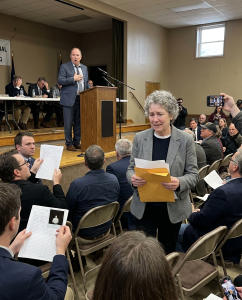
Then the clerk called, “Evelyn Weller.”
A ripple moved through the audience.
Evelyn stood, gathered her folder, and walked to the microphone. She felt every eye on her. Somewhere in the middle rows, someone whispered her name.
She introduced herself clearly, stated that she was a retired teacher and current resident of Marlowe Ridge, and began reading from her notes.
At first her voice sounded too formal, even to her own ears. But as she moved through the contract numbers and payment dates, habit took over. Teachers learn how to pace information so a room can follow. She laid out the discrepancies one by one. Project allocations that did not match completed work. Duplicate invoices. shell vendor inconsistencies. Emergency drainage funds assigned to neighborhoods still visibly damaged. Award clusters connecting municipal spending to entities with direct family ties to the mayor.
A murmur rose.
Someone near the back said, “She’s naming actual contracts.”
Another person hushed him.
Evelyn continued. She did not accuse anyone of theft directly, not yet. She asked for an independent audit. She requested a public explanation of the listed expenditures and vendor approvals. She stated that, in her review, the records suggested deliberate misrepresentation of municipal spending.
When she finished, the auditorium was no longer casually attentive. It was alert. Tight. Interested.
Then Mayor Mercer stood.
His timing was perfect. Not rushed, not indignant. He approached his microphone like a man stepping in to correct a misunderstanding at Thanksgiving dinner.
“With respect,” he began, “Ms. Weller is mistaken.”
A few people exhaled.
He glanced toward Evelyn with a sympathetic expression so skillfully calibrated it felt insulting.
“She is a retired teacher, not a forensic accountant. These are partial records, stripped of context, and municipal finance is often more complex than it appears from isolated paperwork.”
He let that settle.
Then he turned back toward the crowd.
“I understand that people become concerned when they see unfamiliar documents. But concern is not proof. And spreading conclusions before the facts are understood can damage reputations unfairly.”
Evelyn felt the room shifting, not fully against her yet, but wobbling.
Mercer saw it too. He pressed harder.
“I’ll be blunt,” he said. “What Ms. Weller is claiming here is false. She is wrong. And if she continues presenting false claims as fact, then yes, she is lying to this community.”
The word struck like a slap.
Lying.
Not confused. Not misinformed. A liar.
A few people looked at Evelyn with pity. Others with irritation. One man actually smirked. The humiliation was immediate and physical. Heat climbed her neck. Her folder suddenly felt childish in her hands, her printed spreadsheets frail beside the authority of his voice and title.
Mercer kept going, sensing advantage.
“This is what happens when incomplete information becomes a performance,” he said. “It is irresponsible, and it disrespects the hardworking city staff who actually understand these systems.”
Evelyn might have faltered then. She might have returned to her seat with the room half-convinced she had misread ordinary bureaucracy.
But Mercer made one mistake.
He became arrogant.
He leaned back slightly and said, “If Ms. Weller has real evidence of wrongdoing, she should present it now instead of wasting everyone’s time.”
There was a small rustle in the room as heads turned toward Evelyn.
Something inside her went cold and steady.
She had not intended to use the second set of documents publicly. She had planned to speak, force acknowledgment, and hand the rest to investigators. But Mercer’s contempt changed the equation. More importantly, his confidence told her he did not know how much she had.
He thought she was bluffing.
Evelyn lowered her folder.
Then she reached into her tote and withdrew the sealed manila envelope.
At first, the movement barely registered. Mercer watched with the indulgent patience of a man preparing to dismantle a final weak argument. Evelyn stepped away from the microphone and walked directly into the audience.
She stopped beside Eli Grant, the county paper’s most skeptical reporter—a man known for distrusting everyone equally—and handed him the envelope.
“Please open it,” she said.
He frowned but did as she asked.
First came the ledger scans.
Then the transfer pages.
Then the photograph.
Eli’s face changed before anyone else’s did.
He stood up so quickly his chair scraped the floor.
“Mayor Mercer,” he said, voice suddenly sharpened into something dangerous, “would you like to explain why your initials appear next to undocumented disbursements from municipal infrastructure accounts?”
The room snapped toward the stage.
Mercer did not answer immediately.
Instead he held out his hand. “Let me see those.”
Eli did not move.
The regional reporter beside him leaned in. “Is that a personal ledger?”
Councilwoman Alvarez rose halfway from her chair and stared openly at the pages from where she stood. The finance director looked down so abruptly that Evelyn noticed sweat collecting along his temple. Near the side door, Police Captain Ross straightened from the wall where he had been standing with ceremonial boredom and fixed his attention on the mayor.
Questions started from every direction at once.
“That’s Maple Street drainage funding.”
“Why is Ridgeway Civic on there?”
“Is that tomorrow’s date?”
“Who took that photo?”
Mercer attempted a smile and failed.
“These documents are fabricated,” he said.
Then, realizing the photo was too specific for blanket denial, he pivoted.
“I have never seen these materials.”
That was worse.
Because seconds later, flustered and trying to regain ground, he added, “Internal accounting shorthand can be misleading to the untrained eye.”
A terrible silence followed.
He had just commented on the content of documents he claimed never to have seen.
Evelyn saw the exact instant several people in the room caught it. Faces changed. Not dramatically. Not theatrically. Just enough. Doubt becoming recognition. Recognition becoming alarm.
Mercer turned toward the council table, perhaps expecting support.
He found none.
Councilwoman Alvarez slowly stood all the way up now, one hand braced against the table. Her expression was no longer distracted. It was horrified. The city attorney was reading the page Eli had passed down to him, lips parted slightly as if his brain had stopped keeping pace with his eyes. The finance director looked close to ill.
Evelyn should have felt triumph. Instead she felt sadness so heavy it nearly buckled her knees. This was her town. These were public funds meant for roads, drains, parks, school routes, elderly access ramps. Real things for real people. The fraud was not abstract anymore. It had faces. Flooded houses. Broken playgrounds. Tax bills.
Then Alvarez spoke.
“Who else signed this?”
The question landed like a dropped weight.
Because the ledger did not point to one corrupt man operating alone. It pointed to a chain. Approvals. Routing marks. Procurement releases. Department authorizations. Someone in public works. Someone in finance. Maybe more than one someone in council.
Mercer’s voice cracked for the first time. “You do not understand what you’re looking at.”
Nobody cared.
Captain Ross stepped toward the stage and bent to speak quietly with the city attorney. Whatever he said drained the man’s face. In the third row, the regional journalist was already on the phone with her editor. A clerk near the aisle stood up abruptly, looked toward the exit, then sat back down when she realized cameras had turned in her direction.
Evelyn scanned the council table and saw something she would remember for years: not shock, but fear. Genuine fear. One councilman kept his hands flat on the table and stared at the documents as though touching them might implicate him. Another would not look at Mercer at all.
Then Eli Grant lifted a second transfer sheet and said, “There’s a movement scheduled for tomorrow morning from the emergency reserve account into a vendor clearing line.”
Several people spoke over each other. “Tomorrow?”
“Another payout?”
“Move it where?”
“Before what?”
The answer was visible in the paperwork. A rush transfer. Final quarter scramble. Money being shifted through the same layered contractor chain before an outside state review due the following week. The scheme had been in motion even as Mercer prepared to sit through that town hall and call Evelyn a liar.
That was what broke the room.
Not just the theft.
Not just the ledger.
The fact that it was still happening.
Mercer finally lost the composed cadence that had carried him through eleven years of politics.
“This meeting is adjourned,” he snapped.
No one listened.
Captain Ross stepped onto the stage and said, loudly enough for the room to hear, “Mayor, do not leave.”
Mercer turned, stunned. “Excuse me?”
“Do not leave the stage.”
The words weren’t shouted. They didn’t need to be. Their force came from how publicly they were spoken.
A camera operator moved closer. Someone in the audience gasped. One of the city clerks began to cry.
Mercer looked around as though expecting someone—anyone—to step in and restore the familiar order of things. The council. The attorney. The officers. The reporters. The townspeople who had applauded him at summer festivals and reelection breakfasts. But the arrangement had changed. Power had shifted in real time, and he could feel it.
For the first time all evening, his face showed naked fear.
Not embarrassment. Not outrage.
Fear.
Within twenty minutes, state investigators had been contacted. The county prosecutor’s office was notified before the auditorium had even emptied. Copies of the ledger pages were photographed, timestamped, and spread to too many phones and cameras to vanish. The envelope that had appeared under Evelyn’s door had done exactly what its sender intended: it had forced daylight onto a system built to survive in shadows.
The aftermath came fast.
Search warrants were executed the next morning at City Hall and at Mercer’s private office. The wall safe in the photo existed. So did the black ledger. Ridgeway Civic Partners unraveled within a week under scrutiny. Two shell contractors dissolved on paper almost overnight, too late to prevent digital records from being recovered. By the end of the month, the finance director had resigned, one council aide had taken immunity in exchange for testimony, and formal charges were pending against multiple individuals tied to procurement fraud, embezzlement, falsification of public records, and conspiracy.
Mercer himself resigned before he could be removed.
The press photographed him leaving the courthouse three weeks later, no tie, no smile, head down. People in Marlowe Ridge studied those images the way they studied storm damage: not because it was beautiful, but because they needed proof that what had happened was real.
Evelyn was asked a hundred times whether she regretted speaking publicly.
She always answered the same way.
“I regret that it was necessary.”
What she never said aloud was how close she had come to staying silent. How humiliating those first seconds had felt when Mercer called her a liar. How easily the moment might have ended there if he had not pushed too far, if he had not mistaken age for weakness and humiliation for surrender.
The town changed after that.
Not magically. Corruption does not disappear because one man falls. Roads still needed repair. Trust took longer to rebuild than budgets. People argued bitterly over who knew what and when. Some residents insisted Mercer could not have acted alone. Others felt ashamed they had defended him for so long. Council meetings stayed crowded for months. Citizens who had never attended before began requesting records, asking sharper questions, and refusing polished answers.
Maple Street finally got its drainage project the following spring.
The dead park near Crescent Avenue was renovated before summer.
The retaining wall by the school was rebuilt.
Small things, maybe, compared to the betrayal. But in a town where public money had been turned into private comfort, small visible repairs became symbols. Evidence that government could still serve the people paying for it.
As for the envelope’s sender, Evelyn never learned the identity for certain.
She had suspicions. Most people did. Maybe a clerk with a conscience. Maybe an accountant who realized the mayor would sacrifice everyone else first. Maybe someone inside the machine who finally got tired of watching the town bleed while pretending the books were clean.
Whoever it was, they had chosen carefully.
They had given the truth to someone they believed would not bury it.
In the months that followed, strangers stopped Evelyn at the grocery store, the post office, the pharmacy. Some thanked her. Some apologized for doubting her. A few admitted, in embarrassed voices, that they had nearly believed Mercer when he dismissed her as confused and out of her depth.
She understood why.
Authority has a costume. Titles, microphones, calm voices, expensive suits. Truth often arrives looking much less impressive: a retired teacher with a folder. A woman whose hands shake before she speaks. Someone who seems easier to dismiss than the man at the center table.
That was the lesson Marlowe Ridge had paid dearly to learn.
The most dangerous lie in the room had not come from the person called a liar.
It had come from the man who believed public confidence would protect him longer than facts could expose him.
Even long after Mercer’s name disappeared from office signage, people still talked about that night in the auditorium. They talked about the moment he smiled and called Evelyn a liar in front of two hundred people. And they talked about the five minutes that followed, when one envelope moved through a reporter’s hands and changed the direction of every eye in the room.
Because that was the detail no one forgot.
Not the insult.
Not even the evidence.
It was the look on Daniel Mercer’s face when he realized nobody was watching Evelyn anymore.
They were all staring at him.
And maybe that was the aftershock that lingered longest in Evelyn’s mind too: how often power depends not on truth, but on where a crowd is trained to look. How many years had Mercer survived because everyone kept their eyes where he wanted them? How many other polished men in other polished rooms were still counting on that same old reflex?
She never found that answer.
But every time she heard someone dismiss a difficult question because of who asked it, she thought back to the auditorium, the envelope, the silence, and the turning of the room.
Sometimes justice begins with proof.
And sometimes it begins one heartbeat earlier, in the instant a crowd stops looking where it has been told to look, and starts looking where the truth has been hiding all along.