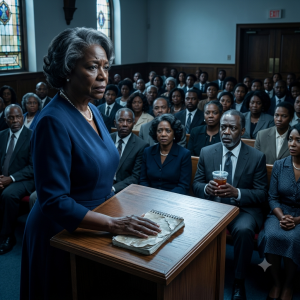
She walked up to that microphone in her good navy dress, set a small water-stained notebook on the podium in front of the whole congregation, and said seven words that made Gerald’s face go the color of old chalk.
But let me back up eight months.
—
Rosalind Mae Hutchins had been a fixture at Calvary Baptist for forty-one years.
She helped paint the nursery walls in 1987. She organized the first women’s prayer circle. And thirty years ago, she started the choir with six women, a borrowed keyboard, and a hymnal held together with a rubber band.
That choir was her heartbeat.
So when the new treasurer — Gerald Pruett, smooth-talking, cologne-wearing, always-with-a-compliment Gerald — stood up at the March business meeting and presented his “findings,” Rosalind sat very still.
He had spreadsheets. He had highlighted rows. He had a sorrowful expression that had clearly been practiced in a mirror.
“The discrepancies in the building fund,” he said, shaking his head slowly, “point to one person with consistent access.”
He never said her name out loud.
He didn’t have to.
Every head in that room turned toward Rosalind.
—
She was asked to step down from the choir “temporarily, out of an abundance of caution.” Temporarily lasted three Sundays before they gave her seat — her *founder’s* seat — to a woman who hadn’t even been a member for a full year.
People she’d known for decades stopped meeting her eyes in the fellowship hall.
Her friend Linda, who Rosalind had sat beside for twenty-two years, started choosing the other side of the sanctuary.
It nearly broke her.
*Nearly.*
What saved her — and nobody knew this — was the little notebook.
She’d found it six weeks before any of this started, tucked inside a box of donated books left by the back door of the church library. Water-stained cover, spiral binding, a woman’s handwriting inside so small and cramped it looked like it was trying to hide from someone.
Rosalind had read the first page and gone very quiet.
She’d been carrying it inside her worn leather Bible ever since. At Sunday service, at committee meetings, in the pew where she still sat alone — she would rest her hand on that Bible, feel the slight bulge of the notebook beneath, and not open it.
Not yet.
She just needed one more thing first.
—
Here’s what Gerald Pruett did not know about Rosalind Mae Hutchins.
She had forty-one years of relationships in this town. She knew the librarians and the bank tellers and the woman who did alterations at the dry cleaner on Route 9.
And she was, at her core, a very patient woman.
It took her two months to find out that Gerald had been married before he came to Calvary Baptist. Three weeks after that, she found out his first wife, Darlene, was living in Macon, Georgia, working at a dental office on the east side.
Rosalind wrote her a letter. Old-fashioned, handwritten, three pages.
Darlene called her the same week.
They talked for two hours.
Then they talked every Sunday afternoon for the next five months.
By the time the spring potluck rolled around — the big one, the one the whole congregation comes to, the one Gerald had started running like it was *his* event — Rosalind knew things.
About a church in Savannah.
About a women’s auxiliary in Macon.
About a building fund there, too.
—
She dressed carefully that morning. The good navy dress, the one she wore when things mattered. Low block heels. Her mother’s pearl earrings.
She put the leather Bible in her purse, that little water-stained notebook tucked safely inside it.
She brought her green bean casserole because she was not an animal.
She set it on the table. She hugged three people. She waited while the room filled up — folding tables end to end, the good tablecloths, children running between the chairs, Gerald holding court by the sweet tea with his big warm laugh.
Pastor Dennis was just reaching for the microphone to call everyone to the blessing when Rosalind stepped forward.
“Pastor, if I could have just a moment.”
She walked to the podium like she owned every inch of the floor between them.
She set her Bible down. Reached inside. Placed that small, water-stained spiral notebook on the podium where every person in that room could see it.
She smoothed her navy dress.
She looked at Gerald.
And Rosalind Mae Hutchins, thirty-year founder of the Calvary Baptist Sanctuary Choir, leaned into the microphone and said, clear as a bell:
“Before we say grace, I believe Gerald has something he’d like to explain to this room.”
The sweet tea in Gerald’s cup trembled.
He didn’t move.
Nobody moved.
—
The notebook belonged to a woman named Patricia Ann Greer.
That’s what the inside cover said, in that same small, hiding handwriting. Patricia Ann Greer, and below her name, the name of a church — New Covenant Fellowship, Savannah, Georgia.
Rosalind had figured out, over those long Sunday phone calls with Darlene, that Patricia Greer had been the bookkeeper at New Covenant Fellowship for eleven years. She’d been meticulous. She’d written down everything — not in the official ledgers Gerald kept access to, but in this little spiral notebook she apparently carried in her purse like a second conscience.
Deposit dates. Withdrawal amounts. The way certain line items in the building fund seemed to grow and then quietly shrink in the weeks before Gerald transferred his membership north.
Patricia Greer had died of a stroke fourteen months ago. Her daughter had donated her books to a library sale without reading them first.
The notebook had traveled two hundred miles in a cardboard box and ended up by the back door of Calvary Baptist, where Rosalind found it on a Tuesday morning in October.
Providence, Rosalind had decided, was sometimes very slow and sometimes very precise.
—
Gerald Pruett had been standing by that sweet tea for a full thirty seconds now, and the color had not returned to his face.
He was a big man, broad-shouldered, with the kind of easy smile that had probably charmed every newcomers’ dinner he’d ever attended. But the smile was entirely gone. In its place was something smaller and more honest than anything he’d shown this congregation in two years.
Rosalind waited. She was good at waiting.
“I don’t — ” he started.
“I have a phone number,” Rosalind said pleasantly, into the microphone. “For a woman named Darlene. Your first wife. She drove up from Macon this morning and is sitting in the third row.”
Sixty heads swiveled at once.
There was Darlene. Small woman, close-cropped silver hair, good wool blazer. She raised one hand in a calm, unhurried wave, like she was greeting a neighbor across a fence.
Gerald Pruett sat down. He just — sat down, right there in the folding chair behind him, as if his legs had made the decision without consulting the rest of him.
—
What came out over the next twenty minutes was not comfortable. There is no version of this story where it was comfortable.
But the congregation of Calvary Baptist heard it, and they sat with it, and to their credit most of them stayed seated and quiet and let the thing breathe.
Gerald had come to Calvary Baptist because things had gotten too warm for him in Savannah. The building fund discrepancies at New Covenant Fellowship had never been formally investigated — the church board had quietly asked him to move on rather than weather the scandal — but Patricia Greer had kept her notebook, and Darlene had known something was wrong for years, and a pattern, once you could see all of it laid out, was impossible to mistake for coincidence.
The money he’d moved at Calvary Baptist was not an enormous sum. Just under four thousand dollars, shifted through three different line items in a way that was genuinely difficult to follow unless you knew what you were looking for.
He’d pointed at Rosalind because she’d been chair of the building committee for a decade and her name was on the account. It was the easiest move available to him.
He had not counted on the fact that Rosalind Mae Hutchins had found someone else’s notebook.
—
Pastor Dennis took the microphone back gently. He was a steady man, not given to theatrics, and he used that steadiness now.
He asked Gerald directly whether the accounting Rosalind had laid out was accurate.
Gerald said, “Most of it.”
That was enough.
Two of the deacons quietly moved to either side of the doorway — not dramatically, not like a movie, just two older men standing where they were standing. Gerald did not try to leave.
Someone called Brother Calvin, who did bookkeeping for three businesses on the highway, and he arrived in twenty-five minutes still wearing his Saturday yardwork clothes. He sat at the folding table with the church ledgers and Rosalind’s documentation and Gerald’s original spreadsheets and went through all of it methodically while the congregation ate their potluck in a fellowship hall that was quieter than it had ever been.
The children still ran between the chairs. Someone put out the rolls. Life is strange that way.
—
Here is the part where three people cried.
Rosalind was standing by the window, holding a paper plate she hadn’t eaten from, when Linda crossed the fellowship hall.
Linda, who had moved to the other side of the sanctuary. Linda, who had stopped meeting her eyes.
She walked up to Rosalind and she did not say anything for a moment. Then she said, “I am so sorry. I am so deeply sorry.”
Rosalind set down her paper plate.
And Linda — practical, reserved, never-been-a-hugger Linda — put her arms around Rosalind and held on, and that is when the crying started.
First Linda. Then Rosalind, which surprised Rosalind more than anyone. Then a woman named Bette who’d been watching from the dessert table and simply couldn’t help herself.
Nobody was ashamed of any of it.
—
The clapping started before Brother Calvin had finished his full accounting, which technically meant the resolution wasn’t even complete yet, but you cannot always control these things.
It was Marcus Webb, nineteen years old, who had been in the children’s choir when Rosalind founded it and was now in his first year of college. He stood up from his folding chair in the middle of the room and started clapping, looking straight at Rosalind, and it spread the way those things spread when they’re genuine — not a performative wave, but one person after another making a personal decision, until the sound filled the hall.
Rosalind stood there in her navy dress and her mother’s pearl earrings, and she didn’t quite know what to do with her hands.
She settled for clasping them in front of her, the way she’d stood at that choir podium for thirty years, and she nodded once, and that seemed to be enough.
—
Gerald Pruett left with one of the deacons to have a separate conversation, the kind that involves a legal pad and eventually, some months later, a check that made the building fund whole.
The church board voted the following Wednesday to restore the full accounting of what had happened and issue a written apology to Rosalind, which she received, read carefully, and placed inside her Bible.
They asked her to come back to the choir.
She said she’d think about it, which was her way of saying yes but not yet, because she’d earned the right to make them wait a little.
She came back the first Sunday in June. Walked in through the side door, took her seat — her seat, the founder’s seat, which no one had occupied since she left — and opened her folder to the first hymn.
The other women didn’t make a fuss, which was exactly right. They just adjusted slightly to make room, the way you do for someone who belongs.
—
The water-stained notebook Rosalind turned over to the deacon board, who forwarded it to New Covenant Fellowship in Savannah, who turned it over to their own board, who turned it over to an attorney.
That process took a while and involves people and institutions outside this story.
What matters here is that Patricia Ann Greer, bookkeeper, note-taker, careful keeper of a record she never got to use — her work mattered. It reached forward out of a cardboard box of donated books and did what she’d apparently always intended it to do.
Rosalind thinks about that sometimes. She thought about it on the first Sunday in June, sitting in her seat, waiting for the opening chord.
She had carried that notebook inside her Bible for eight months. She’d rested her hand on it in the dark pew and drawn something from it — patience, maybe. The knowledge that somewhere, someone had already seen what she was seeing and written it down.
You are not the first, that little notebook had said to her, without saying a word.
You are not alone.
And the truth keeps.
—
The choir sang “Great Is Thy Faithfulness” that first Sunday back, because Pastor Dennis had a sense of occasion, and because sometimes the old songs are old because they’re right.
Rosalind came in on the second measure, exactly where she always had, exactly on pitch.
Linda, back on her usual side of the sanctuary, closed her eyes.
The building fund was whole.
The notebook was where it needed to be.
And Rosalind Mae Hutchins was home.