I walked into a stranger’s estate sale in Duluth and found proof that my father had been lying for thirty years.
Let me back up.
My name is Renee. And as far as my family knows, I died when I was nine years old.
—
I wasn’t looking for anything that Saturday morning. Just killing time before my dentist appointment, following a hand-lettered sign that said ESTATE SALE — EVERYTHING MUST GO, which is the kind of sign that has always pulled me like a magnet. I’ve haunted estate sales my whole adult life. My therapist says it’s about belonging. I think it’s just that other people’s things comfort me in a way I’ve never been able to explain.
I paid my dollar at the door and walked in.
And I stopped breathing.
The wallpaper in the entryway — cream-colored, with a thin border of pale blue morning glories running along the top — I knew that wallpaper. I knew it the way you know a face from a dream. The way you know something that lives in your body, not your brain.
I had stood in this entryway as a little girl.
I had run my fingers along those morning glories a thousand times.
My legs carried me forward even though my mind was screaming at me to stop, to leave, to get back in my car and drive away and never think about this again. I moved through the living room like I was underwater. Strangers were picking through furniture and dishes and boxes of old paperwork. A woman in a red parka was haggling over a lamp I recognized from our den.
That lamp.
I gripped the doorframe.
This was my childhood home. The home I had been taken from at age nine by a social worker named Mrs. Patterson who smelled like Ivory soap and spoke to me very softly. The home my father had told my younger siblings I would never be coming back to — because I was gone. Because I was dead. Because there had been a car accident and Renee wasn’t coming home.
I know this because I found my own obituary fourteen years ago. A small-town notice in a newspaper archive. Nine words: *Renee Halvorsen, age 9, lost in tragic accident. Survived by father.*
Survived by father.
Not by siblings. Because they were too young to count, I suppose. Or because listing them would have made it too real, too specific, too much of a lie to maintain.
I had spent fourteen years trying to find those siblings. Two of them. A boy and a girl, younger than me. I don’t know their grown-up faces. I don’t know their last names — whether they kept Halvorsen or whether our father changed that, too. I don’t know if they’re still in Minnesota or if they ever learned the truth or if they still believe their big sister died in a car that went off a road somewhere in a county I’ve never been able to verify.
And then I saw it.
On a folding table near the window, between a cracked picture frame and a set of mismatched salt shakers, sitting in a cardboard box marked FREE – MISC / JUNK.
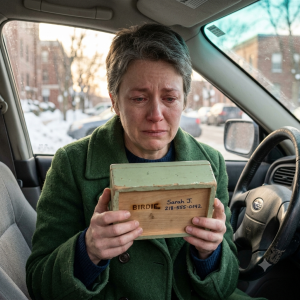
A small wooden jewelry box. Hand-painted. Pale green, the color of new leaves. The paint worn soft at the corners from handling.
I crossed the room.
I picked it up.
My hands were shaking before I even turned it over.
Burned into the bottom, in careful letters — the kind a person makes when they have time and intention and love — was a single word.
*Birdie.*
My nickname. The one only my mother had ever used, before she got sick. The one no one outside our family walls had ever known. The one I had almost convinced myself I had imagined, the way you start to doubt your own memories when you’ve been told often enough that your memories are wrong.
The box was marked $2.
Two dollars.
I stood there for a long moment. I thought about how strange it was that this box existed at all. My father had told everyone I was dead. He had built a whole story around my disappearance — a grave story, a grief story, a story with a car accident at the center of it. If I was dead, then this box should have been buried with me, or thrown away, or never made at all.
Instead it had lived in this house for thirty years.
I brought it to the woman at the card table by the door. She took my two dollars without looking up.
I walked out to my car.
I sat for a long moment with the box in my lap.
And then I turned it over one more time — because something had caught my eye and I hadn’t let myself look at it fully, not yet, not inside where all those strangers could see my face fall apart.
There, beneath my name, written in ink that looked far too dark and too crisp to be thirty years old —
Written in the heavy block handwriting I would know anywhere, the handwriting of a man I have spent three decades trying to forget —
Was a name I didn’t recognize.
And a phone number.
And the ink was fresh.
—
The name was Della Voss.
Not Halvorsen. Voss. A name I had never heard in my life.
The phone number had a 218 area code. Northern Minnesota. Twenty miles from where I was sitting.
I stared at it until the numbers started to swim. My dentist appointment was in forty minutes. I remember thinking that, which seems insane now — I remember thinking I really shouldn’t be late because they charge a cancellation fee. As if cancellation fees mattered. As if anything in my whole organized, carefully constructed adult life mattered against the weight of what I was holding.
I opened the box.
Inside, there was a folded piece of notebook paper, college-ruled, the kind you can buy at any Walgreens in America. When I unfolded it, my hands were shaking so badly I tore one corner.
It said: *I know you’ve been looking. I’ve been looking too. Please call.*
That was it. No explanation. No salutation. No signature beyond the name on the outside of the box.
Della Voss.
I called the number.
It rang four times and I was already composing myself for voicemail when someone picked up. A woman. Her voice was low and careful, like someone who had practiced being calm. Like someone who had waited a long time for a phone to ring and didn’t want to betray how long.
She said hello.
I said: “This is Renee.”
There was a silence that lasted exactly as long as it took both of us to understand that this was real.
And then she said: “I know. I’ve known you were in Duluth for two years.”
—
Her name wasn’t Della. That was our grandmother’s name, her mother’s mother, a woman I had no memory of because she’d died when I was four. The woman on the phone was my sister.
My sister, who I had not spoken to since she was six years old.
Her name now is Petra. Petra Voss, because she’d taken her husband’s name when she married at twenty-two. Petra, who had spent the last eleven years trying to find me the same way I’d spent fourteen years trying to find her — through ancestry sites, through court records, through the kind of methodical grieving that looks from the outside like detective work but from the inside feels like keeping your heart beating by hand.
She found me two years ago. A property record. My name attached to a lease on an apartment on the east side of Duluth. She had driven past my building once. She told me that quietly, a little ashamed of it. She had sat in the parking lot for an hour trying to decide whether to knock on doors, and then she’d driven home.
She wasn’t sure I wanted to be found.
She wasn’t sure I knew she was alive.
She didn’t know what our father had told me, and she was terrified that whatever lie he’d used on me was worse than the lie he’d used on them.
The lie he’d used on them was that I’d gone to live with our mother’s family in Wisconsin, people they’d never met, and that I’d died in that first winter. A fever. Very fast. He’d said there was no sense dragging them to a funeral for a sister they barely remembered.
That was his version.
In his version, I died of a fever. In my version, I died in a car accident. Two different deaths for the same living person.
I don’t know why he needed two different stories. I have a theory, but it took me a while to get there.
—
Petra told me all of this in the parking lot of a Perkins restaurant on the edge of Duluth, an hour after I called her, while we sat across from each other in a booth and kept touching each other’s hands like we were checking that the other one was solid. She had driven straight there. So had I.
She looked like our mother. I hadn’t been prepared for that. I hadn’t been prepared for how much it would hurt, in the best possible way, to look at a stranger’s face and see something you thought was gone forever.
She still had the same small gap between her front teeth. I remember that gap. I remember it from when she was six and I was nine and I used to pretend to steal her nose and she would laugh and show all her teeth.
The gap was still there.
I cried in a Perkins parking lot in Duluth for about fifteen minutes and a waitress came out to ask if we needed anything and Petra said we were fine and the waitress said take your time, honey, in the voice of a woman who had seen a lot of things in a parking lot and wasn’t going to make it weird, and I will be grateful to that woman for the rest of my life.
—
Our brother, whose name is Marcus, lives in Bemidji now. He’s forty-one. He has three kids. He knew Petra had been searching and he had asked her once, quietly, not to tell him anything until there was something real to tell, because he couldn’t handle the almost.
Petra called him that afternoon, from my car, with me sitting next to her.
When she said I was there — when she said his name and then said *Renee is here, she’s right here, she’s been in Duluth* — the sound he made is not something I’m going to describe because it belongs to him and not to the internet.
But I’m going to tell you that I held the phone afterward and I said his name, Marcus, and he said my name back, and that’s still the whole thing, right there. That’s all of it.
—
Now. The box.
I want to explain the box, because that’s what you’re still wondering about. I was wondering about it too.
Our father died eight months ago. Lung cancer, fast. Petra and Marcus both knew because they’d stayed in contact with him — or rather, they had maintained a careful, cautious orbit around him for years, the way you do with a person who is the source of your damage and also still your father. He had never told them the truth. He had maintained both lies, simultaneously, for thirty years. He had been to Petra’s wedding. He had met Marcus’s kids. He had never said a word.
He left the house to both of them. A small inheritance, enough to clear some debt. Petra had driven up to handle the estate, which is how the sale came to be, and she had gone through the house herself first, and she had found the jewelry box at the back of a closet shelf, behind winter coats, in a shoebox.
The box my mother had made. Petra remembers it, faintly — remembers seeing it on our mother’s dresser when she was very small, before our mother got too sick to keep the house the way she’d kept it. Birdie was what our mother called me. Petra didn’t know that until she saw the burned letters on the bottom and something shifted in her memory, something very old and very faint, and she understood.
She understood that our father had kept it. For thirty years, he had kept it.
She thinks it’s possible — and I’ve come to think this too, slowly, in the months since — that he kept it because he felt guilty. That somewhere in the part of him that was still a person rather than just a collection of bad decisions and worse lies, he had held on to that one small green box the way you hold on to evidence of your own crime. Not to confess. Not to make it right. Just because throwing it away would have meant he felt nothing, and even he couldn’t go that far.
I don’t know if that makes me feel better or worse. Some days it does one thing, some days the other.
But Petra had found it, and she’d understood what it was, and she’d gone home and found my lease record again and driven to Duluth and walked into that house one more time.
She put the box on the free table.
She wrote her name and number on the bottom with a Sharpie.
And then she went home and she waited.
She told me she almost came back to get it three separate times over the following two weeks. She told me she was convinced I wasn’t going to see it, or I’d see it and not understand, or I’d understand and not call.
I told her I almost didn’t go into the sale at all. I told her I had been two blocks away, and I almost turned left instead of right, and I would have been ten minutes early to the dentist instead, and none of this would have happened.
She said she doesn’t believe in things like fate.
I said I’m not sure what I believe.
We sat with that for a while.
—
I didn’t go to the dentist. I rescheduled. They did charge me the fee.
The green box is on my kitchen windowsill now. I look at it every morning when I’m making coffee. It still has the Sharpie on the bottom — Petra’s handwriting over the burned letters, her name sitting right under mine like an address. I haven’t decided yet whether to clean it off or leave it. My therapist says there’s no wrong answer, which is therapist for: *you already know what you want to do.*
She’s right. I’m going to leave it.
Petra came for dinner last month. She brought her daughter, who is seven, who has the same gap between her front teeth, who climbed into my lap halfway through the meal and announced that she was tired, and then fell asleep there, with her whole small weight trusting me completely.
I sat very still for a long time after she fell asleep.
I didn’t want to move. I didn’t want to be anywhere else in the world. I just sat in my kitchen in Duluth and held my sister’s daughter and looked at the green box on the windowsill and thought about how strange it is, the way things survive. How they outlast the lies told about them. How they wait.
Marcus is coming up in the spring, with his family. We’re going to have a lot of meals to catch up on.
We have time.
We have so much time.