She didn’t go there looking for answers.
She went there because it was the only librarian job within sixty miles that didn’t require her to explain the gap in her résumé — the years she’d spent fighting a government office over a file that said she didn’t exist.
But answers have a way of finding you anyway.
—
My name is Loretta Blaine.
And until three weeks ago, I believed I was the only person on earth who knew that name had ever meant anything to my father.
I was wrong.
—
The Veterans’ Home outside Branson sits back from Route 76 behind a row of old pin oaks, the kind of place that smells like floor wax and old coffee and something quieter underneath — like time itself has decided to slow down out of respect.
I took the volunteer librarian position in early October.
I told myself it was just a job.
I told myself I was over it.
I was not over it.
—
My father, Sergeant Dale Blaine, U.S. Army, passed away four years ago.
I found out from a Google alert.
His obituary listed one surviving child — a son named Curtis, from his second marriage — and a loving wife of twenty-two years.
It did not list me.
It never listed me.
Because somewhere between my parents’ divorce and my father’s second wedding, a woman named Patrice decided I was an inconvenience, and she was the kind of woman who dealt with inconveniences permanently.
She had my name removed from the VA’s next-of-kin file.
She forged the paperwork.
I spent eleven months trying to prove it, and by the time I could, my father was already gone, and Patrice had already collected everything.
I had nothing.
Except the memory of mailing him a birthday card when I was nine years old — purple construction paper, a drawing of a horse, and my name spelled out in orange crayon.
A card I was later told he never received.
—
Curtis Blaine checked into the Veterans’ Home on a Tuesday.
I didn’t know who he was at first.
He was just a quiet man in his early forties, walked with a cane, kept to himself, always requested the same Louis L’Amour novel from the cart even though I’m fairly sure he’d already read it twice.
It was his third visit to the library cart before I noticed what was hanging around his neck.
Dog tags.
Old ones, worn soft at the edges the way metal gets when it’s been handled for years and years by worried hands.
I almost didn’t look closer.
But something made me.
—
The name on the front was my father’s.
BLAINE, DALE R.
I knew it before I could breathe.
But it was the back that stopped me cold.
Because scratched into the metal — crude, uneven, done by hand and clearly done fast, like someone pressing hard with whatever was nearby — was a single word.
A name.
*Loretta.*
—
I didn’t say anything to Curtis that day.
I went home and sat in my car in the parking lot of a Dollar General on Highway 65 and I cried in a way I haven’t cried since I found out about my father from a Google alert.
Because my father had scratched my name into his dog tags.
In secret.
Where no one would think to look.
He hadn’t forgotten me.
He had *hidden* me somewhere safe.
—
It took me a week to work up the courage to speak to Curtis beyond the usual pleasantries.
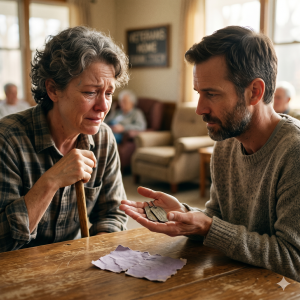
He was in the sunroom on a Thursday afternoon, the dog tags resting against his chest the way they always were, and I sat down across from him with a cup of coffee I didn’t drink and said, as calmly as I could manage:
“That name on the back of your father’s dog tags — do you know who Loretta was?”
Curtis looked at me for a long moment.
Something moved across his face that I still don’t have a word for.
“No,” he said quietly. “But he made me promise to find her.”
—
I didn’t tell him who I was.
Not then.
I asked if I could see them — just for a moment — and he handed them to me without hesitation, like some part of him already knew.
I turned them over in my palm once.
Twice.
Three times.
The chain was old, the clasp broken, wrapped in a piece of electrical tape to hold it together.
I don’t know what made me look inside the clasp.
But I pressed the tape back, and folded inside the broken hinge — pressed impossibly small, the paper soft as cloth from years of being carried — was something I recognized before I even fully opened it.
Purple construction paper.
My handwriting.
Age nine.
The birthday card I had been told my whole life he never received.
He had kept it next to his heart for thirty years.
And then I looked up at Curtis — my brother, who never knew I existed — and I had no idea what to say.
—
So I said the only true thing I had.
“My name is Loretta Blaine. Dale was my father too.”
Curtis didn’t move for a moment. He just looked at me. And I watched something happen behind his eyes — not shock exactly, more like a door swinging open onto a room he’d always suspected was there but had never been allowed to enter.
“She told me you died,” he said finally. “When I was about twelve. She said Dad had a daughter once, before my mother, and that she died when she was little. A car accident.”
Patrice.
Even that. She had even taken that from me — turned me into a ghost story, a sad thing that had already happened, a door that could never be opened because the person on the other side had been declared dead before Curtis was old enough to ask questions.
I held the card in both hands.
“I didn’t die,” I said. “I’ve been trying to find my way back for a long time.”
—
Curtis cried before I did.
This big quiet man with a cane and a worn-out Louis L’Amour novel cried in the sunroom of a veterans’ home in Branson, Missouri, and I sat across from him and let him, because some things need room.
When he could speak again, he told me about our father.
He talked for two hours.
He talked about a man who went quiet every year around the third week of March — my birthday, as it turns out. Who kept a locked box in the top of his closet that Patrice said was old Army paperwork and nobody was allowed to touch. Who, in the last month of his life, had pulled Curtis close and pressed the dog tags into his hands and made him promise — made him swear on whatever was holy — that he would find the girl named Loretta and give them to her.
“He said he owed her an apology he never got to make,” Curtis told me. “He said she’d understand what it meant when she saw it.”
He hadn’t known I was alive.
He hadn’t known where I was.
He only knew that I existed, and that he had failed me, and that the only thing he could still do was leave a trail.
His name on the front.
My name on the back.
And the proof of his love folded inside, in case I ever doubted it.
—
We sat together until the late afternoon light went orange through the sunroom windows.
Curtis asked me questions and I answered them, and I asked him questions and he answered those, and somewhere in the middle of all of it I realized that I was talking to someone who shared my father’s laugh — this low, surprised sound, like he’d been caught off guard by something being funny — and that I had been cheated out of knowing that laugh for forty years.
That grief is a separate thing, still sitting with me. I suspect it will for a while.
But here is what else is sitting with me.
Curtis has asked if I’ll come for Thanksgiving.
He has a wife named Gail and two kids, nine and twelve, and apparently the twelve-year-old draws horses, which I only know because Curtis mentioned it in passing and had to stop talking for a second when he saw my face.
He has also told me that the locked box — the one from the top of the closet — was given to him after our father died, and that inside it he found, among other things, thirty-seven birthday cards. One for every birthday I’d had between the ages of ten and forty-seven.
Our father had kept writing them.
Every single year.
He’d just had nowhere to send them.
—
I still work at the Veterans’ Home on Route 76. I still push the library cart down the hallway on Tuesday and Thursday mornings, still smell the floor wax and the old coffee.
But I stop at Curtis’s room first now, before I do anything else.
Sometimes we just talk. Sometimes I read to him — he finally let me pick something other than Louis L’Amour. Sometimes we just sit in the sunroom with our coffee and don’t say much at all.
He gave me the dog tags to keep. I told him I couldn’t take them, and he told me Dad had been real clear about that part.
They’re around my neck as I write this.
I can feel them when I breathe.
—
I don’t know what to do with thirty-seven undelivered birthday cards yet. I’ve read a few. I have to take them slowly — one at a time, on days when I’m ready, because they are thirty-seven small pieces of a man trying to reach through a wall that was built around him without his knowledge, and they are also thirty-seven small pieces of me understanding, finally and completely, that I was loved the whole time.
I was always loved.
I just couldn’t get to it.
—
I am telling this story here because three weeks ago I was a woman with a gap in her résumé and a name that felt like a wound, and now I am a woman with a brother and thirty-seven birthday cards and a pair of dog tags that smell faintly of something I can’t name but that feels, to me, like the word *safe.*
My father couldn’t fix what Patrice had done.
But he refused to let me disappear entirely.
He scratched my name somewhere she would never think to look.
He folded the proof of my existence inside a broken clasp.
He carried me next to his heart for thirty years and told his son to find me when he couldn’t anymore.
—
Sergeant Dale Blaine.
He never stopped being my father.
He was just waiting for me to find my way home.
I think, for the first time in a very long time, I have.