She walked into that room carrying thirty-seven years of silence and a brass compass that didn’t belong to her.
Nobody recognized her yet.
That was the whole point.
—
The Mississippi heat was already thick at nine in the morning, the kind that presses against your collar before you’ve even reached the door. The Natchez chapter house looked exactly the same — white columns, crepe myrtle along the fence, the faint smell of old wood and rose water that Wren Pickett had never, in all these years, been able to forget.
She paused at the bottom of the steps.
Touched the compass on her lapel.
It was small. Brass, going soft at the edges from decades of handling. Four initials engraved on the back in a script too fine to read without good light and reading glasses: *E.M.B.H.* Not her initials. Had never been her initials.
She’d worn it to this building once before. In 1987. She was twenty-four years old, in her grandmother’s white gloves and a blue linen dress she’d saved three paychecks to buy, and she had been so *sure* that this was the day.
It was not that day.
—
She’d done everything right.
The genealogy application had taken her two years. She’d driven to three different county courthouses. She’d had a historian in Virginia verify the paper trail herself. Seven generations, documented, clean, unbroken — straight back to a soldier named Elias Pickett who crossed into South Carolina in 1779 with a musket and a prayer and didn’t stop walking until the war was over.
The induction ceremony had already started. Sixty women in white gloves, the chapter president reading Wren’s lineage aloud into a room that smelled exactly like it did today.
And then Dottie Fontenot stood up.
She didn’t raise her hand. Didn’t wait to be called on. Just rose from her chair in the second row, in that ivory brooch she always wore, and announced to the entire room that Wren Pickett’s bloodline was, and she used this exact word, *”store-bought.”*
She said the Pickett family had “purchased respectability” for two generations and that the application was an embarrassment to the chapter.
She said it in front of everyone.
She said it because Wren had broken off her engagement to Dottie’s son the previous spring.
She said it because she could.
The room went quiet. The chapter president looked at her notes. No one stood up for Wren. No one said a word.
Wren set her white gloves on her chair, walked out of that building, and did not look back.
—
Not until today.
She had done a few things in the thirty-seven years between that door and this one. Married a man named Dr. Howard Beaumont Calloway — *Beaumont*, like the family name — and built a quiet life in Charlottesville. Finished the history doctorate she’d started. Wrote four books, one of which had shown up on a list that made her editor cry happy tears.
Became, without entirely meaning to, one of the foremost genealogical historians of the colonial South.
Received, six weeks ago, an invitation to keynote the Mississippi State DAR Convention.
They did not know her married name when they sent it.
She had not corrected them.
—
The compass.
She needed to tell you about the compass.
She’d found it on her chair when she came back for her gloves that day in 1987 — tucked under the left one like someone had placed it deliberately. She’d assumed it was hers somehow, slipped from her purse. Didn’t look closely until she got home.
*E.M.B.H.*
Not her initials.
She’d kept it anyway. Meaning to return it. Then too much time passed. Then it became something else — a thing she touched when she needed to remember she was still standing.
She didn’t know, until she’d started preparing for this speech, that at least three women in this chapter had spent *years* quietly looking for a small brass compass with those initials. That it had a history in this building that went back far longer than Dottie Fontenot. That it had belonged to someone the chapter had wronged in a different decade, in a different way, for a different reason.
Same building. Same silence. Same ivory brooch in the front row.
Wren had spent the last six weeks learning everything.
—
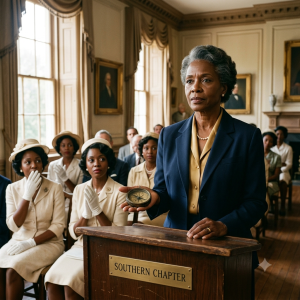
The room was full when she walked in. Name tag that read only *”Dr. Calloway — Keynote.”* Applause when she reached the podium. Bright, welcoming, warm.
Margaret Fontenot — Dottie’s daughter, same brooch, front row center — smiled up at her with absolutely no recognition in her eyes.
Wren set her notecards on the podium.
She looked out at the room.
Then she set the notecards aside entirely.
She looked directly at Margaret Fontenot, and her voice was steady and clear and kind, and she said:
*”Before I begin, I’d like to return something that was taken from this room a very long time ago.”*
She opened her palm.
The front row went absolutely still.
—
The compass caught the light from the tall windows, the brass going warm and amber in the morning sun.
Wren kept her eyes on the room. Not on Margaret. On all of them.
“This compass belonged to a woman named Eunice Mae Beaumont Hargrove,” she said. “She was a founding member of this chapter. Eighteen ninety-one. Her name is on the charter that is framed in your front hallway, which most of you have walked past so many times you’ve stopped seeing it.”
She let that land.
“Eunice was my husband’s great-great-aunt. Which is how I know her story. And which is why, for the last six weeks, I have been unable to sleep.”
The room was so quiet she could hear the ceiling fan turning overhead.
“In 1923, this chapter voted to remove Eunice from her membership. There was no formal complaint. No hearing. No documentation that survives, which I suspect was deliberate. What does survive is a letter she wrote to her sister — my husband’s family kept it — in which she describes being told, privately, by the chapter regent, that her continued presence was making certain members uncomfortable. That her husband’s business associations were considered unsuitable. That it would be better, for everyone, if she simply did not renew.”
Wren paused.
“Her husband ran the oldest Negro-owned insurance firm in Adams County. Eunice herself was the daughter of a freed woman and a white Mississippi landowner who had, against considerable social pressure, legally acknowledged his child and provided for her education. Her lineage was documented. Her service to this chapter was documented. Her character was, by every account, impeccable.”
She looked down at the compass in her palm.
“She left this on her chair. Whether she forgot it or left it on purpose, I cannot tell you. What I can tell you is that her family looked for it for decades. That her granddaughter wrote to this chapter three times requesting its return and received no reply. That the granddaughter died in 1999 believing it was simply gone.”
Wren looked up.
“It was not gone. Someone picked it up. I believe they meant to return it and then found themselves unable to, for reasons I understand better than I’d like to. And then it passed through time the way things do — quietly, from hand to hand, becoming easier not to talk about with every year that went by.”
She closed her fingers around it gently.
“I am talking about it now.”
—
Margaret Fontenot had gone the color of old chalk.
She was not the villain of this story and she probably knew it, which was its own particular kind of discomfort. She had inherited the brooch. She had inherited the front-row seat. She had not, as far as Wren could determine, inherited any knowledge of what her mother had known or done. That was the nature of institutional silence — it protected the people who created it and left everyone else to sit in the residue.
But she was also sitting in the front row of a room where her mother had once destroyed a young woman’s application with a lie dressed up as a social objection, and her face suggested that some piece of this was not entirely news to her.
Wren did not look away from her when she said the next part.
“I have located Eunice Hargrove’s living descendants. Her great-granddaughter is named Clarice. She is sixty-one years old and she teaches AP History at a high school in Memphis. She has her great-great-aunt’s eyes, based on the one photograph I’ve found, and she agreed to let me say her name here today.”
Wren set the compass on the podium.
“This belongs to Clarice. I will be hand-delivering it to her on Friday. But I wanted it in this room one more time first. I wanted everyone here to see it. Because objects carry history whether we acknowledge that history or not. And this chapter has carried a great deal of history without acknowledging it.”
She straightened her papers. Not the notecards — the actual research. Thirty pages, which she’d had printed and bound by the Kinkos off Route 61 the day before she flew in.
“Which brings me, finally, to my keynote.”
—
She spoke for forty-five minutes.
She had prepared a talk on documentary evidence in colonial genealogy, which was what they’d invited her for and which she delivered — thoroughly, rigorously, with the warmth she’d developed over twenty years of making dense academic material feel like a story worth following.
But she began it, and ended it, with what she called the obligation of honest recordkeeping.
She talked about the documents that survive and the ones that don’t, and what the absence of a document tells a careful historian. She talked about applications that were denied without cause in the 1920s and 1930s, not just in Mississippi, and what has happened to those families’ relationships with institutions like this one ever since. She talked about the difference between an organization that tends its records and one that curates them to tell a more comfortable story.
She was never unkind. She was never theatrical. She did not raise her voice once.
But when she said, near the end, that the most important genealogical work being done right now was the work of reconnecting families to histories that institutions had actively obscured, and that such work required those institutions to be willing partners in their own honest accounting — she looked at the chapter president, a practical woman named Deborah Ann Suggs who had been shifting in her seat for twenty minutes with the expression of someone doing very hard arithmetic — and she held the look until Deborah Ann gave a slow, deliberate nod.
The applause when she finished was complicated and full and real.
—
Margaret Fontenot found her at the refreshments table afterward.
Wren had been expecting her. She’d helped herself to a glass of sweet tea and was standing near the window where the light came through the old wavy glass and fell in that particular Southern-morning way that had nothing to do with any other kind of morning light in the world.
“Dr. Calloway.”
Wren turned.
Margaret looked like her mother and not like her mother. Older, softer, the brooch slightly crooked at her collar. Her hands were shaking almost too finely to see.
“I don’t know if you remember me,” she said.
“I remember you,” Wren said. “You were fifteen. You had nothing to do with any of it.”
Margaret blinked. Something moved across her face that had probably been waiting there for a long time.
“I want you to know —” she started.
“You don’t have to,” Wren said. Not cutting her off. Just offering her a door she didn’t have to walk through if it was too much. “Not to me. Whatever accounting needs to happen, it’s between you and this chapter and Clarice Hargrove’s family, and those are the people whose forgiveness matters.”
Margaret nodded. She looked down at the compass on the podium, which Wren had not yet retrieved.
“She talked about it,” she said. “My mother. When she was sick, at the end. She talked about — a compass. I didn’t understand what she meant.”
Wren said nothing.
“I think she was sorry,” Margaret said, which was the most complicated thing anyone had said to Wren in recent memory. Sorry for which part, she did not ask. It was probably a long list and Margaret was probably only beginning to understand its length.
“People often are,” Wren said. “Eventually.”
She picked up her sweet tea. She picked up the compass.
“I have a four o’clock flight,” she said, and the kindness in her voice was genuine, which was the thing that had taken her the longest to arrive at — not the research, not the speech, not even the thirty-seven years, but the genuine kindness, which was not the same as forgiveness and did not require it. “I hope you have a good rest of your convention.”
She walked out of that building.
This time she looked back.
Just once, at the door, at the white columns and the crepe myrtle and the old wavy windows. At the charter on the wall that she could just barely make out from the steps — the old formal script, the names in a row, Eunice Mae Beaumont Hargrove third from the top.
Still there. Still legible, if you stopped to look.
Then she put the compass in her jacket pocket, walked to her rental car, and drove toward Memphis, where a sixty-one-year-old high school history teacher was waiting for something her family had been owed for a hundred years.
—
Clarice opened the door before Wren had finished knocking, like she’d been standing on the other side of it.
She was tall. She had her great-great-aunt’s eyes. She did not say anything for a moment when Wren held out her hand with the compass in it.
Then she said, quietly, “Lord.”
She took it carefully, the way you take something that has crossed a long distance to reach you.
Turned it over.
Read the initials with her thumb, the way you read something you’ve known about your whole life but never touched.
“Come inside,” she said. “Please. I just made coffee and I have been waiting to talk to somebody about Eunice since I was about nine years old.”
—
They sat at Clarice’s kitchen table for three hours.
Wren had her research. Clarice had a shoebox. The shoebox had the letter — the one Eunice had written to her sister in 1923, which Wren had only known about from a mention in a secondary source, the original of which she had not dared to hope she’d ever see.
She read it with her reading glasses on and her coffee going cold.
Eunice’s handwriting was small and very controlled, the handwriting of a woman who had been taught penmanship as an act of self-assertion. The letter did not express bitterness. It expressed, with devastating precision, the plain facts of what had happened, and then it said: *I will not let them have the telling of it. That I keep for myself.*
Wren looked up.
Clarice was watching her.
“She kept it for herself,” Wren said.
“And now I’ve got it,” Clarice said. “And now you’ve got it. And now we’re going to figure out what to do with it together, I hope.”
Wren thought about the book she hadn’t started yet, the one her editor had been asking about, the one she hadn’t known the shape of until approximately forty-five minutes ago.
“Yes,” she said. “I believe we are.”
—
She flew home to Charlottesville that night, the compass no longer in her pocket, her carry-on ten pounds lighter with the research she’d left with Clarice.
Howard was awake when she got in, reading in the chair he always read in, and he looked up and said simply, “How did it go?”
She set down her bag. She stood in the hallway of their house for a moment, still in her jacket, and thought about thirty-seven years and a building that smelled like old wood and rose water and a woman named Eunice who had refused to let them have the telling of it.
“It went the way it was supposed to,” she said. “Finally.”
He nodded like he understood, because he did.
She hung up her jacket.
She went to make tea.
She started writing the next morning.