Every Tuesday morning for three months, Earl Hutchins had been making two cups of coffee instead of one.
He never planned to.
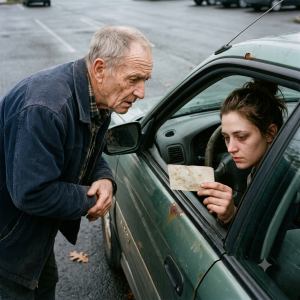
It started on a cold February morning when he pulled into the lot of his old hardware store — still his, even in retirement, because his son ran it now and Earl couldn’t quite let go — and noticed a rust-eaten green Subaru parked in the corner spot. Engine off. A young woman in the driver’s seat, maybe mid-twenties, just sitting there. Hands folded over something in her lap.
He almost didn’t look twice.
But something made him.
She wasn’t on her phone. Wasn’t crying. Wasn’t eating. She was just *still* — the kind of still you only see in people who are carrying something heavy and have gotten real good at not showing it.
Earl went inside, put on the Mr. Coffee, and poured himself a cup. Then he stood at the window and watched her for a minute. She was looking at the front door of the shop like it held an answer she wasn’t sure she deserved.
By the time he looked down at his mug, he’d already poured a second one.
He walked out before he could talk himself out of it, set the coffee on her hood — cream, two sugars, just a guess — and walked back inside without looking at her.
The next Tuesday, she was there again.
Same spot. Same stillness.
And Earl noticed for the first time what she was holding.
A small index card. Worn at the edges, water-stained like it had been carried a long time. She held it flat in both hands, fingers curled gently around it — but she never looked down at it. Not once. Just stared ahead, gripping it the way you grip something you can’t let go of, even when you’re not sure why you’re still holding on.
Earl put out the coffee again.
The next week, a small paper plate of his wife Linda’s snickerdoodles appeared next to the cup.
The week after that, a grocery store carnation — pink, a little crooked — from the bucket by the register.
He never saw her take any of it. But it was always gone by the time he unlocked the front door.
He told Linda about the young woman on a Sunday night over pot roast, and Linda got that look she gets — soft around the eyes — and said, “Earl Hutchins, you find the ones who need finding.”
He said, “I haven’t even met her.”
Linda said, “You already have.”
But Earl was a practical man. A hardware store man. Seventy-two years old, the kind of man who believed in doing things properly. Introducing yourself. Shaking hands. Knowing a person’s name.
So the eighth Tuesday, he decided.
He made the coffee early. He put Linda’s lemon pound cake on the plate. He walked outside in the gray Oregon morning, stood beside her car, and knocked on the window.
She startled — just slightly — and turned to look at him.
She was younger than he’d thought. Dark circles under her eyes. A kindness in her face that looked like it had survived something.
She rolled the window down.
Earl smiled. Said, “I’m Earl. I’ve been leaving your coffee.”
She blinked. Then her chin trembled, just for a second, before she pulled it back under control. She said, very quietly, “I know.”
And then Earl did what he always did without thinking — he glanced down.
Because that was the thing about Earl. He noticed details. It’s what made him good at the hardware business all those years. The hinge that’s a quarter-turn loose. The board with the wrong grain. The thing that doesn’t quite fit but nobody else has spotted yet.
He glanced down at the index card she’d pressed flat against the steering wheel.
And his whole body went still.
Because he recognized the handwriting.
Not as something he’d seen before.
As something he had written.
His own looping cursive. The way he always made his capital H — just slightly tilted left. The way he ran his sevens through the middle, the way his father had taught him, the way no one did anymore.
That card, worn soft as cloth, water-stained and creased —
He had written it.
He just had no idea when. Or how it had ended up in her hands. Or why this young woman had been driving to his parking lot every Tuesday morning, holding his words like a prayer she already knew by heart.
He looked up at her face.
She was watching him read it.
And she said, “You don’t remember me yet.”
“But you will.”
Earl stood there in the gray Oregon morning and felt something move through him that he couldn’t name. Not fear. Not quite wonder. Something in between, the feeling of standing in a doorway before your eyes have adjusted to what’s on the other side.
He said, “Can I read it?”
She hesitated. Just a beat. Then she turned the card over in her hands and held it out to him.
It was a three-by-five index card, the old-fashioned kind with the faint blue lines. The writing was his. He was certain of it the way you’re certain of your own face in a mirror. But the certainty made no sense because he could not place the memory of writing these particular words, and Earl Hutchins had a good memory. People commented on it. His son called it his hardware store brain — a place for everything, everything in its place.
He read what the card said.
It said: *You are not too much. You are not too little. You are exactly enough for the life that is waiting for you. Don’t give up before Tuesday.*
And below that, in the same hand: *— E. Hutchins, Hutchins Hardware, Millbrook.*
Earl read it twice. Then he looked up at her and said, “I wrote this?”
She nodded.
“When?”
She said, “Seven years ago. I was nineteen.” She paused. “I came into your store. I don’t know if you remember. It was a Tuesday in November. I was — ” she stopped, seemed to choose her words carefully. “I was not doing well. I sat in your parking lot for a long time before I came inside. I needed something to do with my hands, so I came in to buy picture hooks. I didn’t have a picture to hang. I just needed something to do.”
Earl was quiet. He was reaching back into seven years of Tuesdays and finding only the general shape of them — the bell over the door, the smell of sawdust and machine oil, the thousand faces of people who needed a thing and came in to find it.
She said, “You rang me up. I was crying, but I was doing that thing where you try to cry without moving your face. I thought I was being invisible.” She almost smiled. “You were not fooled.”
And right then, something shifted in the back of Earl’s mind. The way a detail will sometimes surface hours after you’ve been trying to remember it, when you’ve stopped trying. He couldn’t see her face at nineteen. But he remembered a feeling. A Tuesday. A girl buying picture hooks who didn’t have any pictures.
He said slowly, “I came around the counter.”
She said, “Yes.”
“I said you looked like you could use a minute.”
“You said I looked like I was carrying something heavy.” Her voice was steady but her hands were not — she’d taken the card back and was holding it again, both palms flat around it. “I said I was fine. You said — ” she stopped. Cleared her throat. “You said, fine is not a feeling, it’s a fence. And then you tore a card off the pad you keep by the register and you wrote that down and you handed it to me, and you said, you tuck that away somewhere and you read it on the hard days.”
Earl remembered the pad. Yellow, from the office supply place in town, slightly tacky on the back. He’d kept one by the register for thirty years. Lists, notes, phone numbers.
He didn’t remember the girl. But he remembered the gesture of the card because it was something he did. Not often. But sometimes, when a person came in carrying more than what they’d come to buy, Earl would write something down. Linda said it was because he couldn’t help himself, that his mother had been the same way, reaching toward the hurting thing in a person the way other people reached toward the door.
He looked at the young woman in the green Subaru.
He said, “Did it help?”
She was quiet for a moment. “It helped me get to Wednesday.” She looked down at the card. “And then it helped me get to the next Wednesday. I kept it in my coat pocket for a year. Then my wallet. Then — ” she touched the edge of it, the soft worn corner — “I just kept it.”
Earl said, “What’s your name?”
She said, “Nora. Nora Vesel.”
He said it back to her. “Nora.”
She looked at him then, really looked at him, and Earl saw what Linda had seen from the very beginning without even meeting her — the weight of seven years of carrying a thing, and the particular exhaustion of a person who has survived and is not entirely sure what to do with that fact.
He said, “What brought you back?”
Nora looked out through the windshield at the front door of the store, at the painted H in Hutchins that his son had redone two summers ago in the same font, same color, same slight leftward lean. She was quiet long enough that Earl didn’t push. He’d learned a long time ago that some answers needed space around them.
She said, “I moved away after that winter. Went to stay with my aunt in Bend. Got better, slowly. Got a nursing degree. Got a life — a real one.” She paused. “I got assigned to a patient in Eugene eight months ago. End-stage. He was scared and alone and I used to sit with him on the night shifts when things were bad, and I’d talk him through it. One night he asked me how I kept from despairing, and I told him about this card.” She touched it again. “He asked to hear what it said. So I read it to him.” Her voice was careful and even, the voice of a person who has learned to tell hard things without coming apart. “He died on a Tuesday morning. Peaceful. I was there.”
Earl didn’t say anything. He just listened.
“After he passed, I kept thinking about the card. About Millbrook. About the fact that I had never — ” she stopped. “I had never come back. I had never said thank you. And I thought, what if the person who wrote this doesn’t know that it mattered? What if he wrote it and forgot it and never knew?” She shook her head slightly. “That felt wrong to me. It felt like something left undone.”
Earl’s chest was doing something complicated and he was grateful for the gray morning and the excuse it gave him to blink.
He said, “You drove three hours to say thank you.”
She said, “I drove three hours and then I sat in your parking lot for seven Tuesdays because I didn’t know what to say.”
He laughed. It came out rough and real. “And then some old man kept bringing you coffee.”
She laughed too, and the sound of it was like a window opening. “And snickerdoodles,” she said. “Those were really good snickerdoodles.”
“Linda will be insufferable when I tell her that.”
They stood there a moment — or she sat and he stood — in the quiet of it. The hardware store behind him. The morning coming up pale and cold over the tree line. A crow calling somewhere in the parking lot.
Earl said, “You know, I meant what I wrote. Then and now. You are exactly enough for the life waiting for you.” He gestured vaguely at her, at the green Subaru, at the general fact of her sitting there alive and a nurse and present. “Looks to me like you found it.”
Nora pressed her lips together and nodded once, the way people do when they don’t trust their voice.
He said, “You want to come inside? It’s warmer. Linda made a pound cake.”
She said, “I don’t want to intrude.”
He said, “Nora. You’ve been drinking my coffee for two months. You’re already family.”
She laughed again, and this time it was the full version, the one without any reservation in it, and she got out of the car with the index card still in her hand.
Earl held the door open.
Inside, the Mr. Coffee was gurgling and the store smelled the way it always had — wood and oil and something dry and particular that Earl had never been able to name but that had always meant to him something solid and useful and good. His son Danny was in the back doing inventory and he looked up and nodded at Nora the way Hutchins people nod at strangers, which is to say, not like strangers at all.
Earl poured two cups. Cream, two sugars, because he already knew.
Nora sat on the stool by the counter, the same one where customers had been sitting for forty years to wait for keys to be cut or advice to be given or simply to rest for a minute in a place that felt like it was in no hurry.
She set the index card on the counter between them.
They talked for an hour and a half.
She told him about nursing school, about the hard years before it, about her aunt in Bend who had made soup and not asked too many questions. She told him about the patient, whose name was Gerald, who had worked his whole life in a cannery and had a daughter in Phoenix who made it in time and held his hand at the end.
Earl told her about the store, about Danny taking over, about the particular grief and pride that lives in the space between those two things. He told her about Linda’s garden and the way Oregon gets in April, which is the best thing about living there. He told her about his father, who had taught him to run his sevens through the middle, and who had been the kind of man who meant what he wrote.
At some point Linda called, and Earl told her there was someone she needed to meet, and Linda said of course there is, and said to bring her for dinner Sunday.
Nora looked at the card one more time before she left. She ran her thumb along the edge of it — that familiar motion, seven years of it — and then she looked up at Earl with an expression he recognized. It was the look of a person setting something down.
She said, “Can I leave this here?”
Earl understood what she meant. Not lose it. Not discard it. Leave it in the place it came from, where it had always been headed.
He said, “I’ll keep it safe.”
She tucked it into his hand.
It was light, that little card. Light the way only a thing can be when it has been carried a long time and finally given to the right person to hold.
Nora Vesel drove back to Eugene on a Tuesday morning in May with the windows down and the radio up and nothing in her hands, which were right where they needed to be — on the wheel, on the road, on the way to whatever was next.
And Earl Hutchins went back inside, tucked the index card under the lip of the register where his yellow notepad had always sat, and poured himself a third cup of coffee.
He stood at the window for a while, looking out at the empty corner spot.
Then he heard Danny come in from the back, and he turned around.
“Who was that?” Danny asked.
Earl said, “Someone I helped a long time ago.”
Danny said, “Yeah?”
Earl said, “And someone who helped me.”
Danny didn’t ask what that meant. He’d grown up in this store. He understood that sometimes people came in carrying more than what they’d come to buy, and that the right response to that was not to make a fuss about it but simply to be there, solid and useful and unhurried, the way a good place always is.
Earl refilled his cup.
It was going to be a fine Tuesday.