The day I walked back into my father’s diner, I was nobody.
That was the point.
Thirty years ago, I was Loretta Mae Sutton — the girl who grew up sleeping in the back booth, who could recite the pie rotation by heart, who watched her daddy flip pancakes at 5 a.m. like it was a sacred act. I was the one he promised would carry it on.
Then one afternoon, I was nothing.
A lawyer’s letter. A signature that wasn’t mine. A deed with my name scratched out — literally scratched, like someone had taken a pen and dragged it back and forth until I disappeared — and my stepbrother Dale’s name written in its place.
Daddy was gone by then. Couldn’t ask him.
Or so they told me.
I left Pigeon Forge with two garbage bags and a broken understanding of how the world worked. I rebuilt myself slow, the way you do when the ground keeps shifting. Went to culinary school in Knoxville. Wrote about food under a pen name for twenty years. Built a reputation I kept carefully anonymous, because anonymous critics eat better. They get the truth.
And now I’m Margot Fields, staff reviewer for a regional dining publication, sitting at a corner table in Sutton’s Family Kitchen — the diner my father built with his own hands — because the county has flagged it for a final health inspection, and my review is part of the record.
One bad write-up and the bank pulls the loan.
Dale doesn’t know who I am.
Nobody does.
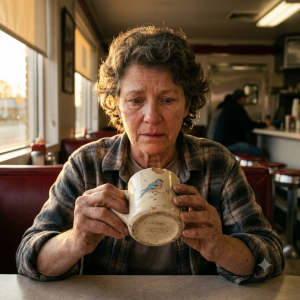
I ordered coffee, because that’s always where a diner’s soul lives. The waitress — young, sweet, clearly exhausted — brought it in a plain white mug. Perfectly ordinary. I opened my notebook.
And then I saw it.
Behind the counter, on the second shelf above the coffee station, between a stack of laminated menus and a jar of Sweet’N Low packets —
A mug.
Cream-colored, slightly lopsided the way handmade things are, with a small cracked bluebird painted on the side in colors that had faded from bright to soft. One wing chipped at the tip.
I made a sound I didn’t mean to make.
The waitress looked up. “You okay, hon?”
“Fine,” I said. “I’m fine.”
But I wasn’t.
That mug — that exact mug — my father made it for me at a craft fair on the Parkway when I was nine years old. I remember standing next to the pottery wheel, watching him paint the bluebird with a tiny brush, his tongue tucked in the corner of his mouth the way it did when he concentrated. That one’s yours, Rettie. Don’t let anybody take it.
I left it behind when I left. I thought it was gone.
I thought a lot of things were gone.
I wrote two pages of notes. I ate the biscuits, which were his recipe — I’d know it in my sleep — and I felt the grief of that settle somewhere behind my sternum. Dale hadn’t changed the recipes. I didn’t know what to do with that.
I came back the next morning. And the morning after that. I told myself it was due diligence. Thorough critics return multiple times.
The mug was always there.
On the third visit, it was on a different shelf. Lower. Closer.
On the fourth visit, it was on the counter.
I asked the young waitress about it, casually, the way you ask about a piece of art on a wall. “That old mug — is it for sale?”
She looked at it like she’d never really seen it before. “Huh. I don’t even know where that came from. It just kind of… shows up. Dale says his daddy left it here years ago but he doesn’t remember it meaning anything special.” She shrugged. “I can ask.”
His daddy.
My daddy.
On my fifth and final visit — the day I had to file my review — I came in early, before the breakfast rush.
The mug was sitting at my table.
Not on the counter. Not on a shelf.
At my table. My specific corner table. Set out like it was waiting.
My hands weren’t steady when I picked it up.
It was lighter than I remembered. The crack along the base had been repaired — badly, with something that had yellowed with age. The bluebird’s eye was still there, a single dark dot my father had pressed in with the tip of the brush.
I turned it over the way you turn over anything that frightens you.
The bottom was rough, unglazed. Pottery always is.
But there, in pencil — faded almost to nothing, pressed hard into the clay before it fired, the way you’d write something you wanted to last —
My father’s handwriting.
Not my name.
A date.
A single date.
And it was not the day I was born.
It was not the day the diner opened.
It was the exact date — month, day, year — that the lawyer called me and told me James Earl Sutton had passed away quietly in his sleep, and that I had been left nothing, and that I should not contest it.
The date they told me my father died.
My coffee went cold.
The morning light came through the window the same gold it always had.
And I sat in my father’s diner, holding my father’s mug, wondering if I had been lied to about the one thing I never thought to question.
I sat there long enough that the breakfast rush started filling in around me. Booths filled up. The bell above the door rang every few minutes. The young waitress — her name tag said Kayla — moved through the room with the efficient exhaustion of someone who’d been on her feet since before the sun came up.
I kept the mug in both hands.
The date on the bottom was March 14th. Thirty years ago.
I had spent thirty years on March 14th doing some version of the same thing: going somewhere quiet, eating something plain, not answering the phone. I told myself it was how I grieved. I never told anyone what the day was. I never explained to the few people close enough to notice that I went somewhere else on that date every single year.
March 14th was the day my father died.
Except.
I’m a food critic. My entire professional existence depends on noticing what doesn’t add up. A sauce that claims to be from scratch but has the uniformity of something from a pouch. A kitchen that says farm-to-table but has no seasonal variation. Thirty years of reading what’s real and what’s constructed.
And something about that date, written in my father’s hand, on the bottom of a mug he made before that date ever existed —
Didn’t add up.
He couldn’t have written the date of his own death. Not unless he knew it was coming. Not unless the date written there wasn’t the date he died.
Not unless the date they gave me was wrong.
I was still working through it when the kitchen door swung open and Dale came out.
I had not seen Dale Sutton in thirty years. I’d formed a picture of him in my mind over those decades — sharp-edged, prosperous, the kind of man who wins by paperwork. In my imagination he had his mother’s pointed features and a salesman’s ease.
The man who came out of that kitchen was nothing like that.
He was heavy and slow-moving, with my father’s wide forehead and the look of someone who hadn’t slept well in a long time. He had a dish towel over his shoulder. His apron was flour-dusted. He went to the coffee station first thing, same as Daddy always did, and poured himself half a cup and drank it standing up, looking out at the room the way you look at something you’re responsible for.
I watched him notice the mug wasn’t on the counter.
He looked at the shelf. Then the other shelf. Then he scanned the room, and his eyes stopped when they got to my table.
He went still.
I don’t know what he saw in my face from across that diner. Maybe nothing. Maybe everything. I am told I have a resting expression that gives very little away; it’s served me well for twenty years of undercover criticism.
But Dale Sutton set down his coffee cup, wiped his hands on the dish towel, and walked over to my table.
He stood there for a moment looking at the mug in my hands. Then he looked at me. Something moved across his face that I couldn’t name. It wasn’t guilt. It wasn’t surprise.
It looked almost like relief.
“I been putting that mug out for four days,” he said. “I didn’t know if you’d pick it up.”
My voice, when I found it, was very steady. “You knew who I was.”
“Third morning. Kayla said a lady kept asking about Daddy’s mug.” He pulled out the chair across from me and sat down without asking. “There’s only one person on earth who’d ask about that mug.”
“Then you know I’m here to review the diner.”
“I know.”
“You know what a bad review means for the loan.”
“I know that too.”
He didn’t seem afraid. That was the thing that confused me. A man with everything at stake, sitting across from the person who could take it, and he looked like someone who’d just put down something very heavy after carrying it for a long time.
“I need to tell you something,” he said. “And I need you to let me get through it before you say anything. Because I’ve been trying to figure out how to say it for about twenty-five years and I still don’t have it right.”
I put the mug down on the table between us. “Talk.”
He looked at his hands. They were a working man’s hands, same as my father’s.
“Daddy didn’t die on March 14th,” he said. “He had a stroke on March 14th. A bad one. He was in the hospital for eleven days.”
The sound of the diner kept going around us. Someone called for a coffee refill. The bell above the door rang.
“My mother made the call to you,” Dale said. “I was seventeen. I didn’t — I didn’t know she was going to do it the way she did it. I didn’t know she was going to tell you he was already gone. By the time I found out what she’d said, you’d already — you were already gone. We didn’t know where you went.”
“You could have found me.”
“We didn’t try hard enough.” He said it flat, without excuse. “That’s the truth and I’m not going to dress it up. I was seventeen and I was scared of her and I wasn’t brave. I’m not asking you to forgive that part.”
The mug sat between us with its faded bluebird and its unglazed bottom and the date my father had his stroke, not the date he died.
“When did he actually die?” My voice came out smaller than I meant it to.
Dale looked up. “He didn’t.”
The room tilted.
“Daddy is alive, Loretta.”
I heard it. I processed each word individually. And then I heard it again.
“He’s been in a care facility out on 441 for eleven years,” Dale said. “Before that he was here. He lived in the back — we converted the old storage room. The strokes took a lot. He can’t work. He can’t run the kitchen. But he — he knows things. He has good days.” Dale’s jaw tightened. “He asks about you on the good days.”
I picked up the mug. I don’t know why. I just needed to hold something.
“The deed,” I said.
“My mother did that. Had it done while he was in the hospital the first time and couldn’t — he couldn’t contest anything for a while. By the time he could, she’d already —” Dale stopped. Breathed. “She’s been gone eight years. I’m not going to stand here and talk about what she was, because it doesn’t help anything. What she did was wrong. What I didn’t do was wrong. I’ve known that every day I’ve been running this place.”
“Then why —”
“Because it was all I knew how to do.” His voice broke on the last word, just slightly, and he steadied it. “I grew up in this kitchen same as you did. Different reasons why we were here. Different everything. But this place is all I’ve got, and I’ve been running it the way he taught me, his recipes, his hours, his way of doing things, because I didn’t know how else to keep him in it.” He looked around the room. “And I’ve been wrong about that, too. The lawyer says the original deed transfer can be challenged. I had her look at it last year. I should’ve done it sooner.”
I thought about twenty years of eating in other people’s restaurants and writing about what was real and what wasn’t. I thought about every March 14th I’d spent alone.
“Why didn’t you just call me?” I asked. “At any point. Any year.”
“I didn’t have the right to,” he said. “And I was a coward. And the longer I waited, the more wrong it felt to try.” He pushed his coffee cup aside. “But then the health inspection came up, and I heard the paper was sending a reviewer, and Kayla told me about the woman who kept coming in and asking about the mug — and I thought, if it’s her, maybe this is the way it’s supposed to happen. Maybe this is the only door that was going to open.”
He’d put the mug at my table. He’d left me the only object that connected my father to me, on the chance that I was who he thought I was.
It was a terrible plan. It was the most human plan I’d ever heard.
“The facility on 441,” I said. “What’s it called?”
“Mountain View Care. It’s about four miles north.” He reached into his apron pocket and put a card on the table. It had the address written on it in his handwriting. He’d been carrying it in his pocket. He’d been ready for this. “He has a good spell most mornings. Before lunch is better.”
I looked at the card. I looked at the mug. I looked at Dale Sutton, who was not the man I’d been carrying in my imagination for thirty years, and who had wronged me in ways that were real and in ways that were more complicated than I’d known, and who had kept my father’s recipes alive in a kitchen that was supposed to be mine, and who was watching me now with the look of a man waiting for a sentence to be read.
“I haven’t filed my review yet,” I said.
He nodded once.
“The biscuits are his recipe.”
“Yes.”
“The coffee is slightly under-extracted. Whoever’s setting the grind needs to go coarser by about two clicks.”
Something shifted in his face. Not quite a smile. Something older than a smile.
“I’ll tell the morning cook.”
“The health violations the county flagged — which ones are actual problems and which ones are paperwork?”
“Two are real. Reach-in cooler seal on the left unit and the hood vent needs a full cleaning. Both are scheduled. I’ve got the invoices.” He paused. “I can show you.”
“Show me.”
He showed me. The invoices were real. The appointments were on the books. There was a logbook for the cooler temperature checks that went back four years, every single day, the kind of record-keeping that belongs to someone who is trying very hard not to fail a thing that matters.
I walked through the kitchen. It was clean the way a working kitchen is clean — not sterile, not staged, but ordered and intentional. The walk-in was organized the way Daddy had always organized it, proteins on the bottom, dairy at eye level, everything dated.
I thought about the review I had come here to write.
I wrote it that afternoon, at a coffee shop three blocks away, the mug on the table beside me because I hadn’t put it down and Dale hadn’t asked me to. I wrote it honestly, the way I have always written honestly, because the work doesn’t mean anything if you let it bend for personal reasons in either direction. I noted the things that were good — and there were many things that were good, because my father’s kitchen, even run by someone else, was still my father’s kitchen. I noted the outstanding items and the scheduled corrections. I noted that the diner represented a consistent, community-rooted standard of home cooking that was genuinely difficult to find in a commercialized tourist corridor.
I recommended they be given the opportunity to correct the remaining items before any loan decision was made.
It was the review the place deserved. No more and no less.
I drove out to Mountain View Care the next morning at nine o’clock.
The woman at the front desk was kind. She made a phone call. She walked me down a hallway that smelled like industrial cleaner and, underneath that, coffee.
He was smaller than I remembered. That’s the thing about parents — they’re enormous when you’re young, and then life finds ways to remind you they were always just a person. He was in a recliner by the window with a view of the ridge, and his hair was fully white now, and he had the slightly distant look that the staff had told me meant a quiet morning.
But when I came around where he could see me, something changed in his face.
Not everything came back. I understood that. There were words that didn’t make it from wherever he kept them to where he could use them. His right hand