Every Saturday morning for eleven weeks, Earl Thibodaux watched her from his truck.
He never meant to stare. He’d pull into the lot at Guidry’s Feed & Farm around seven-fifteen, same as always, coffee in a thermos, list in his shirt pocket. And there she’d be — sitting on that old cypress bench outside the door, a young woman with cheekbones you could set a level against and eyes that had seen something heavy.
She always had a biscuit.
Just one.
She’d tear it careful, like she was doing math, and give the bigger half to the little brown dog sitting at her feet.
Earl had kept bees for forty-one years. He knew patience. He knew you don’t rush toward something fragile or it flies away. So he watched. He learned her schedule. He noticed the same worn canvas jacket, no matter the weather. He noticed the dog — a scruffy terrier mix with a faded red bandana tied at his neck.
And he noticed something else.
Tucked into that bandana, folded small and tight as a secret, was a piece of paper.
Every week. Same bandana. Same little folded paper, yellowed at the creases like it had been handled a thousand times.
Earl told himself it was nothing. A dog tag, maybe. A vet record.
But something about the way the young woman touched it — absentmindedly, the way you touch a scar — made him think otherwise.
The third Saturday, he stopped at Poupart’s Bakery on his way in.
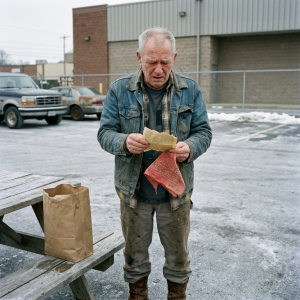
He didn’t make a fuss about it. Just bought six biscuits, a container of fig preserves, two hard-boiled eggs, and a sleeve of those oatmeal cookies his late wife Marlene used to love. He put it all in a brown paper sack, folded the top down twice, and set it on the bench before seven o’clock.
Then he went and sat in his truck and pretended to read his phone.
He watched her find it.
She stood over that sack for a long moment, looking around the empty lot like she expected someone to come claim it. Then she sat down slowly, opened it like it might contain something dangerous, and went very still.
She fed the dog first.
Earl had to look away after that.
The next Saturday he came earlier. Left two sacks — one for her, one for the dog, with a little container of plain boiled chicken he’d made the night before. No note. He didn’t want to spook her. He just wanted her to feel like the world hadn’t entirely forgotten her name.
Weeks passed. The ritual settled in like a good habit.
Earl started adding things. A pair of wool socks, rolled tight. A travel-size tube of lotion when the weather turned cold. A ten-dollar bill folded inside a napkin, three times, so it wouldn’t embarrass her to find it. He never signed his name. Never left a note. Just the brown paper sack, on the bench, before seven.
And every week, she came. She ate. She fed the dog.
And every week, Earl found himself watching that small folded paper tucked in the bandana.
Once, the dog trotted toward his truck — drawn by the smell of beeswax on Earl’s jacket, maybe — and Earl got close enough to see.
The paper wasn’t a tag.
It was folded the way you fold a letter.
The dog let Earl scratch behind his ears for a moment, then turned and trotted back to the bench, and Earl sat with that for the whole drive home.
Eleven weeks.
Then one Saturday in February, the cold kind where frost sits on the hood of your truck till almost nine o’clock, Earl pulled into the lot and stopped.
The brown paper sack was sitting on the bench where he’d left it.
Untouched.
He sat in the truck for twenty minutes. Thirty. The parking lot filled up, then thinned out. Ronnie Guidry unlocked the front door and gave Earl a wave.
The sack didn’t move.
She didn’t come.
Earl waited until half past nine before he got out and walked to the bench. He picked up the sack, figuring he’d come back next week. Try again.
But on the bench, underneath where the sack had been sitting, was the dog’s red bandana.
Folded.
Neat.
Like someone had placed it there on purpose.
Earl’s hands weren’t steady. Hadn’t been since Marlene passed. But he picked up the bandana and turned it over, and the small folded piece of paper fell into his palm.
He stood there in the February cold for a long moment.
Then he unfolded it.
The handwriting inside was his dead daughter’s.
Not like his dead daughter’s.
His dead daughter’s.
The particular curl on the capital E. The way she always wrote her sevens with a crossbar through the middle, the way he’d taught her when she was six years old because that’s how his own father had taught him. The small, self-conscious letters of a person who had learned early not to take up too much room.
Claire.
Earl sat down on the bench. He didn’t decide to. His legs just stopped cooperating.
The note was short. It had been written a long time ago — the paper had that dry, compressed feeling of something that had lived folded for years. But the words were clear.
It said: If you are reading this, someone kind found Biscuit. Please take care of him. He knows how to be good company. He has never once let me be lonely. I hope whoever you are, you are not too lonely either. His favorite thing is plain boiled chicken and having his ears scratched. His second favorite thing is sitting next to a person who isn’t afraid of quiet.
His name is Biscuit and he belongs to Claire Thibodaux and I loved him more than I can say in a note this small.
Earl read it twice. Then he pressed it flat against his knee with his palm, the way you’d press a hand to a wound.
Claire Thibodaux had been dead for four years. She’d gone into the water off the Breaux Bridge on a night in March when Earl hadn’t known where she was or that he should have been looking. She was thirty-one years old. She had her mother’s eyes and her grandfather’s stubbornness and a laugh that arrived about two seconds after everyone else’s, like she needed a moment to decide if joy was safe.
The dog had been hers.
The young woman had been carrying Claire’s dog.
Earl looked at the bandana in his hands. Looked at the empty lot. Looked at the sack of food he’d left and the sack of food still untouched on the bench beside him.
He sat there until Ronnie Guidry came out and asked if he was all right.
Earl said he didn’t entirely know.
He drove home with the bandana in his shirt pocket and the note folded back the way he’d found it, along every crease. He sat at his kitchen table and called his nephew Dennis, who was a deputy with the parish, and told him the whole thing from the beginning. Dennis listened without interrupting, which was not his usual habit.
When Earl finished, Dennis said, give me a day.
It took two.
The young woman’s name was Lucie Fontenot. She was twenty-six. She’d been living out of her car for most of the fall and into the winter, working day labor when she could find it. She and Biscuit had spent six weeks in a church parking lot in Cecilia before someone connected her to a women’s shelter over in Lafayette.
She’d found Biscuit the previous April, tied to a post outside a Dollar General in Breaux Bridge with a note that said free dog good dog please. She’d been on her way to somewhere else and she’d taken him anyway because he’d looked at her like she was the answer to a question he’d been asking for a long time.
Nobody had told her whose dog he was.
Nobody had told her anything.
Dennis got Lucie’s number from the shelter and gave it to Earl, and Earl sat with it written on a Post-it note on his kitchen table for the better part of a day before he called.
She answered on the second ring.
He told her his name. He told her the dog had belonged to his daughter. He told her the whole story from the feed store lot, the biscuits, the bandana, the eleven Saturdays, and when he got to the part where he found the note his voice went somewhere he couldn’t follow it, and he had to stop.
Lucie didn’t rush him.
She sat quiet on the other end of the line the way a person sits quiet when they understand that silence is not emptiness.
When Earl came back, she said, I didn’t know her. I want you to know I didn’t know her. But I’ve been carrying that note for ten months and some days it was the only thing that felt true.
Earl said he understood that.
He asked if she and Biscuit were okay.
She said they were getting there. The shelter had helped her find a room. She had a job lined up at a plant nursery starting Monday. She’d had to leave the feed store lot because the shelter was forty minutes away and she didn’t have reliable transportation yet, and she was sorry she hadn’t found a way to explain.
Earl said there was nothing to be sorry for.
Then he asked if she’d like to come for Sunday dinner.
He said he had a good bit of space and a guest room that needed using and about ninety pounds of honey that nobody was helping him eat. He said the dog would be welcome. He said he wasn’t trying to make anything complicated, he just thought maybe they had both been a little lonely for long enough.
There was a pause.
Then Lucie said, your daughter’s note said you’d be the kind of person to ask.
Earl stopped.
He said, what?
She said, there was another note. On the other side.
He’d only unfolded it once. He’d only looked at one side.
He went and got the note off the kitchen table and turned it over with one hand while he held the phone with the other.
The other side said: Daddy, if this is you — and somehow I think it might be, I think you’d be the one — stop waiting for me to come home and go let somebody else in. You were always better at that than you knew. I got that from you. Biscuit knows a good person. He’ll show you.
I love you. I’m sorry I didn’t say it enough when I could.
Earl sat back down at the kitchen table.
Outside, the February light was coming through the window the way it does when the cold starts thinking about loosening, thin and provisional and honest.
Lucie didn’t say anything for a while.
Earl didn’t either.
Then he said, Sunday at noon. I’ll make a roast. Plain boiled chicken on the side, just for Biscuit.
She said, we’ll be there.
Lucie came that Sunday, and the Sunday after, and the one after that. She took the guest room in March when the shelter’s time limit ran out. She worked at the nursery through spring and into summer and turned out to have a way with plants that the owner said he hadn’t seen in twenty years. She helped Earl with the hives when her schedule allowed, and he taught her to pull frames without flinching, and she taught him that you could put on a podcast while you worked and the bees didn’t mind at all.
Biscuit slept at the foot of Earl’s bed.
The first time he did it, Earl lay in the dark for a long time with his hand on the dog’s back, feeling him breathe.
There were hard days. There were days when Earl would find Lucie sitting on the back porch with the note in her hands, reading it again, and he’d just go out and sit beside her and not ask. There were days when he drove out to the cemetery and talked to Claire and Marlene for a while, and those days he came home tired in a way that sleep didn’t fix. There were days when the grief was not a wave but just the water, everywhere, and you had to remember how to float.
But there were also evenings on the porch with honey dissolved into tea. There were Saturdays back at Guidry’s, the two of them with a list between them, Biscuit on his leash nosing at the feed bags. There was the morning in April when Lucie came in from the nursery with a flat of larkspur seedlings she’d started from seed herself and said she thought the east side of the yard could use some color, if he didn’t mind.
He didn’t mind.
He didn’t mind at all.
Some people have asked Earl how he makes sense of it. The note. The coincidence of it. Whether he thinks Claire knew somehow, intended it, left a trail of breadcrumbs across four years and forty miles of south Louisiana.
Earl says he kept bees for forty-one years. He knows that sometimes a swarm moves in a direction that looks random until you see where it lands, and then it looks like the only possible outcome. He says he’s not a man who needs everything explained to him. He says some things are just the way they are, and the only question that matters is what you do when you find them.
He says his daughter knew him well enough to write him a note and trust that he’d find it.
He says that’s enough. More than enough. More than most people get.
Biscuit is seven years old now, or thereabouts. His muzzle is going gray at the edges. He still wears a bandana — a new one, blue, that Lucie bought him last Christmas — and he still tilts his head when you talk to him like he’s following every word and finding it mostly reasonable.
Earl still goes to Guidry’s on Saturday mornings.
He still brings biscuits.
He just doesn’t eat them alone anymore.