She had been told her daughter was dead.
For forty-three years, she believed it.
Dorothy Nell Pruett, seventy-one years old, retired schoolteacher, Abilene, Texas — a woman who had learned to carry her grief the way you carry a stone in your shoe. You adjust. You limp a little. You stop expecting the pain to go away.
She volunteers Tuesday mornings at Hendrick Medical Center’s lost-and-found. It’s a small room off the main lobby, fluorescent-lit, smelling of old plastic and forgotten things. Umbrellas. Phone chargers. A child’s sneaker, always just one. She catalogs what comes in, tags it, sets it on the shelf.
It is quiet work. She likes quiet work.
She was not prepared for a Tuesday in October.
—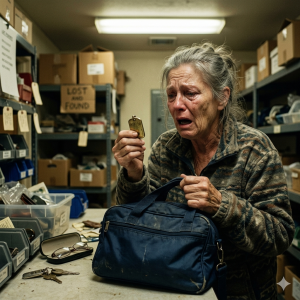
The bag had been sitting in the corner for three weeks — a soft-sided navy overnight bag, no ID tag, no name written on the outside. Standard procedure: if no one claims it in thirty days, it gets donated. Dorothy pulled it onto the table and unzipped it.
Inside, folded neatly: a cotton nightgown. A paperback with a cracked spine. Reading glasses in a hard case. A small bag of toiletries, travel-sized, the kind you pick up at the Dollar General.
And then, beneath the nightgown —
A monogrammed insulin case. Navy blue with white stitching.
The initials read: **E.A.P.**
Dorothy’s hands went still.
Elaine Ann Pruett.
She told herself it was a coincidence. There are other people in the world with those initials. Of course there are. She told herself that even as her fingers were already reaching deeper into the bag.
That’s when she felt it.
Small. Brass. Warm from being tucked in the fabric.
A pill fob, no bigger than a coat button, shaped like a tiny oval. Engraved on the front with a forget-me-not flower, its petals worn nearly smooth — not from neglect, but from the opposite of neglect. From being held. Rubbed between a thumb and forefinger ten thousand times over forty-three years.
Dorothy knew that fob.
She had bought it at a little gift shop on Butternut Street the morning of February 14th, 1982. Valentine’s Day. She had threaded it onto the zipper pull of Elaine’s hospital bag herself, standing in the kitchen while her daughter ate oatmeal and her husband stood by the door with his coat already on.
She had told Elaine it was so she would never lose her bag.
What she had meant was: so I will always find you.
—
Elaine had been seventeen. Difficult, her husband said. Dangerous, the doctor said. Dorothy had never fully believed either word, but in 1982 in West Texas, a woman did not always get to act on what she believed.
Two weeks after Elaine was committed, Robert came home and sat down at the kitchen table and told Dorothy in a flat voice that Elaine had passed. A complication, he said. It happened quickly. He had already handled the arrangements.
There was no funeral Dorothy was allowed to attend.
There was no grave she was ever shown.
She had spent three years asking questions and another forty years learning to stop.
—
She sat in that small fluorescent room for a long time, holding the fob.
It was the same one. She knew it in her hands before she knew it in her head. The forget-me-not. The worn brass. The particular weight of it, lighter than you’d expect, the way small sacred things always are.
Someone had carried this for forty-three years.
Someone had carried this the way Dorothy had carried her grief — every single day, adjusted, close to the skin, never put down.
Her eyes went to the insulin case again. Diabetic. Whoever owned this bag was diabetic.
Elaine had been diagnosed with Type 1 at age nine.
Dorothy turned the fob over in her hands.
She had not looked at the back yet.
She had been afraid to.
On the morning she’d bought it, she had sat with Elaine at the kitchen table and helped her daughter — who had just that year learned cursive and was so proud of it — scratch two words into the brass with the tip of a bobby pin.
Two words. A safeguard. A secret between them.
In case you ever get lost, Dorothy had told her, this is how someone will know you’re mine.
She turned the fob over.
The two words were there.
Worn, but legible. The scratched, careful loops of a seventeen-year-old learning cursive who had pressed so hard with that bobby pin the metal had curled slightly at the edges.
Still there after forty-three years.
And below the two words — written not in the scratched handwriting of a girl, but in the fresh, deliberate ink of a woman who had left this bag here on purpose —
A room number.
Third floor. Room 318.
Dorothy stood up so fast her chair scraped back and hit the wall.
Her hands were shaking.
She was already moving toward the door.
—
The elevator was slow. Dorothy did not wait for it.
She took the stairs, one hand on the railing, her sensible volunteer lanyard swinging against her chest. She was seventy-one years old with a bad left knee and she took those stairs like she was forty years younger and late for the most important thing she had ever been late for.
Which, she understood, she was.
She was forty-three years late.
Third floor was the long-term medical ward. She had never volunteered up here. The hallway was quieter than the lobby, the lighting a warmer yellow, and it smelled of antiseptic and something underneath the antiseptic that was just unmistakably human — meals and sleep and worry and waiting. Doors with small whiteboards, names written in dry-erase marker.
She did not need to read them.
She counted.
310. 312. 314.
Her knee hurt. She did not slow down.
316.
She stopped outside 318.
The whiteboard next to the door said, in neat block letters: PRUETT, E.
Not a married name. Her name. Still her name.
Dorothy put one hand flat against the wall and stood there breathing. Down the hall, a cart wheel squeaked. A monitor beeped somewhere patient and steady. The fluorescent light above 318 hummed at a frequency she would hear for the rest of her life every time she closed her eyes.
She had imagined this moment for three years and then spent forty years burying the imagination. She had no script for it. She had nothing rehearsed.
She knocked.
—
Nothing happened for long enough that Dorothy thought she might have been wrong. That she had followed a coincidence off a cliff. That she would have to go back downstairs and put the bag on the shelf and drive home and sit in her kitchen and be Dorothy Nell Pruett, retired schoolteacher, woman who had lost her daughter, same as always.
Then a voice said, “Come in.”
It was a woman’s voice. Low. A little rough, the way voices get when they’ve been worn down by years of use or years of not enough use. Texas in it, flat and wide. And something else Dorothy couldn’t name yet, something that hit her in the chest like a hand pressing inward.
She opened the door.
—
The woman in the bed was sixty years old, give or take. Gray had come in hard at her temples and threaded through the rest, which was dark, the same dark it had always been, worn long and loose around her shoulders. She was thin in the way that illness makes a person thin, not chosen but imposed. There was a glucose monitor on her left arm, the kind that sticks, a small white disc against pale skin.
Her eyes were brown.
Robert’s eyes had been blue. Dorothy’s were green.
Elaine’s had always been brown, a mystery to both of them, a joke in the family — where did you come from, those eyes? — and the answer was a grandmother on Dorothy’s side who had died before Elaine was born.
Those same eyes looked at Dorothy now from the bed, and they were wet already, already, before a single word was spoken.
Dorothy could not move from the doorway.
The woman in the bed said, “I didn’t know if you still volunteered here. I looked you up. The hospital newsletter. It said Tuesdays.” She stopped. Steadied herself. “I left the bag three weeks ago. I couldn’t — I needed you to find it yourself. I needed it to be you coming to me. I couldn’t walk up to you. I was afraid you’d—”
She stopped again.
“I was afraid,” she said simply.
Dorothy walked to the bed.
She did not say anything. There was nothing yet that language was built to carry. She sat down in the chair beside the bed — the visitor’s chair, the family chair — and she took her daughter’s hand in both of hers, and she held it the way she had not been able to hold it for forty-three years.
Elaine’s hand was shaking.
So was Dorothy’s.
For a while that was enough. That was more than enough. That was forty-three years’ worth of enough, compressed into two women holding hands in a yellow-lit hospital room while a glucose monitor blinked its small, steady blink.
—
It took hours to tell it all. Days, eventually.
But the shape of it came out that afternoon, piece by piece, in the careful way that people tell the stories they have held the longest — not all at once, because all at once would break something.
Robert had not arranged a funeral because there was nothing to arrange.
He had arranged something else entirely.
The facility — a private one, far enough outside Abilene that Dorothy would never happen past it — had agreed, for a fee that Robert had, and this was the word Elaine used, the flat legal word she had learned later, remitted, to transfer guardianship and maintain what Robert called discretion. Elaine had been seventeen. She had no legal standing. She had been told her mother knew. She had been told her mother had agreed it was for the best.
She had believed it for six years.
It was the thing that had taken the longest to stop believing.
“He told you I died,” Elaine said. It wasn’t a question. Her jaw was tight with something old.
“He told me it was a complication,” Dorothy said. “He said it was quick.”
Elaine looked at the ceiling for a moment. Then she looked back.
“He died in 2009,” Dorothy told her. “Stroke. Fast.”
“I know,” Elaine said. “I’d been keeping track.”
She had left at twenty-three, when she’d aged out of what the facility could legally hold her under. She had nothing — no credit history, no transcripts, a Social Security number and the clothes she left in and the overnight bag she’d had since she was seventeen, the one with the brass fob on the zipper.
She had not come back to Abilene. She had been afraid of what she would find. Afraid Dorothy had known. Afraid Dorothy had chosen silence. It was easier, for a long time, to stay away and keep that possibility from becoming a certainty.
She had built a life in Lubbock. Waitressing, then a GED, then ten years of classes taken one at a time at night until she had enough credits to work as a paralegal, which she had done until her health made full-time work impossible. Type 1 diabetes, managed carefully for decades, had begun taking its toll. Kidneys, the doctor said. She was here at Hendrick because a specialist she trusted had privileges here.
She was sixty years old and she was sick and she had carried that fob every day of her life and she had finally decided that fear was a luxury she could no longer afford.
“The two words,” Dorothy said. She was still holding Elaine’s hand. “You knew I’d turn it over.”
“I knew if it was really you, you’d know to turn it over,” Elaine said. “That was the test. I needed it to be a test.”
Dorothy nodded. She understood that. She understood it completely.
—
The two words scratched into the back of the brass fob, in the careful loops of a seventeen-year-old girl who was proud of her cursive, were the words Dorothy had whispered to her daughter every night since she was small. A thing between them. Not remarkable to anyone else. A phrase worn smooth by use, the way the brass itself had been worn smooth by holding.
Come home.
—
There are things that take time to untangle.
There are calls to make and doctors to speak to and a lifetime of separate histories to lay out side by side and begin, slowly, to braid together. There are hard conversations about what was lost and harder ones about what is left. There are days Elaine does not feel well and days she feels better and days Dorothy drives the forty-five minutes from Abilene to Lubbock and sits in her daughter’s apartment and they watch television and don’t talk about any of it and that is its own kind of healing.
There are people in Abilene — old friends of Robert’s, his side of the family — who have opinions about what is happening, and Dorothy has learned, at seventy-one, that she has exactly zero obligation to those opinions.
There is no making up for forty-three years. Dorothy knows that. Elaine knows that. They have said it to each other plainly, the way West Texas women say hard things, without ornament.
But there is this: Tuesday mornings, Dorothy still volunteers at the lost-and-found.
And on the Tuesdays that Elaine is feeling well enough, she drives down from Lubbock and sits in the small fluorescent room with her mother, in a folding chair Dorothy brought from home. She reads her paperback while Dorothy catalogs. Umbrellas. Phone chargers. A child’s sneaker, always just one.
The navy overnight bag is not on the shelf anymore.
Dorothy took it home.
She has it on her dresser. She’s cleaned it, folded the nightgown, replaced the reading glasses case with a new one. She has thought about what to put in it, what it should hold now that it has served its purpose.
The fob is back on the zipper where it belongs.
She leaves the bag unzipped.
She is not going to zip it again.
She has everything she was looking for.