Her name had been erased from history.
Every log. Every deed. Every official record the state of Michigan had ever kept about the old Harlan Point lighthouse on Lake Superior — and Margaret Elaine Harlan’s name was gone from all of it.
Replaced.
Quietly, surgically, completely.
Replaced by the name of a man she had grown up calling her stepbrother.
—
She didn’t know that yet when she took the job.
It was just supposed to be a summer thing. Margaret was sixty-one, recently retired from thirty years of teaching middle school history in Marquette, and the Keweenaw Preservation Society needed someone who knew old buildings and didn’t mind the climb. Restore the interior. Catalog what was left. Help prep the lighthouse for its big public rededication ceremony.
She said yes because the lighthouse had been her father’s.
Because she still remembered the weight of his hand on her shoulder at the top of that spiral staircase, the two of them watching Superior go silver at dusk, him calling her by the name only he ever used.
*Wren.*
“Because you see everything,” he’d told her. “Like a little bird up high.”
She hadn’t been back since his funeral.
—
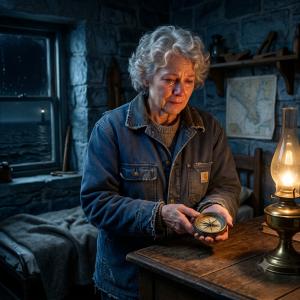
The first morning, she found the compass in a dusty drawer beneath the keeper’s desk.
Brass. Small enough to sit in her palm. Worn smooth on the edges the way things get when they’ve been handled by someone who loved them.
She almost set it aside with the other salvage items.
Then she turned it over.
Her father’s initials — *W.H.* — were engraved on the lid in the same careful hand she recognized from thirty years of birthday cards.
And below that, one word.
*Wren.*
Margaret stood very still in that small stone room while the lake wind pressed against the glass above her.
She told herself it was a coincidence. She told herself lots of things that first morning.
She put the compass in her jacket pocket and went back to work.
—
She found it again on day two.
Not the compass itself — she still had that — but a sketch of it.
There, in the margin of the 1943 keeper’s logbook, drawn in faint pencil as if someone had been sitting at that very desk, turning the same small object over and over in their hands while the lake outside did what Lake Superior does.
The sketch was detailed. Unmistakable.
And beside it, in handwriting she did not recognize, three words:
*She will come.*
Margaret’s hands were not entirely steady when she set the logbook down.
—
That evening, one of the docents — a woman in her late eighties named Ruthie, who had volunteered at the site for years and moved through the rooms like she owned them — stopped Margaret in the stairwell.
Ruthie was wearing the compass around her neck.
Margaret stopped breathing.
“Where did you get that?” she asked, and her voice came out strange and thin, the way voices do when the body already knows something the mind hasn’t caught up to yet.
Ruthie touched it gently. “A man left it at the front door. Oh, this was years ago now. Before it was a preservation site, even. Left it in an envelope with a note that said to give it to the woman who came to restore the light.” She paused. “The note said she’d know what it meant.”
“What was the man’s name?”
Ruthie looked at her with the patient, careful eyes of someone who has been waiting a long time to have this conversation.
“The note was signed *W.H.*”
—
Margaret barely slept.
She sat in her rental cottage two miles down the shore road and turned the compass over in her hands while the lake made its sounds in the dark. Her father had been gone eleven years. He had left this here. For *her.* Which meant he had known, somehow — known what had been done, known she would find her way back, known she would need something to hold onto when she finally understood the full shape of what had been taken from her.
The ceremony was in two days now.
Her stepbrother — Gary, with his easy smile and his name on every plaque and his keynote address already printed in the program she’d found in the welcome packet — was driving up from Grand Rapids tomorrow.
He would stand at that podium and speak about heritage and family legacy and a lighthouse his father had kept for thirty years.
And Margaret would be standing in the back, in her restoration crew jacket, invisible.
Unless.
—
She turned the compass over in her palm one more time — and that’s when she saw it.
Something etched on the back that hadn’t been there before, or that she simply hadn’t looked for, or that she had not been ready to see until this exact moment.
Three lines. Small and precise.
The first was a number: 47.
The second was a word: *HEARTHSTONE.*
The third was a date: *June 14, 1962.*
Margaret sat with those three lines for a long time. Then she got up, put on her coat, and went out into the dark.
—
She was a history teacher for thirty years. She knew how to find things.
Forty-seven was easy once she stopped thinking about it as a number and started thinking about it as a location. The lighthouse had been built in 1891, and she had spent the last week cataloging every stone and timber in it. Every room had been assigned a number in the original construction ledger, which she had photographed and uploaded to the Society’s shared drive. Room forty-seven was the sub-basement storage compartment, the one below the oil cellar, the one she hadn’t been able to open because the hinges were rusted through and she’d put in a work order for a bolt cutter that hadn’t come yet.
She drove back to the lighthouse in the dark with a bolt cutter she borrowed from the maintenance shed behind her rental cottage. She had a key to the lighthouse. She was the restoration lead. She told herself all of this as she drove, because the alternative was to feel like a trespassing sixty-one-year-old woman cutting locks off historical property at eleven at night, which was also accurate.
The sub-basement smelled of cold stone and old mineral oil and something else she couldn’t name — something that might have been the memory of someone who had worked in a small space for a long time and left traces of themselves in the air.
She found the compartment marked 47 in faded red paint on the stone near the floor. The padlock was newer than everything around it. Maybe twenty years old, which would put it at right around the time her father was still alive and still, apparently, thinking about all of this.
The bolt cutter took three tries. Her hands had stopped shaking, which surprised her.
Inside was a tin box. Roughly the size of a shoebox. Sealed with electrical tape that had gone brittle and yellow.
She carried it upstairs into the keeper’s room, sat down at the desk where she had found the compass, and opened it.
—
*HEARTHSTONE* was the name of a law firm.
Hearthstone, Gillard and Associates, Houghton, Michigan. Dissolved 2009. She knew this because the letterhead on the first document in the stack told her the firm’s name, and she had spent thirty years teaching children how to find things out, and finding things out is mostly just a matter of not stopping when you hit the first wall.
But that came later.
What she read first, sitting in the keeper’s room with the lake pressing against the glass and the compass on the desk beside her like a small brass witness — what she read first was her father’s letter.
It was dated June 14, 1962. Her birthday. She had been born on June 14, 1962, at Portage Lake Regional Hospital, delivered by a Dr. Emil Saari who had retired to Florida and died in 1994. She knew this because she was a woman who had always wanted to know the facts of her own life.
The letter was three pages, in her father’s handwriting, and it took her a long time to read it. Not because the words were hard. Because of what they said.
—
Walter Harlan had been appointed keeper of Harlan Point Light in 1958, four years before Margaret was born. The appointment had been his father’s before him, and his grandfather’s before that. The lighthouse carried the family name because a Harlan had built the original fog signal station on that point in 1887 and the family had, through a combination of service and stubbornness, kept it ever since.
In 1959, Walter married a widow from Calumet named Dora Laine. Dora had a son from her first marriage. Gary was seven years old and already, Walter wrote, possessed of a watchfulness that made Walter uneasy in ways he couldn’t yet name.
In 1961, Walter began the process of formally registering Margaret — then not yet born — as his heir to the keeper’s appointment and to the deed of the land parcel attached to the lighthouse, a provision that had been granted to the Harlan family in perpetuity by an 1889 state charter. The land was not large. But it was real. It existed. And it had always passed to a Harlan by blood.
In 1963, when Margaret was one year old, Walter made the mistake of telling Dora about the charter.
He wrote: *I did not understand then what she would do with that knowledge. I did not understand the kind of patience a person can have when they believe they are owed something.*
—
What Dora had done, over the following decade, was methodical and nearly invisible.
She had found a clerk in the county recorder’s office who was susceptible to being liked by a pretty woman, and she had been very pretty, and she had liked him in the particular way that costs a woman things she doesn’t get back. Over a period of years, with a patience that Margaret now found almost admirable in its terrible way, Dora had arranged for certain documents to be altered. Not forged outright — that would have been catchable. Just quietly amended. A name changed in a ledger here. A correction filed there, citing a clerical error in the original. A deed re-recorded with language that was almost identical to the original except for one provision, the one that specified blood heir.
Walter had not discovered any of this until 1979, when Margaret was seventeen and Dora had been dead for two years, and he had gone to register her as beneficiary of the charter and found her name already gone from the records that should have contained it.
He wrote: *I tried to fix it. I want you to know that I tried for years. But I was a lighthouse keeper in the Upper Peninsula and she had picked her clerk well, and by then the alterations were old enough that the people who might have helped me were either gone or believed what the records said. I could not prove what I knew. I am sorry, Wren. I am so sorry. I should have told you. I should have told you when you were old enough and I was still strong enough to fight it with you. Instead I waited for the right moment and then I ran out of time.*
He had been diagnosed with Parkinson’s in 2001. He had written this letter in 2002, while his hands could still manage it.
He wrote: *I cannot fix the records. But I found something Dora could not alter, because she did not know it existed. It is older than her. It is older than all of this. And it will matter more than anything she changed, if you can get it in front of the right person at the right moment. Everything you need is in this box. I am leaving the compass where it will find you, because I have always known you would come back here someday. You are a Harlan and Harlans come back to the water. And I am leaving this box for the same reason I always put the light on, even when I couldn’t see any ships out there.*
*Because someone might need it.*
*I love you, Wren.*
—
The rest of the box was documents.
Most of them were copies Walter had managed to make before the originals were altered — carbons, photographs of pages, a few items he had apparently removed from the records himself before Dora’s clerk could get to them. These alone might have mattered. Might have been enough to raise questions, force an audit, at least complicate Gary’s claim.
But the last item in the box was not a copy of anything.
It was an original.
The 1889 state charter, the actual founding document of the Harlan family’s claim to the lighthouse parcel. Not a copy filed with the county. The original, signed by the state, kept by the family, which was standard practice for such grants at the time. And because it was an original in private hands, because it had lived in this sub-basement rather than in any county office, Dora’s clerk had never touched it.
The charter specified the land grant. It specified the conditions of the keeper’s appointment. And it specified, in the plain declarative language of 1889 legal prose, that the grant was to be held by the Harlan family and passed to blood descendants in perpetuity, and that no amendment to county or state records could supersede the original grant without the express written consent of the blood heir.
At the bottom of the charter, below the state seal, someone had added a handwritten note — not Walter, the handwriting was older, the ink brown with age — that read: *This document remains in the possession of the keeper’s family as proof against any future dispute. The land is the land. The name is the name.*
Margaret read that line three times.
Then she closed the box, put the compass in her pocket, and went back to her cottage to sleep for the first time in days.
—
Gary arrived the next morning in a charcoal SUV with Grand Rapids plates, wearing a fleece vest and carrying a coffee from the gas station on M-26. Margaret watched him from the window of the keeper’s room while he shook hands with the Society director and smiled the easy smile she remembered from childhood — the smile of a man who had never had to wonder whether he was welcome somewhere.
She had made two phone calls before he arrived.
The first was to a lawyer in Houghton named Patricia Voss, who had been highly recommended to her the previous evening by Ruthie, who turned out to know absolutely everyone in Keweenaw County and had apparently been waiting for this phone call for some years. Patricia said she could be at the lighthouse by noon.
The second call was to a reporter at the Mining Gazette in Houghton, a young woman Margaret had met at a historical society fundraiser the previous spring, who arrived forty-five minutes before Patricia did, with a photographer.
Margaret was a history teacher. She knew that the facts were not enough on their own. She knew that the facts needed a witness.
—
The rededication ceremony was scheduled for two o’clock.
At twelve-thirty, in the keeper’s room, with Patricia Voss and two members of the Keweenaw Preservation Society board present, Margaret laid the contents of the tin box out on the desk in the order her father had arranged them.
Patricia Voss put on her reading glasses and did not say anything for a long time.
Then she said: “Where has this been?”
“Sub-basement storage,” Margaret said. “Room forty-seven.”
“And the charter is original? You haven’t had it authenticated?”
“Not yet. But I know my family’s documents. I’ve been looking at them my whole life.”
Patricia looked at her over the glasses. “It won’t matter for today. But it will matter for everything that comes after.”
“I know,” Margaret said. “I’m a patient person.”
—
She did not confront Gary.
She had thought about it, in the dark hours of the previous night, and decided against it. He might have known. He might not have. His mother had done what she’d done when he was a child, and whatever he had built his sense of himself on top of that, she was not going to tear it down with her hands in front of an audience. That was not what her father would have wanted. Walter Harlan had kept a lighthouse. He had put the light on even when he couldn’t see any ships. He had not been a man who performed things.
What she did instead was speak to the Society director, a careful woman named Helen Brandt, who listened to what Margaret told her with an expression of increasing stillness that Margaret recognized as the face of someone understanding that their event was about to be significantly more complicated than planned.
Helen made three phone calls of her own.
Gary’s keynote address was quietly shifted to remarks. The program was adjusted. The ceremony would continue, but the dedication — the formal naming, the unveiling of the new interpretive plaques, the legal transfer of stewardship — would be postponed pending a records review that the Society had apparently always had the authority to request and simply never had reason to.
Gary was told thirty minutes before the ceremony. Margaret was not in the room for that conversation. She was standing at the top of the spiral staircase, looking out at Lake Superior going silver in the afternoon light, the compass warm in her palm.
She thought about her father standing in this same spot. She thought about being seven years old and holding his hand on this same iron railing while the wind came off the water and he called her Wren and told her she could see everything.
She could see everything.
—
The records review took four months.
The charter was authenticated by a historian at Michigan Technological University who spent three weeks with it and produced a report that used the word “remarkable” eleven times. The altered county records were examined by a state archivist who found, once she knew to look