Every Saturday for three months, she got up before the sun.
Not because she had to. Marvene Hodge was 71 years old, retired, and the only thing waiting on her was a cat named Biscuit and a pot of Folgers she didn’t even want anymore.
She got up because of the boy.
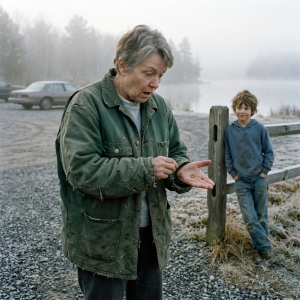
She’d first seen him in late September, when the fog was still sitting low on Upper Klamath Lake and the boat launch smelled like cold water and pine. He couldn’t have been more than nine. Maybe ten. Thin the way kids get when nobody’s paying attention to them. He had one of those old-style bikes with the wide handlebars — rust on the chain, a crack in the seat — and he’d lean it against the same post every time, same spot, like he had a reserved space at a marina he’d never afford.
He never brought food.
She noticed that on week two.
By week three, she’d started making two lunches on Friday nights. Nothing fancy. Peanut butter and honey on white bread, a Ziploc of pretzels, an apple if she had one. She’d fold the whole thing into a brown paper sack, walk down to the launch before he arrived, and tuck it into that little wire basket on the front of his bike.
Then she’d go sit in her truck and watch, from a distance she hoped was respectful, while he found it.
He never looked around to see who left it.
He just opened the bag slow, like he was trying to make it last, and ate every single thing.
Marvene didn’t tell a soul. Not her daughter in Medford. Not her friend Deborah from church. Not anyone.
Some kindnesses, she believed, belonged only to the people sharing them.
She wore her late husband Roy’s old canvas work jacket on the cold mornings. It was too big on her, always had been, and she’d taken to keeping her hands in the front pockets while she sat in the truck. There was a small, worn hole in the left pocket’s seam. She’d been meaning to sew it up for ten years.
It was the right pocket she checked out of habit.
And there was something else she checked, privately, without meaning to. A ritual she’d had for thirty years and never once spoken aloud.
The jacket had belonged to Roy. But the button — the small brass button stamped with a tiny anchor — had come from his Navy peacoat. The one they buried him in, back in 1994. She’d found it in the funeral home parking lot afterward, in the gravel, glinting like it had been waiting for her. One of the buttons from his collar, worked loose somehow.
She’d kept it in a small tin on her nightstand ever since.
Her one private grief, she called it. The one piece of him no one else knew about.
She never brought it to the lake.
She never brought it anywhere.
So on the Saturday morning she arrived twenty minutes early — coffee still in her hand, frost on the windshield — and felt something hard and round at the bottom of her coat pocket, she assumed she was confused.
She assumed she’d just forgotten.
She reached in.
The button sat in her palm, cold as river water. Small. Brass. The anchor pressed into its face the same way she’d memorized it ten thousand times in the dark.
Marvene stood very still in the parking lot.
The boy wasn’t there yet. The lake was glass. A heron moved somewhere in the reeds.
She hadn’t brought it. She was certain she hadn’t brought it. She hadn’t taken it from the tin in years. She hadn’t touched it since last spring when she’d moved the nightstand to vacuum underneath.
Her hands had started to shake, and she was trying to think clearly, trying to be rational, trying to remember — did she bring the jacket to Medford last month, could her daughter have found the tin, could someone have —
She turned the button over.
The back of a brass button should be smooth.
This one wasn’t.
There were words scratched into the metal, four of them, the letters so small and so careful she had to hold it up to catch the early light.
And when she read them, the coffee cup slipped from her other hand and hit the gravel and she didn’t even hear it.
Because those four words — she knew them.
She had written them herself.
In a letter she had written to Roy the night before the funeral, a letter she had folded and held and ultimately decided not to put in the casket with him.
A letter she had taken home instead, and read one final time, and burned in the kitchen sink.
No one had ever seen those words. Not one living person on this earth.
She looked up from her shaking palm.
The boy was standing at the gate.
He was looking directly at her.
And he was smiling, slow and certain, the way people smile when they’ve been waiting a long time for someone to finally understand something.
—
Marvene’s first thought, God help her, was that her mind had finally gone.
Seventy-one years of hard living and cold winters and grief she’d packed down tight, and here it was, the bill coming due in a marina parking lot in Klamath Falls, Oregon, at six-fifteen in the morning.
She closed her fingers around the button.
The boy walked toward her the way children only walk when they’re not afraid of you. Unhurried. Steady. Like he’d rehearsed this, or like he didn’t need to.
He stopped about four feet away and looked up at her with eyes that were a very ordinary brown, a child’s eyes, and said, in a perfectly ordinary child’s voice, “You okay, ma’am?”
Marvene realized she was still holding her arm out, the button in her open palm, like she was offering it to him or to the sky or to no one.
She lowered her hand.
“Where did you get this,” she said. It wasn’t a question the way she meant it to be. It came out flat and strange.
The boy’s expression didn’t change. “I found it,” he said.
“Found it where.”
He pointed, vaguely, toward the gravel near the launch ramp. “Over there. Last week. It was just sitting there.” He paused. “I didn’t know whose it was. I thought maybe it was yours because you’re always here.”
Marvene looked down at the button again.
The words were still there. Four words. Her words, scratched so fine they were nearly invisible unless you tilted the metal just right in the light.
She had written them in pencil in a letter on Roy’s last night. She had spoken them to him at the funeral home before they closed the casket, standing apart from the family, far enough that no one could hear. She had carried them inside her chest ever since, those four words, like something too breakable to put down.
I still need you.
A brass button doesn’t explain that. A boy who finds a button in a gravel parking lot doesn’t explain that. There was no rational account she could construct in which those words ended up on the back of something she’d never scratched a mark into in her life.
And yet.
She looked at the boy. He was watching her with that same patient expression, and she thought, he’s just a child, he doesn’t know what he handed me, he cannot know what any of this means.
“Did you read it?” she asked. “The writing on the back?”
He nodded, a little self-conscious now, like he’d done something he wasn’t sure was allowed. “I had to use a magnifying glass,” he said. “My grandpa has one in his tackle box.”
“Your grandpa,” Marvene said.
“He brings me here. On Saturdays.” He tilted his head. “He drops me off. He can’t walk so good anymore.”
Something settled in Marvene, very slowly, like silt after a disturbance.
“Does your grandpa know you’ve been coming here?” she asked. “All fall?”
“Yes ma’am. He waits in the truck up at the road.” The boy looked toward the gate. “He worries, so I always wave when I get here.”
Marvene turned and looked. There was a truck parked up on the shoulder of the access road that she had always assumed was a fisherman’s. Old blue Ford. She had never thought to look twice at it.
“What’s his name?” she asked. “Your grandpa.”
“Gerald,” the boy said. “Gerald Fitch.”
Marvene didn’t know a Gerald Fitch. The name meant nothing to her.
She looked back down at the button.
Here is what she knew, and she had to hold each piece carefully, because her hands were still unsteady and the morning felt thin and fragile: the button had been on her nightstand in a tin. She had not moved it. She had not brought it here. This boy had found it in the gravel and put it in her coat pocket, either last week or in some moment she hadn’t noticed, one of the Saturdays she’d been watching him and perhaps he had been watching her right back.
A button worked loose from a peacoat at a funeral thirty years ago and never scratched by any human hand.
And four words she had never spoken to a living person.
She turned it over once more. The anchor side, worn and familiar. She had held this ten thousand times. She knew its weight and its edges the way she knew the shape of her own thumbnail.
She was a rational woman. She had been a school secretary for twenty-three years. She balanced her checkbook by hand. She did not put stock in things she couldn’t account for.
And still.
She thought about the heron she’d watched every Saturday, standing at the edge of the reeds, impossibly patient. She thought about the way Roy used to stand at the kitchen window before coffee, just looking at the yard, as if he were memorizing it. She thought about how she’d come to this lake in the first place, in late September, which was not her habit and not her part of town, which she’d driven to on a Tuesday evening because something she could not name had made her restless in a direction.
She thought about the boy.
Thin the way kids get when nobody’s paying attention. But somebody was paying attention. An old man in a truck up at the road, worried enough to wait. And somehow, somewhere in between, this child had developed the habit of arriving early to a boat launch, finding lunches in his bicycle basket, and being gracious enough not to look around for who left them.
Some kindnesses belonged only to the people sharing them.
She had believed that.
She believed it still.
She closed her hand around the button.
“You want to come sit with me?” she said. “My truck’s warmer than standing out here.”
He looked up at the road. She followed his gaze. In the cab of the old blue Ford, just visible, a hand lifted and came back down. Giving permission, or greeting, or both.
“Okay,” the boy said.
They walked to her truck. She put the heat on low. She had two granola bars in the glove compartment, the kind with chocolate chips, and she gave him one and he took it without the performance of refusing, which she appreciated.
They sat quiet for a minute. The lake had turned silver. A pair of coots moved along the far edge.
“Can I ask you something?” the boy said.
“Go ahead.”
“The lunches.” He was looking at the windshield, not at her. “That was you, right?”
Marvene looked at her hands. “Yes,” she said.
He nodded. Didn’t make a thing of it. Just nodded, the way people do when something they already believed turns out to be true.
Then he said, “My grandpa says people who get up early to do something kind are usually carrying something heavy.”
Marvene was quiet for a moment.
“Your grandpa’s a smart man,” she said.
“He says Roy used to say that.”
The cab went very still.
Marvene turned and looked at the boy.
He was watching the coots on the water, perfectly calm, eating his granola bar.
“How does your grandpa know that name?” she asked, and her voice was mostly steady.
The boy seemed to think about it. “He said Roy was his friend,” he said. “A long time ago. In the Navy. He said if I ever met a lady at this lake in a big canvas jacket, that was probably his wife.” He glanced over at her, brief and matter-of-fact, then back at the water. “He said to give her the button if I found it.”
Marvene sat for a long moment in the particular quiet that falls over you when the world has just rearranged itself.
“Gerald Fitch,” she said.
“Yes ma’am.”
“How long has he been bringing you here on Saturdays?”
The boy thought. “Since school started.”
She had been coming since school started. She had come because something had made her restless in a direction, on a Tuesday evening, and she had driven until the restlessness stopped and the lake was there.
She put the truck in park, though it was already in park, and pressed her hands flat against her thighs to steady them.
“Can we go up and talk to him?” she asked. “Your grandpa. Can we go up right now?”
“Yeah,” the boy said, simply. “I think that’s the whole point.”
—
Gerald Fitch was eighty-three years old and needed two canes to get out of the truck, and he used both of them without apology, and by the time he was standing upright on the gravel shoulder Marvene was already certain she had never met him.
But she knew his face.
There was a photograph, in a shoebox under her bed, of Roy at his first posting. 1971. He was twenty-two years old and grinning in that loose, full way he only grinned in his early twenties, before life put some weight on him. And standing next to him, one arm across Roy’s shoulders, was another young man she had never known the name of.
She had looked at that photograph hundreds of times.
She was looking at that man right now, sixty years further along, white-haired and slow-moving and watching her with eyes that had been doing the math of this moment for a very long time.
“Mrs. Hodge,” Gerald Fitch said.
“He talked about you,” Marvene said. The words came out before she’d chosen them.
“He talked about you more,” Gerald said.
The boy had drifted a little ways off, doing what children do when adults have arrived at something that doesn’t need his supervision. He sat on the tailgate of Gerald’s truck and looked at the lake.
Gerald shifted his weight on his canes. “I’ve got something I should have gotten to you a long time ago,” he said. “I kept telling myself the time wasn’t right. Or I didn’t know how to find you. Or it would only hurt.” He looked down at the ground a moment. “I’m eighty-three years old. I’ve run out of reasons to wait.”
He reached into his coat pocket and produced a small envelope. Not new. The paper had gone soft and ivory-colored with age, and it had been opened and resealed, she could see that, the flap gummed back down with careful hands.
“He wrote it on the ship,” Gerald said. “That last deployment. He gave it to me and he said, if something happens to me, and only if something happens to me, I want her to have this when she’s ready. Not at the funeral. Not right after. When she’s ready.” Gerald held the envelope out. “He made me promise.”
Marvene took it.
Her name was on the front, in Roy’s handwriting, which she had not seen in thirty years and which was, apparently, not something a body forgets.
“He had the button from a previous posting,” Gerald said. “He’d kept it a long time. He told me it was the kind of thing that finds its way home eventually.” He paused. “I never understood that until my grandson found it right here in this parking lot, which I can’t explain to you, and I’ve stopped trying.”
Marvene held the envelope in both hands.
“He scratched those words himself?” she asked.
“I saw him do it,” Gerald said. “Said they were the most important four words he knew, and he wanted them somewhere they’d last.”
She had written the same four words in a letter the night before his funeral without knowing he had scratched them into metal before he ever came home.
She stood on the gravel shoulder of a road by a lake in a town she had no particular reason to drive to one Tuesday in September, holding an old envelope with her name on it in handwriting she loved, and she thought: Roy, you ridiculous, wonderful man, you planned this from a ship in the middle of the ocean thirty years ago and you still had to be dramatic about it.
She laughed.
It surprised her. It surprised Gerald too, she could tell, and then he laughed a little as well, and the boy looked over at them from the tailgate with the benign curiosity of a child who doesn’t need to understand everything.
“Will you stay?” Marvene said. “While I read it?”
“If you want,” Gerald said.
“I want,” she said.
She opened the envelope there on the shoulder of the road, with the lake going gold below and the frost melting off the gravel and Biscuit