She stood up in the middle of two thousand people, and the whole room went still.
But I’m getting ahead of myself. Let me tell you about Nadine first.
—
Nadine Collier is 67 years old, retired schoolteacher, First Baptist of Millhaven, Arkansas. Silver locs pinned up with a tortoiseshell clip. Sensible shoes. The kind of woman who brings a casserole before you even know you need one.
For eleven years — eleven — she woke up at 4:30 in the morning and wrote.
Not journaling. Not devotionals. She was composing a full gospel musical. Handwritten. Every melody, every lyric, every staging note scratched out in a water-stained spiral notebook she kept rubber-banded shut, like whatever was inside might escape if she let it breathe too long.
Her daughter used to ask about it.
Nadine would just move it. Purse. Nightstand. Locked glove compartment. Never explain. Just smile and say, “Not yet.”
Eleven years of “not yet.”
And then Brother Marcus Tate arrived.
—
He came in February, transferred from a congregation up in Fayetteville. Forty-two years old, good-looking in that sharp-suit way, voice like warm honey over a Sunday morning. The congregation loved him immediately.
Nadine did too, at first.
She made a mistake she will tell you she earned the right to make at her age.
She trusted him.
She shared the notebook.
Not the original — she wasn’t foolish — but she sat with him three Saturdays in a row and walked him through every page. Every theme. The whole arc of the thing. She thought they were going to workshop it together. Bring it to the Heritage Festival as a collaboration.
That was March.
By May, Brother Tate had filed the copyright paperwork.
In his name only.
—
She found out the way you find out about betrayal in a small church town — a forwarded email she wasn’t supposed to see, landing in her inbox at 6:47 on a Tuesday morning.
She sat at her kitchen table for a long time.
Then she picked up the spiral notebook — still rubber-banded, still water-stained at the corner where she’d spilled coffee on it back in 2014 — and she moved it to her purse.
She didn’t open it.
She never opens it in front of anyone.
—
The regional church council believed him. Why wouldn’t they? He had documentation. He had dates. He had that voice.
Nadine had a notebook nobody had seen inside and a story that sounded, to people who wanted it to sound that way, like a jealous older woman who couldn’t let go.
She was asked, gently, to step back from her music ministry role.
She went to Sunday service anyway. Sat in the fourth pew. Wore her good cream blouse and her mother’s pearl earrings and she sang every hymn like she owned the air in that room.
Because she did.
—
The Arkansas Gospel Heritage Festival.
Sold out. Two thousand seats. The kind of night that gets written up in the state paper.
Brother Tate’s name was on the program. The musical — her musical, every note of it, eleven years of 4:30 mornings — was listed under his. The title had even been changed slightly. Just enough.
Nadine bought a ticket.
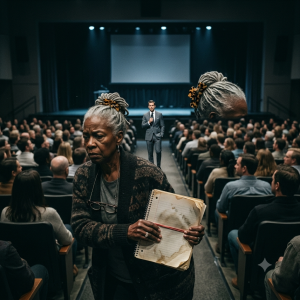
She sat toward the back, which was not like her.
The spiral notebook was in her purse, rubber band still on, still shut.
She had, two weeks before the festival, mailed something. A manila envelope. Thick. She’d stood at the post office counter on a Wednesday afternoon and handed it to the clerk without expression, and when the clerk asked if she wanted tracking, Nadine said, “Yes, ma’am. I surely do.”
She hadn’t told a soul what was in it.
Or who it was addressed to.
—
The house lights went down.
Two thousand people settled into that particular hush that only happens when something feels important.
Brother Marcus Tate walked out from the wings in a white shirt, unhurried, smiling the smile of a man who had already won. He adjusted the microphone. He looked out at the crowd.
He did not look toward the back row.
Nadine’s phone buzzed.
Once.
She looked down.
One word on the screen.
Her chin came up. She took one slow breath. She reached into her purse and her fingers closed around the rubber band on that old spiral notebook —
And Nadine Collier stood up.
—
The word on her phone was: Confirmed.
It was from a woman named Dr. Yvette Brousard, deputy director of the U.S. Copyright Office’s public records division, whom Nadine had called cold, nine weeks earlier, after spending three evenings reading the Copyright Act of 1976 cover to cover at her kitchen table with a yellow highlighter and a legal pad.
What Nadine had mailed in that manila envelope was not a complaint.
It was proof.
—
Here is what no one in that congregation had known, because Nadine had never opened the notebook in front of anyone.
The first page of that water-stained spiral was not lyrics.
It was a date.
April 14, 2013. Written in her precise schoolteacher hand. And beneath the date, a paragraph — in her voice, unmistakable — explaining what she intended to write and why. A kind of letter to herself. A testimony before the testimony existed.
Beneath that: eleven years of entries, every one of them dated, many of them timestamped, because Nadine had formed the habit early on of writing the exact time at the top of every session. 4:31 a.m. 4:47 a.m. The particular insomnia of a woman with something urgent inside her.
But dates in a notebook don’t prove anything by themselves. Anyone can write a date.
What Nadine had done, starting in 2016, was mail herself pages.
Not the originals. Photocopies of completed sections, sealed in envelopes, sent to her own address, never opened. The postal mark on a sealed envelope is a timestamp that belongs to the federal government, and federal timestamps don’t lie, and nobody had ever told Nadine that this strategy was outdated or insufficient because nobody had ever known she was doing it.
Thirty-one envelopes. She still had every one of them. She’d kept them in a shoebox under her bed, banded together with the same kind of rubber band she kept around the notebook, which is a thing you know about a person when you hear it.
When Marcus Tate filed his copyright paperwork in May, he listed his creation date as January of that same year.
Nadine had postmarked envelopes from 2016, 2017, 2018, 2019, and 2020 that contained his complete first act, word for word, note for note.
The manila envelope she mailed to Dr. Brousard’s office contained certified copies of all thirty-one, along with a seven-page letter, typed, single-spaced, that her daughter said later read like the calmest, most devastating document she had ever seen in her life.
Dr. Brousard had taken nine weeks to confirm what any reasonable examination of the dates made plain.
Confirmed.
—
When Nadine stood up in the back of that festival hall, Marcus Tate had just welcomed the audience and was beginning his opening remarks about the creative journey — the phrase he used was “years of spiritual labor” — and at first only the people in her immediate section noticed her.
Then the people in front of them turned around to see what they were looking at.
Then more.
She wasn’t waving her arms. She wasn’t shouting. She was standing perfectly straight in her cream blouse and her mother’s pearl earrings, holding the rubber-banded spiral notebook in one hand and her phone in the other, and she was looking directly at the stage.
Someone near her said, “Ma’am?”
She said, quietly but in the voice of a woman who had controlled thirty-two middle schoolers at a time for twenty-nine years, “I’m all right. I just need him to see me.”
He saw her.
The smile didn’t fall off Marcus Tate’s face all at once. It went in pieces. A man watching something he’d decided could not happen, watching it happen anyway.
—
She did not make a speech.
That is the part of this story people find hardest to believe, because they expect a confrontation scene, a moment of public accusation, some satisfaction that matches the shape of the wound. What they want is for Nadine to walk down that aisle and take the microphone and say everything she’d swallowed for eight months.
She didn’t do any of that.
She stood long enough for the room to be fully, completely still. Long enough for Marcus Tate to understand what her being there meant, and what the notebook in her hand meant, and what the expression on her face meant.
Then she sat back down.
She said later that she sat down because she knew it was already done, and there was nothing left to prove to anyone in that room that she hadn’t already proved to the people who mattered. And she said she sat down because the musical was about grace, every note of it, eleven years of it, and she was not going to dishonor her own work in the house where it was finally being heard.
Even if his name was on the program.
She knew what was coming. She could wait twenty more minutes.
—
What was coming was this.
Halfway through the second act — her second act, the one that pivots from lamentation into jubilation, the turn she’d rewritten four times before she got it right, the piece she’d been most afraid would never be heard — a door at the side of the hall opened.
Two men came in wearing lanyards that identified them as festival administration.
They went to the stage manager first. There was a short conversation. The stage manager’s face changed.
The performance was paused at intermission. A festival official came to the microphone and made an announcement that the remainder of the evening’s program would be postponed pending a scheduling matter. The language was bureaucratic and said nothing. But the information had already begun moving through that auditorium the way information moves through a room full of people who all know each other — in whispers, in sideways glances, in someone’s phone screen lighting up two rows over.
Marcus Tate was escorted off the property before the lobby lights came back on.
—
Nadine sat in her seat until almost everyone else had left.
A young woman from the festival staff came and found her. She was maybe twenty-five, clearly uncomfortable, holding a clipboard she didn’t know what to do with. She said she wasn’t sure what the right thing to say was but she wanted to say something.
Nadine thanked her.
Then her daughter Renee appeared at the end of the row — Renee who had been in the audience too, the only other person who’d known what the text might say — and she sat down next to her mother and took her hand and they stayed like that for a while in the emptying hall.
“You okay, Mama?”
Nadine looked at the stage.
“I will tell you something,” she said. “I heard it tonight. Even with his name on it. I sat in this room and I heard every note I ever wrote, and two thousand people heard it too, and not one of them knew they were hearing it for the first time.” She paused. “That’s not nothing.”
Renee said it wasn’t nothing at all.
—
The copyright dispute was formally resolved four months later. The registration in Marcus Tate’s name was invalidated. The work was re-registered correctly, under the title Nadine had given it in the very first entry of that notebook: Many Are the Mornings.
A small regional theater in Little Rock picked it up the following spring. Full production. Twelve performances. She sat in the third row on opening night — not the fourth pew, not the back row — in the same cream blouse, the same pearl earrings, and a new pair of shoes she’d bought for the occasion, which she will tell you were not entirely sensible but were absolutely worth it.
The spiral notebook was not in her purse that night.
It was on the stage.
They’d asked if they could display it in a small case in the lobby, open to the first page, so people could see the date — April 14, 2013 — and the paragraph she’d written to herself before she’d written a single lyric. Her reasons. Her intention. What she believed the work was for.
She said yes.
She said she thought it had been shut long enough.
—
Brother Marcus Tate moved away from the state. People who knew him say different things about where he went and what he told himself about what happened. That is not this story’s business.
This story’s business is a 67-year-old retired schoolteacher from Millhaven, Arkansas, who got up at 4:30 in the morning for eleven years because she had something true inside her and she was determined to get it out correctly.
Who was betrayed by someone she trusted, in the particular quiet way that trusted people can betray you, where there’s no loudness to point at.
Who read the Copyright Act of 1976 at her kitchen table with a highlighter, because that is what you do when the official channels close the door on you — you find the next door and you read everything you can find about what’s on the other side of it.
Who stood up in a room of two thousand people without raising her voice or saying a single word, because sometimes the most devastating thing you can do is simply be present and be certain.
Who sat back down, because her work was about grace and she knew the difference between a moment that calls for confrontation and a moment that calls for patience, and she had spent eleven years learning to know that difference.
Many Are the Mornings.
Go see it if it comes anywhere near you.
And if you ever think your 4:30 a.m. work doesn’t matter, if you ever think a notebook rubber-banded shut in a purse is a small and foolish thing — remember Nadine Collier. Remember that she kept every envelope. Remember that she went to Sunday service anyway, sat in the fourth pew, and sang like she owned the air.
Because she did.