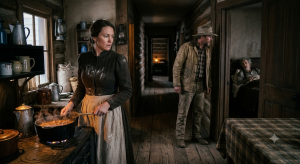
Every Tuesday morning, Ruth Yoder set two extra biscuits on the pan.
Her daughter thought she was just baking too much again. Her neighbor thought it was habit from forty years of feeding a big family. But Ruth knew exactly who those biscuits were for.
She’d first noticed him six months ago.
The UPS truck would pull into her gravel lot just before noon — crunch, crunch, crunch on the stones — and the young man would climb out, carry her packages to the porch, and then do something that stopped her cold the first time she saw it.
He’d get back in the truck. Alone. And just… sit there.
Not on his phone. Not eating. Just sitting with his hands folded on the steering wheel, staring at nothing, like a man carrying something too heavy to put down.
Ruth had watched from behind her curtain in the quilt shop. Shipshewana wasn’t a place where you rushed past quiet suffering without noticing it.
She noticed.
She noticed, too, the way his uniform hung loose on his frame. The hollows under his eyes. The way he moved like someone who hadn’t slept enough in a very long time.
But the thing she couldn’t stop thinking about was the lunch pail.
Battered old canvas, the kind you’d find at a farm sale. And laminated right to the lid — a child’s crayon drawing of a house. Crooked chimney, yellow sun in the corner, the way every child in the world draws a house when they’re small and the world still feels safe.
Every single Tuesday, before he set that pail on the seat beside him, he’d rub the lid with his thumb. Slow and careful, like he was polishing something precious.
He never opened it during his break.
Ruth prayed on it three nights before she did anything. Then she just started tucking a foil packet into his delivery box. Ham biscuit, wrapped warm. A small container of apple butter on the side. No note. Nothing fancy.
The first Tuesday, he stood on her porch for a long moment after he found it. She watched him from behind the fabric bolts. He didn’t look around for her. He just held it in both hands like he wasn’t sure what to do with something given freely.
The second Tuesday, he ate it in the truck.
By the third Tuesday, she’d added a thermos of coffee.
She never spoke to him directly about it. He never knocked to say thank you. But one morning in October, she found a single orange chrysanthemum tucked under her doormat. No note. Just that.
She put it in a mason jar on the windowsill where she could see it while she quilted.
This went on through November. Through the first hard freeze. Through the dark mornings when she had to warm up the kitchen early just to have everything ready in time.
She learned his schedule the way you learn a person’s habits when you care about them without making a fuss about it. He always rubbed the lunch pail before he set it down. He always sat exactly twenty-three minutes. He always pulled out of her lot slowly, like he was reluctant to leave.
She never learned his name.
She told herself that was fine. Some kindness doesn’t need to know a name to be real.
Then last Tuesday came.
She had the biscuits wrapped. The coffee hot. She heard the gravel and felt the small bright lift in her chest she always felt at that sound now.
But the truck that pulled in wasn’t brown.
It was a dark sedan. Navy blue, or maybe black — hard to tell in the gray winter light. It idled for a moment in the spot where the UPS truck always parked. Ruth stood very still behind her curtain, the foil packet warm in both hands.
The driver’s window rolled down.
A man she had never seen — older, thick coat, a face she couldn’t read — reached out his arm.
He was holding the canvas lunch pail.
The crayon house on the lid. The laminate worn soft at the edges. She could see, even from the window, the pale spot in the center where a thumb had polished it ten thousand times.
Her legs carried her to the porch before she’d made the decision to move.
The man looked at her the way people look at you when they’ve been given a task they don’t fully understand but mean to carry out right.
“Ma’am,” he said, his voice low and careful.
“He asked me to make sure you got this before anything else happened.”
Ruth’s hand went to her mouth.
The chrysanthemum was still in the mason jar on the windowsill behind her.
The pail was still warm.
The older man stepped out of the sedan.
For a moment neither of them spoke.
Then Ruth found her voice.
“Is he hurt?”
The man swallowed.
“My name is Walter. I’m his supervisor.”
The answer wasn’t really an answer.
Ruth felt her stomach tighten.
“Please,” she whispered.
Walter looked down at the lunch pail.
“His name is Daniel.”
The name settled heavily between them.
After six months, she finally knew it.
Daniel.
Not “the UPS driver.”
Not “that young man.”
Daniel.
Walter continued carefully.
“Three days ago, he collapsed during a delivery route.”
The world seemed to tilt.
Ruth gripped the porch railing.
“Collapsed?”
“He’d been pushing himself too hard for a long time.”
Walter paused.
“Doctors found an aggressive heart condition. One he didn’t know he had.”
The foil packet slipped slightly in Ruth’s hand.
Walter nodded toward it.
“He talked about those biscuits.”
Ruth blinked.
“What?”
“He talked about them all the time.”
A faint smile crossed the older man’s face.
“He called you ‘the biscuit lady.'”
For the first time, Ruth felt tears sting her eyes.
Walter reached into his coat and pulled out an envelope.
“He left this for you.”
The handwriting on the front was careful and uneven.
For Ruth.
Nothing more.
She sat at her kitchen table after Walter left.
The winter light faded against the windows.
The envelope trembled slightly in her hands.
Inside was a folded letter.
And a photograph.
The photograph showed a little girl with pigtails standing in front of a house.
The same house drawn on the lunch pail.
The same crooked chimney.
The same yellow sun.
Ruth stared at it.
Then she unfolded the letter.
Dear Ruth,
I hope you don’t mind me using your first name. I never knew if I should introduce myself. Every week I meant to. Every week I lost my nerve.
The first biscuit you left on my porch came on the worst day of my life.
My daughter, Emma, died eighteen months ago.
She was seven.
The doctors called it an accident. Everyone said time would help.
Time didn’t.
After she died, I stopped knowing how to live without her.
The lunch pail was hers.
She drew that picture when she was five.
I carried it every day because it was the only thing that still felt connected to her.
That’s why I rubbed the lid.
I wasn’t polishing it.
I was trying to remember her face.
By now Ruth could barely see through the tears.
She continued reading.
Every Tuesday became the hardest day of the week.
Tuesday was the day she used to have lunch with me.
When my route brought me to your property, I would sit there because I couldn’t face driving again right away.
Then one day I found a warm biscuit.
I don’t think you understand what that meant.
People are kind when tragedy is new.
Then life moves on.
But grief doesn’t.
For a long time I felt invisible.
Like everyone expected me to be healed already.
You never asked questions.
You never forced conversation.
You simply remembered I existed.
Week after week.
You gave me something to look forward to.
Something steady.
Something good.
Ruth stopped and pressed a hand against her chest.
The kitchen felt very quiet.
The letter continued.
The chrysanthemum was from Emma’s garden.
I planted it after she died.
You deserved something beautiful.
If you’re reading this, it means things got serious faster than expected.
I don’t know what happens next.
But I wanted you to know that you changed a life.
Not with speeches.
Not with advice.
Just with biscuits and coffee.
The world needs more people who notice.
You noticed.
Thank you.
Daniel.
Ruth cried until the words blurred.
Then she folded the letter carefully and placed it beside the mason jar holding the chrysanthemum.
The next morning, she made a decision.
On Tuesday she baked four extra biscuits.
Not two.
Four.
Her daughter found her in the kitchen before dawn.
“Mom,” she said gently, “he isn’t coming back.”
Ruth nodded.
“I know.”
“Then why are you baking?”
Ruth looked toward the window.
Because she had learned something over the last six months.
Kindness was never a transaction.
It wasn’t something you stopped because the other person couldn’t repay it.
“We’re taking breakfast to the cardiac ward.”
Her daughter stared.
Ruth smiled.
“There’s probably another Daniel sitting somewhere alone.”
The following Tuesday they brought biscuits to nurses.
Then patients.
Then family members sleeping in waiting rooms.
The Tuesday after that, church volunteers joined them.
By spring, the little effort had a name.
Emma’s Table.
Nobody planned it.
It just grew.
A warm meal.
A listening ear.
A reminder that somebody noticed.
Months later, Ruth received a phone call.
The voice on the other end sounded stronger.
Healthier.
“Ruth?”
She froze.
“Daniel?”
A laugh.
The first she’d ever heard from him.
“Yeah.”
She sat down hard in her chair.
For a moment neither spoke.
Neither needed to.
Finally Daniel said, “Walter told me what happened after.”
Ruth smiled through fresh tears.
“People helped.”
“No,” he replied softly.
“You helped first.”
There was silence.
Then he added:
“Emma would’ve liked you.”
Ruth looked toward the mason jar on the windowsill.
The chrysanthemum had long since faded.
But beside it sat a fresh one.
Someone left it every October.
No note.
No explanation.
Just a flower.
And every Tuesday morning after that, Ruth Yoder still set extra biscuits on the pan.
Because sometimes the smallest acts of kindness travel farther than any delivery truck ever could.
And because somewhere, someone was still waiting to be noticed.