Margaret Calloway had spent most of her life believing that libraries taught people how to return things.
Books, certainly. Magazines, DVDs, seed packets, local history binders that should never have left the building in the first place. But also quieter things. Borrowed time. Borrowed comfort. A little peace after a bad week. A place to sit when home felt too loud or too empty. People came into a library carrying invisible burdens, and sometimes they left just a little lighter.
At seventy-two, Margaret was officially retired, though nobody at the county branch believed that word fit her anymore. She still volunteered three mornings a week. She still unlocked the side cabinet where the large-print mysteries were kept. Still knew which elementary school teachers came in before semester breaks and which ranchers pretended not to like poetry even while checking out cowboy verse. She still believed every person who entered the library deserved privacy, dignity, and the chance to be left alone if that was what they needed most.
That was why she noticed the young woman the first day and pretended not to.
It was an October Tuesday, the kind that made the mountains look beautiful and the air feel mean. Margaret was behind the desk processing returns when the front door swung open and the woman stepped in with a gust of cold following close behind her.
She looked no older than thirty, maybe younger. Thin coat. No gloves. Hair tied back loosely, as if she had done it with one hand while searching for something with the other. Her face was tired in the way people got when sleep wasn’t solving the problem anymore. The shadows under her eyes looked pressed into the skin.
She didn’t approach the desk. Didn’t ask for directions. Didn’t browse the new arrivals.
She went straight to the children’s section.
Margaret kept stamping due dates and sliding returned books onto the cart, but she watched from the corner of her eye. The woman moved slowly along the low shelves, fingertips trailing across brightly colored spines. Once, she stopped and stood perfectly still for so long that Margaret thought she might cry. But then she crouched, selected a book, and kept going.
In the end she brought four titles to the counter.
Where the Wild Things Are.
Goodnight Moon.
The Very Hungry Caterpillar.
Frog and Toad Are Friends.
Margaret smiled and asked whether she needed a card. The woman nodded. Margaret explained the fee was fifty cents. The woman emptied her coat pocket and counted out the coins one by one, carefully, with no self-pity and no embarrassment. Only concentration.
When Margaret handed over the temporary card and stamped the due date slip, the woman gathered the books against her chest with both arms. It was such a small movement, but something about it made Margaret’s throat tighten. Those books were not casual reading. They were not for decoration. They were ballast.
The woman left without another word.
The books did not come back in two weeks.
Margaret renewed them.
They did not come back two weeks after that.
Margaret renewed them again.
She never told anyone she was doing it. Janice would have objected on principle. Carol would have worried on Margaret’s behalf. But Margaret had spent too many years working in small public spaces to mistake rules for justice. Overdue notices were useful. They were not sacred. Sometimes a person needed one less thing demanding their attention.
By the eleventh week, Margaret knew the renewal schedule by heart. She also knew she had started looking at the front door every Tuesday morning, as though some part of her expected the woman to return on the same day she had first appeared.
Then, one slow afternoon, something happened that changed the shape of waiting.
Margaret was cleaning up old account records, a tedious task involving duplicate registrations and outdated contact information. The branch had migrated systems over the years, and messy data surfaced like old sediment whenever somebody tried to organize it.
A number caught her eye.
A children’s account linked to the young woman’s registration.
That in itself wasn’t strange. Parents often opened adult cards after using children’s borrowing privileges under a household profile. But when Margaret clicked through the file, her attention sharpened.
The account was seven years old.
Belonged to a boy.
His first and last name were typed in ordinary black text, but attached to the scan of the original form was a note from the day the card had been issued. Margaret could see the signature line, the guardian authorization, the little box the child had checked promising to take care of borrowed books. In the margin, there was a faint blue scribble. She imagined a boy leaning too close to the desk, wanting to claim the card before the ink was even dry.
Then she saw the account status.
Closed.
Flagged.
And in the notes field were three words that made her straighten in her chair.
Closed at guardian request.
Margaret read the line twice, then closed the file.
At the time she didn’t know why it unsettled her so deeply. There was nothing obviously sinister about a guardian closing a child’s card. It happened when families moved, when children aged into teen accounts, when paperwork got cleaned up after a death.
A death.
The thought arrived so suddenly that Margaret looked away from the monitor.
She had seen loss move through library buildings before. A father returning books his wife had been halfway through when she died. A grandmother asking whether late fees could be waived because she had spent the month at a hospital. A little girl using the computer to type a letter to a mother in rehab because she didn’t know where else to do it.
Still, something about that note stayed with her. Perhaps it was because the woman hadn’t looked like someone carelessly misplacing library materials. She had looked like someone carrying a relic.
Margaret told herself not to speculate.
She failed.
Three Tuesdays later, the woman returned.
Margaret was shelving picture books near the mural wall when she heard the front door and felt, before she turned, that it was her. Some arrivals carried their own weight into a room.
The woman’s jacket was the same. So was the exhaustion. But there was a different expression in her eyes now, a stripped-bare look Margaret recognized from hospital waiting rooms and funeral homes. The look of a person who had reached the end of avoidance.
She came to the desk and stopped.
Margaret set down the books in her hand.
Neither spoke.
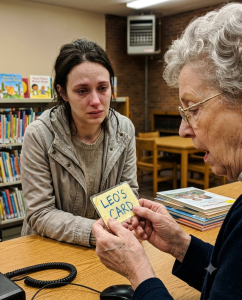
Then the woman slipped a hand into her pocket and placed something on the desk between them.
A library card.
Not the temporary paper sleeve card Margaret had issued in October. This one was older. Laminated. Worn pale at the edges. Soft with handling. Margaret picked it up gently and turned it over.
Blue crayon on the back.
A boy’s name.
A memory stirred—small hands, serious face, the excitement children had when they wrote their names on things that mattered.
Margaret looked up. The woman’s eyes glistened.
In a voice so soft it was almost swallowed by the hum of the heater, she said the name on the back of the card.
Margaret felt the blood leave her face.
The boy from the account.
The child in the file.
The one whose card had been closed at guardian request.
“I remember this number,” Margaret said before she had decided to speak.
The woman stared at her. “You do?”
Margaret nodded. “I saw the record a few weeks ago.”
Something flickered across the woman’s expression. Hope, fear, dread—so tangled Margaret couldn’t separate them.
She lowered her voice. “I didn’t understand the note then.”
The woman swallowed hard. “What note?”
Margaret hesitated. Library privacy mattered. But so did harm. And whatever was happening here already felt larger than policy.
“The account was closed,” Margaret said carefully. “The system says it was closed at guardian request.”
The woman went completely still.
A second passed. Then another.
“I never asked for that,” she whispered.
The words entered Margaret like ice water.
The woman pressed a hand over her mouth and shut her eyes, as if trying to hold herself together physically. When she spoke again, her voice shook. “They told me his belongings had already been collected. They said the hospital had released what they had, and the rest…” She couldn’t finish. She tried again. “They told me there was nothing left.”
Margaret glanced toward the office hallway. “Would you like to sit down?”
The woman shook her head hard. “No. If I sit down, I don’t think I’ll get back up.”
Margaret understood.
“What was your son’s name?” she asked, though she already knew.
The woman looked at the card and said it aloud. This time the name came out broken, but stronger than before, like it had been trapped and was finally forcing its way into the open.
“My name is Elise,” she added after a moment. “He was six.”
Margaret felt her chest tighten. “I’m Margaret.”
A sad, almost disbelieving smile crossed Elise’s face. “I know. It says so on the receipts.”
So she had kept those too, Margaret thought.
Elise looked around the library as though seeing it for the first time without panic. Children whispered near the craft table. A volunteer reshelved audiobooks. Ordinary life went on inches away from catastrophe, the way it always did.
“He loved this place,” Elise said. “I used to bring him every week. He always chose one silly book, one animal book, one bedtime book, and then Frog and Toad. Always Frog and Toad.” Her fingers trembled against the desk. “After he died, I stopped coming. I couldn’t even drive past. Then one day I found the old card in a coat pocket I hadn’t washed because it still smelled like him.”
Margaret said nothing.
“I came back because I wanted to check out the books he loved,” Elise continued. “I don’t know why. Maybe I thought if I read the same pages in the same order, I could hear him again. Or maybe I just needed proof that he was real somewhere outside my head.” Her eyes filled. “Everyone started acting like saying his name too often was a problem to be managed.”
Margaret had no answer worthy of that.
“How did he die?” she asked gently.
Elise’s jaw tightened. “Officially? Complications after surgery.” She looked down. “Unofficially, I still don’t know. He went in for something routine. Then there were delays. Mistakes. Confusing explanations. I asked questions nobody wanted to answer.” She gave a hollow laugh. “After that, people got very kind in the worst possible way.”
Margaret felt the room sharpen around her. “Who told you there was nothing left of his belongings?”
Elise hesitated. “My ex-husband handled most of the paperwork. We were separated, but he stepped in because I…” She shook her head. “I wasn’t functioning. His sister helped. They said they took care of everything. They kept telling me to rest, to grieve, to stop tearing myself apart.” Her face changed as she looked at the card. “But if they closed this account, that means someone came here. Someone signed something.”
Margaret’s librarian instincts, trained on forms and signatures and paper trails, clicked into place. “Not everything here is digital,” she said. “Older closures often had a paper authorization.”
Elise looked at her as though a door had just opened in a wall she thought was solid.
“Would that still exist?”
“If it was filed properly, yes.”
Margaret did not wait for Janice’s permission. Some decisions arrived fully formed.
“Come with me.”
She led Elise down the short hallway to the back office, past the staff restroom and the supply closet that always smelled faintly of dust and lemon cleaner. The records cabinets stood against the wall, gray and unremarkable. Margaret unlocked the upper drawer where archived account closures were kept by year.
Her hands were steady now. Sometimes shock made a person calmer, not less afraid.
She found the year, then the month, then the file number tied to the boy’s account. She slid the folder free and laid it on the table.
Inside were the expected pages: intake form copy, borrowing history summary, closure notation.
And one signed request.
Margaret stared at it.
Not because the signature was illegible. Because it wasn’t Elise’s.
“Is that yours?” she asked, though she already knew the answer.
Elise leaned over the table. Her face drained of color.
“No.”
The signature belonged to another woman.
The relation line read: aunt/temporary guardian.
Elise gripped the metal edge of the table so hard her knuckles whitened. “His aunt?”
“Your ex-husband’s sister?” Margaret asked.
Elise nodded once, mechanically.
Margaret looked again. The date was three days after the boy’s death.
“There’s more,” she murmured.
Attached to the request was an item release acknowledgement. Not library property—personal effects left in a reading nook cubby during a weekly program and later stored at the desk. According to the form, those items had been collected by the same woman on the same day.
Elise’s eyes moved over the page and then stopped.
“What items?” she asked.
Margaret read the line.
“One red child backpack. One library card. One small spiral notebook.”
Elise made a sound Margaret would remember for the rest of her life. Not a scream. Not a sob. A sound of understanding arriving violently.
“He had a notebook,” Elise said. “He drew in it everywhere. Dinosaurs, buses, the moon. He started making lists because he wanted to be like grown-ups.” She turned to Margaret, tears finally spilling. “I asked about his backpack. They told me it had been lost.”
Margaret felt anger bloom, clean and hot.
“May I make copies?” Elise asked, voice shaking.
“Yes,” Margaret said. “And more than copies.”
Janice did object when she learned what was happening. She cited policy, privacy, liability. Margaret listened until Janice had finished, then said with the calm authority of a woman who had spent forty years understanding both systems and people, “The mother is present. The records concern her minor child. The file shows a third party represented herself as guardian. If that representation was false, the branch should want documentation preserved, not hidden.”
Janice, to her credit, recovered quickly. Once she saw the paperwork and Elise’s identification, procedure shifted from resistance to caution. Copies were made. Chain-of-custody notes were added. The branch director was informed.
Elise sat at the small employee table while this happened, one hand over her mouth, the other holding the worn card so tightly Margaret feared it might crack.
“Why would she do that?” Elise asked at last.
Margaret answered with care. “There are many possible reasons. To control what you received. To decide what story was told. To keep something from you.”
Elise closed her eyes. “My ex kept saying I was too fragile for details. That his sister was helping because she was organized. She handled discharge papers, donation forms, calls. I was grateful.” Her mouth twisted. “God, I was grateful.”
Margaret sat beside her. “Being in shock is not consent.”
That sentence seemed to land.
Elise opened her purse with trembling hands and pulled out her phone. “I need to call someone,” she said. “Not him. Not yet.”
She called her cousin, a nurse in Salt Lake City who had questioned the hospital timeline from the start. Margaret heard only one side of the conversation, but it was enough.
“I found paperwork… No, at the library… She signed as guardian… There was a notebook, Rachel… yes, his backpack too… no, I never got either one…”
By the time Elise hung up, her grief had changed expression. It was still there, immense and raw, but now it stood beside something sharper.
They spent the next hour pulling what records the library was legally allowed to release. The borrowing history showed the boy’s favorite books over two years. Frog and Toad twenty-three times. Counting books. Space books. One improbable fascination with bees. Margaret printed the list without asking whether Elise wanted it. Some keepsakes should not require permission.
When she handed over the pages, Elise touched the title list as if it were braille.
“I thought I was losing pieces of him because memory fades,” she said. “But some pieces were taken.”
Margaret didn’t pretend otherwise.
That afternoon, Elise did what she had been discouraged from doing for months. She called the pediatric unit social worker directly instead of going through her ex-husband. She requested the personal effects inventory. She requested visitor logs. She requested every release form carrying her son’s name.
Three days later, she returned to the library with Rachel.
The hospital records confirmed that a backpack and spiral notebook had been signed out by the aunt. The release authorization listed “family representative” but included no proof of legal guardianship. The social worker, now alarmed, admitted the unit had relied on information provided by the father and aunt during a chaotic shift change. Elise had not been contacted because staff were told she was sedated and unavailable. She hadn’t been.
More painfully, the notebook was not gone.
Rachel had confronted the aunt that morning. At first the woman denied remembering it. Then, when shown copies of the forms, she broke. She said she had taken the backpack because the father “couldn’t bear more clutter.” She said the notebook contained drawings and “things a grieving mother didn’t need to obsess over.” She had meant to return it later, she claimed, but time passed and then it felt impossible.
“What she really meant,” Rachel said grimly, “is that she read it.”
Elise sat very still.
The notebook was brought over that evening.
Margaret was not there for the delivery, but Elise told her about it the following week.
Her ex-husband came with his sister. Neither met her eyes at first. The backpack was faded red, exactly as described. Inside was the library card, though Elise had already found that in the coat pocket, and a spiral notebook with bent corners and a dinosaur sticker peeling off the front.
Her ex-husband apologized in the language of weak men: not for what he did, but for how upsetting everything had become. He said he had been trying to protect her. He said his sister was only helping. He said they thought she was too fragile to manage one more blow.
Elise asked him whether he had read the notebook.
He said yes.
Then she asked whether there was something in it he didn’t want her to see.
He hesitated.
That was answer enough.
Inside were drawings, lists of favorite animals, attempts at spelling, and several pages from the week before surgery. On one page, her son had drawn himself in a hospital bed next to a nurse with red glasses. Underneath, in painstaking letters, he had written: Dad got mad in hall. Told lady don’t tell Mom again.
Elise showed the page to Rachel first, then to a lawyer.
Nothing in the notebook changed the fact of her son’s death. It did not prove malpractice by itself. Children heard fragments and misunderstood adult conversations. But it raised new questions about what had been said, what concerns had been dismissed, and why the father had been so determined to control information afterward.
The hospital opened an internal review.
Elise filed a formal request for records through counsel.
Her marriage, already broken, ended for good.
Months later, she told Margaret the investigation did not produce the dramatic courtroom ending people imagined when they heard the story. No one was led away in handcuffs. No doctor publicly confessed. The findings used cautious language about communication failures, documentation gaps, and procedural concerns that should have prompted earlier disclosure to both parents.
But something else happened, and to Elise it mattered more.
The official record changed.
A supplementary note was added acknowledging that she had not been properly informed about the collection of her son’s personal belongings and had not authorized the aunt to act as sole guardian representative. The hospital issued a written apology. The library updated its own procedures for release forms involving minors and archived accounts.
And Elise got back the backpack, the notebook, and the right to say her son’s name without anyone flinching or redirecting her pain into silence.
She also returned the four books.
Not all at once. She brought them in on a bright spring morning when the mountains were finally green again. Margaret was at the desk. Elise placed the books down gently, one by one, and smiled through tears.
“I think I’m done renewing them,” she said.
Margaret checked them in, though both women knew the gesture was symbolic. Some things had been overdue far longer than eleven weeks.
Before leaving, Elise handed Margaret a folded sheet of paper. It was a photocopy from the notebook. Not the hospital drawing. A different page.
On it, in a child’s determined print, was a list titled BOOKS FOR WHEN MOM IS SAD.
Frog and Toad.
Moon book.
Bug book.
Wild rumpus.
Margaret had to remove her glasses.
At the bottom of the page, in smaller, wobblier letters, the boy had written: Read wif me.
That copy stayed tucked in Margaret’s desk drawer after that.
Now and then she took it out on quiet mornings while the coffee cooled beside her hand and the heater rattled awake in the walls. She would think of all the ways institutions failed grieving people by demanding neatness from chaos. She would think of how easily kindness could become control when the wrong person took charge of someone else’s pain. And she would think of a mother who came back to the library carrying one soft-edged card because somewhere inside her, hope had survived just long enough to lead her to the one place that still kept a trace of her child.
Margaret still believed libraries taught people how to return things.
But after Elise, she understood something else.
Sometimes a library did not return what had been borrowed.
Sometimes it returned what someone had tried very hard to keep hidden.
And if you were paying attention, the smallest object in the building—a worn little card with a name in blue crayon—could tell you exactly who had loved a child, who had failed him, and who had no right to decide that remembering him was too painful for everyone else.
The hardest part, Margaret thought, was not deciding who was right.
It was realizing how often grief invited helpers, and how often the most dangerous person in the room was the one who called control a kindness.