They all looked up from their phones at the exact same moment.
Not one or two of them. Not the people on the edges who were half-paying attention. Every single board member, the mayor, the tourism director, even the editor from the regional travel magazine. One by one, as their screens lit up, the expressions on their faces shifted from polite public cheer to something far more private and far more dangerous.
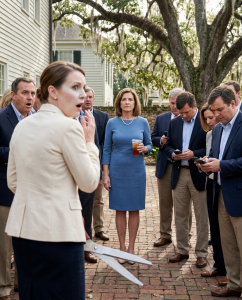
Then they all stared straight past the ribbon, past the cameras, past Darlene Fosse in her cream blazer.
They stared at Cecelia Tureaud.
Cecelia stood at the back of the crowd in a blue dress she reserved for church, funerals, and matters of consequence. In one hand, she held a sweating plastic cup of sweet tea. Her posture was easy, almost relaxed. But there was something in her eyes that made several people around her instinctively step aside.
She did not wave. She did not smile. She only waited.
A second later, the mayor’s ceremonial scissors slipped from his hand and clanged against the brick walkway.
That sound would be retold around Natchitoches for months.
But the truth of what happened that day started long before the ribbon-cutting, and long before anyone’s phone buzzed.
It started with Magnolia House.
The Magnolia House Inn sat on Jefferson Street beneath old oaks and a tangle of climbing jasmine. The front porch wrapped around like an embrace, the paint always fresh even when money was tight. The banister had been smoothed by generations of hands. Guests said the house felt as if it remembered them, and maybe it did. Some places absorb the shape of the people who love them.
Cecelia Tureaud had spent thirty-one years making sure Magnolia House remained that kind of place.
She woke before dawn most mornings. Even after hiring help, she still liked to iron pillowcases herself because she said guests could tell the difference between linen pressed by someone who cared and linen pressed by someone trying to finish a shift. She made pain perdu from scratch, cut fruit by hand, polished old silver, and arranged flowers from the side garden in small glass vases no one noticed until they were gone.
Tourists came for the historic charm and the river-town romance. They came because the travel blogs said the inn was authentic. They came because Magnolia House had once hosted a state senator, or because their aunt had stayed there in 1989, or because someone had written in an online review that breakfast felt like being fed by an old friend.
They came back because of Cecelia.
Over the years, guests became regulars, and regulars became part of the rhythm of her life. She remembered names, anniversaries, food allergies, mourning periods, grandchildren. She sent sympathy cards when former guests lost spouses. She tucked extra biscuits into takeout boxes for long drives. She made people feel that the house was not performing hospitality for profit. It was practicing it as a way of being.
The inn had been in her family since 1897.
That date mattered to Cecelia almost as much as her own birthday. She had grown up hearing stories about the original purchase, about flood seasons and repairs, about births and deaths and one fire that had singed only the kitchen wall because her great-grandmother had caught it in time. Family papers had been preserved with almost obsessive devotion. Tax documents, deeds, church witness notes, letters, maps, receipts—if it touched Magnolia House, someone had saved it.
Her grandmother’s family Bible was thick with folded documents, some so old they crackled when opened. As a child, Cecelia had watched those papers handled with reverence. As an adult, she inherited them.
She also inherited the belief that history did not protect itself. Someone had to keep it in order.
That was why Darlene Fosse felt, at first, like a blessing.
Darlene was polished, ambitious, socially fluent in ways Cecelia never tried to be. She knew donors, magazine editors, event planners, everyone who mattered in tourism circles. She wore cream and linen and expensive perfume that never seemed too strong. She understood branding. She said phrases like “regional positioning” and “elevating legacy properties” and somehow made them sound useful instead of ridiculous.
When Darlene first approached Cecelia about a partnership tied to Magnolia House’s expansion possibilities, plenty of people called it smart. Cecelia knew how to run an inn. Darlene knew how to make people talk about it.
The partnership began carefully. Darlene helped with marketing, package deals, local partnerships, event exposure. Magnolia House appeared in more brochures. Its bookings climbed. Cecelia remained the face and heart of the place while Darlene handled the rooms where contracts got discussed over wine and polite smiles.
Six years passed.
Somewhere in those six years, Darlene became part of Cecelia’s life in ways that felt personal. She attended six Christmas dinners at Cecelia’s house. She sat at a table set with inherited china and listened to family stories. She complimented recipes, brought fig preserves, laughed with Cecelia’s daughter on the phone. She knew where the good silver was kept. She knew how much Magnolia House meant.
That was what made the betrayal so vicious.
Cecelia first heard of it at the crawfish festival.
The music was loud. Someone nearby was arguing over ticket strips. Children in bright shirts ran between folding tables. Cecelia had just finished speaking with a vendor about linens when a woman from the tourism board touched her elbow and asked whether they could talk for a minute.
The woman’s face already told Cecelia it was bad.
“Honey,” she said quietly, guiding her away from the crowd, “you need to know what’s being said about you.”
Cecelia waited.
The woman hesitated, then lowered her voice further.
“Darlene’s telling people the Magnolia House records were falsified. That your family claim to the property isn’t clean. That some of the historic filings don’t match.”
For a moment, the sounds of the festival went flat and far away.
Cecelia did not react right away. Not because she wasn’t stunned, but because the accusation made so little sense she had to arrange it in her mind before she could feel it.
Falsified.
That wasn’t gossip. It was strategy.
By the time she understood the scale of it, the consequences were already arriving.
The Natchitoches Bed and Breakfast Association had begun discussing “concerns” about Magnolia House’s documented history. Those concerns had not come to Cecelia first. They had circulated around her. Questions were framed as due diligence. Expressions of regret were delivered with professional distance. People talked about reputational risk.
Then the regional travel magazine pulled its upcoming feature.
Cecelia had known about that feature for months. A cover spread on Magnolia House was supposed to anchor fall tourism. Photographers had already come out once. Preliminary copy had been discussed. Darlene herself had toasted to it over dinner.
Then suddenly, the feature changed.
Without public explanation, the magazine redirected its attention to Darlene’s newly developed inn.
By the end of the month, Cecelia was removed from the tourism board.
Some members were apologetic. Some avoided her. Some acted so righteous she nearly admired the performance. Everyone seemed to agree that until “certain matters” were clarified, it was best to create distance.
Distance from what Cecelia had built.
Distance from her name.
The town had expected a war.
That was part of what made Cecelia’s next move so unsettling.
She did nothing publicly.
No press statement. No attorney threatening defamation suits. No dramatic insistence on innocence. She continued opening Magnolia House every morning. She greeted guests. She cooked breakfast. She answered emails. She nodded at people downtown.
Her daughter, Elise, called almost every day from Shreveport.
“Mama, she’s stealing your life while you stay quiet.”
“I know what she’s doing,” Cecelia would say.
“Then stop her.”
“I am, baby.”
“How?”
Cecelia would only reply, “I’m doing something.”
It sounded passive to everyone except Cecelia.
In truth, she was moving with terrifying patience.
She began where she always began: with the papers.
She opened boxes in the office. She spread deeds across the dining table after checkout. She unwrapped old survey copies from tissue. She checked names, dates, signatures, legal descriptions, parish notations, witness references. She compared Magnolia House’s current filing language to nineteenth-century tax ledgers.
Then she went beyond her own records.
She spent hours in the parish courthouse archive under dim lights and older dust. She visited the diocesan records room where property disputes had once been noted because church witnesses often stood in for absent clerks. She drove to see a retired surveyor whose father had worked boundary adjustments decades earlier. She located copies of maps that had not been digitized and a transfer correction recorded after a long-ago river boundary dispute shifted how adjacent parcels were described.
Slowly, the shape of it emerged.
Not only were Magnolia House’s records genuine, but one particular corrected survey addendum from 1902 clarified something crucial: the land designation attached to the original inn and its historic naming rights had been preserved through a corrected deed transfer that later summaries often omitted.
That omission mattered.
It mattered because Darlene’s new property sat close enough to borrow prestige from Magnolia House’s history if the old correction disappeared from the story.
And that was not all.
Buried inside the partnership paperwork from six years earlier was an amendment—signed by both women—that specifically acknowledged the historical deed chain and the protected use connected to Magnolia House’s original property identity.
In plain language: Darlene had already acknowledged the truth in writing.
She had known.
Not suspected. Not been confused. Known.
Cecelia found the signed amendment late one Tuesday evening. She sat alone in the office with a lamp on and read the page three times, then once aloud. The rage that came over her was not theatrical. It was cold, focused, and almost clarifying.
Elise was on the phone when Cecelia finally told her.
“Mama?”
“She knew,” Cecelia said.
There was a pause. “What do you mean, she knew?”
“I mean she signed it. Six years ago. She knew every word she was saying against me was false.”
Elise inhaled sharply. “Then sue her.”
“Maybe later,” Cecelia said.
“What do you mean maybe later?”
Cecelia looked at the document in front of her, then at the stack she had built around it. “First I want the right people to read.”
That was when the envelopes were conceived.
Cecelia made copies by hand and by machine, selecting the papers with surgical care. Not everything. Only enough. The corrected 1902 survey addendum. The church witness statement that corresponded to the transfer correction. A cover note, written in faded blue ink from a pen Cecelia favored. And the page from the partnership amendment signed by Darlene that proved prior knowledge.
Each envelope was addressed to a specific recipient. Each contained the same foundation, with small tailored notes where needed. To the board members, Cecelia included the documents necessary to understand that they had voted on false information. To the editor, she enclosed the proof that his redirected feature had benefited a woman who already knew the accusation against Magnolia House could not stand. To the mayor’s office, she added a simple line: I thought you’d want this before the cameras arrive.
She mailed some. Hand-delivered others through channels she knew would be quiet.
No announcement followed.
The beauty of the move was not just the evidence. It was timing.
Darlene’s grand opening was scheduled as a public triumph: televised ribbon-cutting, mayor in attendance, tourism leadership present, local press ready to frame her as a fresh face of heritage hospitality. Cecelia understood spectacle. She had watched Darlene build herself through it. So Cecelia chose the one moment when the people who had helped sideline her would be forced to decide, in public, whether to continue standing beside a lie.
The morning of the event, the envelopes arrived.
And then a peculiar thing happened.
People stopped talking.
In Natchitoches, that was more frightening than rumor.
A board member named Patrice Landry, retired schoolteacher and longtime guardian of procedural respectability, was asked outside the pharmacy what Cecelia had sent.
Patrice tightened her mouth and said, “That’s between me and Cecelia.”
Nothing more.
The editor stopped returning calls. The tourism director postponed a radio appearance. Two board members who had loudly defended Darlene all month suddenly became unavailable. Something heavy had entered the air over town, and everyone who had opened an envelope seemed to be carrying it.
Still, no one canceled the event.
Perhaps they thought it was too late. Perhaps they hoped to manage it quietly after the ceremony. Perhaps some simply did not understand how thoroughly Darlene had been cornered.
At noon, the day was beautiful enough to feel ironic.
October sunlight softened the river. Trees along Cane River cast lacy shadows. The camera crew from Baton Rouge loved the light and kept repositioning for cleaner angles. Guests and local onlookers gathered in semi-circles. Darlene moved through them effortlessly, touching elbows, smiling, laughing with the confidence of someone who had mistaken silence for safety.
When Cecelia arrived, almost no one noticed.
She parked down the street. Walked the block. Joined the crowd at the back. She wore a blue dress that fit beautifully without calling attention to itself. Her hair was pinned. Her earrings were small pearls. She carried sweet tea from home in a clear cup because she refused to stand there with nothing in her hands.
A few people recognized her and went visibly tense.
Cecelia did not acknowledge them.
At the front, the mayor accepted the giant silver ceremonial scissors. The ribbon was stretched. A producer counted down for a clean shot.
Applause started.
Then the phones buzzed.
The explanation would come out later. Several recipients, after opening their envelopes earlier that morning, had forwarded scans and photos to counsel, staff, or one another. Questions began circling in text threads. Someone had flagged the partnership amendment. Someone in the mayor’s office had sent a message marked urgent. Another board member had replied all. By noon, the people on stage were receiving the final wave of what they now understood.
The documents were real.
The signatures were real.
And Darlene was not merely accused of lying. She was demonstrably caught.
The mayor checked his phone first. Then the tourism director. Then Patrice. Then others.
One by one, each face altered.
Their eyes lifted.
Across the ribbon, across Darlene’s shining smile, they found Cecelia standing at the back.
Darlene noticed the silence before she understood the cause. She turned, following their stare.
When she saw Cecelia, something raw and unmistakable crossed her face.
Recognition.
That was the instant the mayor dropped the scissors.
The clang cut through the crowd. Conversations died. Even the camera crew froze.
“What is this?” Darlene asked.
But she did not ask Cecelia. She asked the mayor.
That detail would matter later because it revealed where Darlene thought power still lived.
The mayor did not answer.
Cecelia took one step forward.
“I believe,” she said, her voice even and carrying, “y’all are looking at the survey addendum from 1902. The one attached to the corrected deed transfer after the river boundary dispute.”
No one moved.
Darlene’s color drained.
Cecelia continued, still calm. “Along with the church witness statement, and the partnership amendment signed six years ago.”
A murmur finally moved through the crowd.
Six years ago.
Signed.
The accusation had not been a misunderstanding. It had been planned against facts Darlene already possessed.
The editor from the travel magazine lowered his phone and stared at Darlene with an expression halfway between embarrassment and panic. Patrice looked as though she might cry, not for Darlene, but for herself.
Darlene tried one final pivot. “You don’t understand—”
Cecelia’s gaze hardened just slightly. “I understand completely.”
Then she set her sweet tea down on the brick edge of a flower bed and reached into her handbag.
What she removed was not thick. Just one folded document, worn at the edges.
“This,” she said, unfolding it carefully, “is a copy of the original family correspondence referenced in the transfer correction. The name attached to the holding trust after the dispute was not yours to use, not then and not now.”
Darlene made a movement as if to step forward, then stopped.
Because printed plainly in black ink, above an old notary seal and beneath two witness names, was the detail she had counted on no one surfacing in time: the protected historical designation connected to Magnolia House’s identity had never passed into any line she could claim. Her attempt to blur the records had not just harmed Cecelia. It had positioned her own inn in conflict with the very history she had marketed.
The mayor recovered enough to speak. “Ms. Fosse, is this document authentic?”
Darlene said nothing.
“Darlene?” he repeated.
Still nothing.
The silence now belonged to Cecelia.
Not loud silence. Not dramatic silence. The kind that settles when a room realizes the truth has already won and all that remains is deciding who will admit they helped the lie.
The camera crew did not stop filming.
Someone in the crowd whispered, “Lord.”
The editor asked weakly, “You signed an amendment acknowledging this?”
Cecelia answered for her. “Yes, she did.”
Darlene looked around as if searching for a version of events she could still control. There wasn’t one. The board members would not meet her eyes. The mayor had stepped back from the ribbon. Patrice was already pulling off her event badge like it had become too heavy to wear.
What happened next was not explosive. There was no screaming, no collapse, no dramatic confession.
That made it worse.
The mayor quietly instructed staff to suspend the ceremony. The camera crew kept shooting until one of Darlene’s people asked them not to, at which point the producer replied that public events were public events. The tourism director moved away to make a call that sounded like damage control. The editor from the magazine, red-faced and sweating, approached Cecelia and asked whether she would be willing to speak privately on Monday.
Cecelia looked at him for a long moment and said, “You had my number before.”
Then she picked up her sweet tea.
Within a week, the consequences spread.
The board issued a statement acknowledging that prior decisions regarding Magnolia House had been made based on incomplete and inaccurate information. It was a bloodless statement, but everyone knew what it meant. Cecelia was invited back to the tourism board. She declined the first invitation and accepted the second, after making them wait long enough to feel it.
The travel magazine shelved the story on Darlene’s inn. Two months later, Magnolia House appeared on the cover after all, photographed in winter light, with Cecelia on the porch in a navy sweater and pearl earrings. The article called her “a steward of history.” People in town pretended that phrase had always fit naturally in their mouths.
As for Darlene, the unraveling was slower than some might have hoped, but deeper.
Investors began asking questions. A branding consultant quietly withdrew. The grand opening footage never aired in the triumphant form it had been intended to. Legal reviews followed, not just of the naming and marketing language surrounding her property, but of disclosures she had made in securing local support. Doors that had opened easily for her started closing with polite regret.
She sent Cecelia one handwritten letter three weeks later.
Cecelia read it in the office, folded it once, and put it in a drawer.
Elise asked what it said.
“That she made mistakes,” Cecelia replied.
“That’s all?”
“And that she never thought I’d go looking that far back.”
Elise stared at her. “You answer?”
Cecelia closed the drawer. “No.”
Spring came. Guests returned. The jasmine climbed again. Magnolia House filled with weddings, reunions, old travelers passing through and new ones arriving because they had heard the story.
Some asked Cecelia about it directly.
She rarely said much.
If pressed, she would only smile a little and say, “Best keep your papers.”
But people in town said more than she ever did.
They said Darlene had underestimated the wrong woman. They said she mistook gentleness for weakness and hospitality for softness. They said she forgot that families who keep Bibles full of documents are not sentimental by accident. They are building archives against exactly this kind of theft.
In the end, Magnolia House remained what it had always been: not merely a business, but an inheritance preserved by someone patient enough to defend it without begging for anyone’s belief first.
And that may have been the part people remembered most.
Cecelia did not win because she shouted louder.
She won because she knew what was true before the room did, and because when the time came, she let the truth arrive all at once in the hands of the very people who had helped push her aside.
By the time they looked up from their phones and saw her standing there in that blue dress, holding sweet tea and saying almost nothing, the matter was already settled.
Darlene had built her rise on the assumption that history could be bent if enough influential people repeated the same lie.
Cecelia answered with paper, patience, and timing.
And long after the magazine cover came out and the board apologized and the town found a new scandal to discuss, one uncomfortable question lingered behind every retelling:
What was the bigger red flag—that Darlene betrayed a woman who welcomed her into her home, or that so many respectable people were ready to believe the lie before they ever asked to see the records?