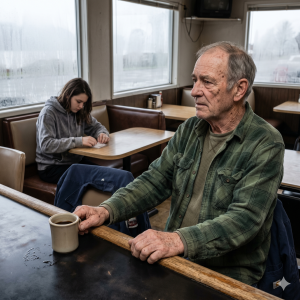
He’d eaten at Dolly’s Harbor Diner every morning for eleven years. Same stool. Same coffee. Same view of the Columbia River going gray in the early light.
Earl Hutchins had retired from the ferry at 65, and the water still called to him. He just didn’t have to answer it anymore.
That’s why he noticed her.
She was tucked into the corner booth like she was trying to take up as little space as possible. Sixteen, maybe seventeen. Dark hair pulled back. A hoodie that had been washed so many times the color had given up.
And she was eating ketchup packets.
Not with anything. Just tearing the corner and squeezing them slow, one after another, like she was rationing.
Earl watched over the rim of his mug and said nothing. Sometimes people don’t want to be seen. He knew that feeling.
But then he saw the card.
She had a laminated library card laid flat on the table in front of her, and she was smoothing it with both thumbs. Back and forth. Back and forth. Like it was a worry stone. Like it was the one thing in the world that was entirely hers.
He came back the next morning. She was there.
Ketchup packets. Corner booth. That library card, getting the same slow, careful treatment from those two thumbs.
Third morning, Earl sat down, looked at his plate — the full breakfast Dolly always brought without him asking, two eggs over easy, wheat toast, hash browns — and he thought about what it felt like to be hungry and too proud to say so.
He picked up his coffee. Walked to the corner booth.
“I ordered too much,” he said. “I can never finish this whole plate. You’d be doing me a favor.”
She looked up at him. Her eyes were the kind of tired that sleep doesn’t fix.
She didn’t say yes. She didn’t say no.
He set the plate down on her table and went back to his stool.
He heard the fork move against the ceramic before he even sat down.
He ordered toast and pretended to read the laminated menu he’d had memorized since 2013.
Dolly refilled his coffee without a word, but he caught her watching the girl. Not unkindly. Just watching.
The girl ate every bite. Then she laid the library card back down on the table and started smoothing it again with her thumbs.
Earl found himself staring at it from across the diner. Just a regular card. The Astoria Public Library logo. A name in small black letters he couldn’t read from here.
Something about the way she touched it made his chest feel tight.
He came back the fourth morning. Same stool. But this time he told Dolly to put whatever the girl in the corner ordered on his tab — and if she didn’t order, to bring her the full breakfast anyway and tell her it was a mistake from the kitchen.
Dolly looked at him for a long moment. Her expression did something complicated.
“Earl,” she said quietly. “You know her?”
“No,” he said. “Do you?”
Dolly glanced toward the corner booth. The girl had come in behind him, was already sliding into her seat, already reaching into her pocket.
Already laying that library card flat on the table.
Already smoothing it. Thumbs moving slow and careful, like a prayer.
“Not exactly,” Dolly said. She set down the coffee pot. “But Russ thinks he does.” She tilted her head toward the cook’s window, where Russ had gone very still, spatula in hand, staring through the pass-through at the girl in the corner.
Earl felt something shift in the room. The way pressure shifts before a storm comes in off the Pacific.
He watched the girl pick up the library card, turn it over once, set it back down.
Both thumbs. Back and forth.
He watched Russ set down the spatula. Watched Dolly walk to the pass-through and lean in close. Watched the two of them talk in low voices, Dolly shaking her head once, Russ pointing — not at the girl, but at the card.
That laminated library card.
Earl’s coffee went cold and he didn’t notice.
Dolly walked out from behind the counter. She came to his stool, and she bent down close, the way you do when you don’t want a room to hear, and her voice was barely a sound at all.
“Earl.” She put her hand on the edge of the counter near his. “That child’s last name.” A pause. “You need to look at it. You need to look at it right now.”
Earl Hutchins, who had navigated the Columbia River in November fog, who had kept his hands steady through storms that turned the water white —
gripped the edge of the counter.
He got up slowly, the way a man does when he’s not sure his legs are going to agree with the decision. He walked toward the corner booth. Not fast. Not the way you walk toward something good or something terrible. Just steady. The way he’d walked the deck of the Astoria Queen for thirty-one years when a crossing got rough.
The girl looked up when she heard him coming. She didn’t reach for the card. She just watched him with those tired eyes and waited to see what the world was about to do to her this time.
Earl stopped at the edge of the table. He looked down.
The library card was right there. Laminated, worn soft at the corners from handling. The Astoria Public Library seal. A barcode. And in the small black print where the cardholder’s name went —
Hutchins, Maya R.
The diner went quiet in a way that had nothing to do with sound. Earl could still hear the coffee percolating, the bell over the door, Russ scraping the flat-top. But some interior thing went absolutely still.
He pulled out the bench across from her and sat down.
She watched him. Her jaw tightened, just slightly, the way young people do when they’re preparing to be disappointed.
“Who gave you this card?” he said. His voice came out quieter than he intended.
She looked at him for a long moment. Deciding something.
“My mom,” she said. “She said libraries were the only place that had to let you in, no matter what. She said to keep it with me.”
Earl nodded slowly. “What’s your mom’s name?”
The girl looked at the card. Her thumbs found the edges of it again without her seeming to notice.
“Was,” she said. “Her name was Rennie.”
Earl sat very still.
Rennie Hutchins had been his daughter-in-law for four years before his son Danny went into the Columbia on a November night in 2014. A fishing accident, the report said, though Earl had spent a long time not being sure he believed that. Danny had been struggling. Danny had been the kind of struggling a father could see and not know how to reach.
After Danny died, Rennie had moved away. Portland, Earl thought. Then he’d lost the thread. She’d been kind to him at the funeral, kinder than she had to be, but they hadn’t known each other well, and grief does strange arithmetic with distance.
He had not known there was a grandchild.
He had not known.
“How long has she been gone?” he asked.
Maya looked at the table. “Eight months.”
“Where have you been staying?”
A pause. “Different places.”
Which meant nowhere good. Which meant nowhere safe. Earl didn’t push it.
“Did she ever mention me?” he asked. “Earl Hutchins. Danny’s father.”
Something moved across Maya’s face. Careful. Cautious. The expression of someone who has learned that hope is a thing that costs you.
“She talked about a ferry man,” she said slowly. “She said Danny’s dad worked the river his whole life and he was the most stubborn, steadiest person she ever met.” A beat. “She said he was the kind of person you could count on to still be in the same place.”
Earl’s throat tightened.
Same stool. Same coffee. Same view of the Columbia River.
Rennie had known that about him. Had known it well enough to pass it down.
He thought about that library card. The way Maya smoothed it with her thumbs, back and forth, back and forth. He understood it now. It wasn’t a worry stone. It wasn’t just an object.
It was a compass. Rennie had given her daughter a compass and told her where to point it.
Dolly appeared at the table without being asked. She set down a full plate in front of Maya — eggs, toast, hash browns, a side of fruit that wasn’t on the regular menu — and she set down a fresh coffee in front of Earl, and she didn’t say a single word, just rested her hand on the girl’s shoulder for one brief second before she walked away.
Maya stared at the plate. She pressed her lips together hard.
“You don’t have to—” she started.
“I know I don’t,” Earl said.
She ate. He drank his coffee and looked out at the river. The morning light was doing what it always did, burning the gray off slow, turning the water from pewter to something closer to silver. He’d watched it happen eleven thousand mornings, give or take, and it still wasn’t boring.
He let her eat in peace. He figured she’d had enough people crowding her.
When the plate was clean she sat back and looked at him with those worn-out eyes, and he could see Danny in the line of her jaw, the set of her shoulders, and something that must have been pure Rennie in the directness of her gaze.
“I didn’t know you existed,” he said. “I want you to know that. If I had known, I would have come a long time ago.”
She considered that. Weighing it the way you weigh things when you’ve had to get good at telling the difference between what people say and what they mean.
“Mom kept things separate,” she said finally. “She wasn’t — she wasn’t mad at you or anything. She just thought it was easier. After.”
Earl nodded. He understood easier. He’d done easier himself for a while, after Danny. Easier had its uses and its costs, same as everything.
“Where are you sleeping?” he asked.
She looked at the window.
“Maya.”
“There’s a place,” she said. “It’s fine.”
“Is it warm?”
A short silence that was its own kind of answer.
Earl looked at his hands on the table. Old ferryman’s hands, rope-scarred, thick at the knuckles. Hands that had held a wheel through thirty-one years of this river.
“I have a house on Niagara Avenue,” he said. “Three bedrooms. It’s just me.” He kept his voice matter-of-fact, the same way he’d set that plate down four mornings ago. No performance. No pressure. Just a thing being offered. “The second bedroom has a window that looks at the water. I always thought that room was wasted on nobody.”
Maya looked at him.
“I’m not a charity case,” she said. Quiet. Firm. Danny’s stubbornness, exact.
“No,” Earl agreed. “You’re my son’s daughter. That’s different.”
She looked at the library card on the table between them. She picked it up. Turned it over in her hands once, the way she always did, that small deliberate rotation.
Then she set it back down. And for the first time in four mornings, she left it alone.
She didn’t smooth it. She didn’t need to.
She’d found what it was pointing at.
“Okay,” she said.
It wasn’t a big word. Earl had heard bigger ones in his life, ones with more syllables, more ceremony. But he couldn’t think of one that had ever hit him harder.
He left a forty-dollar bill on the table for Dolly, which was twice what it should have been, and Dolly saw it and didn’t say a thing, just tucked it in her apron and looked out the window the way people do when they don’t want you to see their face doing something complicated.
Russ knocked twice on the pass-through as they walked past. Just twice. Earl raised a hand without turning around.
Outside, the Columbia was all the way silver now. The fog had burned completely off.
Maya stood on the sidewalk and looked at the river. Earl stood beside her. Neither of them said anything for a minute.
“Mom used to say it was the same river,” Maya said finally. “No matter where she went, she’d look at water and tell herself it was all connected. Same river.”
“She wasn’t wrong,” Earl said.
They walked to his truck. He didn’t make a fuss about holding the door or not holding it. He just walked to his side and got in and she got in on hers, and he started the engine, and they drove up through Astoria while the morning opened over the water.
He didn’t know what the next part looked like. He was sixty-six years old and he hadn’t raised a child in decades and this girl had been through things he didn’t fully know yet. There would be logistics. There would be paperwork and phone calls and conversations that wouldn’t be easy.
But he’d navigated the Columbia in November fog. He knew how to go slow when you couldn’t see far. He knew how to trust the instruments and hold your course.
He glanced over at Maya. She was watching the water through the window, and her hands were in her lap, and they were still.
Earl Hutchins drove his granddaughter home.