He had been dead for forty years.
That’s what I believed. That’s what the death certificate said. That’s what the Logan County coroner’s office told me when I was twenty-six years old, seven months pregnant, and completely alone.
Logging accident. Body unrecoverable. Case closed.
I lost the life insurance when they found a clerical error in the policy — his fault, they said, a box he’d checked wrong, a signature missing. I lost the house six months later. I lost a lot of things that year that I never really got back.
But I kept the belt buckle.
It was the one thing I had of Dale’s that felt real. Small, tarnished silver, no bigger than a biscuit tin lid. His initials on the back. And engraved on the front, the date of the accident — June 14, 1984 — like the universe had stamped it permanent.
I wore it on a leather cord around my neck for forty years. People asked about it sometimes. I’d say it was a keepsake. I never said from who.
Some griefs you just carry quiet.
—
I’m sixty-six now. I do estate work. Cataloging, photographing, helping families sort through what’s left when someone passes. It’s steady work and I’m good at it, and mostly it doesn’t hurt.
When the call came from a ranch outside Billings — a large property, recently deceased owner, family needed a professional — I didn’t think twice.
The drive out was beautiful. Big sky country, the way Montana gets in October when the light goes amber and the hills go rust. I had my coffee. I had my clipboard. I had, without thinking about it, the buckle around my neck the way I always do.
The house was enormous.
I mean that. Three stories, a wraparound porch, a barn that looked bigger than my entire apartment building. The kind of wealth that doesn’t announce itself because it doesn’t have to.
The widow — a trim woman about my age, silver hair, pearl earrings — met me at the door and gave me a firm handshake and said, “Start in the trophy room. There’s a lot in there.”
There was.
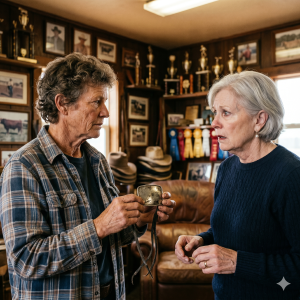
Walls and walls of it. Rodeo trophies, hunting mounts, framed photographs spanning decades. A man’s whole life on display. A successful life. A long life.
I started at the far wall with my clipboard, photographing each piece, logging the inscriptions. First trophy, second trophy, third—
I stopped.
The engraving on the base of a 1987 roping trophy read:
Dale R. Whitfield. Champion.
My hand went still.
I told myself it was a common name. I told myself I was being foolish. I moved to the next shelf.
Dale R. Whitfield. 1991.
And the next.
D.R. Whitfield. Billings Invitational. 1995.
My clipboard hit the floor and I didn’t pick it up.
I walked the length of that room slowly, the way you walk when your legs have gone strange under you. Trophy after trophy after trophy. Twenty, maybe thirty of them, spanning the years from 1986 straight through to 2019.
The years after he died.
The decades after he died.
And in every single one, the same name.
The same man.
My hand found the buckle at my throat without me telling it to. I held it there, fingers wrapped around that small tarnished disk, that date pressed into my palm — June 14, 1984 — and I stood in the middle of a dead man’s trophy room and understood that he had not been dead at all.
He had been here.
He had been winning rodeos and building a ranch and living a full, prosperous, photographed life not four hours from where I raised our daughter alone on whatever work I could find.
He had faked his death.
He had let me lose everything.
And then he had lived.
My fingers were shaking when I turned the buckle over. I don’t know why I did it. Force of habit. Something to hold onto.
His initials on the back. That date on the front.
A sound in the doorway.
I turned.
The widow stood there, pearl earrings, silver hair, watching me with an expression I couldn’t read.
Her eyes dropped.
To the buckle.
In my shaking palm.
The color left her face so fast it was like watching a curtain drop.
She took one slow step into the room, then stopped, her voice barely above a breath:
“Where did you get that?”
She was staring at it the way you stare at something impossible.
“He told me,” she whispered, “he buried that with you.”
—
The room was very quiet.
Outside, somewhere past the barn, a horse made a low sound and then was silent again. The October wind pressed against the windows. Everything was still except my heart, which was going like a triphammer behind my ribs.
I said, “With me.”
She nodded, very slowly, like she was agreeing to something terrible.
I said, “Ma’am, I’m not dead.”
She put her hand out and gripped the doorframe. She didn’t say anything for a long moment. Her eyes went from the buckle to my face and back to the buckle, and I watched something in her expression move through several rooms at once — confusion, then recognition, then a kind of dawning, sickened understanding.
“He said you died,” she said. “In the same accident. A woman from his crew. He said he was the only one who survived, and he was so destroyed by the guilt that he couldn’t go back. He couldn’t face West Virginia. He couldn’t face any of it.” She paused. “He said he kept that buckle because it was found near — near where they thought you’d been. He said it was the only thing left of you. He carried it for a year before he could bear to set it down.”
My throat had closed up entirely.
“He built a box,” she said. “A little cedar box, lined it with velvet. He kept the buckle in there on the nightstand for thirty-two years. When he got sick last spring he asked me to bury it with him. Said it was the one thing he still owed.” She stopped. “I honored that. I put it in his hand myself.”
I opened my palm and looked down at the buckle.
The tarnished silver. The initials. The date.
“This buckle,” I said carefully, “has been around my neck since 1984. Dale gave it to me three weeks before the accident. Before his accident. Before his very convenient, insurance-adjacent, body-unrecoverable accident.”
The silence that followed was the loudest thing I’d heard in forty years.
She crossed the room then. Not fast — she moved like a woman who was processing things in real time and needed the steps to do it. She stopped a few feet away and looked at the buckle close, and I held it out so she could see the back. The initials. D.R.W., scratched in by hand, not engraved, the way a young man might scratch his initials into something with a penknife and a sense of ownership.
Her face did something I can only describe as collapse and reassemble.
“There were two,” she said. “That’s what that means. There were two.”
“There were two what?”
She turned away from me and went to the shelving unit along the south wall — not the trophies, a lower shelf, the kind that holds the ordinary daily things of a life. Books. A radio. A ceramic dish for keys. And at the far end, a small cedar box with a brass latch.
She stood in front of it for a moment with her back to me.
Then she opened it.
She reached in and turned around and held it out, and in her open palm sat a belt buckle. Small, tarnished silver, no bigger than a biscuit tin lid. The same oval shape. The same patina. Same hand-scratched initials on the back.
Same date on the front.
June 14, 1984.
I sat down on the floor.
I didn’t choose to. My legs just stopped working and the floor came up and I sat there in the middle of that trophy room with forty years of grief and forty years of anger and forty years of I don’t even know what all flooding into the same space at the same time, and I could not have stood up if the house were on fire.
She sat down across from me. Right there on the floor, pearl earrings and all.
We sat with the two buckles between us.
After a while she said, “Tell me about him.”
So I did.
I told her about Dale Whitfield of Logan County, West Virginia, who was twenty-eight years old and lean as a fence post and could charm the birds out of the trees when he wanted to. Who I’d married in 1982 in a courthouse in front of a judge and her secretary because we couldn’t afford anything bigger. Who cried when I told him I was pregnant, and I mean cried, happy tears, big messy ones he was embarrassed about. Who kissed me goodbye on a Monday morning in June of 1984, drove away in a truck I never saw again, and was reported dead by Friday.
She listened to all of it without interrupting.
When I finished she said, “I met him in 1985. A cattle auction outside Great Falls. He said his name was Dale Warren. Said he was from Nevada originally. Said he’d never been married.”
Dale Warren.
He’d kept his first name. Of course he had. Dale was the kind of man who was too lazy to answer to something new.
She — her name was Patricia, she told me this somewhere in that hour, Patricia Annette Warren née Kowalczyk — had married him in 1986. Had run this ranch with him for thirty-three years. Had two sons. Had, by all apparent evidence, been happy.
“Was he good to you?” I asked, because I needed to know, because the answer would either make it worse or make it differently bad and I needed to know which.
She thought about it longer than I expected her to.
“Yes,” she said. “Mostly. He was a good man, day to day. He loved this land. He loved the boys. He had a temper he worked hard to keep. He was generous to people who needed help.” She looked at her own buckle. “But there was always a door locked inside him. Somewhere I wasn’t allowed. I thought it was grief.”
“It was,” I said. “Just not the kind he told you about.”
She nodded slowly. “He was guilty his whole life. I could see that. I just didn’t know what for.”
We sat with that for a while.
—
Here is the part people always ask about when I tell this story. They want to know if I was angry. They want to know if I screamed or threw something or called a lawyer right there on the spot.
I was angry. I want to be clear about that. There is a kind of anger that lives so deep in your chest that when it finally gets its name, it doesn’t erupt — it just settles, solid and exact, like a piece of furniture being moved into the room it was always meant for. That’s what I felt.
But the thing I was not prepared for was Patricia.
Because Patricia had also lost something, even if she hadn’t known to grieve it. She had been married for thirty-three years to a man who was not who he said he was. Everything built on it — the ranch, the sons, the name she carried — all of it had a false floor she hadn’t known to look for.
She found out she was a widow and a deceived wife on the same afternoon.
We were both of us sitting with the wreckage of the same man.
After some time she got up and made coffee. I didn’t ask her to, she just did it, and when she came back she handed me a mug and sat back down on the floor, and I thought: this woman and I are going to be in each other’s lives now, ready or not.
I was right about that.
—
The legal part is a longer story and a duller one, but the short version is this: Dale Whitfield’s estate was substantial. The ranch, the land, two vehicles, investments, a not-insignificant amount of cash. He had died, this time legitimately, of a cardiac event in September of that year. He had a will. The will left everything to Patricia and their sons.
The will had been made by Dale Warren, who did not legally exist.
The man who died was, under the law and under his original birth certificate, Dale Raymond Whitfield. Who had a legal wife in West Virginia. Who had never filed for divorce. Who had, it emerged, also never paid a dime of child support for a daughter he had left behind.
A daughter named June.
Because I had named her for the month it happened, because I was twenty-six and alone and all I had was that one brutal fact to hold onto, and I suppose I wanted her to carry it with her so she’d always know where she came from.
June is forty years old now and she’s a nurse in Charleston and she is fierce and funny and more competent than anyone I have ever known, and she did not take the news about her father calmly. I want to be honest about that. There was a period of months that were very hard on all of us.
But she got there.
She’s a practical woman, my daughter. She got that from the half of her family that didn’t disappear.
The legal process took nearly two years. Patricia’s attorneys and my attorney, who was a very patient woman named Donna, worked through it piece by piece. What came out of it was an agreement that was fair to Patricia, fair to their sons — who were as blindsided as anyone and who I want to say were decent men, decent to me, under circumstances they didn’t deserve — and fair to June, who had been owed something since before she could walk.
I won’t give you the number. That’s not what this story is about.
—
What it’s about is the buckle.
At the end of that first day, when I was getting ready to drive back to my motel, Patricia stopped me at the door. She was holding the cedar box.
“I want you to have this,” she said. “The one he was keeping. I know it’s not the original — yours is. But I think you should have it. I think he owed you that, at minimum.”
I took the box. I stood on that wraparound porch in the amber October light and looked at the second buckle, the one Dale had made or had made or had found somewhere to stand in for the one he’d given me, the one he’d built a little altar to guilt and carried on his nightstand for thirty-two years.
I thought about what that meant. Whether it absolved anything, or just measured how much he’d known, his whole long prosperous life, exactly what he’d done.
I decided it didn’t matter. I decided I was sixty-six years old and I was done letting Dale Whitfield determine the shape of what mattered to me.
I put it in my coat pocket.
I drove back to the motel.
I called June.
When she picked up I said, “There’s something I need to tell you, and I need you to sit down first,” and she said, “Mama, you’re scaring me,” and I said, “I know, baby. Sit down anyway.”
—
I still wear the buckle. My buckle. The one he gave me.
People ask about it sometimes. I still say it’s a keepsake. But now when they ask from who, I tell them.
I tell them it belonged to a man who made the mistake of his life and spent forty years knowing it and never once doing the one thing that would have helped — which was picking up a phone and telling the truth to the woman he’d left behind.
I tell them it’s a reminder.
Not to miss him. I stopped missing him somewhere in my forties, when I finally had enough distance to see what I’d been grieving — not Dale, exactly, but the life I’d expected, the solid ground I’d thought I was standing on.
I wear it as a reminder that I built new ground.
That June exists, and is magnificent.
That I’ve sat on the floors of stranger’s houses with stranger’s widows and come out the other side.
That I am sixty-six years old and still standing, and the man who bet against that lost.
I wear it because it’s mine.
It was always mine.
He just forgot that when he left.