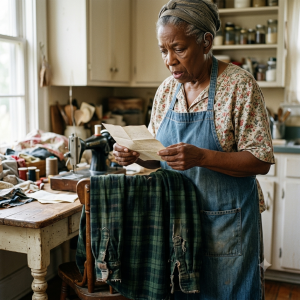
Mae Sutton has been sewing prom dresses in her Savannah kitchen for eleven years, and she can read a girl the moment she walks through the door.
She can tell the ones who are nervous. The ones who’ve never had something made just for them. The ones who hold their breath when they step onto the little wooden platform she keeps by the window, like they’re afraid to take up too much space in the world.
But Destiny was different.
The girl showed up the first Tuesday in March wearing a flannel shirt three sizes too big — heavy cotton, dark green plaid, clearly a man’s. The sleeves hung past her wrists. The hem nearly reached her knees. It was 74 degrees outside.
Mae noticed. Mae notices everything. She’s been hard of hearing since her fifties, so she watches people the way most folks listen to them — close, careful, catching the things they don’t mean to show.
She didn’t say a word about the shirt.
Week two, Destiny came back.
Same shirt.
Mae pinned the bodice. Chalked the hem. Asked about school. Destiny answered in short, polite sentences and kept the flannel pulled tight around her shoulders the whole time, even when she was standing in the half-finished gown.
Week three — same shirt. Destiny held the collar closed with one hand while Mae worked.
The other girls who came through Mae’s kitchen that spring, they’d peel off their jackets, kick off their shoes, laugh too loud about boys and dresses and who was wearing what. They filled the room up.
Destiny got quieter every week.
But she always showed up. Always on time. Always with a little “yes ma’am” and “thank you, Miss Mae” that made Mae’s chest do something she couldn’t name.
By week four, Mae had noticed the shirt had been mended. Carefully. Small, tight stitches along the left cuff — the kind a person makes when they know what they’re doing and they want it to last.
Someone who loved that shirt had fixed it.
Mae pressed her lips together and kept sewing.
The color of Destiny’s gown was a deep rose — not pink, not red, but something in between, like the last light before sunset over the Savannah River. It was going to be beautiful. Mae knew it from the first bolt of fabric.
She just needed one final fitting. The zipper. The bustle. The hem.
“Honey, I’m gonna need you to take the shirt off this time,” Mae said, keeping her voice gentle. “Just for a few minutes. I need to see the back of the neckline.”
Destiny stood very still.
Mae waited. She’d learned to wait.
Finally, Destiny nodded. She reached up, slow as anything, and slid the flannel off her shoulders.
She folded it. Set it on the chair beside the platform like she was laying down something sacred. Her hands smoothed the collar once before she let it go.
Mae helped her step into the gown.
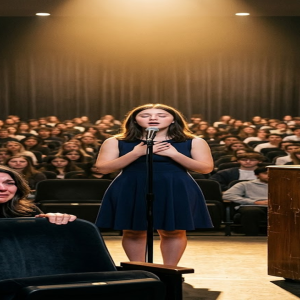
And the dress — Lord, that dress. The moment the zipper went up, Destiny’s whole face changed. Mae watched it happen in the little mirror she keeps by the window. Watched the girl see herself, maybe for the first time, as someone who belonged somewhere beautiful.
Mae’s eyes got wet. She’s not ashamed of that.
She worked quickly — hemming, adjusting, making the tiny tucks at the shoulders that would make the gown sit just right. She was nearly done when she reached for the flannel shirt to set it somewhere safe, out of the way.
It was heavier than it should have been.
Mae paused.
She ran her hands along the lining — that old familiar feeling of a seamstress who knows fabric the way some people know faces. There was something inside. Folded flat. Sewn in along the hem with small, deliberate stitches.
She looked at Destiny, who was still watching herself in the mirror, both hands pressed to her collarbone.
Mae should have set it down.
Instead, she picked up her seam ripper from the pin cushion on the windowsill — the same one she’s had for thirty years, the one her mother gave her — and she opened the lining, just enough.
Inside was a piece of paper. Folded in quarters. Soft at the creases like it had been opened and refolded a hundred times.
Mae lifted it out.
Her hands went completely still.
Because she recognized the handwriting.
It was her own.
Not recent. Not the cramped, careful print she uses now when she’s labeling a pattern or writing down a measurement. This was her old handwriting. The big looping cursive she had in her thirties, before her hands developed the stiffness that changed how she held a pen.
Mae stood there in her kitchen on a Thursday afternoon in April with a piece of paper in her hand, and the whole room felt like it had tilted two degrees.
She looked at Destiny. Destiny was still looking in the mirror. Still hadn’t noticed.
Mae unfolded it the rest of the way.
It was a letter. Dated June of 2003. And it began: My darling girl, if you’re reading this, it means I didn’t get to say it out loud.
Mae’s knees went strange underneath her. She reached back and found the edge of the little step stool and sat down on it, right there on the floor beside the platform, and she read.
The letter was written to a baby not yet born. A daughter. It talked about the garden the writer hoped to plant someday. About a grandmother’s recipe for peach cake that had to be written down before it was lost. About how much the writer hoped her daughter would know, from her very first breath, that she was wanted.
And at the bottom, signed in that same looping cursive: All my love, always — Diane.
Mae pressed the letter to her chest.
Diane Sutton had been Mae’s younger sister. She’d died in the fall of 2003, six weeks before her daughter was born. A car accident on I-16, a wet road, an ordinary Tuesday that became the worst day of Mae’s life. The baby had survived. A miracle, the doctors said, though Mae had never been fully able to call it that without also calling it the cruelest thing she’d ever seen God do.
The baby had gone to Diane’s husband’s family. They’d moved to Augusta. Mae had seen the child exactly four times over the years — a funeral, a Christmas, two awkward Sunday dinners before the distance and the grief made everyone stop trying.
She had not seen the girl in nine years.
Destiny.
Mae looked up.
Destiny had turned away from the mirror. She was watching Mae with an expression that was not surprise. It was something older and more exhausted than surprise. It was the look of someone who has been carrying a weight so long they can’t remember what it felt like not to carry it.
“You knew,” Mae said. Her voice came out smaller than she intended.
Destiny nodded once.
“My grandma Rose told me, after Grandpa passed. She said she thought I ought to know. She gave me the shirt.” Destiny looked at her hands. “She said it was my daddy’s, but he gave it to my mama when they were dating. And she said my mama had sewn something into it before she went to the hospital. That she’d sewn it in there for me to find someday.”
Mae couldn’t speak. She was still sitting on the step stool with the letter against her chest and thirty-three years of loving her sister pressing up behind her eyes.
“I didn’t know how to find you,” Destiny said. “I just — I looked you up. I saw you made dresses. I needed a dress.” She paused. “I thought maybe I could just see what you were like. And then I’d figure out the rest.”
“Four weeks,” Mae managed. “You came here four weeks and didn’t say anything.”
“I didn’t know what to say.” Destiny’s voice was quiet but it didn’t shake. She’d clearly decided some time ago to be steady about this. “I’m not asking for anything. I just wanted to know you a little. That’s all.”
Mae stood up from the step stool. It took her a moment because her legs were uncertain and because she is sixty-one years old and some movements require more intention than they used to. She crossed the three steps between them and she put her hands on either side of that girl’s face — this girl in a rose-colored dress, this girl with her sister’s exact same eyes, Lord help her — and she looked at her for a long time.
“You’ve got her nose,” Mae said finally. “I always told her it was a perfect nose and she never believed me.”
Something cracked open in Destiny’s face then. Not dramatic. Just a slow, quiet giving way, like a door that’s been swollen shut finally deciding to swing.
She didn’t cry hard. Just leaked, the way people do when they’ve been holding something in place for a very long time. Mae pulled her in and held her, the rose-colored gown and all, and let her.
They stood there in the kitchen for a while. The afternoon light came through the window the way it does in Savannah in April, thick and gold, falling across the little wooden platform and the pin cushion and the bolts of fabric stacked against the wall.
Mae’s cat, Luther, wandered in from the hallway, looked at both of them, and wandered back out. He has always been indifferent to human emotion. Mae has always found this somewhat comforting.
Eventually they separated and Mae went to put the kettle on because that is what Mae does when she doesn’t know what else to do, and Destiny carefully changed back into her jeans and the flannel shirt and sat down at the kitchen table.
They talked for two hours. Mae showed her pictures on her phone — Diane at seventeen, Diane at her wedding, Diane in the garden she actually did plant, the summer before she died. Destiny looked at each one for a long time without saying much.
She told Mae a little about her life. She was seventeen. She ran cross-country. She liked history class and hated chemistry and she’d taught herself to sew last year using YouTube videos, which Mae filed away as something they would return to later.
She said her dad had remarried when she was four and her stepmother was fine, really, she was fine, but sometimes Destiny just felt like she was living a little bit outside of something she couldn’t name. Like there was a room she’d never been shown the door to.
Mae understood that completely.
Before Destiny left, Mae refolded the letter and tucked it back inside the shirt, and then she sat down at her sewing table and she stitched the lining back up, slow and deliberate, with a thread that matched exactly.
She handed the shirt back.
“Your mama wrote that for you,” she said. “You carry it however you need to.”
Destiny held the shirt for a moment. Then she looked up.
“Miss Mae,” she said, “would it be okay if I came back? Not just for the dress. Just — to come back.”
Mae had been a seamstress for eleven years. She had seen girls walk through her door nervous, hopeful, uncertain, already beautiful without knowing it. She had seen them step onto that little wooden platform and hold their breath and become, in the space of a few weeks, something more finished, more themselves, more ready for wherever they were headed.
She had never had one walk through the door and give her back something she thought was gone.
“Honey,” Mae said, “you show up whenever you want. I always got something that needs pinning.”
Destiny’s prom was three weeks later. Mae went. She stood in the back of the school gymnasium in her good dress and her low heels and she watched her sister’s daughter walk in wearing a gown the color of the last light over the Savannah River, and she thought: Diane. Look.
The dress fit perfectly. Mae had made sure of it.
That’s the whole job, really. You take the fabric. You learn the shape of the person. You make something that fits them so well they forget to be afraid.
Mae has been doing it for eleven years. She expects she’ll be doing it for eleven more.