She bought the building.
The one with the brass nameplate that used to read *Harlan Ridge Mining Co.* — the same building where, five years ago, they laughed at her.
Not chuckled. Not smiled politely.
*Laughed.*
But we’ll get to that.
—
Her name is Dottie Mabry. Sixty-one years old. Coal miner’s widow. Woman who has been making biscuits since she was seven years old, standing on a step stool in her grandmother’s kitchen in McDowell County, West Virginia.
When her husband Raymond passed — black lung, three days after Christmas, the way too many of those stories end — Dottie did what she knew.
She baked.
Not to cope. Not as therapy.
To survive.
She sold pies out of her kitchen window. Then cakes at the church bazaar. Then wedding cakes, birthday cakes, funeral cakes — because in a small Appalachian town, you need a cake for every occasion life hands you, and life hands you plenty.
Word spread the way word does in those mountains. Slow, then all at once.
She saved every dollar. Kept her books in a spiral notebook with a rooster on the cover. And when she had enough — or thought she did — she drove forty minutes in Raymond’s old truck to sit across from a table of men in suits at a regional small-business loan meeting.
She had her folder. Her numbers. Her five-year plan written out in her careful, even handwriting.
She also had, tucked in the front pocket of her good apron — the navy blue one she wore for serious occasions — a worn, grease-stained index card folded in thirds.
She touched it once before she walked in.
She does that. Touches it whenever she needs something steadied inside her.
Nobody knows what’s written on it.
She has never let a single person read it.
—
The meeting lasted eleven minutes.
She knew because she watched the clock on the wall — a big round thing with a Harlan Ridge Mining Co. logo on the face, the same company her Raymond had given thirty-one years of his lungs to.
She laid out her numbers.
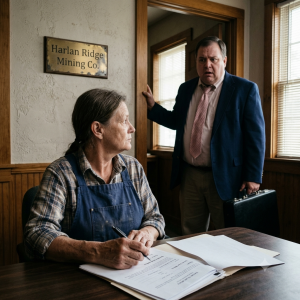
One of the men — heavyset, pink tie, the particular confidence of someone who has never once doubted his right to be in a room — leaned back in his chair and smiled at the others.
“Mrs. Mabry,” he said, and she could already hear it coming, the way you can hear weather before it arrives, “this is a real sweet little hobby you’ve got here.”
The table laughed.
His name, she would later learn, was Gerald Fitch. Regional director of something or other. The kind of man who forgets the names of the people he dismisses.
She did not cry.
She touched the index card through her apron pocket.
She picked up her folder.
She thanked them for their time — *genuinely* thanked them, in that gracious Appalachian way that some people mistake for submission — and she walked out.
She sat in Raymond’s truck for a few minutes in the parking lot.
Then she drove home and she baked.
—
Five years is a long time.
Long enough to build something from nothing when nobody gave you permission to.
She found investors through her church network and a small-business women’s collective out of Charleston. She opened a small location in town — just four tables, a counter, a reach-in case full of things that made people close their eyes when they took the first bite.
*Dottie’s* became the kind of place people drove an hour for.
Food writers came. Then a regional magazine. Then, quietly, something larger started to take notice.
And Harlan Ridge Mining Co.?
They went under. Corporate decisions made far away from these mountains. The headquarters building — a solid, handsome three-story brick on Main Street — sat empty for two years.
Dottie had watched that building her whole life.
Raymond had walked into it every morning for three decades through a side entrance she could see from the road.
When it went to auction, Dottie was the only serious buyer.
—
The closing was set for a Tuesday morning.
She wore the navy apron — her serious occasions one.
The index card was in the pocket.
She touched it in the parking lot.
The conference room inside smelled like old carpet and stale coffee, and the brass nameplate on the front door hadn’t been polished in months.
The title company rep spread the documents across the table. Pointed to the signature lines. Handed her a pen.
The room was quiet the way rooms get when something historic and long-overdue is finally happening.
Dottie looked down at the deed.
*Harlan Ridge Mining Co. Headquarters. Buyer: Dorothy Jean Mabry.*
Her hand was steady.
And then the door opened.
A man walked in with a visitor’s badge clipped to his lapel — pink tie, a little older, a little heavier, still wearing the same expression that certain men never seem to put down.
Gerald Fitch.
Applying, she would later learn, to rent commercial space in the building.
The building she was holding a pen over.
The room went absolutely silent.
Dottie looked up from the deed.
She smiled — slowly, like something she had been carrying for five years finally found a place to rest.
“Gerald,” she said. “I was hoping you’d be here for this.”
His face did something she had never seen it do before.
And her hand, still holding the pen, moved toward the signature line.
—
She signed her name the way she does everything. Completely. No hesitation.
*Dorothy Jean Mabry.*
The title rep collected the pages. Slid a folder across the table. Said the words that are supposed to be routine — “Congratulations, you’re now the owner” — but his voice had gone a little quiet, the way voices do when they understand they are witnessing something that has nothing to do with paperwork.
Gerald Fitch had not moved from the doorway.
He was holding his own folder — his lease application, she assumed. His request to occupy a corner of the building that now belonged to the woman he had laughed at. His expression had done the thing she’d noticed: the confidence had slipped, just slightly, the way a mask slips when the person wearing it is suddenly unsure whether they’re still in the right room.
He cleared his throat.
“Dottie,” he said — *Dottie*, first name, like they were old friends, like he remembered her — “I didn’t know you were the buyer.”
“I know you didn’t,” she said.
She stood up from the table. Smoothed her apron with both hands. The index card was in the pocket, right where it always was, and she did not touch it. She didn’t need to. Whatever it had always steadied in her was already steady on its own now.
She picked up her folder. The one that said *owner* on the tab instead of *applicant*.
Then she looked at Gerald Fitch for a long moment in the way that a person looks at something they have been deciding about for a very long time.
“Send your paperwork to my office,” she said. “I’ll have someone review it.”
Not *yes*. Not *no*.
Just: I’ll have someone review it.
She walked past him and out into the hallway — the same hallway Raymond had walked through thirty-one years of mornings, the same building that had a clock on the wall with the company logo, the same company that had worked her husband until his lungs gave out and then sent a form letter.
She pushed through the front door into the October air.
The brass nameplate was right there at eye level.
*Harlan Ridge Mining Co.*
She touched it once, the way she touches the index card.
Then she got in Raymond’s truck — she still drives it, always will — and she called her daughter.
“It’s done,” she said, and that was all she needed to say, because her daughter started crying immediately and that set Dottie off too, both of them sitting with the phone pressed to their ears and not talking for almost a minute, which is its own kind of conversation.
—
The nameplate came down that same afternoon.
She’d arranged it in advance. A man named Curtis, who had done odd jobs around town for thirty years, pulled up with a ladder and a socket wrench before the sun moved off the brick.
He asked her what she wanted to do with it.
She told him to set it inside, by the door. She wasn’t ready to throw it away and she wasn’t sure she ever would be. Some things you keep not because they’re good but because forgetting them entirely seems like a different kind of dishonesty.
The new nameplate went up the following week.
Hand-lettered. Brass, same as the old one, because she liked the look of brass and she wasn’t going to let Gerald Fitch ruin brass for her.
*Dottie’s — Main Street.*
Below that, in slightly smaller letters, the thing she’d decided on after thinking about it for two years:
*Est. in the memory of Raymond Earl Mabry.*
The day it went up, half the town came out and stood on the sidewalk just to look at it.
—
The building is three stories.
The ground floor is the bakery — bigger than the first location, with twelve tables now and a long counter and a case that holds things people drive from four counties over to buy. The kitchen in back is the size of her whole first restaurant. She has six employees, all local, all paid well.
The second floor she rents to a woman’s health clinic and a small law office that does a lot of its work pro bono. She charges them below market. She does not apologize for this.
The third floor is still being decided. She has ideas. They involve young people from the county who want to start something of their own, who have the folder and the numbers and the five-year plan but not yet the person willing to sit across the table and take them seriously.
She knows exactly what that costs a person. She is not interested in adding to that cost for anyone else.
—
Gerald Fitch’s application was reviewed.
She did it herself, in the end. Sat with it for an evening at her kitchen table with a cup of coffee going cold beside her.
She thought about what Raymond would have said. Raymond was not a bitter man — thirty-one years in those mines and he came home every evening and he was still kind, still funny, still himself — and she had always tried to be worthy of that.
She approved the application.
Small space, second floor, back corner. Fair market rate, same lease terms as everyone else. No special treatment in either direction.
She left a note with the approval letter. Short. Her handwriting, careful and even.
*I don’t hold onto things that don’t serve the living. This building is for the living now. — D.M.*
She heard later, through the particular telephone of a small town, that Gerald Fitch had read that note and gone quiet for a while.
She hoped it did something to him.
Not harm. Just something.
The kind of something that turns a person slightly, imperceptibly, in a better direction. She believed people were capable of that. She had to. The alternative was a kind of heaviness she had no interest in carrying.
—
The index card.
People ask. They have always asked.
Her daughter has asked. Her pastor has asked. A reporter from a regional paper asked, delicately, near the end of a long interview, and Dottie smiled at her and said, “That’s mine.”
She has never shown it to anyone.
What is known: it’s an index card, white, lined. It has been folded in thirds so many times the creases are soft as cloth. There are grease stains on it — butter, probably, or lard — from years in the pocket of a baking apron.
What is speculated: that it’s something Raymond wrote. That it’s a Bible verse. That it’s a recipe. That it’s a list of reasons.
Dottie doesn’t correct any of these guesses.
What she has said, once, to her daughter, late at night after a long day when the question came up again:
“It’s just something I needed to remember. Something that was true when nothing else felt true. I looked at it every time I was about to stop.”
Her daughter asked if she still needed it.
Dottie thought about that for a moment.
“I still carry it,” she said. “But I haven’t unfolded it in a while.”
She said it the way a person says something when they realize, right in the middle of saying it, that it is more true than they knew.
—
The brass nameplate over the door catches the morning light at a certain angle, around eight o’clock, when the first customers are already lined up on the sidewalk.
Dottie is always there before they are.
She is in the kitchen by five-thirty. Flour on her hands by five thirty-one. She does not need an alarm. Her body has known this schedule for so long that sleep simply releases her at the right moment, like it understands it’s part of something larger than rest.
She makes the biscuits herself, still. Every morning. Has not delegated this. Will not.
She learned how on a step stool in McDowell County when she was seven years old, and she will do it until she can’t, and she suspects she’ll be doing it for a very long time yet.
Some mornings, when the kitchen is warm and the light is just coming and the smell of butter and flour is filling up the space that used to belong to a company that thought it owned these mountains, she finds herself talking to Raymond.
Not out loud, mostly.
Just a kind of interior address, the way you talk to someone who is close enough that words are almost beside the point.
*Look at this*, she tells him.
*Look at what we’ve got here.*
And she goes back to work, because the biscuits don’t make themselves, and the doors open at seven, and there are people coming.
There are always people coming.