She didn’t cry when they threw her cake in the trash.
That’s the part people always get wrong when they hear this story.
They assume Elena Reyes must have broken down in the parking lot of that Fort Bragg community center, mascara running, hands shaking on the steering wheel of her old Civic. They assume she went home and called her mother in Pampanga and sobbed into the phone.
She didn’t.
What she did was reach into the front pocket of her apron, pull out a small hand-painted recipe card — the one her Lola had written in careful Tagalog the week before Elena left the Philippines — fold it once, twice, and slip it into her wallet.
Quietly. Like she was saving it from them.
She’s carried it everywhere since. For twelve years, that little card has lived folded into the corner of every ID holder, every lanyard, every credential badge she’s ever worn.
Today it’s tucked behind her judging credentials for the Fort Bragg Holiday Baking Championship.
The one that’s being filmed for national television.
—
Let me take you back to the beginning, because you need to understand what happened in that gymnasium to understand what’s happening right now.
Elena was twenty-six. Her husband, Sergeant First Class Danny Reyes, had just been deployed. She was new to Fort Bragg, new to North Carolina, new to the particular ecosystem of an Officers’ Wives Club, where the unspoken rules were numerous and no one handed you a guide.
The annual bake sale auction was a tradition. A fundraiser. A social audition, though no one called it that.
Elena spent three days on her bibingka.
She used real salted egg. She sourced the right rice flour. She lined the little clay pots with banana leaves she’d found — miraculously — at a Filipino grocery store two hours away in Raleigh. She made it exactly the way her grandmother taught her, the way it smelled at Christmas morning Mass in San Fernando.
She carried it in on a ceramic platter, covered in foil, hands trembling just slightly with pride.
She set it on the table.
And a woman — in a pressed floral blouse, hair done beautifully, volunteer ribbon pinned to her chest — picked up the platter, looked at Elena, and said, loud enough for the row of folding tables to hear:
*”Honey, we said American food.”*
She set it behind the table.
Then, when Elena didn’t move fast enough, she picked it up again and placed it — gently, which somehow made it worse — in the large black trash can beside the door.
Someone laughed. Not unkindly, they probably thought. Just a little.
Elena reached into her apron pocket, folded her grandmother’s recipe card, and put it in her wallet.
She did not cry.
—
Twelve years is a long time.
Long enough for a soft-spoken military wife to start a food blog because she had nothing else to do during deployments. Long enough for that blog to become something. Long enough for a cookbook — *Lola’s Table: Filipino Flavors, American Home* — to land on the New York Times list and stay there for eleven weeks.
Long enough for the producers of the Fort Bragg Holiday Baking Championship, a feel-good special airing on the Food Network the week before Christmas, to personally call Elena Reyes and ask if she would be their celebrity judge.
She said yes before they finished the sentence.
She didn’t tell them why.
—
This morning, Elena pinned her judging credentials to the lapel of her blazer — a deep burgundy blazer, the color of Christmas, the color of confidence. She unfolded her Lola’s recipe card, pressed her thumb across the faded Tagalog letters, and slid it into the corner of the badge holder the way she always does.
A little laminated card. Barely visible.
Her armor. Her answer. Her reason.
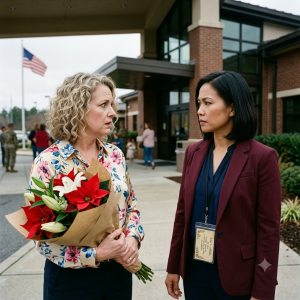
The production van pulled up to the base at 9 a.m. There were cameras. There were crew members in headsets. There was a woman standing at the entrance to the community center — the same gymnasium, though Elena had not confirmed that detail until right now — holding a welcome bouquet of red poinsettias and white lilies.
The woman was smiling the wide, practiced smile of someone who volunteers for everything and knows how to be in photographs.
Elena stepped out of the van.
The woman took three steps forward, bouquet extended, smile enormous.
And then she stopped.
Because Elena had looked up.
Their eyes met the way eyes meet when the brain is processing something it doesn’t want to be true.
Elena watched the smile freeze.
She watched the woman’s gaze drop — just for a fraction of a second — to the lapel of the burgundy blazer. To the judging credential. To the small laminated card tucked into the corner, its hand-painted Tagalog lettering just barely catching the light from the open studio door.
Elena did not look away.
And the woman’s lips had already begun to move — forming a word, or a name, or maybe just the beginning of an explanation that was twelve years too late —
“Elena.”
That’s what she said. Just that. The bouquet trembled once in her hands, the white lilies nodding slightly, as if they too weren’t sure what came next.
Her name was Cheryl Maddox. Elena had not forgotten it. She had never tried to.
For a moment neither of them spoke. A sound technician walked between them carrying a coil of cable, completely oblivious, and the spell broke just enough for the world to resume.
Elena reached out and took the bouquet from Cheryl’s hands.
Not warmly. Not coldly. Evenly. The way you accept something that is being offered, because declining it would make a scene, and Elena Reyes had spent twelve years refusing to make scenes on other people’s behalf.
“Thank you,” Elena said. “These are beautiful.”
And she walked inside.
—
I need to stop here and tell you something about Elena, because some of you are already imagining what comes next, and you’re probably imagining it wrong.
You’re imagining a confrontation. A reckoning. You’re imagining Cheryl Maddox standing in front of a national television camera while Elena levels some perfectly crafted sentence at her that encapsulates twelve years of dignity held intact.
Elena had imagined that too, once. In the early years, she’d written those sentences in her head during long deployments, lying awake in the house on base while Danny was in places she couldn’t track on a map. She’d written whole speeches. She’d constructed entire courtroom moments.
She’d stopped somewhere around the time the cookbook sold its second printing.
Not because she’d forgiven it. Not exactly. But because she’d realized something: the version of herself who needed Cheryl Maddox to apologize was the version who still believed Cheryl Maddox had the power to define her. And that version of herself had been gone for a long time.
What Elena wanted — what she’d actually come back here for — was simpler and stranger and more personal than revenge.
She wanted to cook her grandmother’s food in that gymnasium.
She wanted to stand in the room where it had been thrown away, and have it matter.
—
The competition ran across the morning. Twelve bakers, all military families stationed at Bragg, competing in three rounds with a holiday theme. Elena sat at the judges’ table with two co-judges: a local restaurateur named Marcus Webb who knew his way around a tasting note, and a retired Army colonel named Diane Park who turned out to have strong opinions about cardamom and wasn’t shy about them.
Elena liked Diane immediately.
The bakers were wonderful. A twenty-year-old corporal made a sweet potato layer cake that stopped conversation at the judges’ table. A grandmother of four, whose son was currently overseas, presented a tray of German Lebkuchen she’d learned to make when her husband was stationed in Heidelberg in the nineties — her hands shook slightly when she set them down, and she apologized for it, and Elena told her there was absolutely nothing to apologize for.
She meant every word.
Between rounds, Cheryl Maddox circulated the edges of the room with a clipboard, coordinating volunteers. She was clearly in her element here — efficient, capable, the kind of woman who remembers where the extra extension cords are stored and how many folding chairs fit in the back hallway. Elena noticed all of this the way she noticed most things: quietly, without expression.
During the second break, Cheryl appeared at Elena’s elbow.
“Could I speak with you for a moment?” she said. Her voice was careful. Controlled. But something underneath it wasn’t.
Elena looked at her for a beat. Then she nodded and followed her to a quieter corner near the fire exit, where the camera crew wasn’t set up.
Cheryl had clearly rehearsed something. You could tell by the way it came apart.
“I know you probably don’t remember me,” she started, and Elena let that go because it seemed like Cheryl needed the fiction of it to get through the sentence.
“That day,” Cheryl continued. “The bake sale. I’ve — ” She stopped. She looked at the floor. “I’ve thought about it. I want you to know that.”
Elena waited.
“What I did was rude and it was wrong and I have genuinely — ” Cheryl’s voice caught on something. “My daughter married a man from Cebu. We’ve been to the Philippines three times now. His mother made bibingka for us at Christmas and I —” She stopped again. Her eyes were bright. “I knew. The moment I saw it on the table, I already knew I’d been wrong. But I was — I don’t know what I was. I was the kind of woman I don’t want to be anymore.”
She looked up at Elena directly then, which took something.
Elena looked back at her.
The thing is, there was no great speech waiting. No twelve-years-in-the-making verdict. There was just a gymnasium, and the smell of baked sugar in the air, and a woman who had done a small, cutting thing a long time ago and had clearly carried it differently than Elena had — heavier, maybe, in the way guilt is always heavier than grief.
“I know you thought about it,” Elena said finally. “I can tell.”
That was it. That was all she gave her. Not absolution. Not its opposite. Just the acknowledgment that she was seen.
Cheryl nodded. Her chin wobbled once and then steadied.
“The bibingka,” Elena said. “Did your mother-in-law use fresh coconut milk or canned?”
Cheryl blinked. Then, helplessly, she almost smiled. “Fresh. She wouldn’t hear of anything else.”
“That’s the right answer,” Elena said.
And she walked back to the judges’ table.
—
The winner of the Fort Bragg Holiday Baking Championship was the corporal with the sweet potato cake. His name was Jermaine Okafor, he was twenty years old, and he’d learned to bake from his grandmother in Savannah because she said a man who could feed people would never be poor in the ways that mattered. He cried when they announced it. Marcus Webb handed him a napkin. Colonel Park pretended to study her notes.
Elena shook his hand and told him his frosting technique was the best she’d seen all year, and she meant that completely.
The cameras captured most of it. The segment will air the week before Christmas, sandwiched between a kitchen tour and a cookie swap special. Jermaine’s grandmother will watch it from Savannah, surrounded by her church friends, and will cry again, and will have been right about everything.
—
Afterward, in the parking lot, Elena sat in the back of the production van for a few minutes before the drive back.
She took the credential badge off her lapel.
She opened the badge holder and slid the recipe card out — her Lola’s handwriting, faded now, the painted border worn soft at the edges. Rice flour. Coconut milk. Salted egg. Banana leaf. The proportions written in a hand that had kneaded dough and braided hair and cupped Elena’s face and said, in Tagalog, that the food we make is the longest letter we ever send.
Elena pressed her thumb across the letters. The way she always does.
Then she folded the card once, twice, and slid it back into her wallet.
Not because she needed armor anymore.
Because it was her grandmother’s handwriting, and she loved it, and she would carry it everywhere for the rest of her life.
—
Danny picked her up from the production company’s hotel that evening. He still had the same truck, newer version. He waited in the parking lot with two cups of coffee, which is exactly the kind of man he is.
She got in. He handed her a cup without asking how it went, because he’s also the kind of man who knows when to wait.
She took a sip. She looked out the windshield at the North Carolina dark.
“How was it?” he asked, eventually.
She thought about Jermaine Okafor crying over his sweet potato cake. She thought about the grandmother’s shaking hands and her Heidelberg Lebkuchen. She thought about Cheryl Maddox saying *fresh, she wouldn’t hear of anything else.* She thought about standing in that gymnasium while it smelled like butter and vanilla and something that had finally, after twelve years, been answered.
“Good,” Elena said. “It was really good.”
Danny nodded and pulled out of the lot.
And on the way home she told him all of it — not the speech she’d never given, not the confrontation that had never come — just the corporal and his grandmother’s lesson, the cardamom colonel, the bibingka question in the corner by the fire exit, and the way the whole gymnasium had smelled like Christmas.
He listened to every word.
That’s the story.
That’s all of it.
She didn’t need them to know what they’d thrown away. She just needed to go back and let it be worth something in the room where it wasn’t.
She did.
💛🇵🇭