They tried to erase her name from the building she saved.
Twelve years later, Lottie Mae Beaufort walked back through those doors anyway.
—
She didn’t come in angry.
That’s the thing people still talk about, down at the docks and in the fellowship halls along the coast. Lottie Mae didn’t come in hot. She came in quiet — the way the tide comes in. You don’t notice it until the water is already at your feet.
She was wearing ivory silk.
And she was carrying the deed.
—
But I’m getting ahead of myself. Let me go back to the beginning. Because you need to understand what they took from her before you can understand what she brought back.
Lottie Mae grew up on St. Helena Island, one of the last places in America where Gullah families still held land their great-great-grandparents had farmed themselves. Her people knew those tidal creeks the way most people know their own living rooms. Her father cast nets before sunrise. Her mother pressed sweetgrass into baskets so fine they hung in museums now.
She wasn’t supposed to end up on the Charleston Historic Preservation Committee.
But her husband, James Beaufort, had believed in her the way only certain men do — completely, without condition. He’d pulled strings, written letters, sat across from his older brother Randall at a supper table and said *she belongs in that room.*
Randall had smiled and agreed.
For a while, it worked.
Lottie Mae brought knowledge to that committee that no one else had. She knew which structures on those islands were sacred. Which ones held stories that couldn’t be rebuilt once they were gone. She spoke softly in those meetings, but she brought documentation. She brought research. She brought a hand-drawn map of every historic Gullah structure within forty miles of the harbor.
And she brought the brass compass.
She’d found it in James’s tackle box after he passed — a small, worn thing, the color of old pennies, engraved on the back with three initials she could never quite make out. *L.B.J.?* *E.B.T.?* The letters were rubbed smooth by decades of handling. She didn’t know whose it was or where it came from.
But she set it on the table at the start of every meeting.
Just set it there. Never said a word about it.
People noticed. Nobody asked.
—
Then James died.
And Randall moved fast.
Within four months, there was a closed-door session she wasn’t invited to. A letter, very polite, very firm. Words like *restructuring* and *community representation* and *transition.*
Randall walked her out personally.
“You did fine,” he told her, holding the door. “But this work really needs people with — you know. Development experience. You’re a shrimper’s wife, Lottie. James understood the world you come from.”
She didn’t argue.
She picked up the brass compass from the conference table, dropped it in her purse, and walked out into the Charleston afternoon without a single word.
—
The project they’d been fighting to fund — a full restoration of the Gullah heritage district on the island’s north end, including three pre-Civil War praise houses — sat stalled for the next ten years.
Three different architects. Two abandoned proposals. One very public falling-out with a federal preservation grant that cost the committee their credibility and almost their charter.
What nobody on that committee knew was where Lottie Mae had gone.
She’d gone to school.
First her certification. Then her license. Then a master’s degree from Clemson, writing her thesis on the structural preservation of vernacular Gullah architecture.
She built a small firm. Took on county jobs. Restored a post office in Beaufort. A schoolhouse in Ridgeland. Quietly, steadily, without any fanfare, she became exactly what Randall had said she’d never be.
And then she submitted a proposal to the federal preservation board — over the heads of the Charleston committee entirely.
It was approved in eleven days.
—
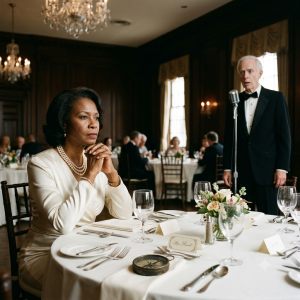
The gala was held on a Friday night in October, the kind of evening where the harbor smells like salt and the whole sky goes pink before it goes dark.
Lottie Mae arrived alone.
Ivory silk. Low heels. Hair pinned up the way her mother used to wear hers to church.
And the brass compass, tucked in the small clutch at her side.
She set it on the registration table when she signed in.
The young woman at the table glanced at it, started to say something, then didn’t.
Inside, the room was full of people who had spent a decade in those meetings without her. They had plaques on the wall now. Programs with their names printed in silver. Randall was at the head table in a tuxedo, talking to the mayor.
He didn’t see her come in.
But she saw him.
She found her seat — *her* name on the place card, right there in the third row, *Lottie Mae Beaufort, Project Architect* — and she set the compass on the table in front of her plate.
The lights dimmed.
The speeches started.
And then the committee chairman, a man named Gerald Pickett who had been in that room the day Randall walked her out, stepped up to the microphone.
His face had gone the color of old brick.
He looked directly at her.
He leaned forward and spoke four words into that microphone — the four words she had waited twelve years to hear.
But what came out of his mouth was not an apology.
—
What Gerald Pickett said was: “She found the deed.”
He said it the way a man says something he has been sitting on for a long time. Quiet. Almost relieved.
The room went very still.
He cleared his throat and tried to collect himself, shuffling his notes on the podium. Then he set the notes aside entirely. When he looked up again, he wasn’t looking at Lottie Mae anymore. He was looking at Randall.
“I’m going to tell this right,” Gerald said. “I owe everybody in this room that much. And I especially owe her.”
—
Here is what Gerald told that room.
When Lottie Mae had been on the committee, she’d done something nobody expected. She’d spent six months in the county deed registry, going back through the original land transfers on the north-end parcels — the ones the Gullah heritage district project was supposed to restore.
And she had found something.
A deed of gift, dated 1887, signed by a man named Ezra Beaufort Tolliver.
Lottie Mae knew that name. James had mentioned it once, years before he died, the way you mention a story you half remember from childhood. Ezra Tolliver had been a free Black landowner after the war, one of the men who’d acquired land under the Port Royal Experiment. He had farmed it, built on it, raised children on it. And then, under circumstances the family never talked about clearly, the land had passed out of his hands sometime around the turn of the century.
The deed of gift wasn’t for farmland.
It was for the building.
The same building that now housed the Charleston Historic Preservation Committee’s offices. The building with the marble foyer and the plaques on the wall and the silver-printed programs. The building that had been transferred, sold, re-sold, and re-deeded so many times in the twentieth century that nobody had bothered to go back further than 1941.
Lottie Mae had gone back further than 1941.
The deed of gift named Ezra Beaufort Tolliver as original grantor.
And it named his descendants as beneficiaries, in the event the property ever returned to use as a civic institution.
She had brought this discovery to the committee. Had documented it carefully, the way she documented everything — copies, certified, organized in a binder with tabs. She’d brought it to a Tuesday meeting in the spring and laid it on the table alongside her hand-drawn map and the brass compass.
Randall had taken the binder home to review it.
It had never come back.
When she asked about it the following week, Randall said the documents were inconclusive. A historical curiosity. Not legally actionable. Nothing to pursue.
Four months later, she was out the door.
—
Gerald Pickett knew all of this because he had been the one to make copies of her copies, without telling anyone, and keep them in a fireproof lockbox in his garage for twelve years.
He had done it because even in the moment, standing there watching Randall hold the door for Lottie Mae and smile his particular smile, something had sat very wrong with Gerald. He was not a brave man. He had not done anything with those copies. He had told himself, for over a decade, that he would do something when the time was right.
The time had gotten right the moment the federal preservation board approved Lottie Mae’s proposal and her name appeared on the project paperwork.
Because the federal board, as part of their due diligence, had required a full title search.
And the title search had surfaced the same deed Gerald had copies of in his garage.
This time, there was no Randall to make a binder disappear.
—
By the time Gerald finished speaking, Randall Beaufort had pushed back from the head table and was standing very straight in his tuxedo, doing the thing men like him do when they’re surrounded — becoming very formal, very correct, very *let’s not be hasty.*
But the mayor, who was sitting right next to him, had taken out her phone.
And the room was not going to let formality save him tonight.
—
Lottie Mae did not stand up.
She did not speak.
She reached into her clutch, took out the brass compass, and held it in her hand under the table where nobody could see. Just held it. The way she always had.
She had figured out the initials two years ago, going through a box of James’s papers she’d finally gotten around to sorting. A letter, in faded pencil, from James’s grandmother to James’s father. It mentioned the compass in passing. Said it had belonged to her grandfather.
*E.B.T.*
Ezra Beaufort Tolliver.
James had carried his great-great-grandfather’s compass in a tackle box without knowing what it was. He had left it to a woman who would spend twelve years finding out.
—
After Gerald finished, a woman from the federal preservation office who had come down from Washington for the gala stood up and confirmed what the title search had found. The deed was valid. The building’s civic use triggered the beneficiary clause. There was, she said carefully, a remediation process. It would not be simple. But it would happen.
She also said that, per the terms of the federal grant and the title findings, the project architect’s name would appear on the building’s permanent historic marker.
Not the committee’s name.
Not Randall’s name.
Lottie Mae Beaufort’s name.
—
People talk about what she did next.
She stood up — not because anyone called on her, not because it was her turn, but because the room was looking at her and she decided she was ready.
She was sixty-one years old. She had calluses on her hands from twelve years of actual restoration work. She had driven four hours that morning to be there.
She said, simply: “The praise houses on the north end will be open to the public by Easter. I’d like to invite every person in this room to come see them.”
That was it.
She sat back down.
She put the compass back in her clutch.
—
Randall left before the dessert course. Nobody stopped him. Nobody needed to.
Gerald Pickett walked over to Lottie Mae’s table afterward and stood there for a moment looking like a man who has finally set down something extremely heavy. He held out his hand.
She shook it.
She didn’t tell him he should have done it sooner.
He already knew.
—
The three praise houses opened the following March, two weeks before Easter.
They had rebuilt them using traditional Gullah techniques — tabby mortar, heart pine timber, hand-hewn joinery. Lottie Mae had insisted on hiring craftspeople from the island communities, people who still knew the old methods, people whose grandparents had known those buildings as living places of worship and not museum pieces.
On the day of the opening, her mother came.
She was eighty-four years old and she walked with a cane and she had not been inside one of those praise houses since she was seven years old, sitting beside her own grandmother on a pine bench worn smooth by generations of use.
She sat down on that bench — restored now, sanded and sealed, but the same wood — and she put her hands in her lap and closed her eyes.
Lottie Mae stood in the doorway and watched her.
She did not take any photographs.
Some things you just let happen.
—
The brass compass is in the building now.
Not the committee’s building. The praise house on the north end, the largest of the three, the one with the original bell tower they’d managed to save and re-hang.
It’s in a small glass case near the entrance, on a shelf alongside a photograph of Ezra Beaufort Tolliver — the only one that exists, taken around 1890, a man standing very straight in a field, looking directly at the camera like he knew somebody someday was going to need to see his face.
The placard reads: *Compass belonging to Ezra Beaufort Tolliver, St. Helena Island, carried by his descendants for four generations. Donated by Lottie Mae Beaufort, Project Architect.*
Below that, in smaller text, her firm’s name and the date of completion.
And below that, one line she wrote herself.
*He knew where he was going. So did she.*
—
I heard this story from a woman who was at the gala that night, a retired schoolteacher from Beaufort who had known Lottie Mae’s mother for forty years. She told it to me on the porch of the church hall after a fish fry, while the kids were running around in the yard and the sun was going down over the water.
She said the thing she remembered most was not Gerald’s speech and not Randall leaving and not even Lottie Mae standing up to speak.
It was the compass on the table.
“She put it there at the beginning of every single meeting,” the woman told me. “For years. And I always wondered why. But now I think I understand it.”
I asked her what she thought it meant.
She looked out at the water for a moment.
“She was reminding herself,” she said. “Not them. Herself. Where she came from. Which direction was true north. So that when they tried to make her feel lost — and they did try — she already had her bearings.”
She rocked her chair once and smiled.
“You can’t walk a woman out of a room she was always supposed to be in. You can only delay her.”