I found out my father had been looking for me for forty years — because I heard his voice on a tape that was recorded before I was even born.
Let me back up.
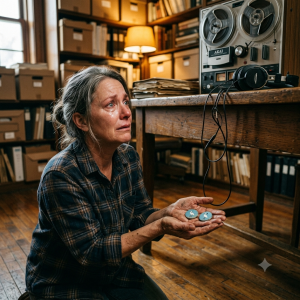
My name is Loretta Broussard. I’m fifty-three years old, I live outside of Shreveport, and for the better part of my adult life I’ve done freelance transcription work — medical records, legal depositions, whatever pays. Last spring, a small parish archive down in St. Landry Parish hired me to transcribe a collection of oral history recordings they’d unearthed during a renovation. Old reel-to-reel tapes, mostly. Interviews with local residents going back to the 1950s.
Quiet work. Solitary work. Exactly the kind I’m good at.
I drove down on a Monday morning in April, set up my equipment in a little back room that smelled like cedar and old paper, and got started.
Most of the tapes were exactly what you’d expect. Farmers talking about the flood of ’73. A schoolteacher remembering the day Kennedy was shot. A woman describing her mother’s recipe for pain perdu in such careful detail that I had to stop and write it down for myself.
I worked through them in order, oldest to newest.
The last tape in the box was different.
No label. No date. The reel itself was smaller than the others, the color of old ivory, and someone had tied a short piece of faded green ribbon around the casing like a tiny bow. I almost set it aside. Something made me load it anyway.
The voice that came through my headphones was an old man’s — low and unhurried, with a Creole accent thick as cane syrup. He wasn’t being interviewed. He was just… talking. Like he was leaving a message for someone he wasn’t sure would ever hear it.
He said he’d been asked to record whatever he wanted to preserve.
So he was going to preserve her.
He started describing a baby girl. His daughter. Born in the spring, he said. She had her grandmother’s hands, he said — long fingers, even as an infant. She liked to grab onto his thumb and hold on so tight it made him laugh every time.
He described the day she disappeared from his life.
He didn’t use the word “adoption.” He used the word “taken.”
He said he’d spent years trying to find her. Decades. He’d written letters. Made phone calls. Driven to offices in three different states with folders full of paperwork and walked out with nothing every single time.
But he said he never stopped.
And then he said something that made me pull my headphones off and sit very still in that cedar-smelling room for a long moment.
He said that when she was born, his mother had pressed a gift into the baby’s blanket. A small thing. Something handmade, so she’d have a piece of them no matter where she ended up.
A wooden button, he said.
Hand-painted. Pale blue. With a single white egret on the face of it.
I looked down at my coat, hanging on the back of my chair.
I have worn the same winter coat for eleven years — a navy wool peacoat I bought at a Goodwill in Baton Rouge. It has four original buttons and one that doesn’t match. I added it myself years ago, after one popped off, because it was the only button in my sewing kit that fit the loop.
A small wooden button. Pale blue. With a single white egret painted on it.
I have no idea where it came from. I’ve had it as long as I can remember. I assumed it had been my mother’s — my adoptive mother — though she passed when I was nineteen and I never thought to ask.
I sat there staring at my coat for so long the tape ran on without me.
When I finally put the headphones back on, the old man’s voice was still going.
He was describing the egret. Why his mother chose it. What it meant to their family. How the bird had been their symbol going back generations, the way some families have a crest.
He said: “If she ever finds that button, she’ll know where she came from.”
My hands were shaking so badly I could barely find the pause button.
I knocked the coat off the chair reaching for it. The blue button hit the floor and skittered under the archive table.
I got down on my knees to find it.
I found it.
And right next to it — lying flat against the old hardwood floor, as if it had been there for years, as if it had been placed there deliberately and patiently and with tremendous hope —
Was another one.
Identical. Pale blue. A single white egret.
I picked them both up and held them in my palm and the archive was so quiet I could hear the tape still turning, the old man’s voice still coming through the headphones on the table above me, still talking, still looking.
I stayed on my knees for a while. I wasn’t ready to stand up yet.
The second button was older than mine. I could see that immediately. The paint on the egret was faded in a way that mine wasn’t, the white gone soft and creamy with age, the fine lines of the wings more worn down. But the hand that made them had been the same hand. The angle of the bird’s neck, the single dark eye, the way the legs trailed out behind like the egret was just lifting off from still water — identical. Made by the same person, in the same sitting, I would have bet anything on it.
I set them side by side in my palm and looked at them for a long time.
Then I put my headphones back on.
The old man was still talking. He’d moved on to other things — a piece of land his family had worked, a brother who’d gone to Houston and never come back, a church that had burned in the sixties. His voice was so steady. So patient. The voice of a man who had made peace with uncertainty while refusing to surrender to it.
Near the end of the tape, he came back to her.
He said he didn’t know if she was even alive. He said he hoped she’d had people who were good to her. He said if she hadn’t — if life had been hard, if she’d had to struggle — he wanted her to know that wasn’t because she wasn’t loved. He wanted her to know it was the opposite.
He gave his name.
Alcide Thibodaux.
He said he lived in Leonville, or he had. He said he was getting old. He said he’d made the recording because his hands had started shaking too badly to write letters anymore, and he still needed to send something out into the world on her behalf. On his own behalf.
He said: “I’m still here, baby girl. I’m still here if you want to find me.”
The tape ended.
I sat in the cedar-smelling room and did not move for a very long time.
Then I went and found the archivist — a small, brisk woman named Mrs. Fontenot who’d shown me to the room that morning and brought me a cup of coffee I hadn’t touched. I showed her the two buttons in my palm. I told her what was on the tape. I watched her face change.
She said the archive had received a box of materials about eight months earlier from the estate of an elderly man in Leonville who had recently passed. She said the box had been sitting in back because they were still cataloguing it. She said the tape had been in a side pocket of the box, tucked in with some letters and a few photographs.
She asked if I was all right.
I told her I didn’t entirely know yet.
She went and got the box.
It was a standard banker’s box, not particularly old. Inside were the letters he’d mentioned — some of them drafts, never sent, addressed to agencies and courthouses and a Catholic social services organization in Lafayette. Underneath those were photographs. A man I’d never seen, at various ages. Young, with a full face and light eyes. Middle-aged, standing in front of a house with yellow siding. Old, sitting on a porch step with a dog leaning against his knee.
I have my father’s hands. I saw that immediately. Long fingers. The same particular way the thumb bends.
There was one photograph that had been placed face-down, separately, at the very bottom of the box. Someone had written on the back in the careful cursive of an older person: For my granddaughter, when she is found.
I turned it over.
It was a woman I’d never seen. Elderly, dark-eyed, sitting very straight in a wooden chair. And in her lap, spread out on a cloth, were buttons. Dozens of them, handmade, in various stages of completion. She was looking directly at the camera with an expression I can only describe as expectant. Like she knew, somehow. Like she was already waiting.
I’m not a person who cries easily. I’ve been on my own most of my life, and you develop a kind of scar tissue after a while. But I sat in that archive and I cried in a way I hadn’t since I was a young woman, and Mrs. Fontenot was very kind about it. She closed the door and left me alone and brought me a fresh coffee without being asked.
Alcide Thibodaux had died the previous November. He was eighty-one years old. He had never stopped looking. The archivist confirmed that much from the estate paperwork — there were legal inquiry forms as recently as two years before his death.
I won’t lie and tell you that wasn’t hard to absorb. I sat with it for several days. I’d spent my whole adult life assuming my birth family either didn’t know where I was or didn’t particularly want to, and learning that the truth was the exact opposite of that — it does something to you. It rearranges things. Some of what it rearranges has been painful.
But here is what I want to tell you, because this isn’t only a story about loss.
He had a son.
I found that out three weeks after the archive visit, after I’d contacted the estate through a lawyer and introduced myself with a DNA test and everything else they reasonably needed from me. Alcide had a son from a later relationship — a half-brother I did not know existed. His name is Darnell. He’s forty-seven, he lives in Breaux Bridge, and he is the one who made sure that box went to the archive instead of a dumpster. He didn’t know what was in it. He just knew his father had spent his life trying to preserve something, and he wanted to honor that.
Darnell and I met for the first time in June, at a diner halfway between our two towns. I brought the buttons. He brought a photograph his father had carried in his wallet — a photograph of me as an infant, which I had never seen, which I did not know existed, which shows me being held by a young man with long fingers and a full face and light eyes, grinning down at me like I was the whole world.
I have it framed on my wall now.
We sat in that diner for four hours. We talked about our father. We talked about our lives. Darnell has two daughters and he cried when he told me about them because he said his father would have loved to know he had a niece. Two nieces. He kept saying I’m sorry he didn’t get to meet you and I kept telling him there was nothing to be sorry for, because there wasn’t.
What I’ve come to understand is this: the tape wasn’t a coincidence. Not entirely. Alcide had brought that box to the archive himself, two years before he died. He’d asked Mrs. Fontenot’s predecessor whether they’d ever had anyone come through to do transcription work. She’d told him yes, sometimes, for the oral history collection. He’d asked if he could add a tape to the collection — said it was personal history he wanted preserved. He’d agreed to a general intake form and left.
He put that tape in a collection he hoped someone would be hired to transcribe.
He put that second button under the table.
Mrs. Fontenot didn’t understand the second part until I explained it. Then she went quiet for a moment and said, very softly, that the table had been moved during the renovation. That originally it had been against the wall. That there had been a small gap under the baseboard where something small could have been tucked.
He left it there like a bread crumb. For me, specifically, if it was ever me.
He couldn’t have known it would work. He couldn’t have known I’d be the one hired, or that I’d still have the button, or that I’d be wearing the coat that day. He just kept placing things in the world and hoping. That’s what he’d been doing for forty years.
I have the two buttons in a small glass dish on my dresser now, next to the photograph. My grandmother made them with her own hands in the spring of 1971, and she pressed one into a blanket around an infant she was about to lose, and kept the other one herself, and I think about that act of faith so often it’s become a kind of daily companion to me. She made two. She always assumed there would be a reunion to close the set.
I finished the transcription job. All the tapes, including his. It’s in the archive now, properly labeled and catalogued, with a note that the original inquiry was resolved.
Last month, Darnell brought his daughters up to Shreveport and I made a big pot of gumbo and we sat on my back porch until it got dark. The older girl, who is twelve, asked me how I ended up with the button on my coat and I told her the whole story from the beginning. She listened to every word without interrupting, which I respected enormously.
When I finished, she thought about it for a minute.
Then she said: “So your grandma made the button, and your dad hid the other one, and you just happened to need a button for your coat.”
I told her that was about the size of it.
She nodded like it all made perfect sense. Like of course that was how it went. Like the world was exactly the kind of place where something lost for forty years could find its way home through a sewing kit and a Goodwill coat and a back room that smelled like cedar and old paper.
I’m starting to think she might be right.