She walked back into that ballroom five years later, and the woman who had her thrown out was sitting in the front row.
Mai didn’t rush.
She never did anymore.
—
She had learned to move slowly the way you learn most things — by surviving the alternative.
Five years ago, Mai Xiong had driven three hours from her little shop on Blackstone Avenue to set up her very first booth at the Central Valley Bridal Expo. She’d spent eleven days pressing flowers for the display. Eleven days cutting and wiring and arranging, her hands smelling like eucalyptus and ribbon and something she hadn’t felt in a long time.
Hope, maybe.
She’d hung her banner. Laid out her business cards. Tucked her vendor badge into the clear plastic sleeve of her lanyard — and that’s when she noticed the dried white peony she’d pressed inside the sleeve weeks earlier. She hadn’t planned it. She’d just found it in her coat pocket one morning and slipped it in, the way you tuck a small prayer somewhere close to your body.
It was the same kind of flower her ex-husband, Derek, had dropped on the kitchen floor the morning he left. A white peony from her own greenhouse. He’d set it on the counter, then knocked it off by accident — or maybe not by accident — and walked out without picking it up.
She had pressed it that night. She didn’t know why. She just couldn’t throw it away.
She was still looking at it, that peony flat and pale behind the plastic, when the security guard tapped her on the shoulder.
“Ma’am. We’ve had a complaint.”
—
The complaint had come from Serena Voss.
Serena was the owner of Voss Floral Group — six locations across Fresno County, a fleet of white vans, a logo on the side of every tent at every farmers market from Clovis to Madera. She was also, as of four months prior, Derek’s fiancée.
Serena had told the expo coordinator that Mai was impersonating a legitimate vendor. That her business registration was fraudulent. That she’d “somehow obtained a badge” she had no right to wear.
None of it was true. All of it worked.
Two security guards walked Mai out through the side entrance while vendors on either side watched from behind their displays. One woman mouthed *I’m sorry.* Most looked away. Mai kept her chin level. She kept her hand pressed flat against her lanyard the whole way out.
She sat in her car in the parking lot on Blackstone for forty-five minutes.
Then she drove home and got back to work.
—
That was the thing about Mai Xiong that Derek had never understood, and that Serena Voss was about to find out.
She did not stop.
She filed her paperwork. She applied for the small business grant she’d been putting off. She hired one part-time employee, then two. She started doing weddings in Sacramento. Then the Bay Area. Then, quietly, something larger — a wholesale arrangement partnership with a hospitality group that none of her competitors in Fresno even knew existed yet.
She never changed the peony.
Every badge, every lanyard, every event she worked — the same dried white flower pressed behind the plastic. Some of her regular clients asked about it. She always said the same thing: *It reminds me to keep going.*
—
This year, the Central Valley Bridal Expo had a new coordinator.
This year, the keynote speaker was someone who had built a floral business from a single storefront into a nationally recognized brand. Someone *Forbes* had called “one of the most quietly influential small business owners in the American wedding industry.”
Someone who had been in that same ballroom before — just not behind the podium.
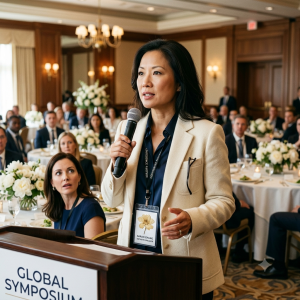
Mai wore a cream blazer. Her lanyard rested against her collarbone, the dried peony visible behind its plastic window, a little more golden now with age but still whole. She walked to the microphone without rushing.
Serena Voss was in the front row, seated at a table she had sponsored. On that table — on *every* table in the room — sat a centerpiece of white peonies and pale eucalyptus, arranged by whoever Serena had hired to decorate the event.
Mai thanked the coordinator. She thanked the audience. She said she wanted to start with a short video about where her company had been — and where it was going.
She clicked the remote.
The projection screen dropped from the ceiling.
The ballroom went dead silent.
Because the logo that filled the wall behind her was one every person in that room recognized.
It was the same logo printed on the small white cards tucked into every single arrangement on every single table.
The arrangements Serena had taken credit for ordering.
—
The logo was a pressed peony. Simple, clean, rendered in pale gold on a white field. Underneath it, in the quiet serif font that had shown up in *Brides* magazine and on two separate segments of a morning show out of San Francisco, were three words:
*Still Here Florals.*
Serena did not move. She understood before most people in the room did, because she had spent the last eight months trying to figure out why her wholesale supplier had quietly, politely, without explanation, declined to renew her contract. She had made calls. She had sent emails. The answer she kept getting was a variation of the same thing: *We’ve made other arrangements.*
She had not, until this moment, known what that meant.
Mai let the room sit with it for three full seconds. She was good at that now. Silence used to feel like a verdict. Now it felt like space she owned.
Then she clicked to the next slide.
It was a photograph of Blackstone Avenue. The original shop, the one she’d locked up five years ago and driven away from with a car full of pressed flowers and a vendor badge she was never allowed to use. The sign in the window still said *Xiong Floral* in hand-painted letters her mother had helped her do the summer she opened.
“I started there,” Mai said. “Most of you don’t know that part.”
—
She told it plainly. She had always been plain-spoken, even back when Derek used to tell her that was a flaw, that she needed to learn to sell herself better, to be warmer, more — and here was his actual word — *approachable.*
She told the room about the eleven days of pressing flowers. About the drive down 99 in the dark with the van smelling like eucalyptus. About unpacking her banner and straightening her cards and feeling, for the first time in a year, like she was building something real.
She did not say Serena’s name. She did not say Derek’s.
She said: “Someone decided I didn’t belong here. And they had enough influence in this room, at that time, to make that stick for one afternoon.”
She paused.
“One afternoon was all they got.”
A woman near the back started clapping before she’d finished the sentence. It spread the way things spread in a room that has been holding its breath — fast and a little unsteady, like the first rain after a long dry season.
—
The video ran for four minutes.
It showed the grant. The second employee, then the third. A wedding in Napa where they’d done twelve hundred stems of ranunculus in four days. A photo of her standing in front of a refrigerated warehouse in Stockton that she now leased with two other woman-owned floral businesses — a cooperative model she’d helped design, which had been written up in a trade publication and then picked up by a business journal and then by a reporter at the *Chronicle* who’d wanted to know how a single-operator shop in Fresno had quietly become a supplier for three hotel groups and a national wedding planning platform.
The last frame of the video was a close-up of her lanyard. The plastic sleeve. The peony inside it, pale and pressed flat, a little translucent at the edges, still perfectly whole.
*It reminds me to keep going.*
The room was quiet again. Different quiet this time.
—
Afterward, people came to find her the way they always do after a talk — a loose current of handshakes and business cards and women who wanted to say something but weren’t sure how to start.
Mai was patient with all of them. She had worked hard to become patient.
She saw Serena stand up from the sponsored table. She watched her gather her things — the tote bag, the blazer, the careful composure of a woman deciding whether to leave quickly or leave slowly.
Serena chose slowly, which meant she had to pass within ten feet of where Mai was standing.
She stopped.
Up close she looked smaller than Mai remembered. Or maybe Mai had just gotten taller in the way that has nothing to do with height.
“I didn’t know,” Serena said, “that you were the one supplying the centerpieces.”
“I know you didn’t,” Mai said.
“I want you to know that I—” Serena stopped. She was a woman who had always known what to say next, and right now she didn’t. “Derek and I aren’t together anymore. I don’t know if that matters to you.”
“It doesn’t,” Mai said. Not unkindly. Just accurately.
Serena nodded. She looked at the lanyard. At the peony behind the plastic.
“That’s been with you the whole time?”
“Since before you ever met me,” Mai said.
—
There was nothing dramatic after that. No scene. No tears. Just a woman picking up her tote bag and walking toward the exit, and another woman turning back to the line of people waiting to talk to her.
One of them was the woman who, five years ago, had been setting up a ribbon display two booths down from Mai’s. The one who had mouthed *I’m sorry* as the security guards walked her out.
Her name was Gail. She had her own business now — custom invitation suites, letterpress, out of a studio in Clovis. She had thought about that morning more times than she could count. She had wondered what happened to the woman with the flower in her badge.
She told Mai all of that, standing in a ballroom full of white peonies and pale eucalyptus, the projection screen still glowing softly behind them.
Mai listened to every word.
Then she reached up, unclipped her lanyard, and slid the plastic sleeve open for the first time in five years.
She took the peony out. It was almost weightless. One petal had gone the color of old piano keys — that warm, complicated ivory that’s not quite white anymore but hasn’t become anything else yet.
She pressed it into Gail’s hand.
“You were the only one who looked at me,” Mai said. “I never forgot that.”
—
She drove back to Fresno that evening with the windows down, the way she used to when she was young and didn’t think about why she did things, just did them. The valley smelled like irrigation water and dry grass and somewhere in there, faintly, the ghost of eucalyptus from the coolers in the back of the van.
Her lanyard hung from the rearview mirror.
The plastic sleeve was empty now. Just clear plastic, a little scuffed, catching the last of the light.
She had carried that flower for five years. It had done what she needed it to do. It had crossed the finish line with her.
She let the window take it somewhere around Madera. She didn’t watch it go.
She kept driving.