I’ve been hand-lettering headstones for eleven years, and I never once thought one of them would have my name on it.
My name. My maiden name. The exact date my sister supposedly drowned.
Let me back up.
—
I’m Marlene. I do engraving work for three historic cemeteries up here in northern Vermont — beautiful old places, the kind with iron gates and maple trees older than the country itself. Mostly I letter veterans’ markers, beloved grandmothers, men who farmed the same land for fifty years. It’s quiet work. I like quiet.
Last month, a new order came through for a stone at Hillcrest — the oldest plot in the county.
Cash payment. No obituary filed. Burial registered under a name I had to look up twice because the county records only showed it once before, back in 1987.
An alias. Someone had used an alias.
I almost let it go. Orders are orders. I set up my tools, smoothed my transfer paper, and started tracing the letters onto the cold gray granite.
Then I saw the name.
*Cecelia Anne Whitford.*
My throat closed.
That was my sister’s name. That was MY maiden name. Whitford. And the date carved underneath it — November 14th — was the date the lake took her. Or the date we were told the lake took her. Twenty-three years ago, and I still can’t say it without my hands going strange.
I told myself it was coincidence.
I finished the stone.
—
But then I found the tin.
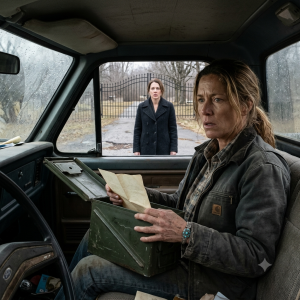
Small. Olive green. Waterproof, the kind hunters use for matches. It was wedged right into the sod at the base of the new marker, like someone had pressed it there deliberately, like a message left in a mailbox.
I pulled it free with two fingers.
My childhood nickname was scratched into the lid.
*Marl-bug.*
My sister used to call me that. Only her. Never anyone else, not once in my entire life.
I stood there in the November wind, grave dirt on my gloves, and I could not breathe.
I told myself I should open it. I didn’t open it.
I brought it to the cemetery office and left it in the lost-and-found basket like a coward. I went home. I made soup. I called my daughter and talked about Thanksgiving plans and did not say one word about any of it.
Three days later, someone left it under my wiper blade.
—
The tin again.
Same tin. I could see the scratch marks on the lid — *Marl-bug* — in handwriting I would know anywhere, in any light, after any number of years.
I sat in my truck for twenty minutes in the Hillcrest parking lot before I could make myself drive away. I brought it home and put it on my kitchen table and stared at it through two cups of coffee and most of a sleepless night.
I went back to the cemetery records the next morning. Dug as deep as the county would let me.
The alias on that burial registration — I traced it back through property records, a P.O. box, a defunct email address registered in Burlington in 2019.
And then to a name I hadn’t heard spoken aloud in over two decades.
—
There are things about the night Cece disappeared that never sat right with me. The body they recovered didn’t look like her — but we were told grief does that, distorts your memory, makes strangers look familiar and familiar faces look wrong. Our mother accepted it. The funeral happened. We moved on because moving on is the only direction grief allows.
But I never fully believed it.
And someone — someone who knows what Cece called me when we were little girls chasing fireflies in the backyard of our house on Orchard Hill Road — wanted me to find that tin.
—
This morning I drove to the engraving shop in Stowe to pick up a supply order. I brought the tin with me. I sat in the parking lot for a long time.
My hands were shaking in a way I couldn’t control.
I pried the lid open with my thumbnail.
Inside, there was something folded. Small. Old. I recognized the paper before I could even process what I was seeing — cream colored, soft at the creases, the kind of stationery our mother kept in the secretary desk in the front hallway.
I started to unfold it.
And when I looked up —
There was a woman standing twenty feet away at the cemetery gate.
Perfectly still.
Watching me.
She was wearing my mother’s silver bracelet. The one with the small turquoise stones. The one we buried with my mother eight years ago.
I know I should have driven away.
I know I should have called someone.
But she took one step toward me, and I saw her face clearly for the first time, and —
—
It was Cece.
Twenty-three years older. Her hair gone from dark brown to the color of birch bark in winter, cut short in a way I’d never seen on her. Deeper lines around her eyes. Thinner through the shoulders. But the eyes themselves — that particular gray-green, the color of the lake in early October — those were exactly the same. Those were the eyes I grew up looking into.
I did not get out of the truck.
I could not get out of the truck. My body had simply stopped taking instructions.
She walked toward me slowly, both hands visible at her sides, like you’d approach an animal you didn’t want to startle. She stopped at the passenger window. She waited.
I unlocked the door.
She got in, and she smelled like woodsmoke and cold air, and she said my name — my real name, not Marl-bug, just Marlene — and her voice was the same. A little rougher. But the same.
We sat there for a long moment and I thought I might actually pass out. My vision went narrow at the edges, the way it did when my daughter was born and the feeling was too large to fit inside me.
“I need you to read the letter before I say anything,” Cece said. “Please. In order. Don’t skip ahead.”
My hands were shaking so badly I could barely unfold the stationery. But I read it.
—
Our mother had written it.
Not recently. The date at the top was March of 2016 — two years before she died. The handwriting was still firm then, still her handwriting, not the trembling script of her last months.
It was four pages long, and I’m not going to share all of it here, because some of it belongs only to my family, to whatever is left of it. But I’ll tell you what I can.
Our mother knew.
She had known since the night it happened, or close enough to since the beginning that the difference doesn’t matter.
Cece had not drowned. Cece had run. She had staged it — or had help staging it, with the cooperation of a woman named Ruth Demers who worked the lake patrol that winter and who is now buried herself in a churchyard outside of Montpelier. The body in the water had been a terrible, tragic coincidence — a young woman from a county two hours south who had actually drowned two days earlier and whose family was still searching. The identification was wrong, and our mother had known it was wrong, and she had accepted it anyway. She had let them bury a stranger in Cece’s place.
Because the alternative was letting the man Cece was running from find out she was alive.
My mother named him in the letter. I recognized the name. He had been around our family for a brief period when I was eleven and Cece was sixteen. He had seemed charming in a way that now, reading my mother’s careful, deliberate sentences, made my stomach turn over.
He had gone to prison in 2009 for things unrelated to us. He died there in 2021.
Our mother had written the letter in 2016 because she was afraid she was running out of time to tell the truth. She had mailed it to a P.O. box in Burlington — to Cece. She had told Cece in the letter that she could come home now, or not, that the choice was hers. That she was sorry she had ever had to make it.
She had also told Cece where she’d be buried.
And she had told her about the bracelet.
—
I asked Cece why it took her seven years after our mother’s letter to come back.
She was quiet for a little while. She was looking out the windshield at the iron gate and the old maples, their branches bare now in the November cold.
“I had a life,” she said finally. “I had people who knew me by another name. I had to make arrangements. And I was scared.” She paused. “I’ve been scared for a long time. It’s a hard habit to stop.”
She told me she’d been living in western Canada. British Columbia, a small town I’d never heard of. She worked in a bakery. She had a dog, a big ridiculous golden retriever named Harold. She had friends, a community, a careful and quiet life she had built from nothing with her own hands.
She had never married. She’d had relationships, she said, but nothing she could let go all the way into, because there was always this — her hand made a gesture I understood perfectly, the gesture of everything unspoken pressing against the inside of your chest.
She had visited the grave twice before she left the tin. Both times she hadn’t been able to stay long enough to do what she came to do. The third time, she saw the name on the new stone. She hadn’t known I was the one who did the lettering work there. She said she stood at the edge of the parking lot for almost an hour reading the name she’d been born with and watching a woman in work gloves who turned out to be her sister, and she made up her mind.
The tin was a test, she admitted. She needed to know if I would look. If I would come back to it. If I was still the kind of person who couldn’t leave a thing alone once it had taken hold of her.
I asked her if she’d been surprised when I left it in the lost-and-found.
She almost smiled. “A little. But you came back to it.”
“I didn’t come back to it,” I said. “You put it on my truck.”
“I know,” she said. “But you didn’t throw it away.”
—
We sat in that truck for four hours.
Four hours of November light going from gray to gray to dark. I turned the engine on at some point to keep us warm, and we talked in that stopped, halting way that happens when you are trying to cover twenty-three years and the words keep running out and having to be replenished.
She asked about our mother’s last years. I told her. I did not make it gentle because she didn’t ask me to make it gentle. Our mother had been sick for two years before she went, and it had been hard, and now I understood something new about how she had spent those two years — what she had been carrying alongside everything else.
Cece cried then. She turned toward the window so I wouldn’t see, but I could see.
I asked about Harold the dog. She pulled out her phone and showed me a picture — this enormous, ridiculous, happy-looking animal lying upside down on a braided rug, tongue out, completely undignified. I laughed. Actually laughed, for the first time in days. It came out of me like something that had been under pressure.
I asked her what she was going to do now.
She said she didn’t know yet. She had a return flight booked for Friday. But she hadn’t decided whether to use it.
I told her my daughter was coming for Thanksgiving next week. My daughter is twenty-six and she has heard me talk about Cece her whole life, not obsessively, not in a way I meant to make into a wound, but just the natural way you talk about someone who is missing from the shape of your family.
I watched Cece’s face when I said that.
“She knows about me?” Cece asked.
“Of course she does,” I said.
—
She cancelled the Friday flight.
She’s staying through Thanksgiving, at least. She’s sleeping in my guest room, which still has the iron bedframe I bought at an estate sale twelve years ago and never got around to replacing. She made coffee this morning before I was even up, and the house smelled like it, and for a split second before I was fully awake I thought I was somewhere else, some other version of my life.
We’re taking it slow. It can’t be anything other than slow — there are twenty-three years of slow to get through, and neither of us is fooling ourselves that this is simple or clean or without grief mixed into it. It isn’t. There’s grief in it like there’s water in the lake. You can’t separate them out.
But yesterday evening we drove out to Orchard Hill Road and sat in the car in front of the house we grew up in. Someone else lives there now. The maple in the front yard is enormous, much bigger than I remember it. The porch light was on.
We didn’t get out. We just looked at it for a while.
Cece said, “The fireflies were always thickest over by the garden.”
I said, “I know.”
We drove home.
—
I’m writing this because I don’t know what else to do with it. I’ve been walking around for three days with this thing living inside me that is too big and too strange to explain in person to anyone who knew me before. Writing it down makes it real in a way that it still, honestly, doesn’t feel.
The stone at Hillcrest still has her name on it. I don’t know what will happen with it. I don’t know what we tell people, or whether there is a we yet, or what the next week looks like let alone the next year.
But I do know this: I finished that stone because orders are orders, and I am glad I did. Because someone needed me to see it. Someone needed me to find the tin and recognize the handwriting and be stubborn enough not to let it go.
She’s in the kitchen right now. I can hear her talking to my cat, who has taken to following her everywhere, the little traitor.
My sister is in my kitchen, talking to my cat.
Twenty-three years.
I have no idea what comes next.
But she’s here.