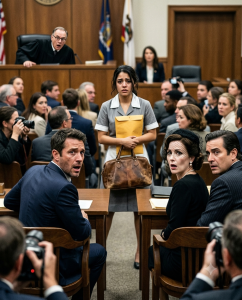
“Your Honor, I have proof.”
For one suspended second, no one in Courtroom 3 moved.
The words had come from the very last row, from a woman most of the room had not noticed until she was already standing. She was young, plainly dressed, wearing the gray-and-white uniform of domestic staff in a room built for power, status, and spectacle. Yet in that instant, the entire trial bent toward her.
Lucía Méndez had spent four years moving silently through the halls of the Montes de Oca mansion. She carried trays, polished silver, changed flowers, and disappeared before conversations among the wealthy reached the point where they assumed privacy. No one asked what she heard. No one wondered what she understood.
That had always been their mistake.
The murder trial of Alejandro Montes de Oca had already become a national obsession. He was the son of Rodrigo Montes de Oca, one of Mexico’s most feared and admired businessmen, a man who had turned ruthless instinct into an empire of hotels, hospitals, and luxury developments. When Rodrigo was found dead in his private study, poisoned by the tea served before bed, the country wanted a villain. Alejandro fit the story too neatly.
He was the heir. There had been a fight. A disputed testament. A fiancée in tears. A trusted family lawyer offering solemn testimony. It was the kind of case television anchors loved because every detail looked expensive and tragic.
By the time the trial opened, Alejandro had already been convicted in the public imagination. He sat in court with bruised wrists and hollow eyes while reporters called him the Killer Prince and speculated about greed, entitlement, and father-son rivalry. Outside the Palace of Justice, large news screens drew crowds all day. Social media tore him apart in real time.
Alejandro’s own memory did little to help him. He had argued bitterly with his father days before the death. Rodrigo had warned him not to marry Daniela Sauri, the woman Alejandro planned to wed. Rodrigo had called her dangerous. Alejandro, insulted and furious, had defended her. They had shouted. Doors had slammed. Staff had heard.
The next night, Rodrigo was dead.
Daniela, devastating in black, gave interviews with a shaking voice and dry eyes. Víctor Almada, the family attorney and Rodrigo’s longtime associate, stood at her side like calm itself. He handled reporters, advised police, surrendered documents, and spoke as though his only wish was for truth to prevail.
Truth, it turned out, had been carefully arranged.
Lucía knew that because she had heard the plan before the murder happened.
She had been carrying Rodrigo’s evening tea to the study when she reached the half-open door and heard voices inside. She recognized Daniela immediately. The tone was what froze her—not grief, not panic, not anger, but something flat and surgical.
“The old man signed the testament change,” Daniela said. “Tomorrow he takes it to the notary. If he does, we get nothing.”
Víctor answered in a low voice. “If the assets move toward the foundation, our leverage disappears.”
“Then it has to be tonight,” Daniela said. “And the blame falls on Alejandro.”
Lucía had not meant to react. But the tray slid in her hands and shattered on the marble. Porcelain exploded. Tea ran across the floor.
“Who’s there?” Víctor shouted.
Lucía ran before they could see her face. She hid in the laundry room, shaking so violently she thought she might faint. For a long time she could hear footsteps in the hall, then silence, then the distant hum of the mansion settling back into performance.
Later that night, the household erupted.
Rodrigo Montes de Oca had collapsed in his study.
Doctors were called too late. Police came. Sirens flashed at the gates. The cup was collected. Staff were questioned. By dawn, the story had hardened: family dispute, poisoned tea, dead patriarch, guilty heir.
Alejandro was arrested before the day was over.
Lucía might have kept silent forever if not for something Rodrigo himself had told her weeks earlier.
He had seemed restless that evening, distracted in a way powerful men rarely allow themselves to appear. She had brought him tea and noticed he had not touched it. Instead, he stared at the dark window and spoke without looking at her.
“If something happens to me,” he said, “there is a hidden drawer in my desk. Do not give what’s inside to anyone in this house. Take it only to justice.”
Lucía had nodded because refusing would have been impossible, but she left confused. Why would a man like Rodrigo Montes de Oca trust a maid with anything that mattered?
After his death, she understood.
While the family staged grief and lawyers controlled movement in the study, Lucía slipped inside during the chaos of the early morning. The room smelled of old wood, tea, and something medicinal beneath it all. Her fingers searched the desk until she found the concealed latch under the lowest drawer.
Inside were several items carefully arranged: a small digital recorder, a packet of financial statements, copies of transfer confirmations, and a folded yellow envelope containing a handwritten letter.
Lucía read the letter in the half-light from the study lamp.
If you are reading this, the wolves arrived first. I trust you because you were the only honest person left in this house. Save my son. He is stubborn, but he is not a murderer. Tell him his father loved him.
She pressed the page against her chest and cried silently because she understood, all at once, how alone Rodrigo must have felt at the end.
She also understood the danger he had just placed in her hands.
The recorder contained a conversation—partially the same one she had overheard, but fuller, clearer, devastating. Rodrigo, suspicious and methodical, had evidently begun documenting what he feared was forming around him. On the audio, Daniela and Víctor discussed the testament, the timing, and the value of letting Alejandro take the fall while the estate was tied up in legal confusion.
The financial records showed transfers through shell companies linked to one of Víctor’s offshore entities and a luxury consultancy attached to Daniela. The money had been moving weeks before Rodrigo died.
Lucía hid the evidence in her room and lived the next month in a state of constant terror. Twice, Daniela questioned staff in a falsely gentle tone about whether anyone had entered the study after the death. Once, Víctor changed the locks on internal office cabinets and told everyone it was for “legal integrity.” Another time, Lucía returned to her small room behind the service wing and found the mattress slightly misaligned. Nothing was missing, but she knew someone had searched.
She stopped sleeping. She carried the recorder with her even while cleaning. She changed where she hid the envelope almost daily. Some nights she considered going to the police directly, but every official statement she saw seemed to come through Víctor. Every headline accepted Daniela’s grief as fact. Every avenue looked already infected.
Then the trial began.
Lucía sat in the back because she wanted to see whether anyone in that courtroom still recognized truth when it arrived from the wrong mouth.
At first, it looked hopeless.
The prosecution laid out a clean story: Rodrigo had argued with Alejandro over inheritance, trust, and authority. The father intended to alter the structure of the estate. The son feared losing power. Poison ended the dispute. Household witnesses described tension. Experts explained toxicology. Daniela, elegant and wounded, testified that Alejandro had said, “One way or another, this ends this week.”
Alejandro denied poisoning his father. He admitted the fight. He admitted rage. He admitted that Rodrigo had opposed his engagement. But in a murder trial, wounded honesty can sound dangerously close to guilt.
Víctor’s testimony was even worse. He looked measured, reluctant, honorable. He described Rodrigo’s concern for the future and his disappointment in Alejandro’s impulsiveness. Then he made one apparently harmless statement that struck Lucía like a blade.
“To my knowledge,” he said, “no member of the household staff had access to confidential conversations in that wing of the residence.”
He was not just testifying. He was sealing the exits.
In that moment Lucía realized silence no longer protected her. It only protected them.
When the judge announced a recess before closing arguments, Lucía rose and shouted the words that stopped the room.
“Your Honor, I have proof.”
Chaos followed immediately. Daniela sprang up in outrage. Víctor objected to the “spectacle.” The prosecutor demanded identity and foundation. Alejandro turned, bewildered, as though a voice had just reached him from another life.
Lucía forced herself to speak clearly.
“My name is Lucía Méndez. I work in the Montes de Oca residence. I heard Daniela Sauri and Víctor Almada talking on the night Don Rodrigo died. And I found evidence Don Rodrigo hid in his desk.”
The judge, to his credit, did not dismiss her.
He ordered the bailiff to bring the evidence forward.
Lucía walked to the front on unsteady legs and handed over the recorder first. Judge Alcántara asked for it to be played over the courtroom audio system.
The first seconds were static. Then Daniela’s voice emerged, clean enough that even the reporters stopped breathing.
“The old man signed the testament change. Tomorrow he takes it to the notary, and then we get nothing.”
Víctor answered, “Once Alejandro is blamed, the estate freezes. We manage the litigation from there.”
Then Daniela again, with chilling certainty: “Tonight. And the son carries it.”
The effect was immediate and brutal.
Daniela’s face emptied of color. Víctor did not speak. The prosecutor looked as if someone had pulled the ground from under his case. Alejandro stared at Daniela with such pure devastation that several people in the gallery looked away.
“That recording is fabricated,” Daniela finally cried. “It’s edited!”
But she spoke too late and too sharply. Panic had broken her performance.
The judge ordered the yellow envelope opened. Inside were the financial records, the hidden transfers, and Rodrigo’s letter. The bank data showed a pattern of secret movement involving accounts associated with Víctor and a consulting vehicle linked to Daniela. But what froze Judge Alcántara was not merely the money.
It was a signature on one authorization document.
A deputy clerk of the court.
Not from this courtroom, but from the broader judicial system.
The implication was immediate: someone inside the machinery of justice might have helped prepare false notarization pathways and timing manipulations around the testament dispute. This was no longer a family murder case. It was becoming a corruption case.
Judge Alcántara sealed the envelope himself and ordered both Daniela Sauri and Víctor Almada detained pending further examination. The courtroom erupted again. Reporters shouted. Daniela screamed that Lucía had ruined everything. Víctor demanded counsel and attempted, for the first time, to drop his composed public voice in favor of legal aggression.
Alejandro remained seated, pale and motionless, until the guards moved toward Daniela. Then he stood.
“Did you ever love me at all?” he asked.
Daniela looked at him with a kind of exhausted contempt. In that instant, the grieving fiancée mask was gone.
“You were useful,” she said.
It was the worst answer he could have received because it was honest.
The trial collapsed that afternoon. Proceedings against Alejandro were suspended pending review of newly introduced evidence and possible prosecutorial misconduct, though the prosecutor himself appeared more duped than corrupt. Within forty-eight hours, Alejandro was released. News channels that had condemned him now replayed the recorder audio every hour, each time with new experts analyzing voice patterns and document trails.
The investigation widened fast.
Forensic review confirmed that the poison had been introduced after the tea left the kitchen but before it reached Rodrigo’s hands. Security footage, previously overlooked because Víctor had controlled collection from private cameras, was recovered from a backup server the estate’s tech vendor still possessed. The footage showed Daniela entering the study corridor minutes before the estimated poisoning window and Víctor following later with a folder.
Phone records placed the two in repeated contact with a financial fixer who specialized in shell transfers and asset concealment. The altered testament packet the prosecution had relied on contained mismatched metadata and sequencing errors. Rodrigo’s real signed directive, found later through the notary he had contacted, confirmed his intention to divert substantial control away from family beneficiaries and into the foundation, specifically limiting Daniela’s access and reducing Víctor’s influence over legal structures tied to the business empire.
The motive was now crystal clear.
Rodrigo had discovered enough irregularities to cut them off.
So they decided he would not live to formalize the change.
Under pressure, one of Víctor’s intermediaries cooperated. Then a household guard admitted he had been told to overlook corridor movement that night. Then the clerk whose name appeared on the authorization trail confessed to accepting payment to fast-track certain paperwork and backdate internal handling.
The wall cracked from every side at once.
Víctor held out longer than Daniela. He denied direct involvement, cast himself as a frightened adviser, and claimed Daniela acted independently. But the recorder, financial records, and recovered messages made that impossible. In one exchange, Daniela asked whether “the son’s fingerprints on the cup” would be enough. Víctor answered, “With your tears, yes.”
That line ended him.
Months later, the court returned with full charges against both. This time, the evidence flowed in the opposite direction. The audio was authenticated. The money trail was mapped. The forged document sequence was explained in meticulous detail. The poison source was linked to a supplier connected through a shell account financed by transferred funds. The conspiracy to frame Alejandro stood in plain view.
Daniela Sauri was convicted of conspiracy to commit murder, fraud, and obstruction of justice. Víctor Almada was convicted on the same counts, along with document tampering and financial crimes related to embezzlement and concealment. The corrupt clerk received a separate sentence under a cooperation agreement.
Alejandro was fully exonerated.
That should have felt like the end. In public terms, it did. The headlines shifted from Killer Prince to Betrayed Heir. Commentators apologized. Some even praised his composure. But private absolution came harder.
When he first returned to the mansion, it no longer felt like a home. It felt like a stage after the audience had left—beautiful, expensive, and haunted by every line that had ever been spoken there. He entered his father’s study alone and stood for a long time at the desk where the hidden drawer had changed everything.
Lucía found him there eventually. She paused at the threshold, unsure whether to enter. He turned when he heard her.
“You saved my life,” he said.
She shook her head. “Your father did. He knew the truth would need somewhere safe to wait.”
Alejandro looked down at the desk. “I didn’t listen to him.”
“No,” Lucía said softly. “But he still tried to protect you.”
He asked whether she had been afraid.
Lucía almost laughed. “Every minute.”
“Why did you still do it?”
She thought of Rodrigo’s letter, of the sound of the cup shattering, of Daniela’s voice saying tonight, of how easy it had been for them to believe a maid would remain silent forever.
“Because someone had to,” she said.
Alejandro later transferred ownership of the mansion to the foundation and reduced his role in the wider business empire until the company’s governance could be restructured. He carried out his father’s final wishes, though not without cost. Public sympathy returned, but trust did not. Some wounds survive acquittal.
As for Lucía, she was offered money, comfort, and public praise she never asked for. She accepted none of the interviews. She did, however, accept one thing: a scholarship fund Rodrigo had created for staff education, which Alejandro expanded in her name after learning she had once wanted to study law.
A year later, she enrolled.
People still told the story as if the shocking moment had been the recorder playing in court, or Daniela’s mask finally breaking, or the judge freezing when he saw corruption reaching deeper than expected.
But the real turning point had come before all of that.
It had come the moment a woman everyone considered invisible decided she would no longer behave like she was.
Because that is what finally destroyed Daniela and Víctor. Not just the evidence. Not just the documents. Not even Rodrigo’s foresight.
It was the arrogance that made them believe the person carrying the tea could never carry the truth.
And that was the detail people argued over long after the verdicts were entered.
Who was more guilty—the woman who poisoned a man for wealth, the lawyer who dressed murder in paperwork, or the son who ignored every warning until it was too late?
Some said Alejandro was a victim twice over: first of betrayal, then of public hunger for a simple villain. Others said Rodrigo had built a world so obsessed with appearances and control that monsters had learned to thrive inside it. A few insisted the biggest red flag had been visible from the start—the fiancée who cried without tears and the lawyer who always seemed just a little too prepared.
Lucía never joined those arguments.
She had heard enough from behind half-open doors to know one thing for certain:
The most dangerous people are often the ones who believe no one beneath them is listening.