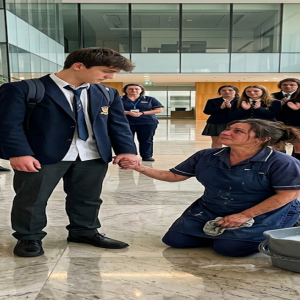
Alice Hayes had 3 guns pointed at her chest the night she saved the paralyzed daughter of the most feared man in Chicago.
By the time it happened, she had already been awake for almost twenty hours.
The community clinic where she worked sat on a corner everyone with money avoided. The paint was peeling, the lights buzzed, and the old radiators made sounds that felt too human after midnight. The place smelled like antiseptic, stale coffee, and desperation. Alice had long ago stopped noticing it unless she imagined what her old classmates from Northwestern would say if they saw her there.
Most of them had gone into sports rehab, private hospitals, research. Alice had ended up working overnight shifts in a neighborhood clinic that treated people who came in bleeding, shaking, coughing, or trying not to die because they couldn’t afford somewhere cleaner.
At 11:45 that night, she sat behind the front desk counting coins for the third time, hoping the total would magically change.
It didn’t.
Thirty-two dollars and forty cents.
She closed her eyes and pressed two fingers against her forehead. Leo’s inhaler prescription was folded in her pocket. The pharmacist had already given her an extra week on trust. There would not be another extra week.
Her son was five years old with huge brown eyes and a chest that betrayed him. On bad nights, he slept propped up with pillows, breathing in thin, ragged pulls that made Alice sit beside him until morning, afraid to blink too long. She knew every sound his lungs made. She knew what panic looked like on a child trying not to scare his mother.
She also knew how hard she had fallen to get here.
Years ago, professors had praised her hands, her instincts, her ability to read the body like language. She had nearly entered a doctoral track. Then Jimmy Gallagher, charming and unreliable in all the ways that still managed to fool her, emptied their account and disappeared when she was eight months pregnant. He left behind rent, debt, and a voicemail that said he was sorry in a voice so casual it still made her sick to remember.
Alice had not had the luxury of falling apart. Leo was born. Bills came. Life hardened. She did too.
The clinic door exploded inward before she could count her coins again.
Three men in dark suits walked in under the roar of rain. Their clothes were expensive, their shoes polished, their faces hard. One kept his hand tucked inside his jacket in a way that made Dr. Aerys Mitchell instantly stop chewing his sandwich when he wandered out of the break room.
“We’re closed,” the doctor said.
The tallest man barely looked at him. “Not anymore.”
Then Vincent Moretti stepped inside.
Alice knew the name before she admitted to herself that she knew the face. Everyone in Chicago had heard stories about Vincent Moretti. Some called him a businessman. Others called him what he was when they were safely behind locked doors: a man who built power out of fear and kept it with precision.
He carried a little girl in his arms.
The clinic changed the second Alice saw her.
The child couldn’t have been older than seven. A cashmere coat covered her, but when Vincent laid her on the trauma bed and pulled it back, Alice saw the rigid arch in her spine, the locked fingers, the jaw clenched so tightly it made the muscles in her face tremble. Her lips were blue. Her body was fighting itself.
“Traumatic cervical injury, two years ago,” Vincent said. “She’s seizing in spasm. Fix it.”
Dr. Mitchell rushed over, then slowed almost immediately. Alice watched fear take over his judgment. “I can sedate her,” he said, “maybe try airway support, but without the right pediatric dosing and history—”
“If she dies,” Vincent said evenly, “everyone in this building dies with her.”
No one doubted him.
Alice moved before she fully decided to.
“Aerys, step back.”
Every eye turned to her.
Vincent’s bodyguards reached for their weapons. Vincent himself stared at her with cold disbelief.
“Who are you?” he asked.
She walked closer to the child. “The person who might be able to help.”
What she saw in Lily wasn’t just a spasm. The girl’s breathing pattern, the cervical tension, the precise way her shoulders locked told Alice this was a neuromuscular cascade. Rare. Dangerous. Easy to make worse if handled wrong. But her grandfather had once taught her a manual release approach for catastrophic lockups when sedation wasn’t an option and time was running out.
The old man had believed healing lived in forgotten places. He had drilled one lesson into her again and again: Hands can rescue a body before machines understand what they’re seeing.
Vincent’s voice dropped. “If you hurt her—”
“Then stop threatening me and hold her still.”
That answer should have gotten her killed.
Instead, something in Vincent shifted, perhaps because he had run out of better options.
Alice touched Lily’s neck and felt the cold, terrifying rigidity beneath the skin. She stabilized the jaw, pressed at the base of the skull, tracked the tension along the spine, and spoke softly to the child the whole time.
“Lily, listen to me. Stay with my voice. Don’t fight it.”
The room became a held breath.
Three minutes passed with no improvement. Dr. Mitchell was sweating. One guard had his gun half-drawn. Rain hammered the windows so hard it sounded like hands trying to get in.
Alice repositioned. She found the trapped knot beneath the shoulder blade where the lock seemed to be feeding from, and she pressed with all the controlled force she had.
A crack snapped through the room.
Then Lily gasped.
Her chest rose. Her fingers unfurled. Pink slowly returned to her mouth. Tears spilled from her eyes as she stared up at Alice in shock and pain and relief.
Vincent did not thank her.
He simply looked at his daughter breathing and then at Alice as though he had just discovered a weapon he had not known existed.
One of his men dropped a stack of cash on the counter. Vincent picked Lily up again, turned toward the door, and paused.
“Your name.”
“Alice Hayes.”
He repeated it, quietly and precisely.
Then he left.
For three days, Alice tried to convince herself that was the end of it.
Life insisted otherwise.
Her landlord taped an eviction notice to her apartment door. The pharmacy refused another extension. Leo woke coughing so hard that she had to carry him to the bathroom and sit on the floor with him while steam filled the air and panic filled her chest.
“Mommy,” he asked afterward, voice thin, “am I gonna go to the hospital again?”
Alice hugged him too tightly. “Not if I can help it.”
The next morning, after she dropped him at daycare, a black Lincoln blocked the alley behind the building. One of the men from the clinic got out.
“Miss Hayes. Mr. Moretti would like to see you.”
She almost laughed at the phrasing. “I’m not interested.”
“It isn’t a request.”
Fear hit first. Then came the practical thought she hated most: men like Vincent Moretti got things done.
She got into the car.
The Moretti estate sat behind gates, cameras, stone walls, and enough security to defend a government compound. The house itself was beautiful in an almost hostile way—vast, spotless, silent. Nothing personal lay in plain sight. Wealth was everywhere, warmth nowhere.
Vincent waited in a dark study lined with books Alice suspected no one read.
“I know about your son,” he said without preamble. “I know about your debt. I know Jimmy Gallagher abandoned you. And I know my daughter stood up straighter this morning than she has in months.”
Alice folded her arms. “Good for her.”
He almost smiled at that. “I’m offering you employment.”
He named a number so high Alice thought she had misheard.
Fifty thousand dollars a month.
Leo would get private specialists. Her debts would disappear. She would live on the estate and treat Lily daily.
“And the catch?” Alice asked.
“You live by my rules. You go nowhere without security. You speak to no one about my family. You betray my trust once, and the arrangement ends.”
There it was. The truth under the generosity.
Still, she pictured Leo with proper medication. Lily with a chance at progress. Rent no longer hanging over them like a blade.
“My son gets a full pediatric respiratory team by tomorrow,” she said. “And you do not threaten me in front of him.”
For the first time, Vincent seemed genuinely surprised by her conditions. Then he nodded.
“Done.”
By evening, Alice and Leo had moved into rooms on the second floor of the mansion.
Leo thought they had entered a fairy tale. He bounced carefully from room to room, amazed by the giant bed and the bathroom bigger than their old kitchen. Alice smiled for him, but every instinct she had remained on edge.
Lily changed almost immediately under consistent treatment. She was fragile, bright, and painfully polite, the kind of child who had learned too early that adults spoke around her as if she were both treasure and burden. During therapy, she clung to Alice’s voice, trusted her hands, and tried harder than any seven-year-old should have to.
Vincent watched many of those sessions in silence.
He did not hover uselessly. He learned. When Alice showed him how to support Lily’s shoulder without triggering pain, he listened. When Lily was scared, she reached for him. When he thought no one saw, he kissed the top of her head like a man praying through contact.
It would have been easier if he had been monstrous all the time.
But houses built on fear do not stay standing without rules, and Alice quickly learned the Moretti house had more than most.
There were rooms staff never entered. Hallways that security patrolled more heavily after midnight. Conversations that stopped when she approached. Vincent’s sister, Bianca, regarded Alice with open contempt from the first dinner onward.
“This arrangement is reckless,” Bianca said one night, swirling wine in a crystal glass. “You bring a stranger in because she touches your daughter and suddenly she lives under our roof?”
“She’s not a stranger,” Lily said quietly. “She helps me.”
Bianca’s smile never reached her eyes. “That is not what I meant.”
The housekeeper, Mrs. Valenti, was kinder but terrified in a way that seemed permanent. Once, while changing bed linens in Alice’s room, she muttered, “Some money costs more than debt,” then refused to explain herself.
Another guard kept staring at Alice as though he knew her from somewhere. When she finally asked his name, he looked away too fast and said, “You should keep your door locked.”
That night, she did.
It still wasn’t enough.
Sometime after midnight, Alice woke to the sense that someone was standing outside her room. She listened. No footsteps. No breathing. Just presence. She slipped out of bed, checked on Leo, and moved toward the door.
The handle turned slightly.
Then a woman’s voice came through the wood, low and urgent.
“Alice Hayes, if you love your son, leave this house before morning.”
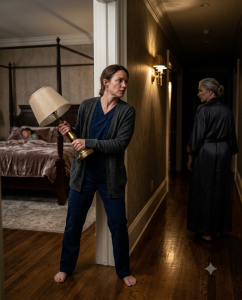
Alice gripped the lamp from the table beside the door. “Who are you?”
A pause.
“Someone who stayed too long.”
Then footsteps retreated down the hall.
Alice yanked open the door, but only caught the blur of a silk robe turning a distant corner. The hallway was empty by the time she followed.
At breakfast, she told Vincent.
He did not dismiss her. He listened, which somehow unsettled her more.
Before he could respond, Lily looked up from her juice and said, “Was it the lady in the blue room?”
The room froze.
Vincent turned slowly to his daughter. “What lady?”
“The one at the end of the west hall,” Lily whispered. “The one who cries.”
Vincent’s face changed in a way Alice had never seen. Not anger. Not fear. Something more dangerous than either—recognition.
He ended breakfast immediately. Two guards appeared. Bianca vanished. The rest of the house seemed to hold itself rigid around an invisible crack.
Alice should have walked away then. Instead, she followed the crack.
That afternoon, while Leo napped under the watch of his new respiratory nurse, Alice went to the west hall.
The door at the end was blue.
It was also locked.
Mrs. Valenti nearly dropped a tray when she saw Alice standing there. “You must not be here.”
“Who’s inside?”
“No one.”
“There was someone at my door.”
The older woman’s face folded with grief. “In houses like this, miss, there are people no one is allowed to name.”
Before Alice could push further, Vincent’s voice came from behind her.
“Leave us.”
Mrs. Valenti hurried off.
Alice turned. “Your daughter knows about the room. Your staff is terrified. A woman warned me to run. You want me here treating your child, then stop lying to me.”
Vincent looked at the blue door for a long moment before answering.
“My wife is inside.”
Alice’s anger stumbled into confusion. “Your wife?”
“She’s been there for eleven months.”
Nothing about the mansion had prepared Alice for that sentence.
“She’s ill,” Vincent said. “And dangerous.”
He opened the door himself.
The room inside was beautiful and terrible. Sunlight filtered through drawn curtains onto expensive furniture no one used. Vases of fresh flowers sat beside untouched tea. At the center, seated near the window in a silk robe, was a woman with dark hair falling past her shoulders and eyes so sharp they made Alice understand Lily’s face in an instant.
She was beautiful, elegant, and very much not free.
“So,” the woman said, studying Alice, “you’re the miracle worker.”
“This is Serafina,” Vincent said. “My wife.”
Serafina laughed softly. “Your prisoner, you mean.”
Alice looked between them. “What is happening here?”
Vincent’s jaw tightened. “She attempted to take Lily and disappear. In the process, Lily was injured.”
Serafina stood so quickly her chair scraped the floor. “That is his version.”
“It is the truth.”
“It is the truth you bought.”
The silence between them felt old, rehearsed, and lethal.
Alice glanced at Serafina’s wrists. No chains. No bruises. But the room itself was a cage, and everyone knew it.
“Tell her,” Serafina said to Vincent. “Tell your saintly little therapist why your daughter’s neck was broken that night.”
Vincent said nothing.
So Serafina told her.
Two years earlier, Vincent had planned to move Lily to another estate after threats from a rival organization escalated. Serafina had begged him to let the girl stay out of it, to send her somewhere safe and anonymous. Vincent refused. An argument followed. A car was arranged. Men were stationed. Somewhere inside that chaos, Serafina tried to take Lily and flee before Vincent’s enemies could use her as leverage.
The convoy never made it out.
A truck rammed the side vehicle. Glass shattered. Guards fired. Lily’s cervical injury came from that crash.
Vincent blamed Serafina for causing it.
Serafina blamed Vincent for building a life in which it could happen at all.
“And since then,” she said, voice shaking with contained fury, “he tells the world I’m unstable and locks me away because that is easier than admitting his empire broke his child.”
Vincent finally spoke. “You endangered her.”
“I tried to save her.”
“You ran with her.”
“From men who would kill for your name.”
The worst part, Alice realized, was that both of them might be telling the truth.
But truth has layers, and the house still had another.
That night, the guard who had kept staring at Alice asked to speak privately. His name was Mateo. In the servant stairwell, far from cameras, he handed her an envelope.
“Don’t tell anyone I gave you this.”
Inside were photocopies of financial records, medical transfers, and one hidden paternity report.
Alice’s breath caught.
Vincent Moretti was not Leo’s father, obviously. The report concerned Lily.
Jimmy Gallagher was.
For a second, the world tilted.
The dates lined up. Two years ago, before he vanished completely, Jimmy had worked as a driver and fixer under aliases for Moretti’s organization. He had also been involved in the route planning the night of the crash. According to the records, Jimmy had secretly fed convoy details to a rival crew in exchange for money.
His betrayal had led to the ambush.
The man who ruined Alice’s life had also helped destroy Lily’s.
And no one in the house knew Alice had once loved him.
Mateo’s face was grim. “Jimmy resurfaced. He contacted Bianca first. He says he has proof Serafina was set up.”
“Set up how?”
“Someone wanted the wife blamed. Someone close enough to know the route.”
“Bianca?”
Mateo didn’t answer.
He didn’t need to.
Alice barely slept. By morning, Bianca approached her in the therapy room with a smile too smooth to trust.
“You’ve become very important here,” Bianca said. “That can be dangerous.”
Alice met her eyes. “For me?”
“For anyone who starts believing they matter more than they do.”
The pieces clicked too fast after that. Bianca had always resented Serafina. Resented Lily’s place in Vincent’s heart. Resented any woman who could influence him. If Jimmy had been desperate enough for money, Bianca would have been clever enough to use him.
Alice arranged the confrontation that night, though later she would admit she had no right to orchestrate anything in that house.
She told Vincent she had found information about Lily’s crash and insisted everyone be present: Vincent, Serafina, Bianca, Mateo, and the household attorney. Leo was asleep under watch. Lily was in the nursery with Mrs. Valenti.
Alice laid the documents on the study desk one by one.
Jimmy Gallagher’s payment transfers.
The route leak.
The communication trail to a private number tied to Bianca’s shell company.
Vincent read in silence. Serafina stopped breathing for a moment. Bianca remained still too long.
Then Alice placed the last item on the table: a recorded voicemail Jimmy had sent from an unregistered number that afternoon after Mateo tracked him down. His voice filled the room, older and thinner but unmistakable.
Bianca had paid him. Bianca had wanted Serafina blamed. The rival ambush had been meant to force Vincent’s wife out of the picture permanently. Lily’s injury had been collateral in a family power play Jimmy was too greedy to refuse.
Bianca’s composure finally cracked.
“You were weak where they were concerned,” she snapped at Vincent. “Your wife questioned you. Your daughter softened you. Everything in this house bent around them.”
Vincent’s face became almost expressionless, which was somehow more frightening than rage.
“You crippled my child,” he said.
Bianca lifted her chin. “Your world did that. I only understood it better than you.”
The guards moved at Vincent’s slightest glance.
Serafina did not scream. She simply sat down, as if the bones had gone out of her body all at once. Alice had the strange, painful thought that a woman could survive imprisonment more easily than vindication.
Vincent’s reckoning was swift, private, and absolute. Bianca was removed from the estate before dawn and, according to the only answer Alice ever got, “dealt with in a way that ensures distance forever.” Jimmy Gallagher disappeared again, though this time Alice suspected he had not been allowed to vanish on his own terms.
More importantly, Vincent opened the west wing doors that same morning.
Serafina walked out without looking at him.
No apology he gave would return Lily’s lost years or undo the prison he had built around grief and certainty. But he did the one thing power rarely does willingly: he gave up control where he had no moral right to keep it. Serafina remained on the estate temporarily for Lily’s sake, no longer confined, no longer silenced. Lawyers and doctors and security arrangements followed. It was messy. Bitter. Human.
Lily, however, began to improve.
Freed from the fear that had soaked every hallway, she responded to therapy with astonishing determination. Her spasms reduced. Her posture strengthened. Some days were still hard, but now both parents sat through sessions without pretending the past had one villain and one victim.
Leo improved too. With proper treatment, his breathing stabilized. Color returned to his cheeks. He ran in the garden with Lily when she was strong enough, the two of them bound by the easy loyalty children form before adults ruin it with explanations.
As for Alice, she was offered every reason to stay.
Money. Security. Gratitude. Influence.
She accepted some, refused more.
She stayed long enough to complete Lily’s critical rehabilitation plan, help transition Leo’s care, and make sure Serafina had independent medical advocates who answered to no one in the Moretti family. Then she left the estate with enough legal compensation to rebuild her life on honest ground.
Months later, she opened a pediatric rehabilitation practice for families who had nowhere else to go. No one entering her clinic needed a famous last name or blood money to be treated with urgency. On the wall behind her desk hung no awards, no degrees, no photos from the Moretti estate. Only one framed note written in a child’s careful hand.
Thank you for helping me breathe.
It was signed by Lily.
Sometimes, late at night, Alice still thought about Vincent standing over that trauma bed, terrifying and helpless at once. She thought about Serafina’s warning through the door, about Bianca’s cold envy, about Jimmy’s betrayal stretching farther than she had ever known. She thought about how close she had come to mistaking rescue for safety.
In the end, the most unsettling part wasn’t that monsters could love their children. It was that love, without humility, could still ruin everything it touched.
And if there was any lesson left in the wreckage, it was this: the biggest red flag is never power by itself. It’s power so certain it believes its fear is the same thing as truth.