I offered a plate of food to God without even knowing it.
Even now, I hesitate before saying those words out loud, because I know how they sound. People hear a story like this and immediately decide what it must be. Some think it is a miracle. Others think it is imagination. A few smile politely and change the subject because they do not want to offend you, but they do not believe you either.
I understand all of that.
If I had heard this story from someone else years ago, I might have reacted the same way. I might have said there had to be a simple explanation. That old men do not vanish. That blessings do not walk up to your gate wearing a worn hat and carrying a faded little bag. That life improves because of hard work, luck, and time, not because a stranger eats beans at your sidewalk table.
And yet, when I go back to that afternoon in my mind, nothing about it feels ordinary.
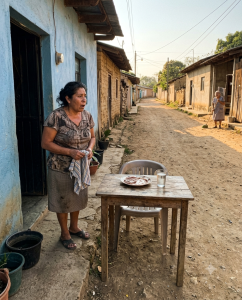
I live in a small village in Oaxaca, the kind of place where everybody notices everything. We are not completely hidden away in the mountains, but we are tucked far enough from the city that life still moves at an older pace. Our roads are dirt. Children run in and out of each other’s houses. Women sweep their front steps in the evening and know exactly who walked by before noon. News arrives by voice before it ever arrives by phone.
In a place like that, strangers stand out immediately.
You can tell when someone does not belong, not because people are unkind, but because the town has its own rhythm, and anyone unfamiliar disturbs it. That day was no different. The sun was still high, though already softening toward late afternoon, and I was finishing up in the kitchen. I had made a pot of beans, warmed tortillas, crumbled fresh cheese into a bowl, and set aside enough for my husband and children. It was not a fancy meal, but it was hot, filling, and made with care.
We were not living in abundance back then. I remember counting things in those days. How much flour was left, how many eggs remained, whether the gas would last to the end of the week, whether my husband’s work would continue or disappear again like it had before. I remember the quiet fear that comes when money is short but no one says it too loudly because saying it makes it feel even more real.
That fear was in our house all the time, sitting with us like an invisible guest.
I had just wiped my hands on my apron when I noticed movement outside. An old man was coming down the road very slowly, stopping at one gate, then the next. He wore an old hat that had lost its shape, a light-colored shirt so faded it looked almost white in places and gray in others, and dark pants dusty from the road. Across his chest he carried a small worn bag, the kind that could hold a few personal things, but not much else.
He was speaking to people as he went, always in the same calm tone, asking if they could spare a coin so he could buy something to eat.
I watched from inside for a moment.
At one house, nobody came out. At another, someone answered quickly and shut the gate again. At the next, I could not hear the words, but I saw the old man nod once and continue on without complaint.
When he reached my gate, I stepped outside before he could knock.
He looked at me, and what struck me first was not hunger. It was peace.
That sounds strange, I know. He looked like a poor man, a tired man, a man who had spent many hours walking in the sun. But he did not look broken. He did not have the desperate look some people get when they are humiliated by needing help. His eyes were clear. His shoulders were relaxed. He seemed almost… certain. Not proud, not demanding, just certain that whatever happened next would happen the way it should.
He asked whether I had a coin to spare so he could get something to eat.
My face burned with embarrassment immediately.
“I do not have money,” I told him. “Things are tight here too.”
It pained me to say it because I could see he had already heard no several times that day. Then I remembered the pot in the kitchen and the stack of warm tortillas still wrapped in cloth.
“But I just made food,” I added. “If you would like, I can serve you a plate.”
He did not hesitate. He did not act ashamed. He simply dipped his head and said, “Yes. Thank you.”
His voice was soft and even, and for some reason that made me want to treat him with extra care.
I dragged out a small table and one of our plastic chairs and set them on the sidewalk in front of the house. I did not want him standing there eating from his hands or balancing a plate awkwardly like someone people wanted gone as quickly as possible. My mother had raised me differently. She used to say, “If a hungry person comes to your door, you do not feed them as if they are less than you. You feed them as if they are visiting your home.”
So I served him the same meal my family had eaten: a generous scoop of beans, fresh cheese on top, hot tortillas, and a glass of water. Nothing fancy. Nothing ceremonial. Just the best of what I had.
He sat down and thanked me with a slight smile.
Then he began to eat.
I stood in the doorway for a moment, half because I wanted to make sure he needed nothing else and half because I was curious. He ate very slowly, with small deliberate movements. He tore the tortilla carefully. He lifted the spoon without hurry. He swallowed as if he had all the time in the world.
That was the first detail that unsettled me.
Someone truly starving usually eats with urgency. Even if they try to hide it, it shows. But this man ate with composure. He was not pretending not to be hungry; he was eating the food, and he seemed to appreciate it. Still, there was no grasping in him, no desperation, no frantic need.
Every now and then, he would raise his eyes toward my house and smile.
Not at me directly. Not at my children, who had begun peeking through the curtain. At the house itself. At the doorway. At the walls. As if he were seeing more than what was in front of him.
I felt a strange shiver travel through me, and I could not explain why.
My youngest son came to my side and whispered, “Mama, does he know us?”
“I do not think so,” I whispered back.
But I was no longer sure.
When he finished eating, he set his spoon down gently and rested both hands on the table. Then he looked at me, really looked at me, in a way that made me feel suddenly transparent, as if my worries, my sleepless nights, my private prayers, all of it had been visible to him from the moment he arrived.
“Thank you,” he said.
“You do not need to thank me,” I replied. “I hope you find somewhere to stay tonight.”
Then he said the words I have never forgotten.
“May this house never be without health or food.”
He did not say it casually, the way people sometimes offer polite blessings out of habit. He said it like a promise. Like a sentence already written somewhere.
For a moment, I just stared at him.
Then I smiled awkwardly and told him to take care. He stood, adjusted the strap of his little bag across his chest, and started walking down the road.
He moved slowly, exactly as before.
I went inside for a rag to wipe the table. I remember that clearly because the rag was hanging from a nail near the sink, and I had to move a bowl to reach it. It took no more than a few seconds. A minute at most.
When I came back outside, the chair was tucked under the table.
The plate was empty. The glass was set neatly beside it.
And the old man was gone.
I froze in the doorway, confused at first, then suddenly cold.
Our road is straight. From my house, you can see to the corner without obstruction. There are no alleys nearby, no open gates close enough for a slow old man to slip through unseen in only a few seconds. If he had continued walking, I should have seen him. If he had crossed the street, I should have seen him. If he had stopped at another house, I should have seen that too.
There was nothing.
I walked to the edge of the sidewalk and looked left. Empty road. I looked right. Empty road. Dust, sunlight, a dog sleeping under a cart, nothing more.
Across from me, my neighbor Tomasa was sweeping her front step.
“Comadre,” I called, trying not to sound rattled, “did you see where the old man went?”
She paused and leaned on her broom. “What old man?”
“The one who was just here. The one eating at my table.”
She frowned. “I did not see anybody leave.”
“He just left now.”
She shook her head. “I have been right here.”
I stared at her, waiting for a laugh, some sign that she had simply been distracted. But her face was serious. She truly had not seen him.
I turned back to the little table.
That was when the second unsettling detail hit me. The chair had been pushed in carefully, not left crooked or half-turned. The plate and glass were arranged neatly, almost respectfully. It was the kind of order someone leaves when they want to show gratitude without making noise.
It was not the setup of a hurried departure. It looked like the meal had ended exactly as intended.
I wiped the table slowly, my skin prickling with something between fear and awe. And into that strange silence came a memory so old it felt like it had been sleeping inside me for years.
My grandmother’s voice.
She used to tell us children never to reject the hungry too quickly, because “sometimes God comes as a poor traveler to see what lives inside your heart.” We would laugh when she said it, and she would scold us for being disrespectful. “You think heaven arrives with trumpets?” she would say. “No. Sometimes heaven arrives dusty and tired, asking only for bread.”
Standing there beside that empty plate, I heard those words as clearly as if she had whispered them into my ear.
That night, I told my husband everything.
I expected him to be practical, maybe amused, maybe skeptical. He is not a cruel man, but he has always been more grounded than I am, less likely to turn unusual things into signs.
Instead, he listened without interrupting.
When I finished, he asked, “How old did he look?”
“Very old,” I said. “But strong in a strange way.”
My husband nodded slowly. “And the hat?”
“Yes.”
“And a little bag?”
I stared at him. “How do you know that?”
He rested his elbows on the table and looked away for a moment before answering. “My mother used to tell a story from her village. About a man like that. She said he would appear in hard times. He never asked for much. Just enough to see what people would do.”
I felt a wave of cold move through me.
“What happened in the story?” I asked.
He gave a weak smile. “That depends on who answered the door.”
The next morning, I could not let it go. I asked around without making too much of it. I did not want the whole village saying I had lost my senses. But little by little, a few comments surfaced that made the skin on my arms rise.
One woman said she had heard a knock at her gate that afternoon, but when she opened it, no one was there.
Another said her dogs had not barked once all evening, which was unusual because they bark at every stranger who passes.
Tomasa, the neighbor who had been sweeping, later insisted she had looked up several times while cleaning and had never seen anyone sitting at my table at all.
That last part frightened me the most.
I knew she was wrong because I had spoken to him, served him, watched him eat. My children had seen him too. But the certainty in her voice shook me.
A few days later, while washing dishes, I picked up the plate I had given him. As I tilted it under the light, I noticed a faint mark near the lower edge. It was not painted. It was not chipped. It looked almost like the outline left by damp fingers after they dry, except the shape resembled a tiny cross.
I rubbed it with soap. It remained.
I said nothing to anyone.
Weeks passed, and life, little by little, began to shift.
My husband found more stable work, the kind that let us breathe for the first time in months. The medical results we had feared for our son came back better than expected. The tightness in our house did not disappear entirely, but it softened. Somehow the kitchen was never empty. Somehow there was always enough. Beans, eggs, tortillas, rice, something from a neighbor’s garden, an extra bag of groceries when we needed it most. Not wealth. Not abundance in the grand sense. But enough, every single time.
Enough has its own kind of miracle when you have lived without certainty.
I never told myself directly that all of this happened because of that one meal. I am careful with such thoughts. Life is complicated, and blessings do not always come with labels attached. But whenever I remembered his face, I felt the same deep stillness I had felt that day standing in the doorway.
As if, for one brief afternoon, something holy had sat outside my house and accepted what little I could give.
Years have passed since then, and I still think of him whenever someone comes asking for food. I do not ask too many questions. I do not measure whether they deserve it. I do not worry about whether they are grateful enough, polite enough, poor enough, convincing enough.
I remember the old man’s calm eyes. I remember the blessing spoken over my family. I remember the impossible emptiness of the road when I returned with the rag in my hand.
So I share what I can.
Maybe he was just a traveler, and the rest is mystery piled on memory.
Or maybe my grandmother was right all along, and heaven does sometimes arrive dusty, slow-footed, and quiet, carrying a worn little bag and asking for a meal.
What stays with me most is not the disappearance, not even the strange blessing that seemed to settle over our home afterward.
It is this:
That day, I almost apologized for not having money.
I almost focused on what I lacked instead of what I still had to offer.
And maybe that is where the real test was waiting.
Not in whether I recognized God.
Not in whether I witnessed something supernatural.
Not in whether I could later prove any of it to anyone else.
But in whether I could look at someone in need and still choose dignity over distance.
Sometimes I wonder what would have happened if I had said no. If I had hidden behind the door. If I had pretended not to hear. If I had decided my own hardship excused me from seeing someone else’s hunger.
Would the road still haunt me the way it does now?
Would I still hear my grandmother’s warning in my ear?
Would my house feel different somehow?
I do not know.
What I do know is that every time I serve beans, warm tortillas, and fresh cheese, I think of that afternoon in the sun. I think of the old man lifting his eyes toward my home and smiling as if he recognized something there before I did.
And I ask myself the same question every time:
If heaven knocked on my door again looking poor, tired, and ordinary… would I know enough to open it without hesitation?
Maybe that is why this story still unsettles me.
Because even after all these years, I cannot decide what was more miraculous—that a stranger vanished from a road where he should have been clearly visible, or that on a day when my family had so little, I still had enough to place before him.
And perhaps that is the part that matters most.
Not whether the old man was truly God.
But that for one quiet afternoon in a dusty village in Oaxaca, I fed someone as if he might be.
And ever since then, I have never been able to look at a hungry person the same way again.