She recognized the handwriting before she recognized the man.
Forty years. And her hands still knew.
—
My name is Dorothy Naatsilanéi Marks. I’m 67 years old. I push a mop through the marble hallways of the Juneau courthouse five nights a week, and I have never once asked for anything from this building except a paycheck and the quiet.
Tonight, the quiet was about to end.
—
It was eleven-thirteen on a Tuesday when I stopped outside Courtroom Four.
Late-night bankruptcy hearings don’t draw crowds. Just lawyers, a judge, a handful of exhausted people watching their lives get sorted into columns. I’d mopped past that door a hundred times without thinking twice.
But something made me look through the little wired-glass window tonight.
Maybe it was the light inside. Maybe it was the way my hand slowed on the mop handle the way it used to slow when my grandmother was trying to tell me something from the other side.
I looked in.
And there, spread open on the defense table, was a document with handwriting I would know if I were blind.
Long, looping cursive. The capital M with that strange double hump, like a camel. The way the letters leaned hard to the right, almost falling over themselves, like they were in a hurry. Like they had somewhere important to be.
Like they had a young woman’s life to ruin.
—
I was twenty-four years old when I was committed.
No hearing. No real explanation that made sense. Just papers, signatures, a door that locked from the outside.
I was Tlingit. I was a woman. I had been making noise about things people didn’t want noise made about. And one morning I was simply… handled.
I lost three years inside that facility. Three years of my twenties. My mother grew old without me in the room. My daughter took her first steps without me seeing them. I missed funerals and births and the ordinary Tuesdays that make up a life.
When I finally walked out, one of the intake nurses — a small woman with sad eyes who never quite looked at the camera when she said hello — pressed something into my palm at the door.
“Someone left this for you,” she whispered. “A long time ago. I kept it.”
It was a small cedar button. The kind our people sew onto regalia. Carved in the old way, with a tiny raven pressed into the face of it.
I didn’t know who had left it. I didn’t know what it meant.
But I put it in my pocket.
And I have carried it every single day since. Through every job, every move, every hard winter. Twenty-two years of it in this uniform alone. Some mornings I reach in just to make sure it’s still there before I start my shift, the way other women check for their keys.
It is the one thing I have never been able to let go of.
—
Tonight, standing in that hallway, I reached into my pocket without thinking.
The button was there. Warm, like it always is. Smooth where my thumb has worn it over decades.
The handwriting on that document was the same handwriting that had signed my commitment papers.
I know because I memorized them. I had nothing but time, in those years, and I used some of it to memorize every curve of every letter of every signature on the papers that had taken my life away.
I had never found the man who signed them. I had looked. Lord knows I had looked.
And here, through four inches of wired glass, in a Juneau courthouse at eleven-thirteen at night, forty years later —
There were his words. Right there.
—
I don’t know what I intended when I pushed the door open.
Just an inch. Just enough to see the room clearly. Just enough to find the face that belonged to that handwriting.
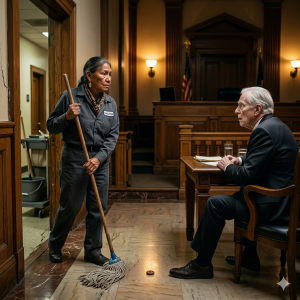
He was at the defendant’s table, silver-haired now, shoulders curved in the particular way of men who have spent a lifetime avoiding consequence. A lawyer at his elbow. A cup of water in front of him.
And then the cedar button slipped from my fingers.
I didn’t even feel it go. One moment it was in my hand, and the next it was on the marble floor, and the sound it made —
Loud as a gunshot.
It skipped once, twice, and then it rolled.
Straight across that floor like it had somewhere to be.
All the way to his chair.
Where it stopped, quiet as a held breath, against the toe of his shoe.
The room had gone completely still.
He looked down at the small carved thing resting against his foot.
And then he looked up.
Straight at me.
And every drop of color left his face.
—
I should have stepped back. I should have let the door swing shut and gone back to my mop and my hallway and my quiet.
Instead I walked in.
I don’t know who I was in that moment. Not the woman who makes herself small in marble hallways. Not the woman who says yes sir and no sir and keeps her eyes on the floor. I walked through that door like someone was walking with me. Like my grandmother had put her hand in the small of my back.
The judge — a young woman, younger than my daughter, with reading glasses pushed up on her forehead — looked up from her papers with an expression that was prepared to be annoyed.
It did not stay annoyed.
I think she saw something in my face that changed her mind about speaking.
The man at the defendant’s table had not moved. His lawyer was already half-risen from his chair, already drawing breath to say something about procedures and unauthorized persons. But the man himself sat perfectly still, and his eyes had not left me, and he looked the way people look when a thing they buried a long time ago walks back into the light.
I bent down and picked up my button. Closed my fist around it.
Then I stood up straight and I looked at him and I said his name.
I had carried that name the same way I’d carried the button. Every day. In the pocket right next to it.
“Harold Fenwick,” I said.
My voice did not shake. I want to be clear about that. After forty years it did not shake.
The lawyer said, “Ma’am, this is an active proceeding —”
“Dr. Harold Fenwick,” I said. “You signed papers in March of 1983. Committing a woman named Dorothy Naatsilanéi Marks to Eastbrook Residential Facility in Sitka. She was twenty-four years old. She had not harmed anyone. She had not been evaluated by a neutral party. She had been making complaints about land leases and the men who were profiting from them. And you signed your name to papers that took three years of her life.”
Silence.
The kind of silence that has weight to it.
Then the judge said, quietly, “Sir. Do you know this woman?”
Harold Fenwick opened his mouth. Closed it. He looked twenty years older than he had sixty seconds ago. The silver hair, the good suit, the cup of water — all of it looked like a costume now. Like something that had been keeping him upright and had just been asked to stop.
“I —” he started.
“I’m her,” I said. “I’m Dorothy Marks. And I have been walking past this room for three years wondering why God kept putting me in this building. Now I know.”
—
What happened next did not happen the way things happen in movies.
Nobody gasped. Nobody cried. The bailiff came over and spoke to me calmly and I spoke to him calmly back, and within a few minutes the hearing had been recessed and I was sitting on a bench in the hallway with a paper cup of water I didn’t drink.
A woman came out of the courtroom about ten minutes later. Not the judge, not the lawyer. One of the people from the gallery — one of the exhausted faces watching their life get sorted into columns. She was maybe fifty-five, weathered in the way of someone who has worked outdoors most of her life, and she sat down on the bench beside me without asking permission.
“I know who you are,” she said.
I looked at her.
“Not you specifically,” she said. “But what happened to you. I grew up in Sitka. My aunt was at Eastbrook same time you were. She used to talk about a woman named Dorothy who kept a carved button and never let it go. Said it was the only beautiful thing in that place.”
I had to look away then. Down at my hands. At the button sitting in my palm.
“You left this for me,” I said. It wasn’t a question.
She shook her head. “Not me. I was a child. But my aunt did. She carved it herself, from a piece of cedar she had found in the courtyard. She wanted you to know that someone in that place saw you. That you were real. That you were worth seeing.”
I have no words for what that felt like. I am not going to try to find them here.
Her aunt’s name had been Agnes. She had been released a year before me. She had died in 2019, in her home in Sitka, surrounded by her family. She had carved buttons her whole life, this woman told me. Had taught her children and her grandchildren. Had never spoken much about Eastbrook, but when she did, she always mentioned the woman named Dorothy who was going to be all right. Who she knew was going to be all right.
“She said you had the kind of eyes that were just resting,” the woman told me. “Not broken. Just resting. Waiting.”
—
I stayed in that courthouse until two in the morning.
I gave a statement to a clerk. I spoke with the judge in her chambers — off the record, she said, but she wanted to understand. She was careful and she was decent and she asked good questions and she wrote things down.
Harold Fenwick had left the building by then. His lawyer had ushered him out quickly, quietly, the way lawyers do when something has gone sideways and the best strategy is distance. I don’t know what becomes of him. That is not mine to carry.
What I know is this.
The bankruptcy hearing he had come to contest involved a parcel of land near Juneau. The same land trust that, forty years ago, had been the subject of the complaints I was making when I was twenty-four years old. Complaints about leases, about money, about whose names were on documents they shouldn’t have been on.
Some things take forty years to come back around.
Some things have nowhere else to go.
—
I finished my shift. I mopped the rest of the hallway and I emptied the bins and I clocked out at four-fifteen the same as always.
When I got to my truck I sat for a while before I started the engine.
The button was in my palm. I had been holding it for hours by then, the way you hold something you’re afraid of losing. But sitting there in the parking lot in the dark, I realized for the first time that it didn’t feel like something I was gripping anymore.
It felt like something I was simply holding.
There’s a difference. Anyone who has ever carried grief for a long time knows the difference.
Agnes had carved a raven into it. The raven in our stories is a trickster, a thief, a transformer. The raven steals the light and loses it and steals it again, and somehow, in all that chaos, the world ends up with light it wouldn’t have had otherwise.
I thought about that woman deciding, inside Eastbrook, with whatever scrap of cedar she had managed to find, to make something beautiful for a stranger. To press a raven into the face of it with whatever tool she had. To leave it at the door for a woman she might never see again.
That is an act of such particular grace that I don’t have a container big enough to hold it.
So I’m putting it here instead. Trusting it to the space between us, wherever you are reading this.
—
Agnes’s niece — her name is Carol, and she lives twenty minutes from me, a fact we both found remarkable — has invited me to come meet the rest of the family this Sunday. Agnes’s granddaughter is learning to carve buttons. She is nine years old.
I am going to bring my button. I am going to let that child hold it. I am going to tell her about her great-great-aunt and the kind of seeing she practiced in dark places.
And then I am going to go back to work on Tuesday, same as always.
I will mop the same hallways. I will pass Courtroom Four. I will reach into my pocket in the early morning quiet the way I have done for twenty-two years.
But I think the weight of it will be different now.
I think I have finally, after forty years, understood what Agnes was trying to tell me.
That I was real. That I was worth seeing.
That I was always going to be all right.