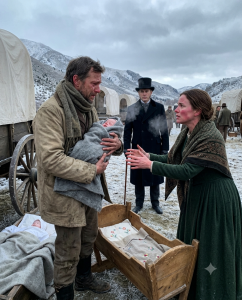
Thomas Brennan held up his newborn sons before forty-seven families and announced that he would sell them for twenty dollars before the cold killed everyone in the pass.
The words seemed to freeze in the air harder than the morning wind.
No one moved.
No one argued.
No one even looked at the babies for very long, as if staring too directly at them would make the moment real in some permanent, unbearable way. They were bundled tightly in rough blankets, their tiny faces flushed pink from the cold, their mouths rooting now and then for the mother who would never feed them again. They still smelled faintly of milk, blood, and woodsmoke.
Off to the side, under a plain white sheet weighed down by stones at the corners, lay Sarah Brennan.
She had survived the labor but not the days after it. She had delivered William and Henry on the trail with the help of shaking hands, boiled water, whispered prayers, and sheer terror. Then the fever came. Then the bleeding worsened. Then she slipped away before the wagon train had fully understood that the cheerful young mother who embroidered flowers on scraps of fabric at dusk was no longer among the living.
The entire camp had been altered by her death. But no one had been altered more than her husband.
Thomas Brennan was not just another man on the trail. He was the wagon captain, the one everyone trusted when rivers ran too high, when ruts deepened into axle-breaking trenches, when dark clouds rolled over the ridges and men began muttering about turning back. He knew how to read terrain, how to ration urgency, how to choose between two dangerous routes and somehow find the one that killed the fewest people.
Families survived because Thomas Brennan did not panic.
So when he stood in the center of the wagon circle with two newborns in his arms and said he could not keep them and keep everyone else alive, nobody dismissed him as heartless. They knew better.
That was why it was so horrifying.
Margaret Holloway stood near the back and pressed trembling fingers into the faded cloth of her skirt. She was thirty-four years old, widowed, and had spent nearly half her life asking God for a child who never came. She had buried hope in stages. First with every passing year. Then with every doctor who offered herbal remedies and false comfort. Then with the polite silences of neighbors. Finally with Daniel, her husband, whose death from pneumonia had taken the last person who could look at her empty arms without pity.
After Daniel died, Margaret sold their house in St. Louis and joined the westbound train. On the frontier, she had told herself, a woman could become useful in ways that mattered more than the one sorrow she could never fix.
And she had.
She cooked, mended, cleaned wounds, soothed fevers, mixed poultices, calmed frightened animals, and once spent an entire night sitting beside a child with croup while his mother slept from exhaustion. People relied on her. She earned her place. But usefulness was not the same as belonging. Some emptinesses could not be worked away.
She looked now at the babies in Thomas’s arms and felt something inside her wrench open so suddenly it almost frightened her.
Thomas spoke again, voice rough with grief and lack of sleep.
“I can’t do both,” he said. “I can’t lead this train through the mountains and keep two infants alive. If I fail at either, people die. Sarah made me promise that if it came to this, I’d find them a good home.”
A murmur moved through the camp.
Some bowed their heads.
Others stared at the ground.
Then James Campbell stepped forward.
Campbell was a merchant from Kentucky with a fine wagon, polished boots, a wife too quiet to interrupt him, and a daughter named Mary who had already learned to laugh softly around her father. He had money, confidence, and the kind of voice men used when they expected to be obeyed.
“Thirty dollars for both,” he said. “My household can feed them, educate them, and secure their future.”
Margaret felt an immediate chill that had nothing to do with the weather.
She had watched James Campbell for weeks. He did not strike people. He did not rage. In some ways that made him worse. He measured everyone by usefulness. A meal, a favor, a kindness, a conversation—everything was a transaction. The hired boy who tended his oxen was spoken to like a ledger entry. His wife looked over her shoulder before every sentence. Mary, only eight years old, had once been corrected in front of the entire camp for laughing too loudly while chasing a hoop.
Campbell’s version of a future was not warmth. It was ownership dressed up as responsibility.
Before Thomas could answer, another couple edged closer.
The Hutchinsons were from a nearby California-bound group that had traveled alongside them for several difficult stretches. They had lost a son to cholera two months earlier, and grief still clung to them visibly. Margaret saw pain in their faces, yes—but she saw calculation too.
“In the gold country,” Mr. Hutchinson said carefully, “strong boys can make a fine life. Raise them right, teach them discipline, and when they’re older they’ll help build something worthwhile.”
Help build something.
Earn their keep.
Useful.
Every phrase landed like dirt on a coffin.
Margaret turned away from the men and looked toward Sarah’s wagon. There, hanging from one side, was the little cradle Sarah had sewn by hand from leftover cloth. Tiny flowers, uneven but hopeful, had been stitched around the edge in faded blue thread. Margaret remembered Sarah smiling nervously over it only weeks ago.
“I know it looks silly,” Sarah had said, rubbing one hand over her round belly. “But I wanted them to have something pretty, even out here.”
Margaret had laughed and told her it wasn’t silly at all.
Now the cradle sat waiting for a mother who would never bend over it again.
That night the camp settled into one of those thin, strained quiets that were never truly quiet. Coughs rose now and then. A baby somewhere else whimpered. Harness chains clinked. Wind worried at the canvas covers. And from Thomas Brennan’s wagon, at intervals that grew more desperate as the temperature dropped, came the cries of his sons.
Different women tried to feed them with cow’s milk diluted in warm water, dripped through cloth. The twins took some and rejected some. Margaret lay awake in her own wagon with her eyes open in the dark, listening to those hungry sounds cut through the camp over and over.
Each cry seemed to reach into the oldest grief she had and pull.
Before dawn, she gave up on sleep.
Frost silvered every surface outside. Breath came out white. The sky was only just beginning to pale when she crossed the camp to Thomas’s wagon. He was there alone, fumbling with a leather harness strap that clearly did not need adjusting. Men often worked with their hands when there was no work left to do.
The twins slept in Sarah’s handmade cradle, pressed close together for warmth.
“Thomas,” Margaret said.
He looked up, and the sight of his face nearly undid her. He looked hollowed out, his eyes red-rimmed, his beard unshaven, the color gone from his skin.
“Don’t sell them,” she said.
He gave a short, hopeless laugh that sounded like something breaking. “Then tell me what you’d have me do.”
She swallowed. “Let me take them.”
He stared as if he had not heard her correctly.
“Both,” she said. “I want both of them.”
He stood very still. “Margaret… you travel alone.”
“I’ve driven my own wagon six months. I can load, ration, mend, and keep pace. I’ve helped with births. I’ve sat with the dying. I know what hardship is.” She drew a breath. “And I want them. Not because I feel sorry for you. Not because I feel sorry for them. Because I would be their mother.”
His mouth tightened at the word.
“It would be too much,” he said, but his voice had weakened.
“For who?” she asked quietly. “For me? Or for you to hand them over?”
He looked down at the babies and did not answer.
“I have enough money for provisions,” she continued. “And enough sense to ask for help where I need it. Women in this camp have already fed them through the night. They won’t suddenly stop because the babies sleep in my wagon.”
His eyes lifted to hers.
“I have something Campbell doesn’t,” she said.
“What?”
“I will love them even if they never become useful to anyone.”
Thomas closed his eyes briefly, and when he opened them again they shone.
That was when another voice entered the cold.
“Brennan,” James Campbell said, approaching in his good coat, “you’re exhausted. Grief makes people romantic. Don’t make a fatal decision because a widow is speaking from loneliness.”
Margaret turned toward him so sharply her skirts snapped around her legs.
“And don’t make one because a merchant sees profit where a mother sees children.”
Campbell’s face hardened. “I’m speaking of stability. Food. Structure. Safety.”
“You’re speaking of ownership,” she said.
His wife had followed several paces behind him, wrapped tightly in her shawl. She said nothing. Mary stood beside her, small and silent.
Thomas raised a hand as if to stop the argument, but he seemed too spent even for that.
Campbell went on. “A woman alone with two infants in the mountains is not mercy. It’s fantasy. If Brennan gives them to you, he may as well bury them himself.”
The words struck hard because they were not entirely foolish. The trail ahead was dangerous. Snow could trap them. Milk could spoil. Babies could sicken in hours. A lone woman with two newborns had almost no margin for error.
Margaret knew all of that.
Still, she stepped to the wagon and laid one hand on the cradle’s edge.
“Then let the truth of the matter be named plainly,” she said. “You don’t want sons. You want future workers who will owe you their lives.”
Campbell’s nostrils flared. “Mind yourself.”
“No,” said a new voice. “She’s minded herself perfectly well.”
Old Reverend Pike emerged from between two wagons, hat in one hand, Bible tucked beneath his arm. The camp preacher was not an official man in any worldly sense, but on the trail that hardly mattered. He had buried the dead, married the living, and prayed over both with the same steady voice. People listened when he chose to speak.
“If these boys are placed with Mrs. Holloway,” he said, “it will be witnessed before the train and written in the family Bible as adoption, not purchase.”
Campbell gave a thin smile. “No one suggested otherwise.”
The reverend met his gaze without blinking. “You suggested it with every careful word.”
Thomas sat down heavily on the wagon wheel as if his legs had at last given out. He covered his mouth with one hand.
“What if they die with you?” he asked Margaret, his voice scraping out of him. “What if I put them in your care and the cold takes you all in the mountains?”
Margaret looked down at the twins. Henry was beginning to fuss, his tiny face tightening before the cry. William slept with one fist tucked beneath his chin.
“Then they’ll die being held,” she whispered. “Not priced.”
For a moment nobody said anything.
Then Mary Campbell moved.
She slipped from her mother’s side and came forward, clutching something beneath her shawl. Her face was pale, her eyes wet and frightened, but there was determination there too.
“Papa,” she said in a voice barely above a whisper, “please don’t.”
Campbell turned sharply. “Mary.”
She flinched, then looked at Thomas instead.
“I heard them last night,” she said. “I heard Mama crying too.”
Every adult in the circle went still.
Campbell’s wife shut her eyes.
Mary unfolded the shawl in shaking hands. Inside was a small piece of cloth—a baby shirt, no bigger than Thomas’s palm. It was one Sarah had stitched weeks earlier while sitting beside the fire with the other women. Margaret recognized it at once: white muslin, blue thread, one crooked seam at the collar.
Mary held it out.
“Mrs. Brennan gave me this to mend because my stitches are neat,” the child said. “She told me if anything happened to her, she didn’t want the babies with people who would make them earn love.”
Campbell’s face changed. It was subtle, but Margaret saw it: not guilt, not softness, but alarm.
Thomas stood so quickly the wagon wheel rocked.
“What did she say?” he asked.
Mary’s lip trembled. “I wasn’t spying. I only heard because I’d gone back for my doll. She was talking to Mama. She said she was afraid. She said if she died, she wanted someone kind. Someone who would let them be children.”
Campbell’s wife finally spoke, and her voice was hoarse with the strain of too many silences.
“She did,” she said.
Her husband turned on her. “Eleanor.”
But something in her had broken open too.
“She did,” Eleanor repeated, louder this time. “Sarah asked me whether Mrs. Holloway was as gentle as she seemed. She said Margaret had steady hands, and that if the worst happened…” Eleanor’s breath shook. “I didn’t speak because I knew what you intended, James.”
Campbell’s control slipped for the first time. “Enough.”
“No,” Eleanor said. “Not enough. Never enough with you.”
The words stunned everyone, perhaps even Eleanor most of all.
Reverend Pike stepped closer to Thomas. “You have your answer.”
Thomas looked at Margaret, then at the twins, then at Sarah’s still-covered body in the gray dawn. For several long seconds no one dared interrupt him.
At last he reached into the cradle and lifted Henry, then William. The babies stirred and fussed in the cold air. He held them against his chest and bowed his head over them. When he spoke, his voice was almost too low to hear.
“I told her I’d keep them safe,” he said. “I thought that meant choosing strength over love.”
He turned to Margaret.
“Maybe she knew better.”
He placed Henry in Margaret’s arms first. Then William.
The weight of them hit her like a physical blow. So small. So warm despite the cold. So frighteningly real. For one instant she thought she might break apart under the force of wanting them and the terror of deserving them.
Thomas rested one shaking hand over the blankets.
“If you take them,” he said, “you take all of it. The feed, the risk, the nights, the sickness, the fear. Nothing easy comes with them.”
Margaret looked down at the twins, then back at him. “I know.”
“Then say their names,” he said.
She swallowed against tears.
“William,” she whispered. “Henry.”
Thomas nodded once, as if the hearing of it mattered.
Reverend Pike opened the Bible there in the freezing dawn and wrote the transfer in careful script. Witnesses signed. Eleanor Campbell signed too, her hand steadier than Margaret expected. James Campbell did not.
The train moved on that morning with Thomas still at its head and Margaret’s wagon now carrying two more lives than it had the day before.
It was not easy.
Nothing about the next weeks was easy.
The twins woke in staggered turns and sometimes together, which was a misery of timing only mothers fully understood. Margaret rode little and walked often, one baby wrapped against her chest while the other slept in a padded crate she had secured with blankets inside the wagon. Women across the train traded help in practical, wordless ways: warm stones wrapped in cloth to keep the babies’ feet hot, extra rags for nappies, broth set aside for Margaret when she was too tired to ask, hands to rock one child while she soothed the other.
Thomas did not hover, but neither did he distance himself. He checked the wagon wheels, adjusted routes to avoid the worst jolts where he could, and once rode back in sleet just to ask if Henry’s cough had eased. He never interfered. He simply watched, with the look of a man learning to live with a decision that hurt and healed him at the same time.
The mountains nearly proved Campbell right.
A storm caught them high in a narrow stretch where the wind howled between stone walls and drove snow sideways under the wagon covers. One ox went down. A child developed fever. Firewood ran low. William stopped nursing from the rag and went frighteningly limp for half a day. Margaret spent hours with him against her skin under layers of blankets, begging him in a raw whisper not to leave her after she had only just found him.
He did not leave.
Henry, by contrast, screamed like a tiny furious preacher until the entire wagon train knew his lungs worked.
They made it through the pass thinner, wearier, and far humbler than when they entered it.
Something changed after that.
Not just in Margaret, though she changed most visibly. Her face grew sharper from fatigue, but warmer from purpose. She stopped moving like a woman trying to fill empty time and started moving like a mother whose every hour had shape. She sang now, quietly at first, then more boldly. Little songs Daniel used to hum. Folk tunes Sarah had liked. Nonsense rhymes for hiccups and tears. The babies learned her scent, her step, her voice. They quieted faster in her arms than in anyone else’s.
And something changed in Thomas too.
Leadership had cost him tenderness for a while, perhaps even the right to imagine himself keeping it. But when the train finally rolled into the greener valleys west of the mountains and the air softened enough that mothers stopped checking infant fingers for frostbite every hour, he began visiting Margaret’s campfire more often at dusk.
Never long. Never presumptuous.
He’d stand there, ask after the boys, let William curl his fist around one finger, let Henry glare at him with his mother’s dark eyes, then leave before the conversation could turn delicate.
The others noticed.
So did Margaret.
Months later, in the Oregon Territory, the wagon train dissolved into separate futures. Land was claimed. Cabins were raised. Fences imagined. Lives that had once been tied by survival began to separate into ordinary distances.
Margaret settled on a small parcel not far from a creek and closer than expected to Thomas’s own claim.
No one had planned that, though everyone pretended they had.
The boys grew.
William was thoughtful, watchful, and gentle. Henry came into every room as if arriving for an argument. They fought over wooden toys, chased chickens, climbed where they should not, and once covered Thomas’s boots in mud so completely that even he laughed. Margaret raised them with steadiness, not softness alone. They learned chores, honesty, and how to apologize properly. But they also learned something less common on the frontier: that love was not a wage to be earned.
When they were old enough to ask about Sarah, Margaret told them the truth in pieces they could bear. She did not erase their first mother to make room for herself. She gave them both. The woman who bore them and the woman who raised them were not enemies in the story of their lives. They were linked by one desperate act of trust.
When they were older still, Thomas told them his part.
He did not spare himself.
He told them about fear, about the pass, about hearing the camp behind him and the mountain ahead of him and thinking leadership required him to cut out his own heart. He told them he had nearly mistaken survival for goodness. William cried when he heard it. Henry walked out of the cabin, then came back ten minutes later and put both hands on the table because he did not know what to do with forgiveness yet.
Years later, when James Campbell’s name surfaced in conversation, it came attached to the same kind of stories everyone had expected: apprentices worked too hard, accounts kept too tightly, affection rationed like flour in winter. Mary, once grown, left his household and visited Margaret exactly once. She stood in the doorway looking both older and younger than Margaret remembered, then smiled when she saw the twins—no longer twins in blankets, but lanky boys with open faces and dirt on their sleeves.
“I wondered,” Mary admitted softly, “whether they became what he wanted.”
Margaret looked out the window where Henry was arguing with a fence post and William was trying to fix what Henry had kicked loose.
“No,” she said. “They became themselves.”
Mary cried then, but not for long.
On a late autumn evening not many years after the journey, Margaret stood on the porch while the boys chased each other through the yard and Thomas repaired a broken latch nearby. The light was low and gold. Smoke rose from the chimney. Somewhere in the grass a cricket kept insisting on itself.
Thomas straightened and looked at the boys, then at her.
“I used to think the worst day of my life was the one I lost Sarah,” he said quietly. “Now I think the worst day was the one I almost lost them too.”
Margaret knew what he meant. The loss would not have been death. It would have been a life handed to the wrong kind of hands.
“She trusted you to choose,” Margaret said.
He nodded. “I almost failed.”
“But you didn’t.”
He looked at her for a long moment. “Because you spoke.”
She might have answered that Sarah had spoken first, through fear and foresight and the testimony of a child. She might have said a whole camp had helped save the boys in one practical act after another. But that wasn’t what sat between them then.
What sat there was simpler and harder.
Love had interrupted a transaction.
Mercy had stood in the way of usefulness.
And two boys who had once nearly been sold for the price of provisions were now laughing in the yard as if they had always belonged to the world that way.
The frontier had a habit of forcing impossible choices, and not every desperate decision was made by evil people. Sometimes it was made by grieving people. Tired people. Frightened people. People who mistook harshness for wisdom because kindness felt too fragile to survive.
But in the end, what saved William and Henry was not money, nor status, nor a practical speech about their future value.
It was a barren widow who understood that children were not investments.
It was a dead mother’s instinct reaching forward through another woman’s memory.
It was a frightened little girl telling the truth.
And maybe that is the part that lingers longest: not that Thomas nearly sold his sons, but that the clearest voices in the moment belonged to the people the world was most likely to overlook.
A grieving widow.
A silenced wife.
A little girl no one thought was listening.
Sometimes the biggest red flag is not cruelty in its loudest form. Sometimes it is the calm, reasonable voice explaining why love should be replaced by usefulness. And sometimes the only thing standing between a child and that bargain is one person willing to say no at exactly the right time.