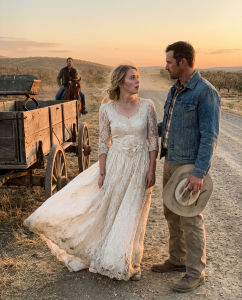
“Do you have anywhere to go?” he asked the abandoned bride.
She said no.
And he answered, “You do now.”
If Hazel Lyndon had burst into tears in the church that afternoon, Bonham would have known what to do with her. The women would have gathered close with their sad eyes and practiced tenderness. The men would have shaken their heads at Dorsey Lott’s behavior while secretly thanking God that public humiliation belonged to someone else that day. By supper, the story would have already been flattened into something easy to carry.
Poor Hazel. Poor thing. Such a shame.
But Hazel did not cry.
She stood beneath white flowers in her mother’s wedding dress, holding the note that had just ended her life as cleanly as an axe through dry wood, and the stillness of her face unsettled the whole church.
For forty minutes they had waited.
The pastor had resorted to reordering his papers twice. Two children had been hauled out by their mothers for whispering too loudly. An elderly widow in the third pew had taken to fanning herself in slow, sharp strokes that sounded like judgment. No one looked directly at Hazel for long. Looking too long would mean admitting they had come to witness a wedding and had instead been given a spectacle.
Then the farm boy entered with the envelope, and every last hope in the room died before Hazel even broke the seal.
Dorsey’s handwriting.
Dorsey’s cowardice.
Five lines. That was all he gave her.
He had thought better of things. Circumstances had changed. It would be best not to proceed.
Not a word about love. Not a word about regret. Not a word that sounded like a man ending a promise he had once made before God and town and family. Only the neat, bloodless language of someone canceling a delivery.
Hazel folded the note because her hands needed something to do other than shake. She slipped it into her glove, lifted her chin, and walked out.
Behind her, whispers rose like flies.
Banker’s daughter.
Coldwater.
Dowry.
Fortune.
Hazel heard every word and kept moving.
By the time she reached the road beyond the last house in Bonham, the sun had turned hard and slanting, and the lace at the hem of her dress was gray with dust. She sat on a roadside stone because her legs would go no farther. Not yet.
Her father had been dead for seven months.
That winter, the debts came for everything. The cabin. The equipment. The hives. The bees. The little shelves lined with honey jars that glowed like trapped amber in the afternoon light. Men who had once admired her father’s patience and kindness took inventory of his life with dry fingers and colder eyes. Hazel sold what she could, packed what she couldn’t, and discovered how quickly grief turned practical when a woman had nowhere to sleep and no land in her name.
Dorsey had arrived in those days like certainty.
He was not a deep man, and Hazel had known that even then. He liked admiration too much. He smiled more brightly when other people were watching. He talked about the future as if a good life could be assembled from visible things: a strong porch, proper curtains, a respectable wife, a dinner table full of guests. But after the losses came, visible things had their own kind of mercy. Dorsey offered marriage, stability, a house, protection from pity and speculation. Hazel did not marry him out of girlish foolishness. She agreed because the world had narrowed, and his promise looked like the only safe doorway left.
By the time Micah Hart found her, that doorway was ash.
He approached as though she were something injured and proud enough to bolt. Hat in hand. Eyes steady. No pity.
Micah had known her father. For years he had bought honey from him and occasionally asked about bees in the practical tone of a man thinking of crops and weather and next season. He owned land north of Bonham, a ranch bordered by an orchard that never quite prospered. He lived alone except for an older housekeeper named Mrs. Weller, who came by during the day and went home before dark. He was thirty-four, self-contained, and so sparing with words that people who did not know him often mistook silence for coldness.
Hazel had always known better.
Cold men did not crouch beside dying hives to ask questions in careful voices. Cold men did not carry jars of honey home wrapped in old cloth so the glass would not break. Cold men did not stand at the back of a church and look furious on behalf of a woman they barely spoke to.
“Do you have anywhere to go?” he asked.
The answer came out before pride could stop it.
“No.”
His reply changed the direction of her life.
“You do now.”
He offered work, not rescue. A room with a lock, wages, and a place to build hives if the orchard responded. He said the trees needed bees. He said there was no one in Bonham who knew them better than she did. He said a town that blamed a humiliated woman for being humiliated had no right to script the rest of her story.
That was what made her trust him.
Not the room. Not the money. Not even the practical sense of the offer.
It was the way he spoke as though her future were not a fallen thing to be picked through, but a choice still belonging to her.
So Hazel stood.
She had nearly placed a hand on the wagon frame when she saw the rider on the hill.
Dorsey.
He came down with dust rising under his horse’s hooves and a look on his face that was all wrong for a man who had just abandoned a bride. He looked irritated. Possessive. Offended by what he was seeing.
“Hazel,” he said when he stopped. “This doesn’t need to become something worse.”
She stared at him. “You sent a letter.”
“I was trying to spare you.”
Micah stood nearby, saying nothing at first. Dorsey ignored him with the careful disrespect of one man measuring another and deciding not to recognize his weight.
“You don’t know what people will say if you leave with Hart,” Dorsey said.
The absurdity of that nearly knocked the breath out of Hazel. “You left me in front of the whole church.”
His mouth tightened. “There are things you don’t understand. Things your father never told you.”
Then he pulled a folded paper from his coat.
Micah’s face changed, but only slightly. The shift was small enough most people would have missed it. Hazel did not. It was not guilt she saw there. It was anger mixed with something harder to name.
“What is that?” she asked.
Dorsey did not answer her directly. He looked at Micah. “You should tell her before I do.”
Micah stepped forward and took the paper from Dorsey’s hand with such calm efficiency that Dorsey had no time to stop him. He unfolded it, scanned it once, and then handed it to Hazel.
It was a bill of sale dated three months earlier.
Her father’s remaining beekeeping crates, equipment, and one set of handwritten apiary journals had been purchased from the debt collector after the estate was seized.
Buyer: Micah Hart.
Hazel looked up slowly.
Dorsey smiled then, sensing the cut had landed. “He never mentioned that, did he? Thought you might enjoy learning that the man offering you charity bought up the last of your father’s life before the ground was even cold.”
Micah’s voice stayed level. “I bought them so the collector wouldn’t burn the journals for kindling. I went to find you after. You were already gone from the cabin.”
Hazel’s heartbeat pounded in her ears. “You have my father’s journals?”
“Yes.”
“Why didn’t you tell me?”
“Because on the day you were left at the altar, I was trying to get you off the road before dark, not hand you another grief.”
Dorsey let out a soft laugh. “Convenient.”
Micah turned then, and Hazel finally saw the force he kept leashed under all that reserve.
“You want convenient?” Micah asked. “Tell her why you were marrying her in the first place.”
The color changed in Dorsey’s face. Not much. Enough.
Hazel looked from one man to the other.
Micah continued. “Her father’s journals contain more than hive notes. They contain records of bloom cycles, pollination patterns, and wild colony sites across three counties. Your future father-in-law from Coldwater wanted them.”
Dorsey snapped, “That’s nonsense.”
“It isn’t,” Micah said. “Eugene Bell bought acreage west of the river two years ago. His peach trees have been failing. He wants commercial hives on land that’s too unstable for men who don’t understand them. Hazel’s father did.”
Hazel felt the world tilt slightly.
Her father had kept journals constantly, true. Notes on queen temperaments, nectar flows, weather shifts, bloom timing, weak colonies, strong ones, strange swarms. As a girl, she had thought he wrote because he loved order. She had never imagined anyone else might see those books as valuable.
Dorsey’s silence said enough.
Micah went on. “Bell promised him an introduction to his daughter and financing for a feed store if he delivered the journals after the wedding. He didn’t expect Bell’s daughter to object to taking a man already half-married in the eyes of the county. So he tried to end things cleanly with a note. Then he heard you were leaving with me and panicked.”
Hazel looked at Dorsey. “Is that true?”
He tried to recover his charm, but it had gone thin around the edges. “Hazel, listen to me. Bell exaggerated. Nothing was settled. Men talk. Arrangements change. I was trying to make something of myself.”
“With my father’s work,” she said.
“With information he left behind,” Dorsey shot back, impatience finally breaking through. “You couldn’t even use it without land or money. Bell could. I could. We could have built something.”
The “we” arrived too late and sounded too false.
Micah said quietly, “He came back because he thinks if he takes you with him, the journals might still follow.”
Hazel lowered her gaze to the paper in her hand. She should have felt shattered. Instead, something colder and steadier was taking shape inside her.
She lifted her eyes to Dorsey again. “Did you ever intend to marry me today?”
He hesitated.
That was her answer.
Micah’s wagon creaked softly in the evening wind. Dorsey shifted in the saddle, suddenly aware that he had lost the room in which lies usually worked. There was no church now, no audience eager to preserve appearances, no mother pressing a handkerchief to her lips and begging everyone to calm down. Only a dusty road, a fading sky, and a woman he had mistaken for manageable.
Hazel folded the bill of sale and handed it back to Micah. “Take me to the orchard.”
Dorsey straightened. “Hazel.”
She did not even look at him. “You should leave before you embarrass yourself any further.”
His voice sharpened. “You don’t know what you’re choosing.”
Now she did look at him, and what she saw was smaller than the thing she had feared all day.
“I know exactly what I’m not choosing.”
She climbed into Micah’s wagon.
Dorsey wheeled his horse forward half a step, but Micah moved just enough to block the path. Nothing dramatic. Nothing loud. Just certainty set in human form.
“If you bother her again,” Micah said, “you’ll answer to me.”
Dorsey sneered, but the edge of him had gone weak. He looked from Micah to Hazel, searching for some last opening. There wasn’t one. He had already spent his power in public cruelty and private greed. All that remained was the sound of his own failure.
He rode away without another word.
The orchard sat on a rise north of Bonham where the air ran sweeter and cooler after sunset. The farmhouse was plain, sturdy, and cleaner than Hazel expected from a man living mostly alone. Mrs. Weller arrived at dawn the next morning, took one look at the wedding dress hanging over a chair to air out, and said only, “I’ll make breakfast. Then we’ll see what can be saved of both fabric and spirit.”
It was the kindest thing anyone had said to Hazel in days.
The first week was strange. Hazel moved through the orchard as if entering a conversation already in progress. The apple trees had more blossom than fruit set. The peaches bloomed beautifully and dropped too many young fruit before maturity. Pears stood stubborn and underperforming. She walked row by row, studying timing, windbreaks, water, ground cover, and the absence she had felt before ever stepping onto the land.
Micah was right.
The orchard wanted bees.
On the third day, he brought out a crate from the barn. Inside lay her father’s journals, wrapped in oilcloth.
“I should have told you sooner,” he said.
Hazel rested her hand on the bundle for a long moment before unwrapping it. The smell of wax, paper, and faint smoke rose up so suddenly it nearly undid her. Her father’s handwriting met her in narrow, precise lines, as alive on the page as if he had just stepped out of the room. Notes on queens, swarms, weather, bloom maps. But Micah had also been right about something else. There were records there of value beyond memory. Cross-season observations. Wild colony locations. Pollination routes. Detailed notes on soil and bloom overlap that no orchard owner in three counties could have assembled from guesswork.
Hazel looked up from the pages. “You knew what these were.”
“I knew they mattered. I didn’t know how much until I read enough to understand your father was keeping records finer than anything I’d ever seen.”
“And you still bought them.”
“To keep them from being lost.”
“Not for yourself?”
Micah met her gaze. “I won’t pretend I didn’t think they might help the orchard. But they were always yours.”
That mattered too.
He had been wrong to keep the truth from her, and she told him so. He listened without defending himself more than necessary. That mattered most.
By early spring they had rebuilt three hives from salvaged boxes and new frames. Then four. Then six. Hazel worked bareheaded in warm weather, sleeves rolled, smoke drifting silver around her while Micah watched, learned, and followed instructions with steady patience. He was not naturally graceful with bees, but he was careful, and careful men could be taught almost anything.
The orchard changed by degrees so small they would have escaped anyone lacking faith. More bees in blossom. More fruit set. Fewer blossoms wasted. Stronger hum in the rows at noon. By midsummer, branches that had sagged empty for years began to bow under real promise.
News traveled.
Bonham first treated Hazel’s move to Micah’s property as a scandal deferred. Then came the fruit. Then came the honey. Then came the fact that Micah Hart’s neglected orchard was finally producing the best crop anyone had seen from that land in six years. People who had watched Hazel walk out of church like a public wound now found reasons to stop by the market table where Hart fruit sat beside amber jars labeled simply LYNDON APIARY.
That name had been Micah’s decision. He said the work was hers and should carry her father’s.
Dorsey’s fortunes went the opposite direction. Eugene Bell of Coldwater did not appreciate public embarrassment or men who failed at the first hard test of their character. The proposed business arrangement vanished. So did the possible marriage to Bell’s daughter. By harvest, Dorsey was the subject of a different kind of whispering in Bonham. Not admiration. Not envy. Merely the mild contempt reserved for a man who had overreached and been seen doing it.
He came to the orchard once that autumn.
Hazel was checking a late hive when she spotted him at the gate. He dismounted but did not come closer after noticing Micah nearby.
“I came to apologize,” he said.
“No,” Hazel answered. “You came because this place is thriving and you can’t bear that I am too.”
He had no reply worth offering.
Micah did not send him off. He didn’t need to. Hazel did it herself.
Winter settled in kinder than the last one. There was enough money from fruit and honey to speak of expansion without sounding foolish. Mrs. Weller declared the house no longer felt like a place men merely slept in between chores. Hazel mended her mother’s wedding dress and packed it carefully away, not because it had become meaningless, but because it had become only cloth again.
One evening near Christmas, Micah found her in the barn loft reading from her father’s journals by lantern light. Snow pressed against the windows. The hives outside were quiet with cold.
“I’ve been meaning to ask you something,” he said.
Hazel looked up, smiling faintly. “That sounds dangerous.”
“It may be.”
He came closer, not hurried, not nervous exactly, but with the gravity of a man who knew words could alter a life.
“When I asked whether you had anywhere to go,” he said, “I meant only what I said then. Work. Safety. A place to stand. Nothing was owed. Nothing has ever been owed.”
“I know.”
“But I can’t go on pretending I want only your good opinion when I want far more than that.”
Hazel closed the journal.
The barn seemed to hold the silence gently, as if even the rafters had leaned in.
Micah continued, “I don’t want your answer out of gratitude. I don’t want it because Dorsey was a fool. And I won’t ask while there’s any chance you still feel like a woman picked up from the side of the road because no one else would have her. That is not what I see when I look at you. It never was.”
She stared at him, and this time the tears came.
Not from humiliation.
Not from grief.
From the unbearable relief of being known correctly.
“What do you see?” she asked.
His expression softened in a way it rarely did for anyone else.
“I see the woman who brought my land back to life.”
Hazel laughed through tears then, and when he kissed her, it felt nothing like rescue.
It felt like recognition.
They married the following spring in the orchard among the trees she had helped save. Mrs. Weller cried openly. Half of Bonham attended, partly out of affection and partly because a town always likes being near the stories it once misunderstood. Hazel wore a simple blue dress. No veil. No white flowers. No borrowed illusion of safety.
She did not need any of that now.
Afterward, as guests drifted under the branches with slices of pie in hand, Hazel stood for a moment where the bees moved lazily among the blossoms and thought of that first wedding day, of the note in her glove, the road, the dust, the stone where she had sat believing her life had ended in public.
It had ended, in a way.
What she had not known then was that some endings were not punishments. Some were the violent clearing required before anything honest could grow.
Later, people still debated parts of the story in the way towns do for years. Some said Micah should have told Hazel about the journals sooner. He should have. Some said Hazel had been too proud at the altar and too hard on Dorsey after. She had not. Some said Dorsey had merely been practical, trying to secure a better future. But practicality without loyalty is just cowardice wearing polished boots.
Hazel never argued with any of them.
She had bees to tend, fruit to gather, and a life built not on promise but on proof.
And if there was one thing she had learned from the day she was abandoned under white flowers and offered a future on a dusty road, it was this:
The worst red flag is not the man who leaves when life gets difficult.
It is the man who believes he can come back once someone else has shown you what respect was supposed to look like all along.