The name on the plaque stopped my hand mid-stroke.
I’d been painting room numbers for three days straight — steady work, good pay, the kind of job that lets your mind go quiet while your hands stay busy. The Grand Halcyon Hotel in Leadville, Colorado had been closed for eleven years, and the new owners were pouring everything into a proper reopening. Historic brass fixtures. Hand-lettered signage. The whole story.
I was the woman they hired to tell it, one careful brushstroke at a time.
My name is Donna Hartwell. I’m sixty-one years old, I have a bad knee and a good eye for detail, and I was absolutely not prepared for what I found on the morning of day four.
The hotel manager had left a wooden crate outside my work area — the permanent suite plaques, the ones that don’t come down. Reserved for long-term owners and investors. Heavy. Serious. The kind of sign that means someone is staying.
I lifted the first one.
Polished brass. Clean serif font. And the name engraved across the front:
EDWARD R. CALLOWAY.
I sat down on the floor of that hallway.
Because Edward R. Calloway was my brother.
—
He’d been gone for thirty years. That was the official story — the one my mother told at the small, closed-casket service, the one that let the family collect on a life insurance policy I was never shown, the one that explained why we suddenly had enough money to keep the house in Pueblo the year everything fell apart.
I was twenty-nine when they told me Eddie was dead. I cried for months.
But I never saw a body.
I told myself that was just how it happened sometimes. I told myself grief makes you paranoid. I told myself a lot of things over thirty years.
I was still sitting on that floor when I noticed something beneath my paintbrush kit.
A small brass key.
Old-fashioned. Heavy for its size. Stamped clearly on the bow with a single number:
7.
I turned it over in my palm. Room 7 was on the ground floor — one of the original railroad rooms, restored but unoccupied. I hadn’t painted that door number. Someone else had done it before I arrived.
I asked the manager about the key at lunch.
She frowned. Said all the original keys had been collected and locked in the office safe when the renovation began. Said there was no reason a loose key should be anywhere in the building.
She took it from me.
I drove to the diner down the road to eat my sandwich in peace.
When I got back to my car, the key was sitting on my passenger seat.
—
I told myself I was losing my mind.
I went back upstairs. I painted. I focused on the clean lines, the way the gold leaf catches light, the satisfaction of a letter made exactly right.
By late afternoon I had finished the third floor and moved up to the fourth — the top floor, the quiet one, where the owner’s suite sat at the end of a long corridor like a period at the end of a sentence.
The suite with Eddie’s name on the door.
I was alone up there. I’d checked. I had locked the supply room behind me myself, tried every handle on the hall, confirmed I was the only person on that floor.
So I cannot explain what I found when I passed room 407.
The door was open two inches.
Inside, on the center of the freshly made bed — white coverlet, tight corners, untouched since housekeeping — sat the brass key.
Stamped with the number 7.
My hands were shaking when I picked it up. My knee ached when I backed into the hallway. My mind was doing what minds do when thirty years of a story start to crack down the middle — reaching for any explanation that keeps the world familiar.
I walked to the end of the corridor.
I stood there with the key in my fist.
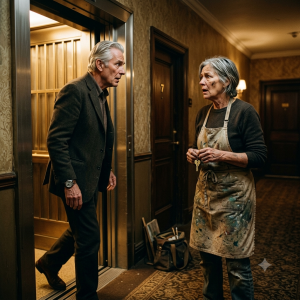
And then the elevator at the end of the hall chimed softly.
The doors slid open.
The man who stepped out was tall. Silver-haired. He moved the way our father used to move — like someone who had learned to take up exactly as much space as he needed, and no more.
He saw me.
He stopped.
And I saw, on his left wrist — worn, scratched, unmistakable — the watch my father was buried in.
The watch I watched them clasp onto his wrist in the funeral home in 1987.
The man’s mouth opened.
Neither of us said a word.
—
And then he said my name.
Not Donna. Not Mrs. Hartwell. He said “Donnie,” the way only two people in the world ever called me, and one of them had been in the ground since 1987.
My knees went. Not the bad one — both of them. I caught the wall with my palm and the key hit the carpet and neither of us moved to pick it up.
“It’s me,” he said. His voice was lower than I remembered. Worn down at the edges like river rock. But the rhythm of it, the particular way he paused after those two words as if he understood they weren’t enough and was giving me time — that was Eddie. That had always been Eddie.
“You’re dead,” I said.
He closed his eyes. “I know.”
—
We sat in the two wingback chairs at the end of the corridor for a long time before either of us spoke again. He’d pulled them from the sitting alcove himself, arranged them facing each other like he’d been planning this conversation for years. Maybe he had.
His name, he told me, was still Edward Calloway. He hadn’t changed it. He’d thought about it a hundred times and couldn’t make himself do it. Said it felt like the last honest thing he owned.
In 1993, he had been in a situation — that was the word he used first, situation, and then he stopped and made himself say the real word, which was trouble. Serious trouble. The kind that comes when you are twenty-six years old and you owe the wrong people a sum of money you will never be able to repay, and those people have made clear what repayment looks like if it isn’t cash.
He’d gone to our mother.
She hadn’t hesitated. That was the part that landed on me like a stone dropped from a height — she hadn’t hesitated. She had a plan within a week. A contact through the church, of all places, a man who knew people who could make a disappearance look like a death and a death look like paperwork. It cost her the life insurance policy, which she had apparently taken out on Eddie two years prior without any of us knowing. The payout was just enough to clear his debt, give him seed money, and keep the house.
She told me and my sister he was gone. She told the town. She told herself, he said, until she believed it the way you can believe something you invented if you repeat it long enough.
“She did it to save me,” he said.
“She let me grieve you for thirty years,” I said.
He didn’t argue with that. He just looked at his hands.
—
The watch.
I had to ask about the watch.
He reached across and unclasped it and held it out to me. The crystal was scratched. The leather band had been replaced at least twice, you could see the different shades. But the face was the same — that particular cream color, the small railroad second hand, the tiny nick at the two o’clock position where Dad had caught it on a fence in 1974 and never got it fixed.
“Mom gave it to me before the funeral,” he said. “Said she couldn’t put it in the ground. Said it was the one thing she couldn’t do.”
So they’d buried him without it. I thought about that closed casket. I thought about standing at the grave in November wind, holding my sister’s hand, both of us crying. I thought about my mother standing perfectly still with her face arranged into something that wasn’t grief exactly but that I had always assumed was her way of grieving.
Now I understood what it actually was. It was the face of someone keeping a very large secret upright.
I held the watch. It was warm from his wrist.
I gave it back to him.
—
After he disappeared — after the false death — he’d gone west. Nevada first, then Oregon, then eventually up into Montana for almost a decade. He worked with his hands, the way we were both raised to do. Carpentry. Finish work. He had a good eye too, turns out. Runs in the family.
He got sober in Montana. He met a woman named Carol who he described carefully and with great specificity as the finest person he had ever known. They had two kids, both grown now. He showed me photographs on his phone. A boy with our grandfather’s jaw. A girl who has his eyes, which means she has my eyes, which I was not ready for.
He’d built a real life. A quiet one. The kind you have to build from scratch because you can’t borrow anything from the one that came before.
He’d done well enough, over time, that he had money to invest. A former client had brought him into a small hospitality group. The group had bought the Halcyon two years ago.
He hadn’t known I would be here.
That part, he made very clear, his voice going low and steady in the way I recognized as Eddie being serious. He had not orchestrated this. He had hired a signage company in Denver. The company had sent me.
He’d seen my name on the work order the morning of day one.
He’d spent three days trying to decide whether to come.
—
I asked him about the key.
He looked at me for a moment, then looked at the carpet where it was still lying between us.
“I left it outside your supply room that first morning,” he said. “I wanted — I don’t know what I wanted. A sign. Some way to know if you’d pick it up or turn it in. What you’d do with it.”
“I turned it in,” I said. “The manager took it.”
“I know. I have a second one.” He reached into his jacket pocket and placed an identical key on the arm of my chair. “Room 7 was where I stayed when I came out to consult on the renovation last spring. I had them leave it set up. In case.”
“In case of what?”
He looked at me the way he used to look at me when we were kids and he’d done something he wasn’t sure he could talk his way out of. Guilty and hopeful in equal measure.
“In case I needed somewhere to show you,” he said. “Somewhere that was just ours, for a minute. Before we had to figure out what comes next.”
—
Room 7 was small and warm and smelled like new plaster and old timber. There was a window that looked out onto a side alley and beyond it, the mountains going gray-blue in the late afternoon light. There were two ladder-back chairs and a round table and nothing else except the particular quality of silence that very old rooms hold onto regardless of what you do to them.
We sat there for two hours.
He told me things. I told him things. We talked about our mother, who died in 2019 and who had — he pulled a folded envelope from the inside pocket of his jacket and set it on the table between us — left him a letter to give to me if he ever found a way. It was sealed. My name was on it in her handwriting.
I didn’t open it in front of him. I’m not sure I was ready to hear her explain herself yet. I needed a little more time with just my brother first.
We talked about his kids. I told him about my own daughter, Reese, who is thirty-four and teaches elementary school in Fort Collins and who has never known she had an uncle. That one hit him hard. He put his hand over his mouth and looked at the window for a long time.
“She has cousins,” he finally said.
“Yeah,” I said. “She does.”
—
I went back to work the next morning.
I had a job to finish, and Donna Hartwell finishes her jobs. That hasn’t changed in thirty years and it isn’t going to change now.
I painted the suite plaques one by one, corridor by corridor. I mixed the gold just the way I like it, and I kept my lines clean, and I let my hands stay busy while my mind worked through everything it needed to work through.
When I got to the fourth floor, I painted EDWARD R. CALLOWAY in the same careful serif I’d used on every other plaque in the building. I took my time with it. I made it right.
He stood behind me while I worked. He’d asked if he could watch, and I’d said yes. We didn’t talk much. The quiet was a different kind than it had been in the hallway the day before — easier, the way quiet gets when two people have already said the hard things.
When I finished, I stepped back, and he stepped forward, and we both looked at his name on the door of the room where he was going to live.
“It’s good,” he said.
“It’s your name,” I said. “It should be right.”
—
That was four months ago.
I have since met his children, whose names are Marcus and Lily. Marcus brought his wife and their eighteen-month-old son, whose name is James after our father, and when that boy held up his arms to be picked up and I lifted him without thinking, Eddie had to walk outside for a minute to collect himself.
Reese knows everything. She cried and then she asked seventeen extremely practical questions, which is exactly how she has handled every difficult thing since she was eight years old, and I love her for it.
There is still a great deal we haven’t sorted out. There are thirty years of missing in the middle of our family that don’t simply fill back in. Some things my mother did I am still angry about. Some things Eddie did — disappearing, staying gone, letting me carry that grief — I have not finished processing and may not finish for a long time.
But he didn’t stay gone when he had a chance to come back.
That counts for something. I’ve decided it counts for something.
—
The Grand Halcyon Hotel reopened on a Thursday in late September. I was invited to the ribbon cutting, which surprised me until Eddie said, quietly, that he’d made sure I was on the list.
The lobby looked beautiful. The brass fixtures caught the light. The hand-lettered signage was on every door and above every arch, the gold leaf exactly as warm as I’d wanted it. A photographer from the local paper took pictures of the interior and without knowing who I was asked me if I was a guest.
I said I was the woman who did the letters.
She said they were the most beautiful part of the whole building.
I said thank you and meant it. It’s the work I know how to do. It’s the work that brought me here, to this hallway, to this moment, to the elevator doors sliding open and my brother stepping out of them like a man who had finally decided to stop being dead.
The key is on my kitchen windowsill at home. I kept it. Eddie said I should.
Some doors, he said, you want to know you can always open.
He’s right about that. He’s not right about everything — thirty years is a long time, and there are parts of who he’s become that I’m still learning, and I’m sure there are parts of me that surprise him too. But about that, he’s right.
I have my brother back.
I have a niece named Lily who laughs exactly like our mother did, loud and without apology.
I have a great-nephew named James who held up his arms to me like I was someone he’d always known was coming.
And I have a letter, still sealed, sitting in my nightstand drawer, in my mother’s handwriting, waiting for the morning when I’m ready.
I’ll get there.
Some things you have to do in your own time, at your own pace, one careful stroke at a time.
That part I’ve always known how to do.