She walked into that Seattle hotel eleven years later as the owner.
Nobody recognized her.
That was the point.
—
Her name was Nora Swanson — though in Ketchikan, the people who knew her best called her something else, a name passed down through her mother’s line, a name that meant *the one who listens to the grain of the wood.*
She had driven down from Alaska with a portfolio under her arm and a dream that felt almost embarrassingly simple: one piece. One carved cedar panel in a hotel lobby that saw twelve thousand guests a year. A chance to tell a story in wood the way her grandmother had taught her, the way her grandmother’s grandmother had taught her grandmother.
She wore her good blouse that day. Her nicest earrings.
And around her neck, as always, the small cedar raven pendant her uncle had carved for her when she was nine years old, worn so smooth from years of touching that the wings had gone soft at the edges.
She always reached for it before she spoke.
She reached for it that morning too — just before she introduced herself to the woman standing at the front desk of the Hargrove Marquette Hotel.
That was her first mistake.
—
Margaret Hargrove — the owner’s wife, the woman who made every aesthetic decision in that building from the carpet to the cocktail menu — looked at Nora’s portfolio for exactly forty-five seconds.
Then she laughed.
Not a quiet laugh. Not a polite, dismissive laugh.
A loud one.
The kind that bounces off marble floors and twenty-foot ceilings and finds every single person in an atrium and makes sure they are all looking.
*”Driftwood crafts,”* Margaret said, loud enough that the man at the elevator turned around, *”belong in a bait shop.”*
Nora stood very still.
She touched the little cedar raven at her collarbone.
She did not say a single word.
She picked up her portfolio, walked back through those glass doors, and drove north on the I-5 with her jaw set and her hands steady on the wheel, and if she cried anywhere in those nine hundred miles, she did it alone.
—
What Margaret Hargrove did not know — what almost no one in that hotel knew — was what Nora Swanson did with eleven years of silence.
She carved.
She built.
She sold a panel to a tech founder in Medina who couldn’t stop staring at it during a dinner party. He introduced her to a collector. The collector introduced her to a gallery. The gallery introduced her to a foundation.
Quietly. Carefully. The way you split cedar — always *with* the grain, never against it.
And in the corner of every single piece she made — every panel, every bowl, every monumental installation that eventually landed in corporate atriums and private homes and one very talked-about museum lobby in Vancouver — she carved the same small mark.
A raven, no bigger than a thumbnail.
The signature of the most sought-after Indigenous artist in the Pacific Northwest, whose real name most collectors had never even Googled, because the work spoke so loudly there was nothing else to hear.
—
The Hargrove Marquette had been struggling for six years.
The new boutique hotel market had not been kind to Margaret’s husband Gerald. Bad timing, bad loans, a renovation budget that spiraled into something Gerald did not like to discuss at dinner.
The offer that saved them came through a holding company.
Quiet. Clean. More than fair.
Gerald had signed before he ever thought to ask who was behind it.
—
The morning of the ownership transfer meeting, Nora arrived in a gray blazer and dark slacks.
No portfolio this time.
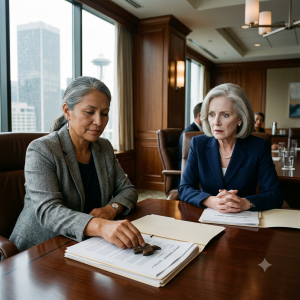
She sat down at the long conference table across from Gerald’s lawyer, across from Gerald, across from Margaret — who had not been told much, who had been told only that a silent partner was formalizing a majority stake, who was already bored and already talking.
Margaret glanced at the woman across from her.
Something small and cedar-colored caught her eye.
A pendant at the woman’s collarbone.
A raven, worn smooth at the wings.
Something shifted in Margaret’s face — just slightly, just at the edges — the way a person looks when a word is on the tip of their tongue, when something familiar is almost, *almost* connecting.
The lawyer cleared his throat and slid the ownership documents to the center of the table.
Margaret’s eyes moved from the pendant to the woman’s face.
Back to the pendant.
Her mouth opened.
*”Are those — are you going to want to put totem poles in the lobby, or—”*
The woman reached up.
Unclasped the little cedar raven from her neck.
Set it down on top of the paperwork.
Didn’t say a word.
And Margaret Hargrove finally looked — *really looked* — at the signature mark carved into its back, the same mark she had seen last month in a magazine spread about the most valuable private Native art collection in the Pacific Northwest, the same mark the article had called *”instantly recognizable to anyone who has been paying attention.”*
The color left her face.
The room went very quiet.
And Nora Swanson folded her hands on the table and waited.
—
Margaret’s mouth worked without making sound for a moment. Like a word was caught somewhere between her chest and her lips and didn’t know which direction to go.
Gerald looked at his wife. Then at the pendant. Then at the lawyer. The lawyer was studying his legal pad with the focused intensity of a man who very much wanted to be somewhere else.
“I’m sorry,” Margaret finally said. “I’m — I don’t—”
“You don’t need to be sorry,” Nora said.
Her voice was even. Not warm, exactly. Not cold either. Just steady in the way that old wood is steady, the way something is steady when it has been tested by weight and held.
“I need you to sign,” Nora said.
Gerald reached for the pen.
—
After the papers were signed and the lawyer had packed up his briefcase with quiet, practiced efficiency, after Gerald had shaken Nora’s hand twice — too many times — and said *”we look forward to working with you”* in the tone of a man who was genuinely unsure whether he had just been saved or ruined, after all of that, Margaret was still in her chair.
She was looking at the cedar raven on the table.
“May I,” she started. Stopped. “May I ask you something.”
Nora was putting on her coat.
“You can ask.”
“Why here.” It wasn’t quite a question. “You could have bought — you have that kind of — why this hotel. Why us.”
Nora buttoned the top button of her coat. She looked at the room — the high ceilings, the marble, the light coming through the tall windows and landing exactly where it had landed eleven years ago when she was twenty-eight years old in her good blouse with her portfolio and her whole chest full of hope.
“Because of where it sits,” she said.
Margaret waited.
“This atrium gets northeastern light from October through March. Morning light. The kind that moves.” Nora looked up at the windows, and something in her face that had been carefully composed opened slightly, the way a door opens when someone finally comes home. “I wanted to put a panel in this space eleven years ago. I still want to put a panel in this space. The light hasn’t changed.”
She picked up the cedar raven from the table.
She held it in her palm for a moment — not putting it back on, just holding it — and then she looked at Margaret directly for the first time that morning.
“The work was always about the light,” Nora said. “It was never about you.”
—
She commissioned herself.
That spring, the Hargrove Marquette closed for six weeks for what the press release called a “landmark renovation and rebranding.” When the doors opened again, the lobby had been reoriented — new furniture, new desk placement, the carpet finally gone in favor of something warmer, something that breathed.
And on the wall between the two elevator banks, in exactly the spot Nora had described in a portfolio that had been laughed out of this building on a Tuesday morning eleven years prior, there was a cedar panel twelve feet wide and eight feet tall.
It took her four months to carve.
It showed a coastline at the edge of a storm — not the drama of the storm but the moment just before, when the water goes a particular shade of green and the herons all stand very still and even the wind seems to hold its breath. It showed a woman in a cedar dugout, her back to the viewer, reading the surface of the water the way her grandmother had taught her to. And threaded through the entire piece, if you looked closely, running along the grain of the wood the way a creek runs along the low ground because that is simply where it belongs — there were ravens.
Dozens of them.
Some obvious. Some hidden so deep in the pattern that hotel guests had been known to stand in front of it for ten minutes before they found one, and then keep looking, because finding the first one made you wonder how many more you’d missed.
Every single one of them had the same mark carved at its base.
No bigger than a thumbnail.
—
The panel was written about in three national publications that year. A travel magazine called the lobby one of the ten most beautiful hotel interiors in the country. Someone’s photograph of the panel taken on a phone in the golden morning light — the northeastern light, October light, exactly the light Nora had driven nine hundred miles to stand in front of — was shared two million times.
Nora read about all of this in Ketchikan, sitting at her workbench, working on a commission for a library in Juneau.
She did not have a public comment.
She touched her collarbone, where the raven hung again, and she went back to work.
—
Margaret Hargrove still works at the hotel. She oversees events. She is very professional and very good at it and she does her job with a kind of focused attention she did not always have before.
There is a framed photograph in the small staff office behind the lobby — a photo of the panel the morning it was unveiled, before the doors opened, with the light on it just right.
Nobody put it there on Margaret’s orders. It appeared one morning and she did not take it down.
Nobody asks her about it.
She never explains it.
Some things you carry quietly. The way a piece of cedar carries the rings of every year it stood before anyone ever touched it. The way a raven pendant carries the shape of every hand that reached for it in a hard moment.
The grain holds.
It always holds.