She didn’t die in childbirth.
I know that now. I know it because of a key on a blue ribbon — and because a 71-year-old bank manager went pale as a sheet and told me he watched her walk away.
Let me back up.
My name is Renee Calloway. I’m an estate appraiser out of Columbus, and last Tuesday I drove two hours west to a little town called Millhaven, Ohio, to do a job I’ve done a hundred times before. Tri-County Savings was closing its doors after 61 years. My job was simple: catalog the unclaimed safe-deposit boxes, document the contents, hand everything over to the state.
Straightforward work. Quiet work. The kind that suits me.
The branch manager, Mr. Gerald Foss — white-haired, bifocals, the kind of man who still wears a tie on a Tuesday — handed me a clipboard and a ring of master keys and told me to start at box 89 and work my way down the wall.
Box 89. Savings bonds from 1974.
Box 97. A man’s watch and three rings.
Box 103. Nothing but a handwritten recipe for apple butter and a photograph of a barn.
I documented everything carefully, the way I always do. Most of these boxes hold the quiet leftovers of ordinary lives. I don’t let myself think too hard about the people who once cared about these things. That’s not the job.
Then I got to box 114.
The file card listed it under the name Margaret E. Dollen. Deceased, 1987. Box sealed that same year. Never renewed, never claimed, turned over to the unclaimed property list and somehow overlooked for 38 years in a small-town filing cabinet.
I signed the form. I turned the master key.
And when the little metal door swung open, the first thing I saw was a fold of fabric. Pale blue. So pale it had gone almost gray with age, but I knew that color the way I know my own face in a mirror.
Dusty blue.
The exact blue of the baby blanket I have slept within arm’s reach of for 47 years. The blanket I was wrapped in when the nurses handed me to my grandmother, two hours after my mother — they told me — passed away on the table.
I stood very still in that bank vault.
My hands were not steady when I reached in.
The fabric turned out to be a small grosgrain ribbon, the kind you’d find on a little girl’s Easter dress. And threaded through that ribbon — tied to it with a careful double knot, the kind a person ties when they want something to stay — was a single brass house key.
Old. Ordinary. Nothing special to look at.
But it was sitting on top of a sealed envelope.
And the envelope had two words written on the front in faded blue ink, in a woman’s careful cursive.
*For Renee.*
I cannot tell you how long I stood there. I cannot tell you how my legs held me up. I am a practical woman. I have spent my whole career sorting through other people’s memories without losing myself in them.
I lost myself completely.
I picked up the ribbon. The key was warm from the vault’s climate system, and for one irrational second I felt like it had been waiting — like it had been sitting in the dark for 38 years holding its breath for me to come open that door.
The dusty blue ribbon.
The same blue.
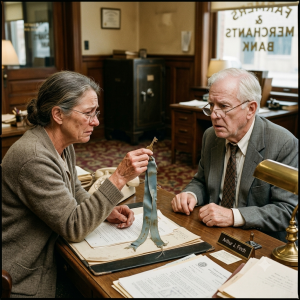
I carried the box out to the manager’s desk on legs I couldn’t quite feel. Gerald Foss looked up from his coffee and I set the key down between us without a word.
And something happened to his face.
The color left it. Not slowly — all at once, like someone had pulled a plug. He set his mug down with a small, careful click. His eyes went from the key to my face. Back to the key. And I watched him recognize something. Watched him remember.
The silence lasted a long time.
When he finally spoke, his voice had gone low and rough, like the words had been stored somewhere for a long time and weren’t sure they still fit right.
“That key,” he said.
He stopped. Swallowed.
“I know exactly what door it opens.”
He looked at me the way people look at you when they are about to change the entire story of your life.
“Because I watched her lock it the morning she left you behind.”
I sat down in the chair across from his desk. I didn’t ask. I just sat down and waited, the way you wait for something large and unavoidable to arrive.
Gerald Foss folded his hands on the desk like a man preparing to testify.
He had been twenty-three years old in 1977, he said. Brand new at the bank, just a teller. Margaret Dollen had been a customer for two years by then. She came in every Friday to deposit her paycheck from the county extension office where she did administrative work. He said she was the kind of woman people noticed — not loud about it, but present. She had dark hair and a precise way of speaking and she always remembered the names of everyone who helped her.
She was twenty-six when she came in that last Friday in September.
She was alone, which was not unusual. What was unusual was that she had been crying recently. She had covered it up well, Gerald said, but he had a mother and two sisters and he knew the particular flatness a face gets after it has finished doing something it didn’t want to do.
She opened the safe-deposit box. She put something inside. She sealed it and she handed him the secondary key — the renter’s copy — and asked him to hold onto it personally, not in the standard drawer, but in his own jacket pocket.
He was twenty-three. He didn’t know to ask why.
She said, and Gerald Foss repeated her exact words to me the way a man repeats words he has turned over in his mind for decades: “If a young woman ever comes in here asking about Margaret Dollen, you give her that key. You’ll know her because she’ll already have the other one.”
Then she thanked him. She walked out of the bank. He watched her through the plate-glass window, and she turned left on Millhaven’s main street, and that was the last time anyone in this town saw her.
He paused. He unfolded and refolded his hands.
“I kept that key for eleven years,” he said. “In my jacket pocket, then in my desk drawer when I moved up to manager. Then she turned up on the deceased list in ’87 and I — I didn’t know what to do. So I put the key in the box with the rest of her things and I told myself that was that.”
He looked at the key lying on the desk between us.
“And then I told myself that for 38 more years.”
I opened the envelope.
I had been holding it in my lap since the vault, pressing my thumb against the seal the way you press a bruise to make sure it’s real. Now I opened it.
There were three pages inside. Folded in thirds, handwritten front and back, in the same careful cursive as the envelope. Blue ink. The pages were soft with age, the kind of soft that fabric gets, like they had been handled many times before they were finally put away.
She started by saying she knew this was a coward’s way to explain herself, and that if she could have found a braver way she would have taken it.
I will not put everything she wrote here. Some of it is mine in a way that I don’t have the words for yet.
But I will tell you the shape of it.
Her name was Margaret Eleanor Dollen. She grew up in Millhaven, the youngest of four children, in a family that went to church twice on Sundays and believed very firmly in the way things were supposed to be done. She was twenty-five when she got pregnant. The man involved was married, and when she told him, he told her that if she made any trouble he would make things very difficult for her family in this town, and she understood that he could, and that he would.
She did not name him in the letter. She said only that he was a coward and she was sorry she had trusted him and that she had made peace with God about her part in it.
What she had not made peace with was what she did next.
She was frightened. She was alone. She did not believe she could raise a child without support, without a name, without any of the scaffolding that held a life together in a place like Millhaven in 1977. She had a sister who had lost a baby the year before and was desperate and kind and living in Columbus with a husband who had a steady job.
Her sister’s name was Frances.
Frances Calloway.
I had to put the letter down for a moment.
Frances Calloway was my grandmother. The woman who raised me. The woman who held my hand at every school play and taught me to drive a stick shift in an empty church parking lot and sat with me through my divorce and died four years ago at eighty-one still sharp as a tack, still making her own pie crusts, still sleeping in the same house she’d lived in for fifty years.
The woman who told me my mother had died on the table.
I don’t know how long I sat there. Gerald Foss had the good grace to look out the window at the parking lot and leave me alone with it.
What the letter said was this: Frances and my grandmother’s husband could not have children of their own. Margaret came to Columbus for the last three months. When I was born, Frances and her husband were listed on the paperwork. Margaret held me once, she wrote. Just once, for about twenty minutes, while the nurses were occupied. She described the blanket. She said she had bought two yards of that fabric, dusty blue, and made the blanket herself in the evenings during those three months, and that she had kept a piece of it, just the ribbon she’d cut from the edge, tied around the only key she had left to her name.
She said she left because Frances made her promise to. She said Frances was afraid that if Margaret stayed close, the arrangement would come apart and I would somehow end up belonging to no one. She said she believed Frances was right. She said she had regretted the promise every day since she made it.
She moved to Michigan. She worked. She lived alone, mostly. She came back to Millhaven once, in 1984, just to drive past Frances’s house in Columbus and see if she could see anything, and she could see a little girl in the front yard in a red coat and that was enough to last her a while.
She died in 1987. A car accident, Route 30 outside of Findlay, in November. Icy roads. She was thirty-six years old.
The last page of the letter was shorter than the others.
She said: I know you may not want any of this. I know it may only complicate a life that is already good and full and complete without me in it. Frances is a good woman and she loves you and nothing I have told you changes that.
But I want you to know that I did not leave you because I didn’t want you. I want you to know that for some women, in some times and places, the bravest thing they could do was make sure their child got to somewhere safe — even when that meant walking away from that safety themselves.
I want you to know that I thought about you every day.
And then she said: The key is to a small house. I kept renting it. I’ve been paying it since you were born and as long as I’m alive I’ll keep paying it. It’s yours if you want it. It’s nothing special. But it’s the place I was going to bring you home to, if things had gone differently.
And at the very bottom of the last page, in slightly smaller letters, like a thought she’d added after she thought she was done:
The deed is in the kitchen, third drawer on the right. I left it in your name.
Gerald Foss helped me find the address in the old county records. It took about forty minutes. The property taxes had been paid continuously until 1987 and then the county had let the thing sit in a kind of bureaucratic limbo for thirty-eight years, the way small counties sometimes do with properties that cost more to process than they’re worth on paper.
It is a small white house on a gravel road four miles outside of Millhaven. A one-story, two-bedroom house with a covered porch and a silver maple in the front yard that has had about thirty-eight years to become an enormous silver maple.
The key worked.
I want you to understand that. The lock was stiff and I had to put both hands on it, but the key worked. The door swung open onto a small, dark living room that smelled like closed-up time — that particular smell of old air that hasn’t been asked to do anything in a very long while.
There was a couch under a sheet. A small kitchen with yellow curtains, faded nearly white. A woodstove. A short hallway.
I went to the kitchen. Third drawer on the right.
There was the deed. Folded inside a plain envelope. My name on the front in the same careful cursive, the same blue ink.
Renee.
Just Renee. She would not have known the last name I’d end up with.
But she knew the right drawer. She knew the right key. She knew the right color of ribbon.
She knew me the way a person knows a thing they have carried quietly for a very long time, without ever being able to set it down.
I sat on the floor of that kitchen for a long time. The afternoon light came through the yellow curtains and laid itself down on the linoleum in long pale squares. The silver maple outside made a sound in the wind. The house was cold but it was not unfriendly. It had been waiting the way the key had been waiting, patiently, without complaint, because it had been built for a specific purpose and it had not yet gotten to serve that purpose.
Here is what I know now that I did not know last Tuesday morning.
My mother was not a woman who abandoned me. She was a woman who was twenty-six years old and alone and frightened, and she made the best decision she could find for me inside a set of options that should have been wider than they were. She made me a blanket. She paid rent on a house for ten years for a daughter she never got to raise. She wrote me a letter she had no guarantee I would ever find and she left it in the only place she could think of where I might someday come across it.
Frances — my grandmother — was complicated. I am not ready to be done being angry about what she told me, about the story of the delivery room, about the particular cruelty of letting me grieve a woman who was out there living and breathing and thinking about me. I am not ready to be done with that.
But I also know that Frances held me every night of my childhood. I know she showed up. I know she loved me in the loud, present, daily way that my mother never got the chance to. Two things can be true. I am learning that two things can be true.
I drove home to Columbus that night with the deed on the passenger seat and the ribbon in my coat pocket and three pages of a dead woman’s handwriting that I have already read so many times I could recite them.
I have a half-sister in Lansing, Michigan. I found her last Thursday. Margaret had a daughter up there in 1981, a different man, a better situation, and that daughter is named Carol and she is fifty-three years old and she already knew she had a half-sibling somewhere in Ohio. Margaret had told her. She cried when I called. I cried when she cried. We are going to meet in two weeks at a diner roughly equidistant between our two cities and I am terrified and glad.
The house needs work. The porch boards are soft and the kitchen wants new plumbing and whatever the previous iteration of the furnace was doing, it has long since decided to stop. I have a contractor going out next week.
I am going to fix it up. I am going to go back to Millhaven.
I am not sure yet what I’m going to do with it after that. Maybe I’ll rent it. Maybe I’ll sit on that porch in the summer with Carol and figure it out. Maybe I’ll just need to have it for a while — to know it’s there, that something she made and paid for and intended for me is standing on a piece of Ohio ground with my name on the deed.
She knew the right color of ribbon.
She knew me.
I think for now that’s enough.