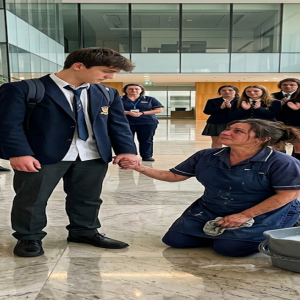
They fined her $4,200, read her name out loud at a town hall meeting, and nearly forced her to sell the only home she’d ever shared with Gerald.
Fourteen months later, Loretta walked into that same room and made every single one of them go completely silent.
But I’m getting ahead of myself.
—
Loretta Marsh has lived on Cloverfield Drive for thirty-one years.
She raised two kids there. Buried a husband there. Planted the same yellow mums by the mailbox every October because Gerald loved the way they looked against the red brick.
She was not the kind of woman who made enemies.
Which is exactly why she never saw Carol Fenton coming.
—
Carol moved in four houses down about three years ago.
Friendly at first. Too friendly, some would say. The kind of neighbor who showed up with a casserole and left knowing more about your business than she had any right to.
Loretta didn’t think much of it.
She was still grieving. Still learning how to be one person in a house built for two.
Gerald’s woodworking studio was out back — a proper little workshop he’d built himself, with good lighting and sawdust permanently in the floorboards. After he passed, Loretta let a few of his woodworking friends use it on weekends. Nothing formal. No money exchanged. Just old men who missed their friend, keeping his tools warm.
Carol made it into something else entirely.
—
By the time Loretta understood what was happening, the HOA board had already received three separate complaints — all filed anonymously, all citing “illegal subletting activity” in violation of Section 7(b) of the Cloverfield HOA covenant.
She stood at that town hall meeting alone.
Gerald would have known what to say. Loretta just stood there while her name was read aloud and her neighbors — people she’d brought Christmas cookies to for three decades — stared at their shoes.
The fine was $4,200.
The shame was worse.
—
She paid the fine.
She didn’t fight it.
And she went home and pulled an old battered blue ledger down from the hall closet shelf — the one Gerald used to keep notes in, with the broken brass clasp that never quite closed right — and she sat at the kitchen table for a very long time.
Then she started writing.
—
Nobody paid much attention to the ledger at first.
It went everywhere with Loretta after that. Tucked under her arm at the grocery store. On the passenger seat of her Buick. Set on the table beside her coffee at the neighborhood book swap.
She never opened it in front of anyone.
Not once.
But people noticed Carol noticing it.
Twice at the mailboxes, Carol had angled the conversation toward it — “What are you always scribbling in that thing, Loretta?” — with a laugh that didn’t quite reach her eyes.
Once, at the neighborhood Fourth of July cookout, Carol had offered to carry Loretta’s bag inside, reaching specifically for the side pocket where the ledger sat.
Loretta had smiled and said, “I’ve got it, hon.”
She always had it.
—
Fourteen months.
That’s how long Loretta spent quietly, carefully, without a single word to anyone, building what she later described to her daughter as “just a record of things.”
Property records. Meeting minutes buried in the HOA archive going back eleven years. Photographs with timestamps. A conversation she’d had the good sense to let go to voicemail and the better sense to save.
And one document — one specific document — that explained why Carol Fenton had been so very motivated to make sure Loretta sold that house.
—
The Cloverfield HOA Annual Gala is held every spring at the Riverside Community Center.
White tablecloths. Centerpieces. The kind of event where people feel important.
Loretta arrived in the navy blue dress she’d worn to Gerald’s retirement dinner. She carried the ledger under her arm, the broken brass clasp catching the light as she moved through the room.
She smiled at everyone.
She sat through the budget presentation.
She applauded the volunteer of the year.
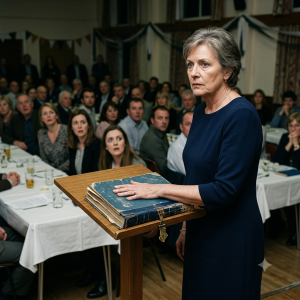
And when the floor was opened for community remarks, Loretta Marsh stood up, walked to the podium with the ledger flat against her chest, and asked for the microphone.
The room gave it to her the way rooms give things to quiet women they’ve underestimated.
She clicked it twice.
The way Gerald always did when he had something important to say.
The room went still.
She didn’t reach for her notes.
She set the ledger flat on the podium, opened the broken brass clasp for the first time in public, and looked up — directly at Carol Fenton, fourth table from the left —
who had already started to stand up.
—
“Sit down, Carol,” Loretta said.
She said it the way you’d say it to a child reaching for something hot. Calm. Almost kind.
Carol sat down.
—
What Loretta read from that ledger took eleven minutes.
She knew because she had practiced it at her kitchen table with a timer, the way Gerald used to practice his remarks before union meetings, pacing the linoleum in his wool socks.
She started with the property records.
Specifically, the property records showing that Carol Fenton’s brother-in-law, a man named Dennis Pryce, was the principal of a real estate holding company called Sunset Ridge Properties LLC — a company that had made a quiet, unsolicited written offer to purchase Loretta’s home fourteen months ago, six weeks before the first anonymous HOA complaint was ever filed.
The offer had come addressed to Gerald.
Gerald had been dead for eight months by then.
—
Loretta paused there to let that settle.
The room was the kind of quiet where you become aware of the ventilation system.
She turned a page.
—
The HOA archive was where it got complicated.
Carol Fenton had been elected to the HOA board — specifically to the Covenant Enforcement Committee — seven months before she filed the first complaint against Loretta. What the archive showed, buried in eleven years of meeting minutes that apparently no one had ever bothered to read consecutively, was that Section 7(b) — the “illegal subletting” clause Carol had used to fine Loretta — had been informally suspended by board vote in 2019.
Suspended, then quietly reinstated fourteen months ago.
One month before the complaints were filed.
Carol had voted to reinstate it herself.
—
The photographs were next.
Loretta had taken them over the course of a year, patiently, the way Gerald used to photograph his woodworking projects at every stage because he said you couldn’t appreciate the finished thing without understanding what it had been.
Photographs of Carol’s own backyard, where two women Loretta didn’t recognize showed up every Tuesday morning with yoga mats and left two hours later. Twelve Tuesdays documented. Always the same two women. Always the same two cars with out-of-county plates.
There was also a Venmo handle.
Loretta had printed the public transaction history.
Thirty-seven payments over eight months, each one described in Carol’s own words as “studio session.”
Section 7(b), as reinstated, defined subletting as any exchange of value for use of a residential outbuilding.
—
The board members were very still.
Three of them had, at various points over the past fourteen months, received what Loretta described only as “small courtesies” from Carol Fenton — gift baskets at Christmas, a case of wine after the budget vote, a weekend use of Carol’s brother-in-law’s lake house, all of which Loretta had documented not because she had any way of proving what they meant, but because, as she put it, “a record of things is just a record of things, and you can each decide what it means to you.”
She was not threatening anyone.
She was just reading her notes.
—
The voicemail was last.
She didn’t play it through the microphone. She simply described it.
It was from Carol, left on a Tuesday evening thirteen months ago, intended — Carol would later claim — for her sister. Wrong contact selected. The kind of mistake that happens when someone is multitasking and not as careful as they should be.
In it, Carol used Loretta’s address. Used the words “the Marsh property.” Talked about square footage and “the comps on that end of the street” and what Dennis thought they could list it for once it was “cleaned up and staged.”
And then, near the end, in a tone that Loretta said she had listened to forty or fifty times just to make sure she was hearing it right, Carol said: “She’s old and she’s alone and she’ll fold. They always fold.”
—
The room did not react the way rooms react in movies.
There was no gasping. No dramatic murmuring.
It was quieter than that.
The kind of quiet that means everyone is privately rearranging something — their face, their memory of events, their understanding of a neighbor they thought they knew.
Carol Fenton was looking at the centerpiece.
—
Loretta closed the ledger.
She pressed the broken brass clasp shut with her thumb the way she always did, because it never quite caught on its own.
She looked out at the room — at people she’d brought Christmas cookies to, at people who had stared at their shoes — and she said the last thing she’d planned to say, the part her daughter had helped her write and rewrite at the kitchen table over two successive Sundays.
“I am not asking this board for anything tonight. I am not filing a complaint. I am not requesting a refund of my fine, though I will note that my attorney advises me I would be entitled to one.”
She let the word attorney land where it would.
“I am here because Gerald and I built a life on this street, and I intend to finish mine here, and I wanted everyone in this room to understand that I know the difference between a neighbor and a person using the word neighbor as cover for something else.”
She picked up the ledger.
“I’ve made copies of everything. They’re in a sealed envelope with my attorney. That envelope stays sealed as long as I live on Cloverfield Drive without further interference.”
She clicked the microphone off.
She walked back to her table.
She sat down and picked up her dessert fork, because there was still a slice of lemon cake in front of her and she saw no reason to let it go to waste.
—
Carol Fenton resigned from the Covenant Enforcement Committee by email the following morning, citing “personal commitments.”
The board voted — unanimously and without discussion at their very next meeting — to rescind Loretta’s fine and issue a formal written apology, which Loretta accepted, framed behind glass, and hung in Gerald’s workshop beside his level and his favorite hand plane.
Dennis Pryce’s company never contacted her again.
—
The yellow mums went in by the mailbox that October, same as always.
Loretta’s daughter drove up from Knoxville to help, and the two of them knelt in the dirt in the thin fall light, pressing the roots down into the good dark soil of a yard that was going nowhere.
A few neighbors waved from the street.
Loretta waved back.
She was not the kind of woman who made enemies.
But she had become, quietly and without any fuss, exactly the kind of woman who made certain they never made the same mistake twice.
Gerald would have loved that.
She thought he probably knew it all along.