She was already on the building before he ever picked up the scissors.
But we’ll get to that.
—
Her name was Rosa Delgado-Fuentes, and she made the best pastelillos in Humboldt Park.
That’s not an opinion. That’s what the line around the block every Saturday morning said. What the women who drove in from Oak Park and Pilsen and Logan Square said. What the little laminated card tucked inside every single one of her pink bakery boxes said — or tried to say.
Nobody could quite read it.
It was her grandmother’s handwriting. One line in Spanish, neat and old-fashioned, the ink slightly faded like something written by a woman who expected her words to last. Rosa had it laminated herself, hundreds of them, same card in every box, same line.
People would squint at it. Turn it sideways. Ask Rosa what it meant.
She’d just smile and say, “You’ll know when it matters.”
—
The night she lost everything, she was wearing her good apron.
She had gone to the city council meeting to defend her vendor license renewal — a formality, she thought. A rubber stamp. She had been operating out of that storefront on North California for eleven years. Clean inspections. Not a single complaint.
She didn’t know Alderman Gerald Voss was going to be there.
She didn’t know his son — her ex-husband — had been whispering in his ear for months.
Gerald Voss stood up in that meeting hall and called her bakery “a documented liability to the community.” He said the words slowly. He was a man who understood the weight of a microphone.
He said her license would not be renewed.
The room was full of people who knew her name. Not one of them stood up.
Rosa walked out with her good apron still tied around her waist and her hands very still at her sides.
Three weeks later, the storefront was dark.
A month after that, Rosa Delgado-Fuentes was gone.
—
The neighborhood moved on, the way neighborhoods do.
The storefront became a vape shop, then a cell phone place, then sat empty for years with a FOR LEASE sign that got so sun-bleached it turned white as a surrender flag.
Gerald Voss got re-elected. Then re-elected again.
His son remarried. Had kids. Coached Little League.
Life layered itself over that empty storefront the way snow layers over something you meant to deal with.
But the cards kept showing up.
That’s the part nobody could explain.
One turned up in the coat pocket of a city inspector — he found it going through an old jacket, the laminated card with that one line of faded Spanish. He didn’t know where it came from. He’d never been inside her bakery.
One showed up tucked inside a case file at the county assessor’s office. Nobody claimed it.
A woman on Cortland Street found one pressed between the pages of a library book she’d checked out in 2019. She posted a photo online. The comments went wild.
“My abuela got one of these in a pastry box like twenty years ago,” someone wrote. “She kept it on her refrigerator until she died.”
“What does it SAY?”
Nobody could agree.
—
Fifteen years.
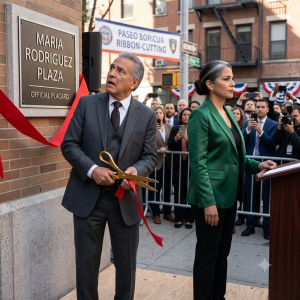
Then, last Tuesday morning, Alderman Gerald Voss — older now, slower, but still very comfortable in front of a camera — stood outside a gleaming new building on Paseo Boricua to cut the ribbon on the city’s brand-new Raíces Latin Food Hall.
Seventeen vendors. Curated. Authentic. A $4.2 million investment in the community, he said.
His investment. His vision.
The cameras were rolling. His staff had the angle perfect. He reached for the ceremonial scissors.
That’s when someone at the back of the crowd said, “Wait — is that — ” and didn’t finish the sentence.
Because a woman had just walked to the podium.
Silk blazer. Silver at her temples. Shoulders straight as a woman who had been waiting a long time to stand exactly here.
She didn’t look at Gerald Voss.
She looked at the cameras.
And Gerald Voss, scissors still open in his hand, looked up at the placard behind her — the official building placard, the one his own office had approved, the one that had been hanging there all morning while he shook hands and smiled — and he read the name.
The name of the lead investor.
The name of the woman who, according to every document his staff had processed for eight months, had simply been listed under a holding company.
The name from that small laminated card he had kept in his desk drawer for fourteen years.
He didn’t understand why he’d kept it. He told himself it was nothing. A reminder. A curiosity.
He read the name on the placard.
His hand froze on the scissors.
The cameras were still rolling.
And into the live microphone, very quietly, like a man who has just seen something he buried stand up and walk toward him —
He said:
“That’s not possible.”
—
Rosa turned and looked at him then. Just looked. The way you look at something small that used to frighten you.
“Alderman,” she said, and her voice was warm and clear and carried to every corner of that crowd. “Thank you for coming.”
She said it the way you’d say it to a guest. The way you’d say it when you are the host.
She turned back to the microphone.
—
Here is what Gerald Voss did not know.
He did not know that the month Rosa left Chicago, she drove to Milwaukee and slept on the couch of her cousin Marisol for six weeks. He did not know that she spent those six weeks doing nothing but reading — business law, food service licensing, municipal code, commercial real estate. Things she had never needed to know before. Things she was going to need to know.
He did not know that she then drove to Cleveland, where a woman named Denise Fortunato-Reyes ran a catering company out of a commercial kitchen and was looking for a business partner. Denise had heard about Rosa. Word travels in those communities. She made a phone call.
Rosa answered.
He did not know about the next three years in Cleveland. The catering. The slow accumulation. The way Rosa learned to talk to investors, learned to read a balance sheet, learned to sit in rooms where people in expensive suits said things designed to make you feel small, and smile pleasantly, and wait.
She was very good at waiting.
He did not know about the holding company she incorporated in Delaware in 2014. Fuentes Heritage LLC. He did not know that over the next decade, Fuentes Heritage quietly became a significant stakeholder in three food hall developments in Cincinnati, Indianapolis, and Minneapolis. He did not know that by the time someone from the city of Chicago reached out to Fuentes Heritage about a exciting new Latin food hall project — a real investment in the community, an alderman’s vision — Rosa Delgado-Fuentes was sitting in an office in a building she owned, looking out at a skyline that had never once stopped belonging, in her mind, to her.
She took the meeting.
She did not tell them who she was. Not for eight months.
She let them process every document. She let them hang the placard. She let Gerald Voss shake hands with the mayor and issue the press release and tell the Tribune it was the proudest achievement of his career.
Then she walked to the podium.
—
She had one more thing to do.
After she spoke — and she spoke beautifully, the crowd pulled toward her like iron filings toward something magnetic — she reached into the inside pocket of her silk blazer.
She took out a laminated card.
It was old. The ink was faded. The handwriting was her grandmother’s, neat and patient, written by a woman who expected her words to last.
She held it up so the cameras could see it.
And then she read it aloud. In Spanish first, then in English. Her voice didn’t waver.
The line said:
“Lo que se hace con manos sucias, manos limpias lo deshacen.”
What is done with dirty hands, clean hands will undo.
—
The crowd was quiet for a moment.
Then it was not quiet at all.
—
People who were there said Gerald Voss didn’t move for a long time. Just stood with those scissors open in his hand, the ribbon still uncut, while the crowd surged forward around Rosa and people were crying and laughing and someone had brought a tray of pastelillos — actual pastelillos, from a vendor who had driven in from Pilsen at five in the morning specifically for this — and the smell of them drifted through the whole crowd like a memory with weight to it.
His aide eventually touched his elbow.
He put the scissors down on the table.
He did not give any more statements that day.
—
Seventeen vendors opened in Raíces Latin Food Hall that morning. Twelve of them were women. Nine were immigrants or the children of immigrants. Four of them had, at various points in the previous fifteen years, been denied city permits or licenses on technicalities that, in retrospect, had a way of benefiting the same people.
Rosa had found them. Quietly, over years. She had helped them get their paperwork in order. She had connected them with a lawyer she trusted — a woman from Pilsen who specialized in exactly these kinds of technicalities. She had not told any of them, until this morning, who she was.
They all knew now.
The woman with the tamal cart was crying so hard she couldn’t ladle. Her daughter took over.
—
The card.
People want to know about the cards. All those cards that kept showing up — in pockets, in books, in case files.
Rosa, when a reporter asked her about it later that afternoon, laughed for the first time all day.
“My grandmother made me promise,” she said. “She said, scatter them like seeds and don’t watch where they land. She said, the ones who find them will know what they mean when they need to.”
The reporter pressed: but how did they get into a city inspector’s coat pocket? Into a county case file?
Rosa looked at the reporter with an expression that was warm and patient and gave absolutely nothing away.
“People carry things without knowing,” she said. “And then one day they turn out their pockets.”
She smiled.
“You’ll know when it matters.”
—
Gerald Voss announced three weeks later that he would not be seeking re-election. His office cited a desire to spend more time with his family. Nobody in the ward was particularly surprised.
His son — Rosa’s ex-husband — showed up at Raíces on the second Saturday it was open. Stood in line. Bought a pink box.
Inside the box, along with the pastelillos, was a small laminated card.
He stood on the sidewalk for a long time, reading it.
Then he folded it carefully and put it in his shirt pocket, over his heart, which is where you put something when you know you’ve been carrying it your whole life without knowing it.
—
Rosa Delgado-Fuentes is not sentimental about what happened to her. She’ll tell you that. She does not describe it as a miracle or a revenge or a comeback story. She does not do interviews where she cries.
She describes it as a process.
“My grandmother used to say that justice is not fast,” she told the Tribune, in the one long profile she agreed to sit for. “She said it moves the way dough rises. You can’t watch it happen. You just have to do the work, cover it up, and trust the warmth will do what warmth does.”
The profile ran on a Sunday. By Monday, the line outside Raíces was around the block.
The women driving in from Oak Park and Pilsen and Logan Square.
Same as before.
Some of them had kept their laminated cards for fifteen years. Some of them brought those cards back and held them up when Rosa came out to walk the line, the way you’d hold up something precious to show the person it came from.
Rosa touched each one. Read each one like it was the first time. Said thank you in a voice that meant it.
Then she went back inside.
There was work to do.
There always had been.