She almost walked right past him.
Dottie Mayes had been coming to Pearl’s Diner on Drayton Street for going on thirty-two years. She knew every crack in the vinyl booth seats. She knew that the ceiling fan above table seven wobbled on Tuesdays. She knew Rhonda the waitress took her smoke break at 2:15 on the dot, rain or shine.
But she had never seen this boy before.
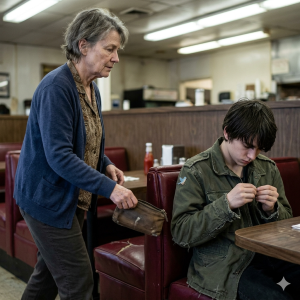
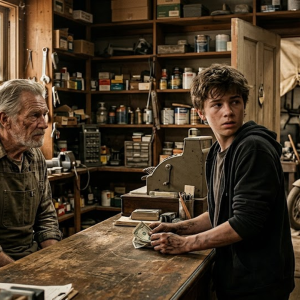
He couldn’t have been more than sixteen. Tucked into the corner booth like he was trying to disappear into the wall, shoulders curved inward, head down. And in his hands — a needle. Thread. His own jacket sleeve, carefully pulled apart at the seam.
Dottie stopped walking.
She’d been a seamstress for forty years. Alterations, wedding gowns, Scout uniforms, burial suits. She had seen every kind of hand hold a needle. Nervous hands. Impatient hands. Her own grandmother’s hands, bent and sure all at once.
This boy’s hands knew what they were doing.
She watched him for just a moment. He was using a double stitch. Clean pull. Even tension. Whoever taught him, they taught him right.
Without thinking — the way you don’t think when something just feels correct — Dottie reached into her purse. She always kept a small zippered pouch. Needles in three sizes. A few colors of thread. Force of habit after four decades.
She walked past his booth, and she set the pouch on the edge of his table without a word.
Didn’t slow down. Didn’t make a show of it.
Just kept walking to her usual spot by the window and ordered her sweet tea.
She wasn’t trying to embarrass him. Lord knows that’s the last thing a teenage boy needs — a stranger making a fuss.
But she did glance back, just once.
And that’s when she saw it.
On the left shoulder of his jacket — small, pressed flat, neat as a pin — a little iron-on patch shaped like a bluebird.
Pale blue. Simple. Like something from a child’s craft kit, but applied with care.
She looked away. Smiled a little to herself. Ordered the chicken salad.
Rhonda came by to refill her tea about twenty minutes later, and Dottie nodded toward the corner booth. “That boy a regular?”
Rhonda glanced over her shoulder. Something shifted in her expression. Not pity exactly. Something more complicated than that.
“He’s been coming in most mornings,” she said, keeping her voice even. “Sits quiet. Nurses a coffee. Never causes a lick of trouble.”
Dottie nodded. Started to let it go.
But then she noticed — when the boy shifted in the booth to gather his things — the hem of his jeans. Reinforced. And on the back pocket, pressed smooth and flat, another bluebird patch.
Same shape. Same pale blue.
Different spot.
She thought about that on the drive home. Thought about it while she watered her window box geraniums. Thought about it that night when she sat down at her sewing machine and the light was good and the house was quiet.
Somebody was keeping track of that boy’s clothes. Somebody with an iron and a steady hand and a small collection of bluebird patches. Somebody who wanted the repairs to show — or maybe wanted him to know they were there. Like little signs. Like breadcrumbs.
I see you. I’m here. Keep going.
She went back to Pearl’s the next morning. Told herself it was just for the biscuits.
The boy was there again. Corner booth. Clean white t-shirt this time — no jacket. And there, at the collar, pressed perfectly flat —
A bluebird.
Dottie sat down at the counter. Rhonda brought her coffee without being asked.
“The boy,” Dottie said quietly. “Does he have family nearby?”
Rhonda set down the coffee pot.
She looked at Dottie for a long moment. The kind of look that means what I’m about to say is going to stay with you.
Then she leaned across the counter, and she dropped her voice so low that Dottie had to hold her breath to hear it.
“Honey, that boy hasn’t had a home to go back to since March.”
Dottie felt her chest tighten.
“But somebody out there,” Rhonda continued, her eyes cutting briefly to the corner booth and back, “has been leaving him a clean, pressed shirt on this exact stool every single Monday morning.”
She straightened up. Glanced toward the door, then back at Dottie.
“And none of us — not one person in this diner — can figure out who.”
Dottie looked down at her coffee.
Then slowly, slowly, she looked toward the corner booth.
The boy was folding something. Carefully. The way you fold something you plan to keep for a long time.
And there on the sleeve —
A bluebird.
Dottie sat with that for a good while. Didn’t speak. Just let her coffee go lukewarm the way she does when her mind is somewhere else entirely.
She was thinking about her mother’s cousin Vera, who used to press little felt hearts onto the inside hems of her children’s school clothes. So they’d carry something warm with them all day and not even know it was there. Dottie had thought that was foolish once. Sentimental. A waste of good felt.
She didn’t think that anymore.
She paid for her coffee. Tipped Rhonda four dollars on a one-fifty cup, the way she always did. And on her way out — just her way out, she told herself, nothing more — she paused at the counter and looked at Rhonda straight.
“Monday mornings,” she said. “What time?”
Rhonda studied her. “Shirt’s always here by six. We don’t open until seven. Earl finds it on the stoop when he comes to start the grill.”
Dottie nodded. Said good morning. Went home.
She was parked on Drayton Street by five-thirty the following Monday.
She brought her thermos and her reading glasses and a paperback she had no intention of actually reading. She backed into a spot across the street where she could see the front stoop of Pearl’s without being obvious about it. The street was quiet that early. A delivery truck. A man walking a beagle. A traffic light cycling through its colors for nobody in particular.
At five forty-eight, a figure came up the sidewalk.
Not a ghost. Not a mystery.
A woman. Maybe seventy. Small-framed, moving slowly but deliberate, the way people move when their joints give them grief but they refuse to let it show. She was carrying a paper grocery bag folded over at the top, held against her chest with both arms.
She climbed the two steps to Pearl’s stoop. Set the bag down. Smoothed it once with one hand, the way you’d pat something you were reluctant to leave.
And then she turned to go.
Dottie was out of her car before she knew she was moving.
“Excuse me,” she called, not too loud. Enough.
The woman stopped. Turned around slowly. She didn’t look startled. She looked, if anything, like she’d been half-expecting this for a while.
“Morning,” she said.
“Morning.” Dottie crossed the street. “I’m sorry to stop you. My name is Dottie. I’ve been — I’ve been watching out for that boy in there. The one who sits in the corner.”
The woman looked at her for a moment. Her eyes were dark and careful and tired in the way that comes from something heavier than just years.
“So have I,” she said.
Her name was Cecile. She’d taught seventh and eighth grade English at Garland Middle School for twenty-six years before she retired. She’d had the boy — his name was Marcus — in her eighth grade class two years ago. Quiet kid. Wrote like an old soul, she said. Strange and lovely little essays about birds and weather and his grandmother’s house.
His grandmother had raised him. Had been raising him since he was four years old.
She died in February.
There were no other relatives who stepped up. There was a cousin somewhere in Macon who couldn’t take him. There was a father whose location nobody could quite pin down. There was the system, which moved slowly and was overwhelmed and was trying its bureaucratic best, but trying and doing are different animals.
Marcus had aged out of one placement in March. He was waiting on another. In the meantime, he was staying nights at a shelter two miles away that let teenagers in if they were in before eight and out by six. Clean. Safe, mostly. But not a home.
Cecile had run into him at the library in April. He was doing homework. She’d sat down next to him and they’d talked for an hour. She had gone home and cried. Then she’d gone to the closet where she kept her late husband Harold’s things — Harold, who had died four years ago and whose clothes she still hadn’t been able to fully give away — and she had found two of his shirts, neatly folded.
Harold had been a small man. Slight. The shirts, she thought, might fit.
She’d ironed them. Folded them sharp as origami. And she’d thought about how to get them to Marcus without embarrassing him, because she’d had enough sixteen-year-olds to know that dignity is everything at sixteen, that being pitied can hurt as much as being hungry.
She’d left the first one at Pearl’s on a Monday because she knew he went there mornings. Rhonda was a former student of hers too, from way back. Rhonda had understood immediately and had not asked many questions, which Cecile appreciated.
“The patches,” Dottie said.
Cecile looked down at her hands. “Harold collected them. He had a whole tin. Little iron-on things — birds, mostly. He liked birds.” She paused. “I put them on so Marcus would know the shirts weren’t from a donation bin. So he’d know somebody specific was thinking about him. Somebody who — ” She stopped. Pressed her lips together. “Somebody who saw him.”
Dottie felt something happening in her throat that she was not going to let become crying on a public sidewalk at six in the morning.
“How many shirts do you have left?” she asked.
Cecile looked up at her. “Three.”
“That’s not enough,” Dottie said.
They stood there on the sidewalk for a moment, the two of them, while the city came slowly awake around them.
“No,” Cecile agreed. “It isn’t.”
What happened next did not happen all at once. Good things rarely do. Good things tend to happen the way a quilt gets made — one piece, then another, then another, until eventually you stand back and realize there’s something whole in front of you.
Dottie started coming to Pearl’s on Monday mornings to make sure Marcus had a hot breakfast, not just coffee. She didn’t sit at his booth. She just caught Rhonda’s eye when he came in and nodded, and Rhonda would put in the order.
She told her friend Patrice at the alterations shop on Clement Street about Marcus, and Patrice, who had a teenage son and understood in her bones what it cost to keep a growing boy in decent clothes, put together a bag without being asked.
Cecile, for her part, knew a woman from her church named Barbara who worked as a case advocate for foster youth through the county. Barbara knew Marcus’s situation. She had been working it. Having someone like Cecile — a former teacher, a community member, someone who could speak to Marcus’s character and stability — call and ask pointed questions about the timeline: that moved something.
It didn’t fix everything. Let’s be honest about that. The system is what it is. But a placement opened up in June. A couple in their fifties, a retired postal worker named Gene and his wife Shirley, who had been fostering teenagers for eleven years and knew how to do it without making a kid feel like a project. Barbara knew them. Vouched for them. Marcus moved in on a Thursday.
Dottie heard this from Cecile, who heard it from Barbara, who had called her specifically because she thought she’d want to know.
She did want to know.
She sat down at her kitchen table and she let herself cry a little, which she generally dislikes doing, and then she blew her nose and got up and made dinner.
She didn’t see Marcus again for almost two months. She hadn’t expected to. She had done what she’d done and that was that, and she told herself she was fine with that.
Then one morning in August, late in the month, when the heat was just starting to go out of the air and you could feel fall somewhere at the edges of things, she came into Pearl’s and there he was.
Not in the corner booth this time.
He was sitting at the counter. He had a glass of orange juice and a plate of eggs and he was talking to Rhonda about something that was making Rhonda laugh, actually laugh, which Dottie had not heard her do in a while.
He was wearing a dark blue henley. Clean. Well-fitted.
On the collar, pressed perfectly flat — a bluebird.
Dottie stopped walking.
He looked up. Saw her. And something moved across his face — recognition, she thought, though she wasn’t sure how. She had never spoken to him directly. She had never been anything other than a woman across a diner who had set a small zipper pouch on the edge of his table one morning and walked away.
But he knew.
Kids always know.
He slid off the counter stool and he stood up, and he was taller than she’d expected, closer to six feet than she’d realized, still growing into himself the way boys do.
“Are you the sewing lady?” he asked.
She laughed. She couldn’t help it.
“I suppose I am,” she said.
He nodded. Like that confirmed something. “Ms. Cecile told me about you.” He looked at her steadily in the way that very serious young people sometimes do, like they’ve decided the courteous thing is to just say the thing directly. “She said I should tell you thank you in person if I ever saw you. So. Thank you.”
“You’re very welcome,” Dottie said.
She meant it to come out easy and light, the way you deflect a compliment at her age. But it didn’t come out that way. It came out real, which surprised her a little.
She sat at the counter. He sat back down. Rhonda brought Dottie her coffee without being asked.
They talked for forty minutes. He told her he was going to be a junior in the fall. That Gene had a woodworking shop in the garage and was teaching him to use a lathe, which Marcus described with great seriousness as harder than it looks. That he was hoping to find a part-time job somewhere that would let him save some money. That he had a particular interest in design — clothes, fabric, the way things are constructed. He had been teaching himself from YouTube videos and library books and the experience of his own hands.
He nodded at her purse when she mentioned she was a seamstress. “I could tell those were good needles you left,” he said. “The eye was clean. Some of the cheap ones, the eye has a little burr to it and it shreds the thread.”
Dottie stared at him.
“You notice that too?” she said.
He smiled for the first time. It changed his whole face.
By the time she left, she had offered him six Saturday mornings in her workroom, learning alterations the right way, and he had said yes before she finished the sentence.
He came that first Saturday with a notebook and two sharpened pencils and she thought her heart might actually break from how prepared he was.
He was a natural. Patient with tricky seams. Good spatial instinct. A real feel for how fabric wants to move, which you cannot teach — either someone has it or they don’t.
By the third Saturday, she was paying him.
By November, she had called in a favor with a woman who ran a small bridal boutique on the north side of town, a woman Dottie had known for twenty years, a woman who was always looking for reliable young help. She passed along Marcus’s name. She told the woman he had good hands and a good head and a very specific kind of patience.
He got the job. Saturdays and two afternoons a week.
Cecile came to Pearl’s for breakfast the morning Dottie told her about it, and they sat together at the window table, the one Dottie had been sitting at alone for thirty-two years, and Dottie ordered the chicken salad even though it was nine in the morning, because she felt like it.
They didn’t talk about what they’d done in any grand way. They didn’t use words like rescue or save, because those words would have felt wrong and also would have been inaccurate. They had just noticed. They had just shown up. They had done the things their hands already knew how to do and trusted that it was enough.
Maybe that’s all any of it ever is.
At some point — Dottie couldn’t recall exactly when — she had started keeping bluebird patches in her sewing pouch. Right alongside the needles and the thread.