Every morning for eleven days, Walt found it on the doorstep.
Same spot. Same little book.
A pocket Spanish-English dictionary, barely bigger than his palm, with a cracked spine and water stains blooming across the cover like old bruises. The pages were soft from use. Someone had loved this book hard.
He’d set it on the counter each morning, next to the register, thinking the owner would come back for it.
Nobody did.
—
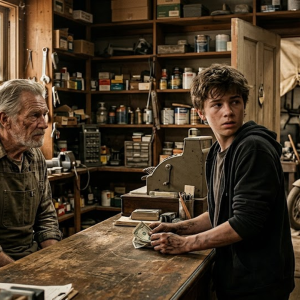
Walt Brewer had run Brewer’s Hardware on Route 66 for thirty-one years. His late wife Carol had kept the books. He kept everything else — the inventory, the regulars, the old coffee machine that still worked if you hit it twice on the left side.
Flagstaff winters were no joke, and Walt had a quiet habit he never advertised.
When someone came in looking for weatherstripping or a bag of concrete patch and their eyes did that quick dart to the price tag — that pause before the slow exhale — Walt had a way of ringing things up that came out a little lower than it should have.
He never made a fuss about it.
Carol used to say he ran the world’s least profitable charity. He’d told her she wasn’t wrong.
—
The woman had first come in about six weeks ago.
Young. Early thirties, maybe. A toddler balanced on her hip and a list written in careful English on the back of an envelope. She’d asked about pipe insulation, sounding out the words slowly, and Walt had walked her through every inch of what she needed.
When she checked out, her total was somehow exactly what she had in her wallet.
She’d looked at the receipt. Then at Walt.
He’d just said, “You have a good day now,” and turned to restock the lag bolts.
She’d come back three more times after that. Always with the list. Always with the little boy. And Walt always found a way to make the numbers work out right.
He never asked her name. She never offered it.
But every time she left, she’d pause at the door for just a moment — like she was working up to saying something — and then the bell above the door would jingle, and she’d be gone.
—
The dictionary showed up the morning after her fourth visit.
He’d assumed it fell out of her bag. He set it aside.
It showed up again the next morning.
And the morning after that.
On the fourth day, Walt finally opened it.
The pages were filled with penciled notes in the margins — English words with phonetic spellings written underneath in a small, careful hand. *Receipt. Inventory. Weatherstripping.* Words you’d need if you were learning a new country one hardware store at a time.
And then, near the back, a single line underlined twice in soft pencil, so faint it was almost a whisper:
*”We are grateful for those who see us.”*
Walt stood at the counter for a long time after that.
He didn’t know her name. He didn’t know her story. But someone had underlined that sentence like it mattered more than anything else on the page.
He closed the book carefully.
He put it right next to the register, where he could see it.
—
On the eleventh morning, Walt didn’t go home.
He made a pot of bad coffee, pulled a stool behind the counter, and waited.
The store stayed dark. The street outside was empty and cold the way only a Flagstaff November morning can be — that high-desert cold that goes straight through you.
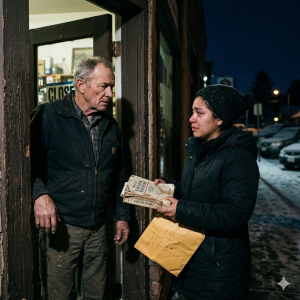
At 5:47 a.m., he heard footsteps on the wooden steps.
Slow ones. Careful.
He crossed to the door in the dark, heart doing something it hadn’t done in a while. He reached for the handle.
He opened the door before she could even knock.
She was standing there with the dictionary in her hand — and the look on her face told him she hadn’t come back for the dictionary at all.
Her eyes were red. The little boy wasn’t with her.
And in her other hand, she was holding something Walt recognized immediately, even in the pale early light.
It was Carol’s handwriting on the outside of the envelope.
His breath left him.
He had no idea how she had it. He had no idea what was inside it. All he knew was that Carol had been gone for three years, and somehow — *somehow* — a piece of her had just walked back up to his door.
“Mr. Walt,” she said softly, her voice steadier than her eyes. “I think it is time we finally meet.”
—
He stepped back from the door without thinking, the way you do when the world tilts slightly and your body reacts before your mind catches up.
She came in.
He turned on the light above the register — the warm one, not the overhead fluorescents — and they stood on opposite sides of the counter the way they always had. Except nothing was the same as it always had been.
“My name is Marisol,” she said. “Marisol Vega.”
Walt nodded. He couldn’t quite find words yet. His eyes kept dropping to the envelope.
It was a standard white envelope, the kind Carol had bought in bulk from this very store. His name was on the front. *Walt.* Not Walter. Carol had never once called him Walter in thirty-four years.
“Where did you get that?” he finally managed.
Marisol set the dictionary on the counter between them. Then, carefully, she set the envelope beside it.
“Your wife gave it to me,” she said. “Three years ago. Almost exactly.”
—
She told him the story in the same careful way she read her hardware lists — slowly, making sure each word landed right.
She had come to Flagstaff from Sonora in the late fall, three years ago, with her son Tomás, who was barely walking then, and a cousin who had a pull-out couch and good intentions. The cousin’s apartment had a slow leak under the kitchen sink that was rotting the cabinet floor. The cousin didn’t own the place and was afraid to tell the landlord. The water had gotten into the walls.
Marisol had come into Brewer’s Hardware to ask about mold and what to do about it and whether they could fix it themselves without the landlord finding out.
She hadn’t had much English yet. She’d had her dictionary.
Walt had been at a supplier meeting in Phoenix that day.
Carol had been minding the store.
Marisol paused there for a moment, watching Walt’s face.
He kept it steady. He’d had three years of practice keeping it steady.
—
Carol, apparently, had done the same thing Walt always did.
She’d walked Marisol through the mold treatment and the cabinet repair and the right caulk for under the sink, and when Marisol had quietly counted out the bills she’d brought, Carol had quietly rung up a total that was somehow less than it should have been.
But Carol had gone one step further.
She had sat Marisol down on the stool behind the counter — the same stool Walt had sat on all night waiting — and spent the better part of an hour going through the dictionary with her. Writing English pronunciations in the margins. Practicing words Marisol would need. *Receipt. Inventory. Weatherstripping.*
Every pencil note in that dictionary. That had been Carol.
Walt reached out and touched the cover of the book. His hand wasn’t entirely steady.
“She told me,” Marisol said softly, “that her husband ran the store most days. She said if I ever needed help, I should come back. She said he was better at the hardware. But she said—” Marisol stopped and pressed her lips together for a moment. “She said he was just as good at the other part.”
Walt looked at the ceiling for a second. Old trick. Doesn’t always work.
It didn’t work this time either.
—
The envelope.
Carol had written it that same afternoon, Marisol explained. Sealed it. Asked Marisol to hold onto it, in the careful, deliberate way of someone who knows something about their own future that they’re not quite ready to say out loud.
Carol had been diagnosed six weeks before that day. She hadn’t told Walt yet — she’d wanted one more normal month, she’d told him later, one more month of Tuesday dinners and bad coffee and Walt complaining about the distributor price on copper fittings.
She hadn’t told Walt about Marisol either. Maybe she’d meant to. Maybe she’d thought there’d be more time.
Marisol had kept the envelope for three years. She’d moved twice. She’d learned English the rest of the way, the hard slow honest way. She’d gotten a job at a hotel on the south side. Tomás was four now and according to Marisol he had opinions about everything, which she said with the exhausted love of a mother who is also a little bit proud about it.
She had held onto the envelope because Carol had asked her to, and because Marisol Vega did not let go of things that mattered.
But when she’d finally found the store — she’d driven past it twice before she got up the nerve — and when the man behind the counter had quietly made her total come out to exactly what she had in her wallet, she’d known.
She’d come back. And she’d kept coming back. Trying to work up to it.
The dictionary had been her way of leaving a door open. Or maybe of knocking without quite knocking.
“I am sorry it took me so long,” she said. “I was—” She searched for the word. “Afraid is not exactly right. I did not want to bring you something sad.”
“You didn’t,” Walt said. His voice was rough but he meant it.
—
He opened the envelope slowly, the way you open something you want to last.
Carol’s handwriting. God, her handwriting. He’d looked at it on grocery lists and birthday cards and hardware invoices for thirty-four years and he still wasn’t prepared for it.
It wasn’t long. Carol had never been someone who needed a lot of words.
*Walt,*
*A young woman came in today named Marisol. She has a little boy and a cousin with a leaky sink and a dictionary she’s worn down to nothing. I helped her the way you always help people, which I learned from watching you, in case you never knew that.*
*I asked her to hold onto this because I wasn’t ready to say it to your face yet, and I’m still not sure I will be by the time I need to. So here it is in writing:*
*You are the best thing I ever saw in a person. The way you ring things up a little lower. The way you never make anyone feel small for needing help. The way you show up. Thirty-one years and you have never once stopped showing up.*
*If you’re reading this and I’m not there — take care of the store. Take care of the regulars. Hit the coffee machine twice on the left.*
*And if that young woman finds you: be kind to her. I have a feeling she’s going to need a hardware store she can trust.*
*I love you, Walt. I have loved you every single day.*
*— Carol*
—
The store was very quiet for a while.
Outside, Route 66 was starting to wake up. A truck went past. Somewhere down the block, a door opened and closed.
Marisol didn’t say anything. She just stood there and let him have the moment, which was exactly the right thing to do.
When Walt finally looked up, he folded the letter back along its creases and held it in both hands.
“She was right about you,” he said.
Marisol looked confused.
“She said you’d find me eventually.” He nodded at the dictionary. “She was usually right about people.”
Marisol almost smiled. Almost. Her eyes were still bright. “She was very kind to me. On a very hard day.”
“That was just Carol,” Walt said simply.
He looked around the store for a moment — the shelves, the lag bolts, the bad coffee machine, all of it exactly where it had always been.
Then he looked at Marisol.
“You said Tomás is four now?”
She nodded.
“Does he like hardware stores?”
She let out a breath that was almost a laugh. “He likes the bins. The little drawers with the screws.”
“Every kid likes the little drawers,” Walt said. “Bring him in sometime. I’ll let him sort the #8 flatheads. Keeps them busy for twenty minutes, I can tell you that from experience.”
This time Marisol did smile. It changed her whole face.
—
She left a little after seven, when the sky had gone from black to that pale high-desert gray that comes before the real light.
Walt stood at the door and watched her car pull out of the lot.
Then he went back to the counter. He poured a cup of bad coffee. He set Carol’s letter beside the register, next to the dictionary.
He thought about the way Carol had spent an hour with a stranger on a hard day, writing phonetic spellings in the margins of a worn-out book. Teaching someone the words they’d need. Never mentioning it. Just doing it.
Thirty-one years and he thought he’d known everything about her.
He hadn’t known the half of it.
—
Marisol came back the following Saturday, as it turned out.
Tomás was with her. He was a solid, serious little kid with Carol’s exact instinct for the small-parts drawers, which he discovered within about forty-five seconds of coming through the door.
Walt let him sort the #8 flatheads.
It kept him busy for twenty-two minutes. Walt counted.
Marisol needed weatherstripping for the apartment she’d just moved into — a real one, her own, no pull-out couch. Walt walked her through every inch of what she needed.
When she checked out, her total came out to exactly what she had.
She looked at the receipt. Then at Walt.
Walt said, “You have a good day now,” and turned to restock the lag bolts.
He heard her pause at the door.
The bell jingled.
But this time, before the sound died out, she spoke.
“Thank you, Mr. Walt,” she said. “For seeing us.”
He didn’t turn around. He just nodded, once, at the shelf in front of him.
The door closed.
He stood there a moment, hand resting on the lag bolts, the store warm and quiet around him.
Then he went and hit the coffee machine twice on the left side.
It worked, same as it always did.