For 21 years, Marlene carried the mail on Route 7 outside of Billings.
She knew every driveway. Every mailbox with the crooked flag. Every dog that would bark and every one that wouldn’t.
When she retired, her doctor said walk more.
So she still walks Route 7.
Old habits, she told people. Just the exercise.
But the truth is, she misses knowing people are okay.
—
It was a Tuesday in early October when she first noticed it.
A child’s crayon drawing, taped to the inside of the front window at the old Hargrove place.
Two stick figures holding hands.
A big yellow sun in the corner — the kind every six-year-old draws the same way, like the sun is smiling just for them.
Marlene smiled at it as she passed.
Didn’t think much of it.
—
Wednesday morning, it was there again.
Same window. Same two figures. Same yellow sun.
Thursday. There.
Friday. There.
By the end of the second week, Marlene realized she was speeding up before she reached that stretch of road — not to get past it, but to get TO it.
To see if the drawing was still there.
It always was. Every single morning.
Gone by afternoon, every single time.
She started calling it her little “good morning.”
—
She knew a family had moved into the Hargrove place sometime in August. A young woman and a little girl, someone at the feed store had mentioned. Quiet. Kept to themselves. Drove an out-of-state car.
Marlene had waved once when she passed. The curtain had shifted.
She told herself it was none of her business.
She told herself that a lot.
—
Three weeks in, she knew the drawing better than she knew her own reflection.
Two figures. Always the same size. Holding hands like neither one planned to let go.
Big yellow sun.
She found herself wondering — who drew it? The little girl, obviously. But who were the two figures supposed to be?
She found herself wondering who taped it up each morning.
She found herself wondering why.
—
And then one Monday, she came around the bend in the gray early light —
And the window was empty.
Marlene stopped walking.
She stood there on the gravel shoulder for a long moment, her breath making small clouds in the cold air.
Just a drawing, she told herself.
Kids move drawings around all the time.
She kept walking.
—
Tuesday. Empty.
Wednesday. Empty.
Thursday, Marlene slowed down and really looked at the house.
No lights on. No car in the drive. No sign of anyone at all.
The curtain wasn’t shifting anymore.
—
She almost talked herself out of it four separate times.
You’re a nosy old woman. You’re not the mail carrier anymore. It’s none of your business.
But here’s the thing about spending 21 years making sure people got what they needed —
You don’t just turn that off.
—
Friday morning, Marlene turned up the gravel drive.
The frost crunched under her boots. The sky was that flat white color that means snow is thinking about coming.
She got to the porch steps.
She raised her hand to knock.
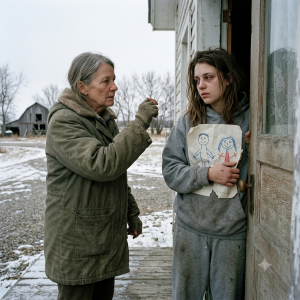
And the door swung open before her knuckles touched the wood.
The woman standing there looked like she hadn’t slept in days.
Hollow eyes. Hair loose. Still in yesterday’s clothes.
She was clutching something to her chest with both hands.
A crayon drawing.
Two stick figures holding hands under a yellow sun.
The woman looked at Marlene — really looked at her, like she was making sure she was real —
And she whispered:
“I was hoping it would be you.”
—
Marlene didn’t say anything right away.
Twenty-one years of knowing when to speak and when to just be still.
She said, “I’m Marlene. I used to carry the mail out here.”
The woman nodded like she already knew. “I’ve seen you walking. Every morning. Cora watches for you.”
“Cora,” Marlene repeated.
“My daughter.” The woman’s voice caught on the word, just slightly, the way a hem catches on a nail. “She’s six. She’s been putting the drawing up every morning since — ” She stopped. Pressed her lips together. “For a while now.”
Marlene looked at the drawing in her arms, then back at the woman’s face.
“Can I come in?” she asked.
—
The inside of the house was warm but strangely still.
The kind of still that happens when people have been very quiet for a long time and don’t quite know how to stop.
There were boxes in the corner of the living room, half unpacked. A child’s sneaker under the coffee table. A mug of tea on the end table that had gone cold hours ago.
The woman’s name was Deb. She said it like an apology, like she wasn’t sure she deserved a name at the moment.
She sat on the edge of the couch and Marlene sat across from her, and for a few seconds neither one spoke.
Then Deb said, “We left our home in June. Back in Spokane. I packed what I could fit in the car and I drove until the money got low and I found this place on a month-to-month and I thought — I thought I just needed to get somewhere quiet and figure things out.”
She smoothed the drawing across her knees. “I didn’t figure things out.”
—
It came out in pieces, the way these things always do.
A husband who had become someone she didn’t recognize. A situation that had gone from bad to frightening to the kind of frightening that makes you drive away at four in the morning with your daughter asleep in the back seat.
She hadn’t told her family. She didn’t want them to worry, and she was ashamed, though she knew she shouldn’t be, and she couldn’t untangle those two things yet.
She had a little money left. Not much.
She had no idea what came next.
“I’ve just been — stuck,” she said. “I get up and I take care of Cora and then I just — stop. I can’t seem to make myself do the next thing. Whatever the next thing is supposed to be.”
She looked at the drawing. “Cora started putting this in the window every morning about two weeks after we got here. I asked her why. She said she was sending a hello to the morning lady.”
Marlene felt something tighten in her chest.
“I didn’t want to tell her to stop,” Deb said quietly. “It was the first thing she’d done that seemed — happy. In a long time.”
—
“And then this week,” Marlene said.
Deb nodded. “I couldn’t get up. I know that sounds like nothing. But I just — I couldn’t. Cora’s been with the family down the road, the Olesens, they offered and I — ” She closed her eyes. “I told myself one more day. I’ve been saying that since Monday.”
“And the drawing.”
“I found it on the kitchen table this morning. She must have left it there before she went to the Olesens. Like a note.” Deb’s chin trembled. “She’s six years old and she left me a note.”
She pressed her hand flat over the two stick figures like she was keeping them warm.
“I was sitting here thinking — I need to do something. I need to call someone. And I kept thinking, if only I could talk to someone who didn’t already know everything, who wouldn’t look at me a certain way. Someone who just — ” She let out a long breath. “And then I heard footsteps on the porch, and I thought, maybe it’s the morning lady.”
She looked up at Marlene.
“I don’t even know why I thought that. I’ve never spoken to you.”
“No,” Marlene said. “But you knew I showed up every day.”
Deb was quiet for a moment.
“Yeah,” she said softly. “I guess I did.”
—
Marlene stayed for two hours.
She didn’t fix everything. She wasn’t foolish enough to think she could.
But she knew people. That had always been the job, underneath the job — not just delivering the mail, but knowing who was on the other side of each door. Knowing which widow needed someone to notice her porch light was on, which farmer hadn’t picked up his seed catalog in three days.
She called her friend Ruth, who had worked at the county social services office for fifteen years and knew every program and resource in a three-county radius.
She called the Olesens and let them know Cora could stay through supper, no rush, everything was fine.
She heated up the cold tea and made Deb eat half a sleeve of crackers she found in the cabinet, because that’s the kind of thing that matters when someone has been running on nothing.
She sat with her while Ruth called back with names and numbers and next steps, real ones, the kind that lead somewhere.
And while Deb was on the phone, Marlene looked around the room.
At the half-unpacked boxes.
At the single sneaker under the table.
At the bare window facing the road.
—
When the Olesen truck pulled up late that afternoon, Cora came through the door in a burst — muddy boots, pigtails coming loose, the specific energy of a child who has been fed cookies by someone else’s grandmother.
She stopped when she saw Marlene.
She looked at her mother, then back at Marlene, with the frank, assessing stare only small children can manage.
“Are you the morning lady?” she asked.
“I am,” Marlene said.
Cora considered this. “I drew us a picture every day so you would know we were okay.”
Marlene felt the words land somewhere deep and permanent.
“I know,” she said. “I looked for it every morning. It made my whole walk better.”
Cora seemed satisfied with this. She climbed up onto the couch next to her mother, tucked herself under Deb’s arm, and announced that the Olesen dog had learned to shake hands and it was the best thing she had ever seen.
Deb looked at Marlene over the top of her daughter’s head.
She didn’t say thank you. She didn’t have to.
—
The next morning, Marlene came around the bend in the early light.
The drawing was in the window.
Same two figures. Same yellow sun.
But this time, there was a third figure next to them. Smaller crayon lines, a little wobbly.
A woman with gray hair and a big smile, holding both their hands.
All three of them under that wide yellow sun.
—
It took a few months.
Ruth’s office connected Deb with a housing advocate and a legal aid contact in Spokane. She found part-time work at the vet clinic in town — she’d had a year of pre-med a long time ago and never quite let it go, and Dr. Parrish said that was good enough to start.
By December, the boxes were unpacked.
By January, Cora knew every dog on Route 7 by name.
—
Marlene still walks every morning.
Old habits, she tells people.
Just the exercise.
But every morning when she comes around that bend, she looks for the light in the window of the old Hargrove place.
And every morning, it’s on.
That’s all she needs to know.