Sofía had long ago stopped expecting kindness from life.
By the time she was old enough to work legally, she had already learned the lessons other people spent years trying to avoid. Hunger made you quiet. Poverty made you useful. And desperation made you tolerate things that would have seemed unbearable to anyone who had ever felt safe.
She did not take the housekeeping job at the Salazar mansion because she thought it would improve her future. She took it because she needed money before the end of the week.
The mansion sat behind iron gates on one of the highest streets in the city, the kind of house people slowed down to admire. It had polished windows, carved balconies, and enough marble inside to make the place feel more like a museum than a home. Everything gleamed. Everything looked expensive. Everything reminded Sofía that she did not belong there.
Still, she showed up before sunrise every day, tied on her apron, and worked until her shoulders throbbed.
Victoria Salazar made sure she felt unwelcome from the beginning.
At first, Sofía assumed it was the normal cruelty of wealthy employers who saw domestic workers as part of the furniture. But it was more focused than that. Victoria did not merely criticize her. She watched her. Studied her. Seemed irritated by her existence in a way that felt deeply personal, though they had never met before Sofía was hired.
If a plate was left out, Victoria called her careless. If the coffee cooled too quickly, she called her stupid. If she passed through a room too quietly, Victoria startled and glared as if Sofía had appeared out of nowhere on purpose.
The insults were bad enough, but it was the look in Victoria’s eyes that unsettled her. It was not the look of a demanding employer.
It was fear disguised as contempt.
Sofía might have left if she had any real choice. But rent was due. Food cost money. The city had no mercy for young women with no family, no degree, and no one willing to speak on their behalf.
So she stayed.
She kept her head down, did her work, and held on to the one treasure she owned.
The necklace.
It was a fine gold chain with a tiny oval locket, old-fashioned and slightly dented from age. The metal was worn smooth in places from years of anxious fingers rubbing it. She had worn it hidden beneath her clothes for as long as she could remember. One of the nuns at the orphanage had told her she arrived wearing it as a toddler, clinging to it so fiercely that no one dared remove it. There had been no note, no certificate, no names that anyone trusted. Just the necklace.
For Sofía, it was more than jewelry. It was evidence that she had existed before the orphanage. That someone, somewhere, had once held her and cared whether she lived.
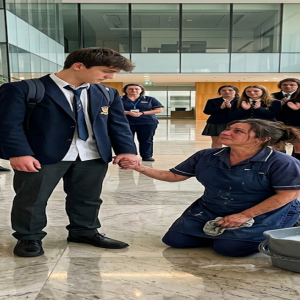
On the Tuesday everything changed, she was kneeling on the kitchen floor with a bucket of soapy water beside her, scrubbing a faint stain near the center island. The kitchen was enormous, lined with spotless counters and copper pans that hung in perfect order. Morning light spilled through the tall windows, turning the marble pale gold.
She reached up to wipe sweat from her neck.
That was when the chain snapped.
The movement was so small she almost did not understand what had happened. Then she felt the sudden absence at her throat and heard the delicate clink of metal against stone.
The locket fell to the floor and sprang open.
Sofía gasped and dropped the rag. She lunged for it, her heart pounding with panic. The clasp had become weaker over the years, and she had always feared the necklace might break. She picked it up carefully, checking the hinge, whispering under her breath as if the locket could hear her apology.
Then heels clicked against the kitchen tiles.
Victoria entered carrying her phone in one hand and irritation already sharpened on her face. “Why is this floor still wet? Do you intend for someone to—”
She stopped mid-sentence.
Her eyes dropped to the object in Sofía’s hands.
All color drained from her face.
It happened so fast that Sofía barely had time to register it. One moment Victoria stood there in a silk robe, every inch the controlled mistress of the house. The next she looked stripped bare by terror.
“What is that?” she whispered.
Sofía, confused, held the necklace closer to herself. “My locket, ma’am. The chain broke.”
Victoria took a step forward.
“Miserable thief!” she shrieked. “Where did you get that from?”
Sofía stared at her. “It’s mine, ma’am. I’ve had it since I was a little girl.”
The answer only made Victoria worse.
She lunged.
There was no warning, no hesitation. Victoria crossed the distance between them and grabbed at the locket with both hands. Sofía twisted away on instinct, but Victoria caught her by the shoulder and shoved her hard against the edge of the counter.
“Give it to me!” Victoria screamed. “Give it here!”
Sofía clutched the necklace to her chest. “Stop! You’re hurting me!”
Victoria scratched at her neck, her arms, her hands, trying to pry her fingers apart. Her face was transformed by something ugly and frantic. Sofía smelled perfume and panic. She felt nails rake across her skin and cried out in pain.
The bucket tipped. Soapy water spread across the floor. A serving spoon clattered down from the counter. Sofía screamed again, louder this time.
Footsteps pounded overhead.
A man’s voice shouted from the upper hallway.
Then Alejandro Salazar rushed into the kitchen.
He was older than Victoria, broad-shouldered even in middle age, with the kind of presence that made other people fall silent. He came down furious, likely expecting to find broken dishes or a servant causing trouble. His expression was already hardening into command.
“What is going on here?”
Neither woman answered.
Victoria stepped back abruptly, breathing hard. Sofía was pressed against the counter, shaking, one hand over her scratched neck. On the floor between them, the gold locket gleamed against the wet marble.
Alejandro’s gaze found it.
He went still.
The stillness was so complete it made the room feel suspended outside time. He took one step closer. Then another. His eyes widened with a kind of recognition so powerful it seemed to hollow him out from the inside.
“No,” he said softly.
He bent down, but before he reached the floor his knees gave way. He caught himself against the island and stared at the locket as if it might vanish.
Sofía had never seen a grown man look so suddenly defenseless.
“That necklace…” His voice cracked. He looked up at no one and everyone at once, tears already filling his eyes. “That necklace belonged to my baby. They told me she died twenty years ago.”
Sofía stopped breathing.
Victoria whispered, “Alejandro—”
He looked at her, and whatever he saw there made his face change.
The story, as he had been given it years earlier, returned all at once. His infant daughter had died in a terrible car accident, he had been told. It happened during a rainy drive on a country road while the child was in the care of his late first wife’s sister. The vehicle went into a ravine. Fire. Chaos. No body recognizable enough to spare him the horror. Everyone told him the same thing: mourn, accept, survive.
He had mourned. He had buried a closed casket. He had learned to live with the wound.
And years later, he married Victoria.
Now there was a young maid in his kitchen wearing his daughter’s locket while his wife looked ready to claw her apart to get it.
Victoria turned toward the service entrance.
Alejandro shot to his feet and seized her wrist before she could reach the door.
“Don’t move,” he said.
She tried to pull away. “You’re insane. She stole it. She must have stolen it from somewhere—”
“From where?” he thundered. “From a grave?”
Victoria’s lips trembled. “I don’t know!”
Sofía stood frozen, blood trickling in thin lines down her forearm. Her mind was scrambling to connect facts that refused to settle into sense. Baby. Twenty years. Locket. Daughter. Her. It sounded impossible, monstrous, absurd.
And yet Victoria’s terror did not look like surprise.
It looked like exposure.
Alejandro crouched and lifted the locket from the floor with reverent, shaking hands. He turned it over. Opened it wider. His thumb brushed the inside edge, and he sucked in a sharp breath.
“There,” he said.
He held it out toward the light.
Inside the gold frame, nearly worn away by time, was a tiny engraving. Sofía had never noticed it. The letters were so small they had blurred into the metal over the years.
Alejandro read it aloud.
“Esperanza.”
He looked at Sofía through tears. “That was the name. The name we chose before she was born. We never announced it. Only the family knew.”
Victoria’s face went blank.
For one second she seemed to realize the lie had reached its limit. Her shoulders lowered. The frantic performance drained away, revealing something colder underneath.
Sofía’s voice barely came out. “Are you saying… that I’m…?”
Alejandro looked wrecked. “I don’t know what I’m saying yet. But I know that locket was placed around my daughter’s neck by her mother the day she was born.”
The room spun.
Sofía had spent her whole life imagining possibilities. Maybe she had been abandoned because her parents were poor. Maybe they had died. Maybe no one wanted her. But this? This felt too enormous to fit inside one body.
Alejandro turned back to Victoria. “Tell me the truth.”
She said nothing.
“Tell me,” he repeated, more dangerously this time.
Victoria laughed once, a small brittle sound that made Sofía’s skin crawl. “Truth? You want truth now? After twenty years?”
Alejandro’s hand tightened around the locket. “What did you do?”
Victoria’s eyes slid toward Sofía. There was hatred there, yes—but also resentment, as if Sofía’s existence had ruined a story she thought was safely buried.
“You were never supposed to come back,” Victoria said.
Sofía felt the words land physically, like a shove to the chest.
Alejandro released Victoria’s wrist in shock, but he did not step away. “What does that mean?”
Victoria lifted her chin. “It means your precious child did not die.”
The silence after that was as violent as a slap.
Alejandro stared at her as if he no longer recognized the woman he had shared a home with. “Say that again.”
“She did not die,” Victoria said, and now that the first confession had escaped, more seemed to force its way up behind it. “There was an accident, yes. But not the one you were told.”
Sofía gripped the counter to stay upright.
Victoria began speaking in clipped, uneven sentences, as though she had told the story many times to herself and hated that she now had to tell it to others. Back then, she had been close to Alejandro’s first wife’s family. She had envied everything: the wealth, the love, the future already mapped out for another woman. When the child was born, Victoria became obsessed. Not with the baby exactly, but with what the baby represented—inheritance, devotion, permanence, a bond no one could replace.
After the first wife died of illness not long after childbirth, the infant became the center of Alejandro’s world. Victoria, who had expected grief to create openings, found herself outside the circle looking in.
Then came the rainy night on the country road.
Victoria had arranged to travel with the child’s caretaker under the pretense of helping. She admitted there had been an argument in the car. She admitted she had wanted the child gone from Alejandro’s life. She admitted she had planned to make the disappearance look like fate.
But the crash had not killed the baby.
It had killed the caretaker.
Victoria had found the infant crying, alive, still wearing the locket.
Instead of taking her for help, Victoria took the necklace off, handed the child to a woman who ran an illegal network that moved children between orphanages and private arrangements, and paid to make the girl disappear.
Alejandro made a sound of such raw horror that Sofía thought he might collapse again.
“You sold my daughter?”
Victoria flinched at the word sold. “I paid to remove a complication.”
Sofía’s stomach turned.
Alejandro stepped toward her, and for a second Sofía feared he might strike Victoria. He did not. His voice became quieter, which was somehow more terrifying.
“You told me my child was dead,” he said. “You watched me bury an empty coffin.”
Victoria’s composure finally cracked. “You would never have looked at me while she lived! Don’t you understand? Everything in that house was about her, about the woman you lost, about a life I could never enter as long as that child existed.”
Sofía felt sick listening to it. Not only because of the cruelty, but because Victoria said it with the twisted certainty of someone who had spent years justifying the unforgivable.
Alejandro turned away, one hand over his mouth.
Then the practical mind beneath his grief surged forward. He took out his phone and called the police.
Victoria lunged for the device, but this time Sofía stepped back and Alejandro kept his distance. He spoke in a calm, clipped tone that shook only once when he gave the address and said there had been a confession regarding the abduction of a child twenty years earlier.
Victoria started crying, truly crying now, begging him not to do this, saying she had loved him, saying the past would destroy all of them.
Alejandro answered without looking at her. “It already did.”
The police arrived within minutes that felt like years.
Statements were taken. Photos were taken of the scratches on Sofía’s skin. The locket was collected and then returned after being documented. Victoria tried, at first, to deny her confession, then to soften it, then to blame others. But too much had already been said, and too many old records began unraveling once investigators knew where to look. A retired nurse linked to closed adoptions. Payments hidden through shell accounts. The caretaker’s original case files riddled with inconsistencies no one had bothered to revisit because everyone accepted the convenient tragedy they had been given.
For Sofía, the days that followed were stranger than any nightmare.
A DNA test was arranged.
She told herself not to believe anything until the results came back. She had learned too early that hope could humiliate a person faster than cruelty. But Alejandro stayed close throughout the process, not smothering, not demanding, just present in a careful, shaken way. He answered questions when he could. Admitted what he did not know. Cried more than once. Apologized for things that were not technically his fault but somehow belonged to him anyway.
When the results confirmed that he was her biological father, Sofía sat in silence for a long time.
She did not throw herself into his arms.
This was not one of those stories.
Love did not instantly bloom because science had stamped a truth onto paper. Twenty stolen years stood between them. He had not raised her. He had not seen her first steps, her fevers, her school days, her loneliness. He had grieved her sincerely, yes, but grief did not erase absence.
Still, there was something in his face when he looked at her that made denial impossible. It was grief mixed with wonder, guilt mixed with tenderness, a father’s love arriving far too late and refusing to stay hidden.
Victoria was charged. More details emerged, each one uglier than the last. The woman who had taken Sofía as a child had since died, but records from old orphanage transfers filled in part of the route that led her there. It appeared Victoria never intended to keep track of her. She only wanted the child gone beyond recovery.
What she had not counted on was the necklace.
The one thing Sofía kept.
The one thing no one managed to strip from her life.
The one object that outlived lies, money, status, and fear.
Weeks later, Sofía returned once to the mansion—not as a maid, but as Alejandro’s invited guest—to collect the few belongings she had left in the servants’ quarters. The house looked different in daylight. Smaller somehow. Less powerful. The spell had broken.
She passed through the kitchen and stopped where the chain had snapped.
Alejandro stood nearby, hands in his pockets, as if unsure whether to speak.
Finally he said, “I know I can’t ask to be forgiven for years I didn’t even know were stolen. But I would like the chance to know you, if you ever allow it.”
Sofía looked down at the locket resting in her palm. The chain had been repaired, but the clasp was still old. Fragile. Scarred. Like memory.
“I don’t know what that looks like yet,” she said honestly.
His eyes filled, but he nodded. “Then we start with what you do know.”
It was not a perfect ending. There are no perfect endings for crimes that steal childhoods. There was court, press, ugly whispers from society people who suddenly pretended they had always disliked Victoria. There were therapy appointments, legal papers, and the slow, painful work of building trust where there should have been a lifetime of it already.
But there was also truth.
And truth, Sofía discovered, had a strange kind of mercy.
It gave names to shadows. It exposed monsters that manners had protected. It returned her to herself, even if it could not return her lost years.
Sometimes she still lay awake at night thinking about how close Victoria came to getting away with it forever. One snapped chain. One ordinary Tuesday morning. That was all it took to bring the past crashing into the light.
The biggest red flag had not been Victoria’s cruelty. Cruelty was obvious. It was the panic beneath it, the way she seemed to hate Sofía for reasons that made no sense until they made too much.
As for forgiveness, Sofía never offered it to Victoria. Some acts ask too much of the wounded.
But for Alejandro, the answer was more complicated.
He had not abandoned her. He had been deceived, broken, and manipulated. Yet he had also lived a life of privilege while she scrubbed floors in his house without either of them knowing who she was. That truth would always ache.
In the end, perhaps that was the hardest part of all: understanding that a person could be both innocent and painfully late.
And that a tiny gold locket had told the truth long before anyone else was brave enough to.