I thought I was about to get fired, but a millionaire changed my life.
That was the sentence I kept hearing in my own head afterward, because even now it sounds too clean, too simple, like the kind of line people use when they want to make a messy story fit inside one breath. The truth was uglier than that, and stranger. It began with soup on a white tablecloth and ended with a locked file, a dead woman’s secret, and the kind of truth that can split a life in half.
At the time, I was twenty-eight years old, working double shifts at Bellamy’s, an upscale restaurant downtown where customers complained if the candles burned too low and management acted like human need was a minor inconvenience. I had been there a little over a year. The pay was barely enough. The stress was constant. But after my mother died six months earlier, I had stopped imagining better things and focused only on surviving the week in front of me.
That night had already gone wrong before the elderly woman ever came in.
The kitchen was backed up. One server had called out sick. Our manager, Kyle, was storming through the dining room with that tense smile he wore when rich customers were around and his real personality had to wait. I had two blisters on my heel, a headache brewing behind my eyes, and a voicemail from my landlord I still hadn’t listened to because I knew exactly what it would say.
Then the hostess seated her in my section.
She came in with a man I assumed was her driver at first, though later I realized that assumption said more about class than anything else. He was too well dressed for that. Dark suit, expensive shoes, silver at his temples, not old but carrying exhaustion in the set of his shoulders. He helped her to the table, spoke softly, then stepped away after she insisted she could handle dinner on her own.
He didn’t leave the restaurant. He just moved to the far side of the room and sat where he could see her.
I noticed it because, in my job, you notice who watches whom.
The elderly woman wore a pale blue sweater, a silk scarf, and a wedding ring she still turned on her finger as if the habit had outlived the marriage. Her posture was upright, careful. Not proud, exactly. Practiced. Like someone who had spent years making sure nobody saw when she was uncomfortable.
I greeted her, took her order, and brought her soup because she said on cold nights it was the only thing she really wanted anymore. She smiled at me in a distracted way, thanked me twice, and then I hurried back into the chaos of the shift.
Maybe a minute later, I heard the spoon tapping.
It was such a small sound. Metal against porcelain. But it repeated with a rhythm that cut through everything else.
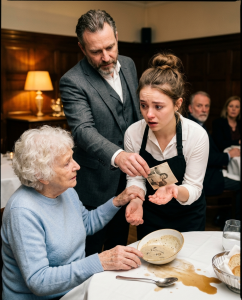
I looked over and saw her hand trembling badly enough that she couldn’t lift the spoon without spilling. The first spill was small. The second ran down the side of the bowl. By the third, it had splashed the tablecloth and dotted her skirt.
She froze.
That was the part that got me. Not the tremor. Not the soup. The freeze. That moment when a person realizes they are no longer struggling privately and the world has noticed.
People stared immediately. They always do.
The woman at the next table leaned away in disgust. A man near the bar frowned as if the old woman had personally offended him. A younger couple looked anywhere but at her, which somehow felt worse. Nobody wanted to help. They just wanted distance from the reminder that bodies fail, dignity slips, and one day it could be them.
The old woman reached for her napkin, but her fingers shook too much. She whispered, “Oh dear,” under her breath and tried again, cheeks turning red.
I knew the rules. Bellamy’s had rules for everything. Don’t sit with customers. Don’t create emotional scenes. Don’t make other guests uncomfortable. Prioritize turnover. Smile through pressure. Never let one table slow the room.
I also knew what public shame looked like.
My mother had worn it often enough.
She had spent years pretending we were fine when we weren’t. Pretending bruises were clumsiness. Pretending our moves from apartment to apartment were fresh starts. Pretending fear was just stress. As a child, I didn’t understand most of it. I only knew she lived in a permanent state of watching doors.
After she died, going through her things felt like reading half a book with the last chapters torn out. There were old bus tickets, fake forwarding addresses, jobs she’d never told me she had, and one locked cash box I hadn’t been able to open. Whatever had happened before we settled in my current city, she had taken great care to bury it.
So when I saw that elderly woman shrinking in front of strangers, something in me refused to stay still.
I walked over, pulled out the empty chair, and sat beside her.
The dining room changed around me. You can feel judgment the way you feel heat.
“Hey,” I said quietly. “You don’t have to do this alone.”
Her eyes widened. “I’m making a mess.”
“No,” I said. “You’re eating soup. It’s a difficult food even on a good day.”
That earned the faintest laugh. I grabbed a clean napkin, dabbed the table, and asked if I could help steady the bowl. She nodded, mortified. I made a point of speaking to her normally, not softly in that exaggerated way people use with the elderly when they’ve mistaken physical struggle for absence of mind.
“What do you think of the soup?” I asked.
She looked at it like she was appraising a business proposal. “It needs pepper.”
I smiled. “That is the harshest and most accurate review this kitchen has ever received.”
This time she laughed for real. Her shoulders loosened. I supported her wrist gently while she guided the spoon with her own hand. Not feeding her. Just helping her keep control. Little by little, the trembling stopped ruling the moment.
That was when I felt someone behind me.
I turned and saw the man in the suit.
Up close, he looked wealthy in the way some people do without displaying it. The fabric, the watch, the polished restraint. But his face was not arrogant. It was tense. Almost pained.
I stood too fast. “Sir, I’m sorry. I know I’m not supposed to—”
He didn’t speak. He looked at his mother first, and I understood from that alone that this was his mother. I also understood that whatever he felt, it was bigger than irritation. There was love in it. Guilt too.
Then he looked at me and reached into his jacket.
I had a flash of pure panic. Complaint card. Corporate contact. Cash tip meant to turn me into a story people tell at dinner parties.
Instead he handed me an old photograph.
It was worn at the edges, kept too long in a wallet or envelope. In the photo, a younger version of the woman at the table stood in a garden, smiling at a little girl in pigtails. The child held her hand and leaned in close, as if safety were a person instead of a place.
On the back, in faded blue ink, were the words: For the girl who waited.
My fingers went numb.
The man’s voice was low. “My mother used to run a shelter for women and children.”
I looked from him to the woman, then back again.
“Years ago,” he continued, “a young waitress used to bring food after her shift. She didn’t trust anyone. Barely spoke. But my mother got her to stay long enough one night to admit she needed help. She had a daughter. She was hiding from a violent man.”
My chest tightened so suddenly I had to grip the table.
The room didn’t disappear exactly, but it lost meaning. Plates clattered somewhere. Someone laughed across the dining room. None of it reached me.
He nodded at the photograph. “That girl was you.”
I stared at him because there are certain sentences the brain refuses to receive on the first try.
I looked at the elderly woman. Her eyes were shining. “You used to hide behind your mother’s coat,” she whispered. “You had two braids and a gap in your smile. You would only come out if I had those strawberry candies in my pocket.”
A memory surfaced so fast it hurt. Not a complete scene. Just a scent—rose soap and old wood. A hallway painted yellow. A hand stroking my hair while my mother cried in another room.
I had spent my whole life believing those fragments were invented.
“My mother recognized your last name when you introduced yourself,” the man said. “She asked me to bring her here tonight because she needed to know if it was really you.”
I sank back into the chair. “My mom told me someone helped us,” I said. “She never said who.”
The old woman’s fingers shook harder as she reached for my hand. “She promised she would disappear if she had to. I told her disappearing is not the same as losing.”
“Why didn’t she ever come back?” I asked.
That was when something shadowed both their faces.
The son crouched beside us, lowering his voice. “Because she believed your father was still looking for her. And because she discovered something before she left that made him much more dangerous than an abusive husband.”
I felt ice move through me.
I hadn’t spoken my father’s name in years. My mother barely had either. When I was little, she called him “the man from before.” When I got older and demanded the truth, she said only this: He is not gone. He is hidden.
At the time, I thought it was trauma talking.
Now I wasn’t so sure.
The man reached into his jacket again and took out an envelope. Cream colored. My name written across the front in elegant, careful handwriting that looked decades older than the paper should have.
“For you,” he said.
Inside was a plane ticket for the next morning, a hotel reservation, and a folded note from his mother.
The handwriting trembled more toward the end, but the message was unmistakable.
Your mother left something with me for safekeeping. I promised not to release it until you were old enough to bear what it contains. I no longer trust time to wait. Come tomorrow. Bring identification. Do not tell anyone where you are going.
Beneath that, one more line:
When you read the final page, you will understand why your mother ran.
I must have read it five times.
“I can’t just leave,” I said automatically. “I have work. I—”
“You need to come,” the old woman said, her voice suddenly stronger than I expected. “There is a file. Your mother came back once, after she’d already started a new life. She was terrified. She told me if anything happened to her before she could explain everything to you, I was to make sure the truth found you anyway.”
My mother had died in a car accident six months earlier.
At least, that was what the police report said.
Nothing about that sentence felt stable anymore.
Kyle chose that moment to appear at my shoulder, furious and tight-lipped. “Why are you sitting down?” he hissed.
I stood so fast my chair scraped.
Before I could speak, the suited man rose and turned to him with a calm that felt more dangerous than anger. “Your employee showed my mother more dignity in five minutes than this establishment showed her all evening.”
Kyle started apologizing immediately, but the man was already pulling out a card. “I own the building this restaurant leases from,” he said. “Tomorrow morning I’d like a conversation with the owner about staff training, accessibility, and whether your management is a liability.”
I had never seen Kyle lose color so quickly.
The man turned back to me as if that interruption had been a mosquito. “My driver will pick you up at seven.”
I should have said no. I barely knew them. I was overtired, emotional, and one bad decision away from losing my job. But the photograph in my hand was real. The memories pressing at the edges of my mind were real. And for the first time in my life, someone was holding a thread that might lead back to the truth my mother died protecting.
So I went.
I barely slept. I told no one. At dawn I opened the locked cash box my mother had left behind, using a hairpin and more desperation than skill. Inside were three things: a necklace I’d never seen before, a folded legal document with no signature on the last page, and a clipping with my father’s name blacked out. The article mentioned a real estate development company, missing funds, and an internal witness who had disappeared before giving testimony.
My hands shook so badly I nearly dropped everything.
At seven sharp, a black car pulled up outside my apartment.
The suited man introduced himself properly during the drive. His name was Adrian Vale. The old woman was Eleanor Vale. He wasn’t just wealthy. He managed his family’s philanthropic foundation and several private holdings. Years ago, Eleanor had funded domestic violence shelters under a different name for safety. My mother had met her through one of them.
“She trusted my mother because she had proof,” Adrian said. “Not just of abuse. Of financial crimes. Your father wasn’t a powerful businessman yet, but he was on his way. He had partners. One of them got nervous and started keeping records. Your mother found some of those records by accident.”
“Why would she have them?”
“Because your father hid things at home. He thought fear made people blind. Sometimes it makes them observant.”
We flew to Boston, then drove to a private office attached to a law firm that represented the Vale family. Eleanor was waiting there, wrapped in a cream shawl, looking smaller in daylight but no less sharp. On the table in front of her sat a gray document box sealed with old evidence tape.
She touched it as if it were something alive.
“I have hated this box,” she said. “I have prayed over it and cursed it. Your mother made me promise two things: keep it safe, and do not let anyone open it until you could choose for yourself what to do with the truth.”
A lawyer entered then, introduced himself, checked my identification, and asked if I understood that the file might contain criminal evidence, allegations, private letters, and material distressing enough to affect any future civil proceedings.
I almost laughed at the formality of it. My whole life already felt like a proceeding.
“Yes,” I said.
He cut the seal.
Inside were bank statements, shell company records, copies of property transfers, handwritten notes, photographs, and a thick letter addressed to me in my mother’s handwriting.
I read that letter first.
She told me everything she had never managed to say out loud.
My father had not just been violent. He had used the businesses he built with his partners to move money through fraudulent property deals. When one accountant threatened to expose them, my father framed him for theft and the man disappeared shortly after. My mother found a ledger hidden inside the lining of a garment bag. She confronted my father in secret, hoping fear might stop him. Instead he beat her, then told her that if she ever tried to leave with me, he would find us both.
So she pretended obedience while making copies.
A waitress at the diner where she worked noticed the bruises. That waitress connected her to a shelter. Eleanor helped us vanish before my father understood how much she knew.
But there was more.
Years later, after we were gone, my father reinvented himself under a slightly altered name. New partners. New state. New public image. He became the kind of man newspapers called “self-made” and charities called “generous.” By the time my mother confirmed where he had resurfaced, he had enough political and financial insulation that going to the police felt dangerous without ironclad proof.
She had gathered what she could, added it to the box, and left it with Eleanor.
Why not tell me earlier? Because she feared I would go after him before I understood the risk. Because she feared I carried his stubbornness more than her caution. Because she wanted me to have at least a few years of life untouched by his shadow.
At the end of the letter, her handwriting grew shaky.
If you are reading this, then either I have run out of courage or run out of time. I am sorry for both. You owe that man nothing. Not your curiosity, not your forgiveness, not your name. But if the truth can still protect someone, then do not bury it for my sake.
There are moments when grief becomes anger so clean it feels medicinal.
I wiped my face and started reading the rest.
The records were damning. Transaction trails. Property purchases routed through shell entities. Insurance claims tied to vacant lots that were never vacant. Correspondence hinting at witness intimidation. And on the last page of a notarized statement from one former associate was the name my mother had been trying to shield me from all those years.
My father had reinvented himself as Daniel Hales.
I knew that name.
Everyone in my city knew that name.
Daniel Hales was a celebrated developer whose face appeared in business magazines and hospital fundraisers. He had donated to local schools. He’d sat on nonprofit boards. Six months earlier, after my mother’s funeral, I had passed a billboard with his company’s newest luxury tower on it and thought absently that the man smiling there looked vaguely familiar.
I nearly vomited.
The room was very still when I finished. Adrian leaned against the far wall, arms crossed. Eleanor watched me with heartbreaking tenderness.
“What happens now?” I asked.
The lawyer answered. “That depends on you. Some of this needs forensic verification. Some may already be time-barred for certain financial charges. But fraud, conspiracy, witness tampering, identity manipulation, possible obstruction—there is enough here to trigger a serious investigation, especially if tied to currently active assets.”
I looked at the photograph again. The little girl in braids. The woman who had once saved us. The mother who had spent years carrying a secret heavy enough to bend the spine.
“I want it all turned over,” I said. “Every page.”
That sentence changed everything.
The next six weeks were a blur of statements, document review, investigators, and a level of legal caution that made ordinary life impossible. I had to move temporarily. My phone was monitored. Reporters got wind of “an inquiry” before they got facts. Daniel Hales denied everything through attorneys. Then he claimed mistaken identity. Then he called it a coordinated attack by business rivals. That lasted until investigators matched signatures across old records, pulled archived incorporation documents, and located a retired bookkeeper who identified him without hesitation.
The moment the public story cracked, more people came forward.
A former assistant who’d been pressured to alter dates.
A contractor who’d been paid through ghost vendors.
A woman who had briefly dated him and recognized controlling behavior she had once dismissed as intensity.
Most devastating of all, the family of the accountant who had disappeared decades earlier finally got authorities to reopen questions around his case.
I was asked more than once whether I wanted to meet my father.
The answer surprised some people, but not me.
No.
I had spent enough of my life shaped by his absence. I wasn’t about to offer him my presence as a gift.
There was one hearing I attended anyway, not because I needed to see him, but because I needed to watch the world stop calling him respectable. He looked older than the photographs, smaller too. Men like that often do once the room no longer agrees to believe them. He glanced at me only once. Whatever he expected to find on my face, he didn’t find it.
Not fear.
Not longing.
Certainly not forgiveness.
Just the end of his access to me.
He was charged on multiple counts tied to fraud and conspiracy, with additional proceedings opened around obstruction and historical coercion. Civil actions followed. Assets froze. Boards dropped him. Newspapers that once praised him printed timelines with words like allegation, evidence, shell company, false identity.
People asked how it felt to expose him.
That was the wrong question.
I didn’t expose him. My mother did. Eleanor did. The missing accountant did. The assistant, the bookkeeper, the women who kept records, the people who finally stopped protecting power because someone handed them proof. I just opened the box.
Bellamy’s fired Kyle two weeks later after the owner, suddenly very concerned about compassion and liability, conducted an internal review. Adrian, to my embarrassment, had made sure the review was thorough. The restaurant offered me my job back with an apology, but by then Eleanor had asked whether I would consider working with one of the foundations she still advised. They were opening a hospitality training initiative focused on disability dignity and trauma-informed service in public spaces.
I said yes.
It felt impossible at first, taking a salary from people who had already changed my life so much. Eleanor settled that quickly.
“This is not charity,” she told me. “This is continuity.”
She became part mentor, part adopted family, part living reminder that rescue can echo forward for decades. Parkinson’s made some days hard for her, but her mind remained fierce. She liked tea too strong, lied about how much candy she still ate, and corrected everyone’s grammar without apology. Sometimes I sat with her at lunch and helped steady her hand. Sometimes she steadied mine.
A year later, after the legal dust settled enough for breathing room, I went through my mother’s remaining boxes again. This time it felt different. Not like archaeology. Like conversation.
I found recipes. Pay stubs. A postcard she never mailed. And tucked inside an old book, a note in her handwriting:
Kindness is how strangers become the reason you survive.
I cried harder over that than I had in court.
Because that was the whole story, in the end. Not the crimes. Not the money. Not even the man who thought terror was a form of ownership. The real story was that one act of kindness had traveled through years, through silence, through illness, through grief, and returned when I needed it most.
The night I sat beside Eleanor in that restaurant, I thought I was risking my job for a stranger.
I wasn’t helping a stranger.
I was reaching back through time to the woman who had once opened a door for my mother and me when every other door looked locked.
Sometimes I still think about how close I came to walking past her table.
How easy it would have been to follow policy, keep moving, let her struggle, tell myself I was too busy, too tired, too powerless to interrupt the cruelty of a room full of staring people.
If I had done that, I might never have learned the truth about my mother. I might never have known who my father really was. I might never have understood that survival leaves behind witnesses, and that love sometimes returns wearing the face of someone you almost didn’t recognize.
People like to ask whether I forgave my mother for keeping so much from me.
That isn’t quite the right word either.
I understood her.
I understood that fear can become a house you keep living in long after the fire is out. I understood that protecting a child sometimes means delaying the truth until she can carry it without breaking. I understood, too, that silence has a cost.
Was she right to wait?
I still don’t know.
Was Eleanor right to keep the box?
Probably.
Was I right to open it?
Without question.
And the biggest red flag of all was never the violence itself, though that should have been enough. It was how effectively charm covered it. How a man could build a reputation so polished that whole communities would lend him trust while the women near him learned to hide evidence in coat linings and shelter offices.
What would I have done if I were my mother?
I hope I would have run sooner.
What would I do now if I saw someone trembling alone while the room looked away?
Exactly what I did that night.
I would sit down.